A property valuation is the figure your taxes, your share on a division of assets, the compensation awarded in court and the court fee are all calculated from. A flat valued a third below its worth on a division means the compensation is a third lower too, and objecting to the report after judgment is far harder than objecting in time.
The valuation itself is carried out by a certified valuer. Our work starts after that: we review the report, challenge an undervaluation, apply for a court-ordered valuation where the figure is decisive, and use the result in the main case.
Why and when a valuation is needed
For a sale
The report is registered in the State Property Fund’s Unified Database of Valuation Reports and receives a unique number, which the notary checks before certifying the deal. The parties set the contract price themselves, but the tax base cannot be lower than the appraised value para. 172.3 of the Tax Code, so an understated price does not reduce the tax.
For dividing matrimonial property
The valuation determines the cash compensation payable to whoever does not get the indivisible item. This is the sharpest situation: each side wants a different figure.
For an inheritance
A valuation is needed where the tax rate is not zero: 5 % personal income tax and a 5 % military levy are calculated from it. For heirs of the first and second degree of kinship (a 0 % rate) a valuation is not mandatory para. 174.8 of the Tax Code.
For court
The value of a monetary claim is set by the value of the property, and the court fee follows from it: 1 % for individuals, within the range 1,331.20 to 16,640 UAH in 2026.
For a mortgage or pledge
And also for insurance and for contributions to share capital.
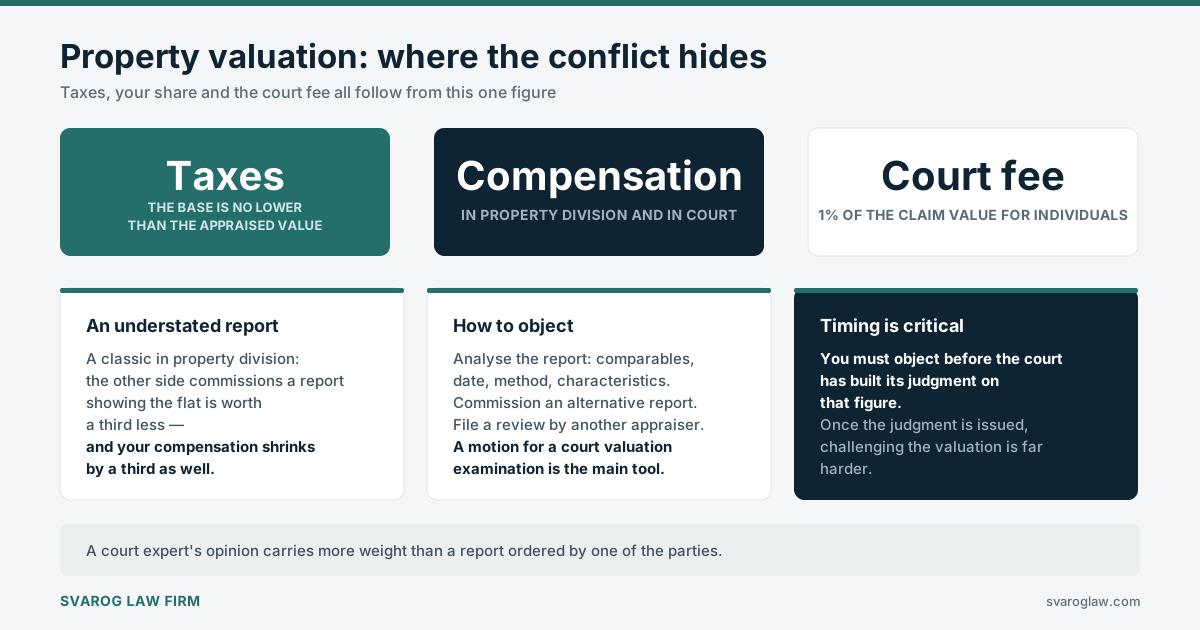
Where the conflict arises
Division of property
A dispute over value most often arises on a division of property: one spouse commissions a report valuing the flat a third below the market and offers the other compensation on that basis. You must object at once, by applying for a court-ordered valuation at the preparatory hearing, before the court builds its judgment on that figure.
Debt recovery
The mirror image. The debtor inflates the value of the property to show that it covers the debt, or the creditor understates it to take the asset cheaply. In enforcement proceedings the valuer’s report can be challenged within the period the enforcement officer sets, and that period is easy to miss.
Valuing a business
A holding in a company or a sole trader’s assets cannot be valued by comparison with flats: an expert report is needed that takes account of assets, liabilities and profitability. This is the most expensive and slowest category.
Confusing types of report
A valuation “for the notary” and a market valuation are two different documents with different purposes, and when a party brings a transaction report to court as evidence of market value, the other side has every ground to have it rejected.
How to challenge an undervaluation
- Analyse the report. Typical errors: the wrong comparables, no allowance for the refurbishment or the floor, an old valuation date, a methodology that does not fit.
- Commission an alternative report from another certified valuer.
- Apply for a court-ordered valuation. A court expert’s report carries more weight than one commissioned by a party.
- Challenge the report by review: another valuer’s review of a poor report often settles the question without a court expert.
Timing is decisive here. The court decides whether to order an expert report at the preparatory hearing, and once the case moves to the merits it is far harder to ask.
Deadlines that are not restored, and what the court checks
An application for an expert report not made at the preparatory hearing without good reason may be left unconsidered. Objections to a valuation in enforcement proceedings go to the enforcement officer within a short period after you see the report.
When weighing two conflicting reports the court looks at the valuation date, how comparable the comparables are (district, floor, condition), the valuer’s qualifications and how thoroughly the property was inspected. A report drawn up without viewing the flat almost always loses.
A case from our practice
In 2025 a wife came to us in a division-of-property case: the husband had filed a report valuing their three-room flat in Troieshchyna well below the market and asked to keep it, paying compensation on that figure. We prepared a review of the report (the comparables came from a different district and ignored the refurbishment) and at the preparatory hearing applied for a court-ordered valuation. The expert put the value about 30 % higher, and the court based its judgment on that. The client’s compensation rose by several hundred thousand hryvnia; the case took about 11 months, and the review and expert report cost about 25,000 UAH (details changed).
How we work
- We establish the purpose of the valuation: it dictates the type of report and the methodology.
- We review the other side’s report: comparables, date, methodology, whether the property’s features were taken into account.
- We select a certified valuer for an alternative report.
- We prepare the application for a court-ordered valuation and frame the questions for the expert: how they are worded affects the result more than the expert does.
- We challenge a poor report by review.
- We use the valuation in the main case: division of property, inheritance, recovery, tax.
Cost of services
Paid separately: the certified valuer’s fee, the court-ordered valuation, and the review of a report.
Court fees in 2026: in a monetary dispute (division of property, recovery) an individual pays 1 % of the value of the claim, but not less than 1,331.20 and not more than 16,640 UAH; through the Electronic Court the rate is multiplied by 0.8. That is why the valuation affects not only the outcome but the cost of entering the case.
Calculate the court fee
The value of the claim follows the value of the property — so a low valuation makes entering the case cheaper, but shrinks your compensation too.
Full price list · Contract for the sale of property
Questions and answers (Property valuation)
What if the court has already given judgment on an undervaluation?
File an appeal within 30 days and argue why the first-instance court should have ordered an expert report, or why the report could not be evidence. New evidence is admitted on appeal only for good reason, so the chances are lower than with a timely objection — but they are not nil.
Who pays for the court-ordered valuation?
Initially the party who applied for it. After judgment the cost is apportioned in line with the relief granted, so if you win it is recovered from the other side.
Can a valuation be commissioned remotely if I am abroad?
The valuer needs to inspect the property, so someone you trust has to provide access to the flat. The engagement with the valuer, receipt of the report and its use in court are handled by the lawyer under a notarised power of attorney.
What do the valuation and the expert report cost?
A valuer’s report depends on the type of property and the purpose; a court-ordered report costs more and is charged at the expert institution’s rates. A review of a report is usually cheaper than a fresh valuation, so that is where we start.
Can a valuation be challenged in enforcement proceedings?
Yes. After seeing the report a party may file objections with the enforcement officer within the period they set and ask for a review or a fresh valuation, and may challenge the officer’s actions in court. A missed deadline is hard to restore, so you must react at once.
Is a valuation needed to gift a flat to a relative?
A gift between family members of the first and second degree of kinship is taxed at zero, and no valuation is needed to determine the tax. For a gift to anyone else a valuation is needed, because 5 % personal income tax and a 5 % military levy are calculated from it.
Contact a Svarog lawyer about a property valuation
Send us the valuation report you disagree with. We will check the methodology, the comparables and the date, tell you whether there are grounds to challenge it, and prepare the application for a court-ordered valuation in time for the preparatory hearing.