

Олександр Сич
29 August 2026
The maximum daily interest rate on a consumer credit may not exceed 1 %, and that figure includes interest, fees and every other mandatory payment (Article 8(5) of the Law “On Consumer Lending”). Late-payment charges are capped at double the National Bank’s discount rate and at 15 % of the overdue instalment. Total penalties may not exceed half the credit received, or, where the credit is less than the minimum wage, twice the sum received.
The 1 % daily cap took full effect on 21 August 2024. Law No. 3498-IX of 22 November 2023 came into force on 24 December 2023 and lowered the ceiling in stages: 2.5 % a day for the first 120 days, 1.5 % for the next 120, and only then 1 %. The rule now lives in Article 8(5) of the Law “On Consumer Lending”, and the daily rate is calculated inclusive of every payment under the contract, so an “interest-free loan with a servicing fee” does not escape the cap.
The National Bank checks compliance in earnest. In December 2025 the regulator fined FC Ye Hroshi more than 2.8 million UAH for exceeding the maximum daily rate and for hidden charges, and in another case imposed a 765,000 UAH fine on Smartiway Ukraine on the same ground. For a borrower that means something simple: a microfinance demand can and should be recalculated. An individual review is on the service page of our credit and microloan lawyer.

Four caps that protect the borrower
| Cap | Level | Basis |
|---|---|---|
| Maximum daily interest rate | 1 % a day of the credit, inclusive of interest, fees and all other payments | Art. 8(5) as amended by Law No. 3498-IX |
| Late-payment charge | no more than double the National Bank discount rate for the period and, at the same time, no more than 15 % of the overdue instalment | Art. 21(2) |
| Total penalties and other charges for breach | no more than half the sum the consumer received under the contract | Art. 21(2) |
| The same for small credits | where the total credit does not exceed one minimum wage (8,647 UAH in 2026) — no more than twice the sum the consumer received | Art. 21(3) |
On top of that comes an express prohibition: a fine and a late-payment charge may not both be applied for the same breach (Article 21(4)). In other words, “a fine for the fact of default plus a charge for each day of default” is double liability, which lenders still write into their contracts out of habit.
The National Bank’s discount rate has stood at 15.5 % since 31 July 2026, so double that is 31 % a year. This limit works alongside the 15 % one: whichever of the two produces the smaller sum applies.
How much can lawfully be charged: a worked example
Take a loan of 8,000 UAH for 30 days. Interest together with every fee is capped at 1 % a day, that is 2,400 UAH for the term of the contract. Since 8,000 UAH is below the minimum wage, the ceiling for penalties here is higher — twice the sum received, 16,000 UAH — and it can only be reached after very long default, because each individual day of charges also runs into the 15 % of the overdue instalment and double the discount rate.
For a 12,000 UAH loan the picture is different: it exceeds the minimum wage, so total penalties may not exceed 6,000 UAH. The smaller borrower is less protected here than the larger one, which often surprises people. All the more reason to check each element of the demand separately rather than argue about the final figure.
Do the new caps apply to an old debt
The daily rate cap does not rewrite the whole period of the loan retrospectively. Chapter II of the Final Provisions of Law No. 3498-IX extends it to contracts made before it took effect only where their term was extended after 24 December 2023. For microloans that is less rare than it sounds: a rollover takes a couple of clicks, and each one pulls the contract under the new cap.
Earlier periods are checked against the rules then in force, and there is plenty to find there too. The caps on late-payment charges and total penalties in Article 21 have applied since 2017. Payments not stated in the contract and not included in the total cost of credit are not recoverable. Paragraph 6 of Chapter IV of the Final Provisions, added by Law No. 533-IX of 17 March 2020, works separately: for default falling within the quarantine period the consumer is released from liability to the lender, that is from penalties. It applies only to contracts made after 10 June 2017, so the date of signature is the first thing to check.
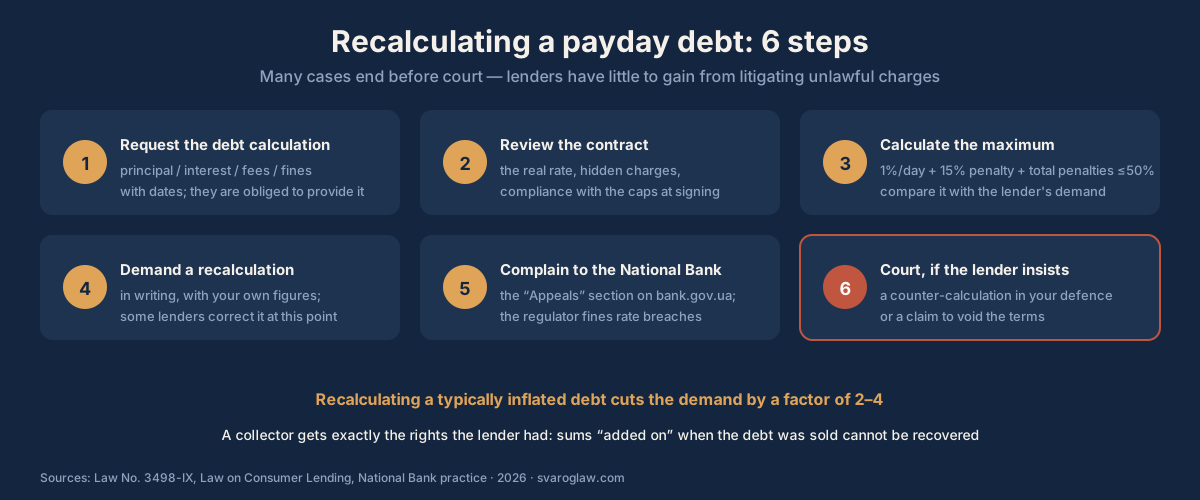
How to recalculate your debt: step by step
- Ask the lender for a detailed calculation of the debt broken down into principal, interest, fees, fines and late-payment charges, with the dates. The lender is obliged to provide it, and a refusal is itself a ground for complaining to the National Bank.
- Check the contract: the real annual rate, the list of every payment, whether the daily rate was within the cap at the date of signature, and whether it was rolled over after 24 December 2023.
- Work out the lawful maximum under each of the four caps separately and set it out in a table with three columns: charged, permitted, difference.
- Send a written demand for recalculation with your figures, by registered post with an inventory of the contents. Some companies adjust the sum at this stage already.
- File a complaint with the National Bank through the enquiries section of its website. Fines for exceeding the rate and for hidden charges are real, and the complaint itself changes the tone of negotiations.
- Prepare the court position if the lender persists: a counter-calculation in your defence to its claim, or your own claim to have the contract terms declared invalid and the lender compelled to recalculate.
Mandatory restructuring: who actually qualifies
“Mandatory restructuring by law” is written about often and inaccurately. The mechanism exists, but it is narrow. Paragraph 7-1 of Chapter IV of the Final Provisions of the Law “On Consumer Lending”, added by Law No. 3156-IX of 10 June 2023, obliges a lender to restructure only where several conditions coincide: the contract was made before 24 February 2022, the credit is not secured by pledge or mortgage, there were no arrears as at 23 February 2022, the borrower is registered as an internally displaced person or lived in or left an area of hostilities or temporarily occupied territory, and they meet one of the vulnerability criteria (state assistance or a pension as their only income, a family member disabled by the war, a large family).
The terms of the restructuring itself: repayment in equal instalments over three years, with interest at a capped rate equal to the National Bank discount rate plus five percentage points. It is not carried out where the contract was already restructured after 24 February 2022, or where its rate is below the cap. Everyone outside those limits has only restructuring by agreement with the lender — more on that on the page about restructuring credit.
The lenders’ typical breaches that a review uncovers
- “service” and “package” fees on top of interest which together push the daily rate above 1 %;
- a rollover charge left out of the calculation of the real annual rate;
- interest charged at the credit rate after the contract term expired;
- a fine and a late-payment charge taken for the same breach, contrary to Article 21(4);
- charges above 15 % of the overdue instalment or above double the National Bank discount rate;
- selling the debt to collectors with sums that do not appear in the original calculation.
When you do not need a lawyer
If the debt is recent, the lender’s calculation is transparent and within the caps, the matter is settled by paying or by agreed restructuring without a lawyer. Help is needed when the demand is several times what you borrowed, when the debt has been resold to collectors, when the lender has already gone to court, and when there are several debts and a single strategy is needed — from recalculating each of them to personal insolvency as a last resort. Our fees are in the section on legal service prices.
Questions and answers
What is the maximum rate on a microloan in 2026?
1 % a day of the credit, inclusive of interest, fees and every other payment (Article 8(5) of the Law “On Consumer Lending”). Products structured to get around the cap are treated by the National Bank as breaches and fined.
I borrowed 8,000 UAH and they are demanding 35,000. Is that lawful?
Check each element separately. Interest with fees for 30 days cannot exceed 2,400 UAH, each day of charges is capped at 15 % of the overdue instalment and at double the discount rate, and all penalties together at twice the sum received, since the credit is below the minimum wage. Demand a detailed calculation.
Is it true that penalties cannot exceed half the credit?
That is the rule in Article 21(2), and it applies to credit above the minimum wage. For smaller credit Article 21(3) sets a higher ceiling — twice the sum received.
Does the 1 % cap apply to debts taken out earlier?
It applies to contracts made before 24 December 2023 where their term was extended after that date. Earlier periods are checked against the caps then in force, and a recalculation usually reduces the sum substantially in any event.
The lender will not give me a detailed calculation. What now?
Send a written demand by registered post and, on a refusal or silence, complain to the National Bank. Without the calculation the lender will struggle to prove the sum in court too.
Where do I complain about a microfinance lender, and does it work?
To the National Bank, through the enquiries section of its website. Practice shows real fines: in December 2025 one company was fined more than 2.8 million UAH for exceeding the daily rate.
Can interest keep accruing for ever until I pay?
No. Interest at the contract rate accrues within the contract term, and once it ends the consequences of default apply, with their own caps. The Supreme Court’s case law is consistently against charging contractual interest beyond the term of the credit.
The debt was sold to collectors and the sum grew. Are they entitled to that?
The new creditor takes exactly the rights the lender had, so a debt cannot be inflated on assignment. Ask for the documents on the assignment of the claim and the original calculation.
What happens if I simply do not pay a microloan?
The debt within its lawful limits does not disappear: the lender can recover it through the courts, and enforcement with frozen accounts follows. The workable strategy is to establish the lawful size of the debt and then negotiate about the right figure.
Can microfinance debts be written off entirely?
The tool exists — personal insolvency — but it is a last resort with consequences for your property and your credit history. In most cases recalculation and restructuring are enough.
Sources
- Law of Ukraine “On Consumer Lending” No. 1734-VIII, Articles 8 and 21 and Chapter IV — zakon.rada.gov.ua/laws/show/1734-19
- Law of Ukraine No. 3498-IX of 22 November 2023 (the daily rate cap and its transitional provisions) — zakon.rada.gov.ua/laws/show/3498-20
- Law of Ukraine No. 3156-IX of 10 June 2023 (mandatory restructuring of consumer credit) — zakon.rada.gov.ua/laws/show/3156-20
- Law of Ukraine No. 533-IX of 17 March 2020 (release from liability for default during quarantine) — zakon.rada.gov.ua/laws/show/533-20
- Law of Ukraine “On the State Budget of Ukraine for 2026” No. 4695-IX (the minimum wage) — zakon.rada.gov.ua/laws/show/4695-20
- Civil Code of Ukraine, Articles 549–552, 1048, 1054 — zakon.rada.gov.ua/laws/show/435-15
- National Bank of Ukraine: the discount rate and protection of financial services consumers — bank.gov.ua
Recalculating a microfinance debt with Svarog
Send us the contract and the latest demand from the lender or the collectors — we will calculate the lawful maximum of your debt under all four caps, check the date of the contract and whether it was rolled over, prepare the demand for recalculation and the complaint to the National Bank, and, if the case is already in court, the counter-calculation. Related services: credit and microloan lawyer, restructuring credit, court representation, full price list.
+38 095 554-54-24 · Kyiv, 7 Khoriva Street (Podil) · Mon–Fri 9.00–18.00