

Олександр Сич
13 October 2026
The case must be closed if the court has not issued a ruling imposing a penalty within a year of the day of the offence. After that, neither a fine (UAH 17,000 under Part 1) nor a driving ban (deprivation of the right to drive) can be imposed any more (CAO, Art. 38(6) and Art. 247(1)(7)). The exception is where criminal proceedings were first conducted over the same events (Art. 38(11)). The day of the offence usually coincides with the day you were stopped on the road. A court’s “suspension” of the case for the duration of military service does not extend the year. However, if the court managed to issue a ruling within the year, a number of courts of appeal uphold it even when the appeal is heard after the year has run out.
The one-year period for Article 130 has applied since 17 March 2021, when Law No. 1231-IX took effect; before that, these cases were subject to the general three-month period under Part 2 of Article 38. That is why “three months” still turns up in old reference guides. We covered the amount of the fine, repeat offences and the line with criminal liability in our article on the UAH 17,000 fine for drink-driving; here we deal only with the time limit. It does not come into play often: in 2025 local courts closed Article 130 cases on this ground in respect of 849 people out of the 125,259 whose cases they heard, and in 2024 in respect of 1,148 (reports by the State Judicial Administration, or SJA, on Form No. 1-п).
How the year under Part 6 of Article 38 of the CAO is counted
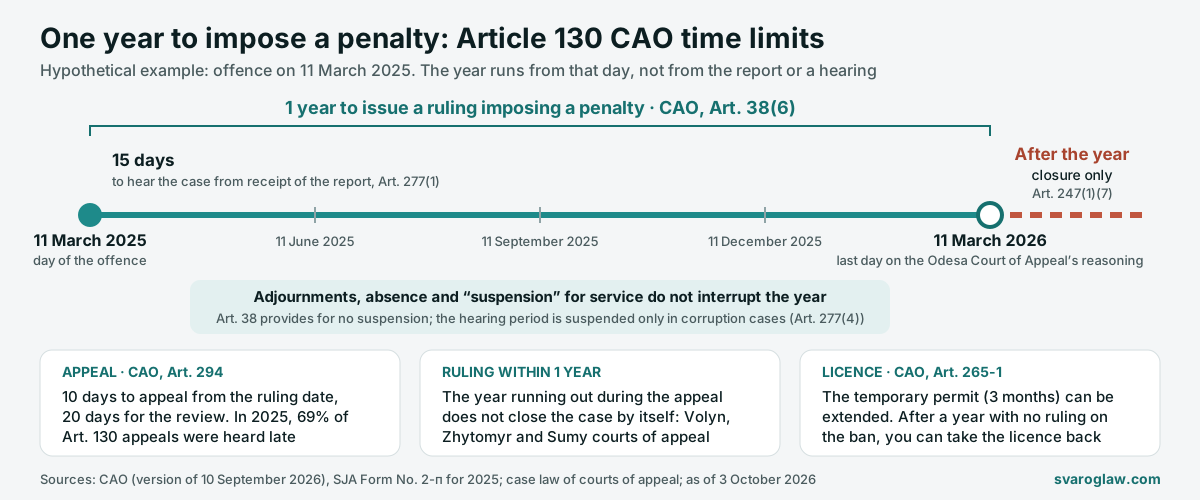
The general time limits for bringing a person to administrative liability are set by Article 38 of the CAO: two months if the case is heard not by a court but by another body (Part 1), and three months if it is heard by a court (Part 2). For Article 130, Part 6 of the same article makes an exception: one year from the day the offence was committed. In its ruling of 12 December 2024 in case No. 990SCGC/20/24, the Grand Chamber of the Supreme Court explained that the time limits for imposing a penalty under Article 38 are preclusive and the CAO does not allow them to be extended. So the court has to issue its ruling before the year is out. A hypothetical example: a driver was stopped on 11 March 2025.
- 11 March 2025, the day of the offence. The year is counted from this day: Part 6 of Article 38 says so directly, so the date of the administrative offence report or of the first hearing does not matter. The Administrative Cassation Court of the Supreme Court confirmed the same principle for the two-month period under Part 1 of Article 38 (ruling of 18 May 2018 in case No. 554/1527/17).
- 15 days after the report reaches the court. That is the time allowed for hearing the case (Art. 277(1)), yet at the end of 2025 local courts still had 23,487 Article 130 cases left undecided.
- The whole year, with no pauses: adjourned hearings, the driver’s failure to appear or a court ruling on “suspension” do not interrupt the period, because Article 38 of the CAO provides neither for suspending nor for interrupting the time limit for imposing a penalty. Even the time limit for hearing a case may be suspended under the code only in corruption cases (Art. 277(4)).
- 11 March 2026, the latest date for the ruling. This calculation follows from a decision of the Odesa Court of Appeal: for an offence of 29 October 2024 it held that a fine imposed on 30 October 2025 came too late, because “one year and one day” had passed since the offence (case No. 505/4318/24). The Supreme Court has no position on the last day, so another court may draw the line a day earlier or later.
- On this calculation, from 12 March 2026 the only option left is closure under Article 247(1)(7): the court issues a ruling to that effect (Art. 284(2)).
Only Part 11 of Article 38 gives a different starting point for Article 130. If criminal proceedings were first conducted over the same events and then closed, a penalty may be imposed no later than three months after the day of the decision to close them. This happens, for example, when a victim of a road accident suffered bodily injuries of at least medium severity and the driver first had to defend themselves in a criminal case under Article 286-1 of the Criminal Code.
Why “suspension” during military service does not extend the year under Article 38 of the CAO
In 2022–2025 some local courts suspended Article 130 cases against service members “until discharge from military service”, by analogy with Article 335 of the Criminal Procedure Code, and after resuming them imposed penalties even though the year had already passed. Courts of appeal quash such rulings: the CAO does not give a court the right to suspend the time limit for hearing a case, so a ruling on “suspension” has no effect on the time limits under Article 38 (Lviv Court of Appeal, case No. 466/4481/24). In the three cases below, the proceedings were ultimately closed:
- Sumy Court of Appeal, 20 October 2025, No. 950/1591/22. Offence on 31 August 2022; the proceedings were suspended for two and a half years, and on 12 May 2025 the driver was fined UAH 17,000 and banned from driving for a year.
- Kyiv Court of Appeal, 27 January 2026, No. 376/1530/23. Offence on 23 May 2023, ruling on 2 October 2025. The court held that the first-instance court had been wrong to conclude that suspending the proceedings interrupted the time limit.
- Zhytomyr Court of Appeal, 18 May 2026, No. 285/2465/23. Offence on 15 April 2023, ruling on 20 April 2026. In the court’s words, Part 6 of Article 38 “provides for no exceptions whatsoever”.
As can be seen from court decisions, the Supreme Court stated in its letter No. 718/0/158-25 of 4 December 2025 that suspending such cases because of military service will be possible only after the CAO is amended. We have not found the original of the letter in open sources; it is summarised, for example, in the ruling of the Illintsi District Court of 23 December 2025 in case No. 131/570/23. Courts are resuming suspended cases with reference to this letter: as of 3 October 2026, the Unified State Register of Court Decisions (the court register) contains more than 50 decisions that mention both the letter’s number and the words “resume the proceedings”.
The year ran out before the ruling or during the appeal
The court closes the proceedings under Article 247(1)(7) of the CAO. If it imposed a penalty all the same, the court of appeal must quash the ruling and close the case, as the Odesa (No. 505/4318/24) and Lviv (No. 442/2150/25) courts of appeal did. For that, you need to appeal within 10 days of the day the ruling was issued or get the missed deadline restored (Art. 294(2)): in the Lviv case the deadline was restored because the driver had not been notified of the hearing. Otherwise the ruling becomes final (Art. 294(1)) and the penalty stands.
Several courts of appeal do not regard the year running out during the appeal as a ground for closure in itself. The Volyn Court of Appeal (No. 161/23096/24) rejected an application to close the case because the penalty had been imposed within the time limit, and the Zhytomyr Court of Appeal (No. 278/2938/24) called the advocate’s argument to that effect “a personal interpretation of the law”.
In case No. 589/4780/23 the first-instance court made it a day before the deadline: offence on 10 September 2023, ruling on 9 September 2024. On 29 September 2026 the Sumy Court of Appeal did not quash that ruling, because the local court “did not go beyond the time limit provided for by Article 38 of the CAO”.
It is different when the court of appeal quashes the ruling because of a procedural violation, for example a hearing held without the driver being properly notified. A new penalty can no longer be imposed after the year has run out, so the case is closed even if guilt has been found proven: this is how the Kharkiv Court of Appeal decided cases No. 953/1154/25 and No. 639/7166/24. We have not found a direct conclusion of the Supreme Court on whether the one-year period covers the appeal, and none will appear through cassation: Article 130 cases do not reach cassation, because the ruling of the court of appeal is final (Art. 294(10)).
The twenty days the law gives the court of appeal (Art. 294(4)) are often not enough: in 2025 courts of appeal heard 9,601 of 13,882 Article 130 appeals (69%) beyond the CAO time limits. They quashed 1,746 rulings and closed the cases, 1,567 of them because there was no event and no elements of an offence. All other grounds together, including expiry of the time limit, account for 179 cases: SJA Form No. 2-п has no separate column for the time limit.
Playing for time until the year is up is risky. The court can hear an Article 130 case without you if you were notified in good time and did not ask for the hearing to be adjourned (Art. 268(1)), since Article 130 is not on the list of cases where attendance is mandatory. An appeal filed after the 10 days is returned unless the court restores the deadline: in case No. 456/4288/24 the appeal was filed almost two years after a ruling issued in the driver’s presence, and restoration was refused (Lviv Court of Appeal, 3 September 2026). And judges have no interest in delay either: on 11 June 2026 the Grand Chamber of the Supreme Court upheld a warning issued to a judge for breaching hearing deadlines, which led to 29 sets of proceedings being closed because the Article 38 time limit had expired (No. 990/582/25, cases from 2019–2021).
15, 10 and 20 days: time limits from the report to enforcement of the ruling
| What happens | Time limit | CAO provision |
|---|---|---|
| Imposing a penalty under Art. 130 | 1 year from the day of the offence | Art. 38(6) |
| Hearing in the local court | 15 days from receipt of the report | Art. 277(1) |
| Appeal | 10 days from the day the ruling is issued | Art. 294(2) |
| Forwarding the appeal with the case file to the court of appeal | 3 days | Art. 294(3) |
| Review on appeal | 20 days from receipt of the case | Art. 294(4) |
| Taking legal effect | Local court ruling: once the appeal period expires; if it has been appealed, the driving ban takes effect only after the decision of the court of appeal. Court of appeal ruling: immediately, not subject to appeal | Art. 294(1), (10); Art. 291(4) |
| Sending the ruling for enforcement | 3 months from the day it is issued; the period is suspended while an appeal is pending | Art. 303(1) |
The last row is easy to confuse with the one-year period. The three-month period for enforcing a ruling is suspended while an appeal is pending, but the CAO has no such rule for the year allowed for imposing a penalty. Nor does the code have an equivalent of Part 2 of Article 49 of the Criminal Code, which suspends the criminal limitation period when a person evades investigation or trial. But evasion does not help either: if you were notified in good time, your failure to appear does not prevent the case from being heard (Art. 268(1)).
Until the case is decided, you have not been deprived of the right to drive: a person is considered deprived of this right only once the court decision takes legal effect (Art. 317-1(2)). Until then the police temporarily seize the licence, but for no more than three months, and issue a temporary permit. In Article 130 cases this permit can be extended for a further three months once the three months are up. If, however, within a year of the seizure the court has not imposed a driving ban on you or has not heard the case in time, demand your licence back regardless of the stage the case has reached; no fee is charged for returning it (Art. 265-1). If it is still not handed back, we will help with the return of your driving licence under Article 130 of the CAO.
Closure under Article 247(1)(7) of the CAO does not mean acquittal
Expiry of the time limit releases you from the penalty but does not disprove guilt: in case No. 950/1591/22 the Sumy Court of Appeal specifically noted that this ground for closure is not exonerating. The consequences can be felt beyond the case itself:
- The closure may be taken into account in public service. In its ruling of 3 November 2022 (No. 520/5582/21), the Administrative Cassation Court of the Supreme Court agreed that closing a case under Part 1 of Article 130 because the time limit had expired does not disprove the guilt established by the court, and this circumstance was taken into account when a prosecutor was dismissed following attestation.
- Civil liability remains: closing the case because the Article 38 time limit has expired does not release you from it, and fault for the accident can be proved by other evidence (Civil Cassation Court of the Supreme Court, 21 April 2025, No. 467/1102/19). Victims can still bring claims for compensation for damage caused by a road traffic accident after such a closure.
- A non-exonerating ground can also turn against you in related cases. The Poltava Court of Appeal treated the closure of cases under Articles 124 and 122-4 for expiry of the time limit, which the defence had not challenged, as an unrevoked finding that the person had been driving, and upheld the penalty under Part 1 of Article 130 (No. 537/6937/25, 18 September 2026).
If guilt has not been proved, however, the case must be closed on an exonerating ground, namely the absence of an event and of the elements of an offence (Art. 247(1)(1)): this is the view of, among others, the Kyiv (No. 367/5898/24) and Poltava (No. 537/6937/25) courts of appeal. There is no uniform approach, though: the Odesa Court of Appeal (No. 505/4318/24) writes that guilt is not established at all when a case is closed for expiry of the time limit. The exonerating ground is much more common than expiry of the time limit: in 2025 Article 130 cases were closed on it in respect of 14,481 people, and for expiry of the time limit in respect of 849. That is why it makes sense to submit evidence that there was no offence even when the time limit has already passed. Finding and checking such evidence is where appealing a drink-driving report under Article 130 of the CAO begins.
In brief: the application, a missed 10-day deadline and the court fee
Will the court close the case on its own, without my application?
It has to: proceedings already opened are “subject to closure” if the Article 38 time limit has expired by the time of the hearing (Art. 247(1)(7)), and the article does not require the person’s consent for this. You can file an application, but the court’s duty does not depend on it. You can draft one without a lawyer: it is enough to state the date of the offence from the report and the case number and to cite Part 6 of Article 38 and Article 247(1)(7). A lawyer is needed when the ruling has already been issued or when there is still time before the year is up and the court will be examining the evidence.
The ruling was issued 13 months after the offence, and the 10 days for an appeal have already passed. What now?
The appeal period runs from the day the ruling was issued (Art. 294(2)), but together with the appeal you can file an application to restore it. The court will restore the period if it finds the reason for missing it valid. That is what happened in case No. 589/4780/23: a copy of the ruling was delivered to the defence lawyer only on 27 August 2026. If, however, you knew about the ruling and did nothing, the appeal will most likely be returned. Once the appeal has been accepted for consideration, a ruling issued after the year ran out must be quashed and the case closed (Lviv Court of Appeal, No. 442/2150/25).
Do I have to pay the court fee if the case was closed because of the time limit?
No. The fee is paid only by the person on whom the court has imposed a penalty (CAO, Art. 40-1). In case No. 474/909/23 the Mykolaiv Court of Appeal explained it plainly: if the proceedings were closed and no penalty was imposed, the fee is not charged.
Where to check: the CAO, 21 court decisions and SJA reports
- CAO, Art. 38, 40-1, 130, 247, 265-1, 268, 277, 284, 291, 294, 303, 317-1 (version of 10 September 2026) — zakon.rada.gov.ua; Law No. 1231-IX of 16 February 2021 — zakon.rada.gov.ua; Criminal Code of Ukraine, Art. 49, 286-1 — zakon.rada.gov.ua
- Supreme Court: Grand Chamber No. 990SCGC/20/24 (court register), No. 990/582/25 (court register); Administrative Cassation Court No. 554/1527/17 (court register), No. 520/5582/21 (court register); Civil Cassation Court No. 467/1102/19 (court register)
- Courts of appeal: Odesa No. 505/4318/24 (court register); Kyiv No. 376/1530/23 (court register), No. 367/5898/24 (court register); Zhytomyr No. 285/2465/23 (court register), No. 278/2938/24 (court register); Lviv No. 466/4481/24 (court register), No. 442/2150/25 (court register), No. 456/4288/24 (court register); Sumy No. 950/1591/22 (court register), No. 589/4780/23 (court register); Volyn No. 161/23096/24 (court register); Kharkiv No. 953/1154/25 (court register), No. 639/7166/24 (court register); Mykolaiv No. 474/909/23 (court register); Poltava No. 537/6937/25 (court register); ruling of the Illintsi District Court No. 131/570/23 (court register)
- SJA court statistics: Form No. 1-п for 2025 and 2024, Form No. 2-п for 2025
Your Article 130 case has been sitting in court for almost a year
Take the report and count the days from the date of the offence. If the year has passed and there is no ruling, the court must close the case. A ruling issued after the year has run out is appealed within 10 days of the day it was issued. And if there is still time before the deadline, get ready to defend yourself at the hearing. A Svarog road accident lawyer will check the dates and the case file and prepare objections, an application to close the case or an appeal.