A notice of suspicion is the moment you stop being “a person under check” and become a party to criminal proceedings, with everything that follows: a preventive measure, seizure of property, a travel ban, notification to your employer.
That first month is not a pause: it is when the position is built, the evidence gathered and the breaches recorded on which the complaint will rest.
When a suspicion is unfounded
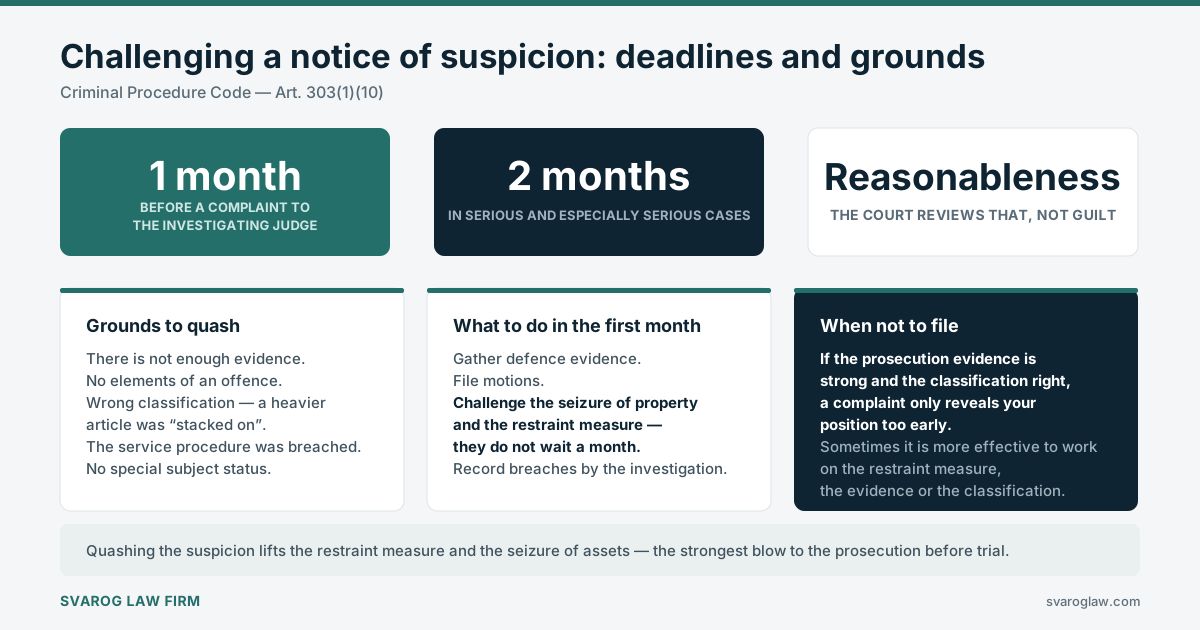
The investigating judge examines not guilt but whether the suspicion is well founded. The complaint succeeds where:
There is not enough evidence
A suspicion must rest on a body of evidence giving grounds to believe the person committed the offence. Assumptions, intelligence and “statements from an anonymous source” do not provide that.
There is no offence
The conduct alleged is not a criminal offence: the classic situation is an unperformed contract that someone is trying to turn into a crime.
The charge is misclassified
The conduct is charged under a more serious article than the facts support, in order to obtain a stricter preventive measure or a longer investigation period.
The service procedure was breached
The notice was drawn up or served by someone without authority, in breach of procedure, or without rights being explained (Arts. 276–278).
There is no special subject
The article applies to an official, and the suspect is not one.
Essential elements are not established
Intent, purpose and the amount of loss are named in the notice but supported by nothing.
When the window opens and when it closes
Time runs from the day the notice was served and depends on what is alleged:
The window for a complaint
- a criminal misdemeanour — a complaint becomes possible after one month;
- a crime of any gravity, including a less serious one — after two months;
- the upper limit is the same for everyone: the complaint is accepted until the prosecutor closes the case or goes to court with an indictment.
It is the upper limit people forget: if the investigation moves fast, the window can close within weeks of opening. So we calculate the dates at the first consultation.
A ruling on such a complaint cannot be appealed: it is not on the list in Art. 309. There is no second attempt with the same arguments, so the complaint goes in fully prepared.
What quashing the suspicion achieves
- the prosecution of you stops to the extent the suspicion is quashed;
- the basis for the preventive measure disappears, but it does not lapse automatically: a separate application is needed (Art. 201), and bail is returned once the court rules;
- a seizure of property is likewise lifted by a separate ruling on application (Art. 174);
- the investigation may serve a fresh notice, but now with the court’s reasoning on the record, and repeating the same mistakes will be harder.
Quashing a suspicion is not the same as closing the case: the charge has to be formulated afresh, and until then the status of suspect is off you.
What to do while the complaint cannot yet be filed
- Inspect the material you do have access to, and record what is missing.
- Do not give evidence without a settled position. The right to remain silent applies here too.
- Gather the defence evidence: documents, references, alibi evidence, specialists’ reports.
- Challenge the other decisions: seizure of property, searches, the preventive measure. These are separate procedures and they do not wait a month.
- File applications to interview defence witnesses, order expert reports, obtain documents.
- Record the breaches: the lawyer not admitted, pressure applied, irregularities during searches. All of it becomes part of the complaint.
Parallel lines of defence
Challenging the suspicion is rarely the only step and almost never the first:
- Varying the preventive measure — replacing detention with bail or house arrest;
- lifting the seizure of property — a separate procedure with its own deadlines;
- recovering seized property;
- an application to close the proceedings where there is no offence;
- excluding evidence obtained in breach of procedure;
- challenging the investigator’s conduct: inaction, refusal of applications.
A case from our practice
In 2025 the director of a small company came to us: a counterparty had not received goods it had paid for, went to the police, and instead of a commercial dispute a suspicion of obtaining money by deception appeared. The file contained nothing but the complaint and a transfer statement. The first two months went on applications to obtain documents and to interview the warehouse staff, and as soon as the deadline allowed we complained to the investigating judge. The judge found the suspicion unfounded: it rested on a breach of contract with no evidence of intent whatever. The investigation continued, but the status of suspect was lifted from the client, and we had the seizure of the company’s accounts lifted by a separate application. The whole thing took about four months. (details changed)
When a complaint is more likely to harm
Investigating judges grant such complaints rarely, and a complaint filed “just in case” has a price: you show the investigation your hand early and give it time to prepare an answer. Where the prosecution evidence is strong and the classification fits the facts, the effort is better spent on the preventive measure, on the evidence, or on reclassification. At the consultation we set out both options with their consequences; the decision is yours.
How we work
- We analyse the notice: whether it is founded, the classification, how it was served, whether the elements are there.
- We calculate the deadline for the complaint, including the upper limit before the indictment.
- We work the first weeks: applications, evidence, recording breaches.
- We prepare the complaint to the investigating judge with full reasoning.
- We run the parallel lines: the preventive measure, the property, the evidence.
- We defend at every stage: pre-trial investigation, trial, appeal.
Cost of services
There is no court fee for a complaint to the investigating judge: fees are not charged in criminal proceedings. Additional cost arises only for an expert’s or specialist’s report, and is agreed separately.
Questions and answers (challenging a notice of suspicion)
The investigating judge refused. Can the ruling be appealed?
No. That ruling is not on the list in Art. 309, so there is no appeal. The arguments that the suspicion is unfounded are then raised at first instance and in applications to vary the preventive measure.
The case has already gone to court with an indictment. Can the suspicion still be challenged?
No; once the prosecutor has gone to court this procedure is closed (Art. 303(1)(10)). But the defects in the suspicion remain live arguments: the classification, the elements of the offence and any service irregularities are examined by the trial court.
Does the complaint suspend the investigation?
No. The investigation continues, investigative steps go on, and the deadlines keep running. So we file the complaint alongside other action: applications, objections to extending the preventive measure, challenges to the seizure of property.
The notice was posted to me and I never received it. Am I already a suspect?
The status arises on proper service in the manner the Code requires. If there was no actual delivery, that is recorded in writing, becomes a separate ground of complaint, and deprives the investigation of any argument that you “failed to attend”. The service documents are what has to be checked.
What does filing the complaint cost the state?
Nothing: no court fee is payable in criminal proceedings, either for a complaint to the investigating judge or for an application to vary a preventive measure. You pay only for the lawyer’s work and, where needed, expert reports.
Can the freeze on the accounts be lifted while the suspicion stands?
Yes. A seizure is lifted separately, on the application of the suspect or the owner of the property, where the need for it has passed or it was imposed without grounds (Art. 174). That route is often faster than challenging the suspicion.
Contact a Svarog lawyer about challenging a notice of suspicion
Send us the notice of suspicion: we will check whether it is founded, how the conduct is classified and how it was served, calculate when the window for a complaint opens and closes, and tell you what to do now. Those first weeks determine everything the complaint will later rest on.