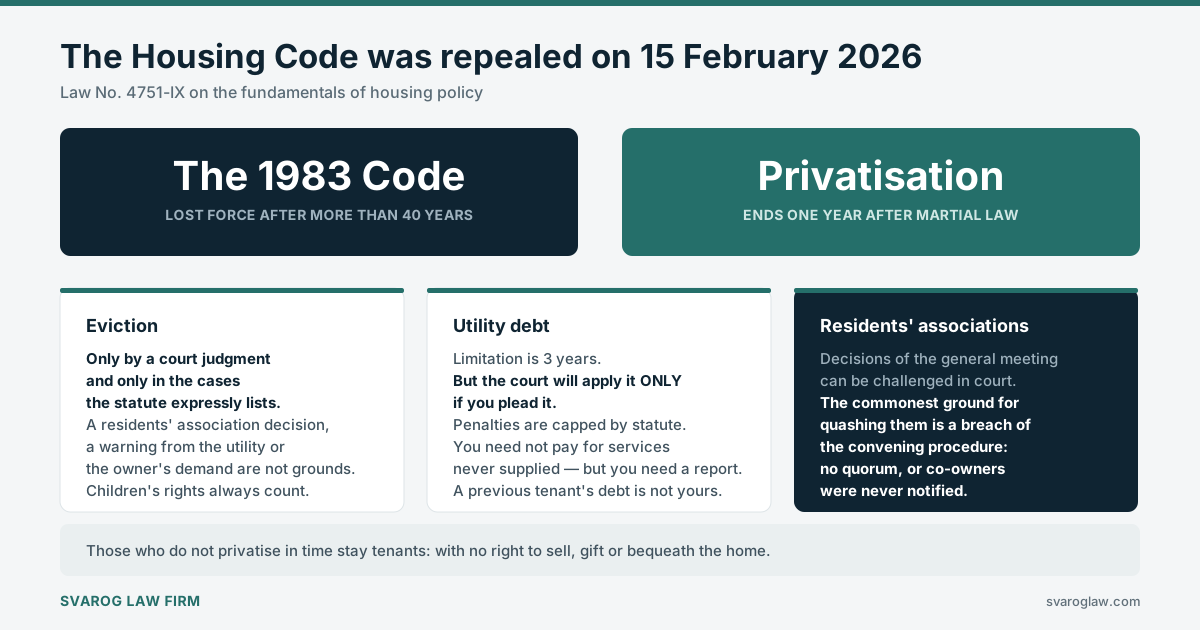
On 15 February 2026 the Law “On the Fundamentals of Housing Policy” (No. 4751-IX) came into force, repealing the 1983 Housing Code of the Ukrainian SSR — the statute Ukrainians lived under for more than forty years.
The rules on occupying housing, eviction, service accommodation and, above all, free privatisation are now set by the new law. Some provisions of the old Code remain in force for the transitional period set by its Chapter IV, so in every dispute one has to check which version of the rules applies to the situation.
A housing lawyer is needed right now: rights that seemed open-ended now have an end date, and some disputes are already decided under the new rules.
What changed on 15 February 2026
Free privatisation now has an end date
Chapter IV of Law No. 4751-IX provides that the right to have housing transferred into ownership free of charge ends one year after martial law ends or is lifted. The date is not yet fixed, because it depends on when martial law is lifted, but the opportunity is now time-limited, and there is no sense in delaying the paperwork.
The Housing Code of the Ukrainian SSR has lapsed
Apart from particular provisions that apply during the transitional period. In practice that means claims and defences now cite the new law and the Civil Code rather than the familiar articles of the Housing Code — and the courts are still working out how to apply them.
Disputes begun before 15 February 2026
Do not disappear: relations that arose earlier are governed by the rules in force when they arose. So the dates of the events in your case matter as much as what happened.
Areas of work
The right to housing
- Privatising a flat — the deadline for free privatisation is now fixed by law
- Establishing title to a home
- Disputes over the right to occupy, registration and deregistration
Eviction and moving in
- Defence against eviction — from a flat, a hostel or service accommodation
- Gaining access to a home a co-owner or relative has shut you out of
- Evicting people who have lost the right to occupy
Money
- Restructuring utility arrears — utility debts, penalties, challenging court orders
- Disputes with residents’ associations and management companies
- Compensation for flooding, accidents and a management company’s failure to act
Conflicts
- Division of matrimonial property — where the home is what is in dispute
- Inheriting a home
- Regularising alterations
- Disputes with developers
Eviction: when it is lawful and when it is not
The main rule has not changed: eviction is allowed only by court order and only in the cases the law expressly provides for. No warning from a management company, decision of a residents’ association or demand from an owner is a ground for eviction in itself, and changing the locks without a court order is taking the law into your own hands.
Eviction is possible where:
Grounds for eviction
- the person has lost the right to occupy, in particular after title passed to a new owner;
- the home is used for other purposes, is being destroyed, or the neighbours’ rights are systematically breached;
- the accommodation is service housing and the employment has ended;
- the home was occupied without authority.
Eviction without alternative accommodation is impossible for certain categories of occupant, and that is the first thing we check: whether you belong to such a category under the new law.
Children are a separate matter. If a child is registered at the home or has a right to use it, any disposal or eviction must take the child’s interests into account and, as a rule, requires the guardianship authority’s consent. Breaching this rule is the commonest ground on which courts set deals and decisions aside.
Utility debts: what can be knocked off
The figure on the bill is rarely what can be recovered from you in court.
Limitation
The general period is three years (Art. 257 of the Civil Code), but it cannot simply be counted back from today: limitation, suspended from 2 April 2020 for the quarantine and martial law, resumed only on 4 September 2025. As a result, 2021–2022 debts are still recoverable in 2026, and we calculate the period for each monthly payment separately. The court applies limitation only on a party’s application (Art. 267(3)), so without a plea in your defence it will not be taken into account.
Penalties have a firm ceiling
Under the Law “On Housing and Utility Services” the penalty is 0.01 % of the debt for each day of delay and cannot exceed 100 % of the total debt. In addition, during martial law the charging of utility penalties was restricted by a separate law, so we check the period of charging against the dates.
Services that were not supplied
No heating, no hot water, no refuse collection — you do not pay for that, but the failure or poor quality must be recorded in a complaint act drawn up with the supplier’s representative present. Without that act the court works from meter readings and standards.
The court order
Utility companies recover debts wholesale through court orders: quick, cheap and without the debtor taking part. An order can be set aside within 15 days of being received (Art. 170 of the Civil Procedure Code), and the case then moves into ordinary proceedings where limitation, the tariff, the penalty and the sum itself can all be contested.
More on this: Restructuring utility arrears.
Disputes with residents’ associations and management companies
- unlawful decisions of general meetings — taken without a quorum, without notifying co-owners, in breach of procedure;
- unjustified levies — for “repairs”, “development” or “security”, never properly approved;
- inaction — the roof is not repaired and the services are not maintained, while the levies keep being collected;
- refusal of access to documents — a co-owner is entitled to know where their money goes;
- compensation for damage — flooding from a leaking roof, property damaged by a burst pipe.
The procedure for convening a meeting is set by Art. 10 of the Law “On Associations of Co-owners of Apartment Buildings”: every co-owner must be notified in writing at least 14 days in advance, the notice must contain the agenda, and the meeting is quorate if co-owners with more than half the votes attend. Some decisions require a qualified majority. Breaching any of these requirements is a ground to have the decision set aside, and it is on procedure that such disputes are most often won.
A case from our practice
In 2025 the owner of a flat in Kyiv’s Darnytsia district came to us: the heating company had obtained a court order for 63,000 UAH of arrears and money was being taken from his card. We set the order aside within the 15-day period and the case moved into ordinary proceedings. In the defence we pleaded limitation for the payments whose period had expired before the suspension, attached the acts drawn up earlier showing that the temperature in the flat fell short of the standards over two heating seasons, and calculated the penalty charged above the statutory ceiling. The court awarded 27,000 UAH instead of the 63,000 claimed. About seven months passed from setting aside the order to judgment, and our fee was 16,000 UAH. (details changed)
When you do not need a lawyer
If the matter can be settled by a written request to the residents’ association, the management company or an administrative services centre, and the other side responds, there is no point paying for a lawyer: write the request yourself, have it registered and keep the reply. Nor does paying an undisputed debt on an agreed schedule need any support.
A housing lawyer is needed when:
- you are facing eviction;
- you need to get back into a home you have been shut out of;
- the utility debt is large or wrongly calculated;
- a court order for the debt has been issued;
- the residents’ association has taken a decision that infringes your rights;
- your flat has been flooded by a fault in the building;
- you live in a hostel or in service accommodation;
- you need to privatise in time, while the transfer is still free.
Cost of services
Court fees in 2026: an individual’s non-monetary claim (eviction, entry, a declaration that someone has lost the right to occupy, setting aside a residents’ association decision) — 1,331.20 UAH; an individual’s monetary claim — 1 % of its value, but not less than 1,331.20 and not more than 16,640 UAH; for a company a non-monetary claim costs 3,328 UAH. An application for a court order is charged at 332.80 UAH, and filing through the Electronic Court reduces the rate by 20 %.
Calculate the court fee for a monetary claim
Eviction, entry and setting aside an association's decision are non-monetary claims: 1,331.20 UAH.
Questions and answers (Housing lawyer)
My ex-husband does not live in the flat but is still registered there. How do I have him deregistered?
Voluntarily it is done by his own application to an administrative services centre. Without his consent you need a court judgment declaring that he has lost the right to occupy, and the registration authority then removes him. What has to be proved is that he does not live there: neighbours’ statements, evidence of where he actually lives, the absence of his belongings, and non-payment of utilities.
Does a utility debt pass to the new owner of a flat?
No; arrears for services consumed are the obligation of whoever was the consumer at the time, and as a rule they do not pass to the buyer with the flat. In practice suppliers still refuse to transfer the account until the debt is paid, so before buying people obtain a certificate of no arrears, and the debt itself is written into the contract as the seller’s obligation.
How long does an eviction or entry case take?
At first instance such disputes usually take 6–10 months, with an appeal adding another 3–6. Cases move faster where there is a complete set of documents for the home and the facts are recorded: statements that the person does not live there, replies from the registration authorities, evidence that access was blocked.
Can a room in a hostel be privatised?
It depends on the building’s status: privatisation is possible if the hostel is in municipal ownership and is not in a category the law excepts (special hostels, hostels attached to educational institutions). The particular address has to be checked against the city council’s decisions and the register, and that is where we start.
I am abroad. Can a housing dispute be run without my coming?
Yes. The engagement letter is signed electronically, the power of attorney is executed at a consulate, and the lawyer attends hearings on a warrant. Attendance in person may be needed only if you are to be examined as a party, and in that case the court usually allows participation by video.
What does privatisation cost apart from the lawyer’s work?
The transfer of the home into ownership is itself free. You pay for the flat’s technical passport and for state registration of title: the administrative fee depends on the registration speed chosen, with the standard period cheapest and expedited service costing several times more. If some documents are missing, archive certificates add to the cost.
Contact a Svarog housing lawyer
Describe the situation and send us the documents for the home — we will check whether the demands made of you are lawful, how much of the utility debt can realistically be recovered in court, and whether there is a risk of eviction. We will also work out the privatisation timetable so you register the home while the transfer is still free.