A reconciliation agreement in criminal proceedings is a procedural document signed by the victim and the suspect or the accused, and approved by the court in its judgment. Articles 468–476 of the Criminal Procedure Code set out how it is made: the accused admits guilt and undertakes to make good the loss, the victim agrees to a specific sentence, and the court imposes it without a full trial.
The main restriction is the category of the case. Under Art. 469(3) CPC reconciliation is allowed in proceedings about criminal misdemeanours, less serious crimes and in private prosecution cases. In cases about serious and especially serious crimes a reconciliation agreement is impossible, however much money a party offers.
So the consultation begins with the classification: which article of the Criminal Code the suspicion cites, which category of gravity it falls into under Art. 12 CC, and whether the law permits an agreement in your case.
In which cases the law permits reconciliation
Categories where an agreement is possible
- criminal misdemeanours: a penalty lighter than imprisonment, or imprisonment of up to two years (Art. 12 CC);
- less serious crimes: a penalty of up to five years’ imprisonment;
- private prosecution cases listed in Art. 477 CPC;
- cases involving domestic violence: here the agreement is made only on the initiative of the victim or their representative (Art. 469 CPC).
Where one offence has several victims, the agreement is approved only with all of them together: a deal with one, while the others object, will not lead to a judgment.
When an agreement can be made and who negotiates
The victim, the suspect or the accused may initiate it; the investigator, the prosecutor and the judge cannot take part in the negotiations. The window is wide: from the notice of suspicion until the court retires to the deliberation room to give judgment (Art. 469(5) CPC), so it can be signed in the second month of the investigation or at the last hearing at first instance. If the agreement is made before the investigation ends, the prosecutor sends it to the court together with the indictment (Art. 474 CPC).
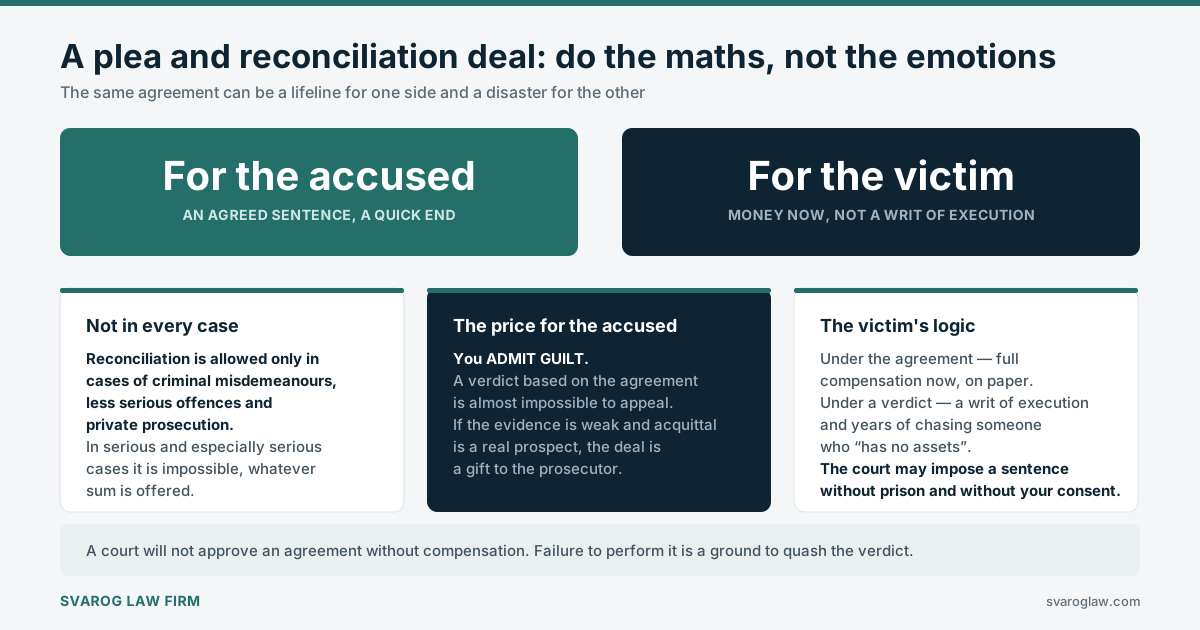
What the accused gets
- an agreed sentence: its type and length are set by the parties, and the court either approves the agreement in that form or refuses it altogether;
- a suspended sentence, if the parties wrote it expressly into the agreement (Art. 471 CPC, Art. 75 CC);
- the case finished in a few hearings instead of a year or more of trial;
- control over the sum: the amount of compensation is agreed, not fixed by the court on the victim’s claim.
The price is high. The accused admits guilt, and a judgment based on an agreement can be appealed only on the grounds listed in Art. 394 CPC: a sentence harsher than the one agreed, the absence of consent to it, the court’s failure to comply with Art. 474 CPC, or the absence of the offence itself. Arguing on appeal that the evidence was weak is too late once guilt has been admitted, so the prosecution case is assessed before the negotiations: where there are procedural breaches or grounds for reclassification, a signed agreement turns a doubtful accusation into a ready-made conviction.
What the victim gets: arithmetic instead of promises
The victim’s logic is financial: an agreement produces money by an agreed date, an ordinary judgment produces a writ of execution and enforcement proceedings.
The procedural side adds weight: a sentence not involving imprisonment can be imposed by the court without the victim’s consent, and then there is neither money within a sensible time nor a severe sentence. The decision is always the victim’s; our task is to show both figures before it is taken.
What the text of the agreement must contain
Article 471 CPC sets out the contents, and leaving out any item is a ground for refusing approval:
Mandatory terms of the agreement
- the parties to the agreement;
- the wording of the suspicion or charge and the classification, citing the article of the Criminal Code;
- the circumstances material to the proceedings;
- the amount of the loss and the date for making it good, or a list of acts not involving compensation that the accused will perform for the victim, and the time for them;
- the agreed sentence and the parties’ consent to its imposition;
- the consequences of making, approving and failing to perform the agreement.
The law allows deferred payment: the agreement may set a date and a schedule instead of money in hand. For the victim that is the document’s weakest point, so we insist either on payment in full before approval or on a short period with the payments broken down.
Why the court refuses approval
The grounds for refusal are listed in Art. 474(7) CPC:
- the terms are contrary to law, in particular the classification is wrong;
- the terms do not serve the public interest;
- the terms infringe the rights, freedoms or interests of the parties or of other people;
- there are reasonable grounds to think the agreement was not voluntary, or that the parties have not in fact reconciled;
- it is obvious that the accused cannot perform the obligations taken on;
- there is no factual basis for a finding of guilt.
Before approving it the judge asks the accused whether they understand the consequences and whether they were pressed into the agreement, and checks whether they are able to do what they promised. A deal drafted in haste stumbles on exactly these points.
What happens if the agreement is not performed
Where the accused does not pay by the agreed date after judgment, the victim or the prosecutor applies to the court that approved the agreement to set the judgment aside (Art. 476 CPC). The judgment is quashed, the proceedings resume in the ordinary way, and deliberate failure to perform the agreement is a separate offence under Art. 389-1 CC. The safeguard works, but it costs months of waiting, so payment before approval is worth more than promises for the future.
A case from our practice
In 2025 the owner of a garage came to us: an employee had taken 90,000 UAH from the till, the case had been opened under Art. 191(1) CC, and the investigation was in its fifth month. The suspect offered to return 40,000 UAH and “close the matter”. We costed the second scenario for the client: a judgment, a writ of execution and years of deductions from a mechanic’s wages, with the risk of receiving nothing. We negotiated through the suspect’s defence lawyer and added the cost of the till audit and the legal fees to the sum. The suspect borrowed from relatives and paid 108,000 UAH in two instalments before the hearing, after which the court approved the agreement at the first attempt with a suspended restriction of liberty. About two months passed between the first meeting and the judgment (details changed).
A lawyer’s work on each side
For the accused
- We assess the prosecution case: what evidence has been gathered, whether it was obtained unlawfully, whether reclassification or closure is possible.
- Where the defence has a real prospect, we say so before the negotiations.
- Where guilt is obvious, we press for the lightest sentence and a sum the client will actually pay on time.
For the victim
- The first task is to calculate the full loss: the direct loss, treatment, lost earnings, non-pecuniary damage, the cost of expert reports.
- An understated figure is lost for good: once the agreement is approved, no further claim arising from the same offence can be brought.
- Then come the guarantees of payment and the arithmetic of the alternative.
Cost of services
There is no court fee for a reconciliation agreement: in criminal proceedings none is charged either for filing the agreement or for appealing the judgment. If no deal is reached and the victim claims the loss in a civil action, the Law “On Court Fees” exempts claimants in cases about losses caused by a criminal offence. So the costs come down to the legal fee and, where needed, the valuation of the loss.
Questions and answers (Reconciliation agreement in criminal proceedings)
How does a reconciliation agreement differ from closing a case on reconciliation?
They are different mechanisms. Under Art. 46 CC someone who has committed a criminal misdemeanour or a negligent less serious crime for the first time is released from liability if they have reconciled with the victim and made good the loss: the case is closed and there is no criminal record. An agreement under Art. 469 CPC ends in a conviction, so where Art. 46 CC applies it is the better route for the accused.
Will there be a criminal record after an agreement?
Yes. The court approves the agreement by a conviction, so the person has a record until it is spent or removed (Arts. 89–91 CC). How long depends on the sentence: after a suspended sentence the record is spent when the probation period ends.
Is the prosecutor’s consent needed for a reconciliation agreement?
The parties are only the victim and the suspect or accused, so the prosecutor’s signature is not required. Their role is different: if the agreement was made before the investigation ended, the prosecutor sends it to the court with the indictment and states a position on approval at the hearing.
Can I change my mind after signing?
Yes, until the court has approved it. Before giving judgment the judge asks each party separately whether they entered into the agreement voluntarily and understand the consequences (Art. 474 CPC); withdrawing at that stage means the proceedings continue in the ordinary way.
There are several victims and we could not agree with all of them. What now?
The court can approve an agreement only with all the victims at once. If one objects, there are two routes: keep negotiating, usually by increasing the sum, or go to an ordinary trial, where the compensation already paid will count as a mitigating circumstance.
Contact Svarog about a reconciliation agreement
Do the arithmetic before you negotiate. We show both scenarios in figures: what a party gains or loses under an agreement, and what a judgment with enforcement proceedings actually delivers. The same agreement can save one side and ruin the other, and which it is depends on who drafted it.