A contract for the sale of real estate must be notarised Art. 657 of the Civil Code, and the buyer’s title arises on state registration, not on signature. Every notary has a standard form, so drawing up a contract of sale comes down to one question: what happens to this contract a year from now, when the seller’s wife you knew nothing about appears, or a creditor proves the deal was made to their detriment.
A notary checks the registers and the formal cleanliness of the deal. They do not check the risks: the seller’s insolvency, children’s rights, the history of title, the validity of earlier transactions in the chain. That is the lawyer’s job, and it is the difference between “the deal is documented” and “the deal is irreversible”.
Tax on a sale of property in 2026
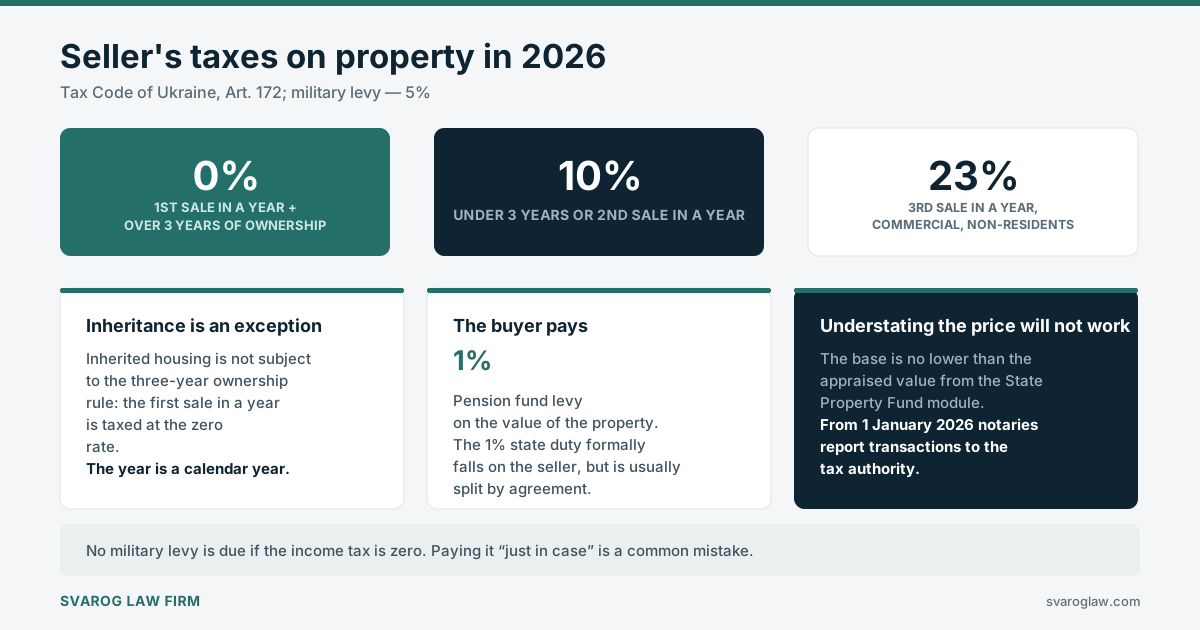
For a seller the key question is which rate applies. It decides whether it is worth waiting out the three-year holding period.
| Situation | Income tax | Military levy | Total |
|---|---|---|---|
| First sale of a home in the calendar year + held over 3 years | 0% | 0% | 0% |
| Inherited home (first sale of the year, holding period irrelevant) | 0% | 0% | 0% |
| First sale of the year, but held under 3 years | 5% | 5% | 10% |
| Second sale of a home within the calendar year | 5% | 5% | 10% |
| Third and each further sale of a home in the year | 18% | 5% | 23% |
| Non-residential or commercial property: first sale of the year | 5% | 5% | 10% |
| Non-residential or commercial property: second and later sales | 18% | 5% | 23% |
| Non-resident seller (any property) | 18% | 5% | 23% |
Rules that save money:
- The year is the calendar year, 1 January to 31 December. A sale in December and the next in January fall in two different tax years.
- No military levy is payable where the income tax rate is zero. There is no need to pay it “just in case”.
- Inheritance removes the three-year requirement: an inherited flat can be sold at once at the zero rate if it is the first sale of the year.
- The tax base cannot be lower than the appraised value in the State Property Fund’s unified database para. 172.3 of the Tax Code. An understated price does not cut the tax: it is calculated on the appraised value, and you also cap what you could recover in a dispute.
- If the three-year holding period has only a few months to run, it is sometimes better to sign a preliminary contract with a deposit and complete later. The difference can be tens of thousands of hryvnia.
The buyer pays a 1% levy to the Pension Fund on the value of the property. The 1% state duty for notarisation (with a private notary, a charge at the same rate) is not assigned by law to either side: the parties decide in the contract who pays, and in practice it is usually split.
From 2026 notaries’ reporting to the tax authority on certified contracts is more detailed: the tax office sees every deal with both the contract price and the appraised value. There is no point hoping a sale goes unnoticed; there is a point in calculating the rate.
What we check before the deal
The owner and the history of title
An extract from the State Register of Property Rights and the whole chain of transfers. Three resales in six months is a red flag: the property is probably being laundered after an unlawful acquisition.
Encumbrances
Mortgage, tax lien, attachments in enforcement and criminal proceedings, bans on disposal.
The spouse’s consent
Property acquired during a marriage is jointly owned. A sale requires the other spouse’s notarised consent Art. 65 of the Family Code. Without it the deal is successfully challenged, and the buyer loses both the flat and the money. A seller who says “we are divorced” or “the flat is in my name only” is exactly the case to check.
Children’s rights
If a child is registered at the property or has a right to use it, the guardianship authority’s consent is required. This is the number one ground for setting sales aside.
The seller’s financial position
The register of debtors, court cases, signs of insolvency. A sale made on the eve of insolvency can be declared invalid as harmful to creditors even years after the purchase.
Technical documentation
Whether the actual layout matches the papers. Unauthorised alterations become your problem after the purchase: an order to restore the previous state, and a block on selling it on.
A case from our practice
In 2025 the buyer of a flat in Obolon came to us: the price was 15% below market and the seller was pressing for the deposit. The register extract showed that in seven months the flat had passed through three owners, and the first of them had sold it under a power of attorney given by someone who was already dead at the time of the deal. A power of attorney ends on the principal’s death (Art. 248 of the Civil Code), so the heirs could have challenged the whole chain. We stopped the deal before the deposit was paid, and the client found another property. The check took four working days and cost 5,000 UAH. (details changed)
The structure of the deal: where the money hides
- How payment is made. Cash handed over at the notary’s, a bank transfer, a letter of credit or a notary’s deposit: each carries its own risk. The most dangerous arrangement is handing over money before the contract is signed.
- The price in the contract. An understated price means that if the deal is set aside you get back only what the contract says.
- When the property is handed over and what follows if the seller does not move out on time. We put both in writing with a specific date and a penalty for each day of delay; “we’ll sort it out between us” does not work in court.
- Penalties for pulling out after the deposit. Under Art. 571 of the Civil Code a party who received a deposit and broke the deal returns it twofold; if the party who paid it walks away, they lose it.
- The seller’s warranties that the property is free of third-party rights, and what happens if that turns out to be untrue.
What to check yourself before the consultation
A buyer can do some of the checks in an hour:
- The State Register of Property Rights — an information report with the property’s history: who became the owner and when, and whether there are encumbrances.
- The Unified Register of Debtors — whether there are open enforcement proceedings against the seller.
- The Unified State Register of Court Decisions — search by the seller’s name and the address: disputes over this flat, a divorce with a property division, creditors’ claims.
- The insolvency register — whether insolvency proceedings are open against the seller (or their sole trader business).
Typical mistakes people arrive with after paying a deposit: a deposit taken on a receipt with no preliminary contract; the spouse’s consent “to be brought on the day”; a child “deregistered” who nevertheless keeps the right to use the home. Each of these is fixable before the deal; afterwards it costs a lawsuit.
How we work
- A legal audit of the property: registers, encumbrances, history of title, court cases, the seller’s status.
- A written opinion on the risks: what could turn into a claim and how to avoid it.
- A tax calculation: which rate applies and whether it can lawfully be reduced.
- Drafting the contract: payment, warranties, penalties, handover.
- Attendance at the notary’s with all documents checked on the spot.
- Oversight of the registration of title and receipt of the extract.
Cost of services
Paid separately: the notary’s charges, the valuation report, the 1% state duty, the 1% Pension Fund levy (buyer), and the administrative fee for registering title.
If the deal has to be challenged or defended in court, the 2026 court fees are: an individual’s claim to declare the contract invalid and recover the property (a monetary claim) — 1% of its value, but not less than 1,331.20 and not more than 16,640 UAH; an individual’s non-monetary claim — 1,331.20 UAH; filing through the Electronic Court multiplies the rate by 0.8.
Calculate the court fee
For an individual's monetary claim — for example to declare a contract invalid and recover the property.
Full price list · Property valuation
Questions and answers (Contract for the sale of property)
Can a sale contract be made under a power of attorney?
Yes, if the power of attorney is notarised and expressly allows the sale of that property and receipt of the money. Before the deal we check the Unified Register of Powers of Attorney to confirm it has not been revoked, and establish that the principal is alive: the power ends on their death (Art. 248 of the Civil Code). Money under such a deal is best transferred to the owner’s own account.
What if the seller is abroad?
The seller can execute a power of attorney at a Ukrainian consulate or before a foreign notary (which then needs an apostille or legalisation, plus a translation). The contract itself is certified by a Ukrainian notary where the property or one of the parties is located.
Can the deal be done remotely?
No. A contract for the sale of real estate is signed before a notary in person or through an advocate. Remotely we give the consultation, audit the registers and draft the contract; your presence is needed only on the day of certification.
What if, after the purchase, a claim is brought to set the contract aside?
The buyer defends as a good-faith purchaser (Art. 388 of the Civil Code): showing that a real price was paid, the registers were checked and they knew nothing of third-party rights. That is why the bank payment documents and the written audit opinion matter.
Can a deposit be recovered if the deal falls through?
It depends whose fault it was. If the seller broke the deal, they return the deposit twofold; if the buyer walked away, the seller keeps it (Art. 571 of the Civil Code). If the receipt says “advance”, or the money was handed over with no preliminary contract, the court usually treats it as an advance and returns it once over.
Contact a Svarog lawyer about a contract for the sale of property
Send us the address of the property and the seller’s documents: we will check the registers, calculate the tax and tell you whether to buy. An audit before the deal costs 5,000 UAH and takes 3–5 working days; challenging a completed deal in court costs from 25,000 UAH in fees, plus the court fee and at least a year of litigation.