Before agreeing a payment schedule, understand the main point: the amount demanded of you is almost never the amount that can be recovered in court.
A utilities debt usually contains items that cannot be recovered: arrears older than three years; penalties charged above the permitted limits; charges for services that were never actually supplied; and doubled amounts caused by court orders you never knew about.
Restructuring a utilities debt without checking it first means you have voluntarily acknowledged the whole amount, and challenging it afterwards is far harder.
What can be taken off the debt
Arrears older than three years
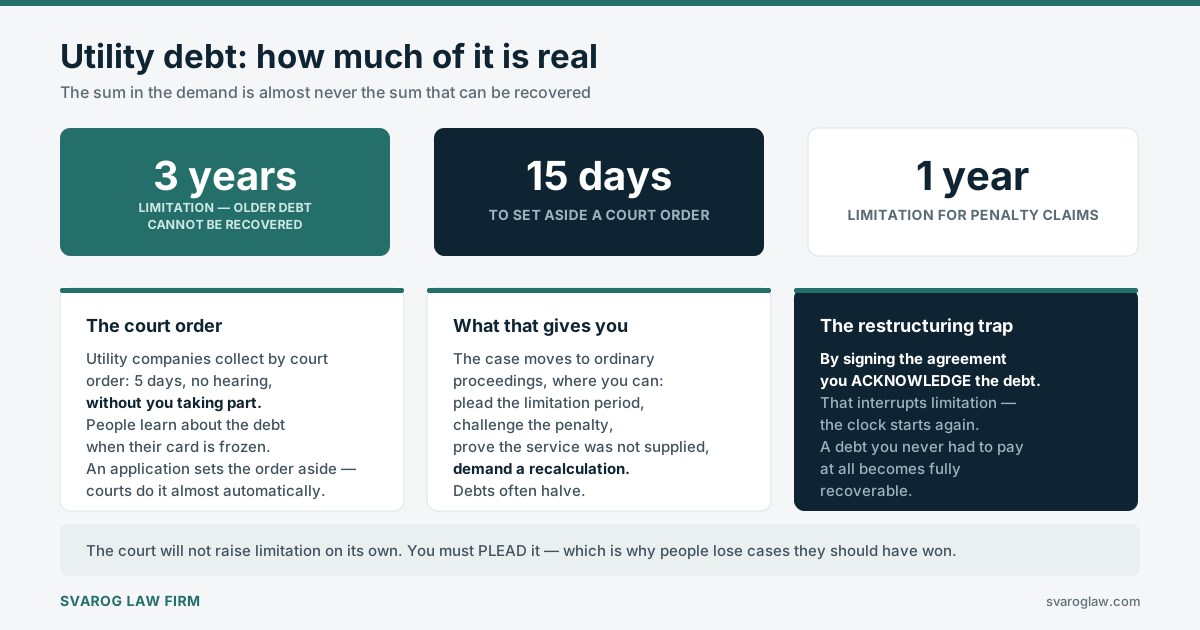
The limitation period is three years (Art. 257 of the Civil Code), and anything beyond it cannot be recovered. But the court applies the limitation period only if the defendant raises it: if you do not, the court will award everything, even a ten-year-old debt. That is why people lose cases they should have won.
Penalties
Under Art. 26(2) of the Law “On Housing and Utility Services” the penalty is 0.01 % of the debt per day of delay and cannot exceed 100 % of the total debt. A shorter limitation period of one year applies to penalty claims (Art. 258 of the Civil Code). We check the martial law period separately: Law No. 2479-IX introduced restrictions on charging and recovering utility penalties, and whether they cover your period and category of consumer is checked against the current wording.
Services that were not supplied
No heating, no hot water, no refuse collection, no cleaning of the stairwell — there is nothing to pay. But the failure must be recorded in a formal report, ideally at the time.
Incorrect charges
For floor area, for the number of registered occupants, for meter readings, for residents who were not there.
Debts of a previous owner or tenant
You are not obliged to pay for someone else’s period, although utility companies often “carry over” the debt to the new occupant.
Court orders: how debts are actually recovered
Utility companies recover arrears on a mass scale by court orders: it is fast, cheap and happens without you, because the court decides the application within five days, with no hearing and without summoning the parties (Art. 167 of the Civil Procedure Code).
The order then goes to the bailiff: frozen accounts, deductions from wages, a travel ban. Many people first learn of the debt when their card stops working.
A court order can be set aside within 15 days of receiving a copy (Art. 170 of the Civil Procedure Code). An application is enough: the court sets the order aside without assessing your reasons, and the case moves into adversarial proceedings, where you can:
- raise the limitation period and remove everything older than three years;
- challenge the penalties;
- prove that the services were not supplied;
- demand a recalculation.
Restructuring: when it makes sense
Restructuring is an agreement with the service provider to repay the debt in instalments, on a schedule.
The amount has been checked and is genuine, you have steady income, and you want to keep your subsidy or avoid court.
- the amount has not been checked — audit first, then negotiate;
- a large part of the debt is older than three years: there is no sense acknowledging what can no longer be recovered;
- most of the sum is penalties, which can be removed anyway;
- you objectively cannot keep to the schedule — then it merely postpones the problem.
The main trap: by signing a restructuring agreement you acknowledge the debt. Acknowledgement interrupts the limitation period (Art. 264 of the Civil Code), time starts again, and a debt you might never have had to pay becomes fully recoverable.
Subsidies and debt
So for families receiving a subsidy a restructuring agreement is often worthwhile even where part of the debt could be challenged. The sensible compromise is to remove the clearly unrecoverable part first and only then spread the remainder over a schedule.
The deadlines that decide the case
The fifteen days to apply to set aside a court order run from service of the copy, so what starts the clock is your actual receipt, not the date of the order. If the deadline has passed, the application is filed together with a request to restore it.
The three-year limitation period is counted separately for each month of charges, so in an old debt some periods fall away and others remain; the one-year period for penalties is counted month by month in the same way. A complaint about a bailiff’s actions must be filed within ten days, and that is the deadline most often lost while the debtor is still working out where the freeze came from.
A case from our practice
In 2025 a Kyiv resident came to us after his salary card was frozen: the heating company had obtained a court order for arrears dating back to 2016, together with penalties. He had never received a copy of the order, so we obtained the enforcement file, applied to set the order aside together with a request to restore the deadline, and the court set it aside. In the adversarial proceedings we raised the limitation period for the old periods and challenged the penalties: about a third of the original claim remained, which the client spread over a schedule and cleared within a year. The work, including lifting the freeze, cost around 12,000 UAH. (details changed)
How we work
- We analyse the calculation of the debt — by period, by service, by amount.
- We set aside the court order if there is one: that moves the case into adversarial proceedings.
- We raise the limitation period and remove everything older than three years.
- We challenge penalties and charges for services that were not supplied.
- We negotiate the restructuring from the real figure.
- We defend you in enforcement and get the freezes lifted.
Cost of services
Court fees (2026): a debtor pays no fee to apply to set aside a court order. The provider pays 332.80 UAH to apply for an order, and for a monetary claim 1 % of the value — from 1,331.20 to 16,640 UAH for an individual and from 3,328 UAH for a company; through the Electronic Court the rate is multiplied by 0.8. The provider tries to pass these sums on to the debtor, so they are part of the dispute too.
Questions and answers (utilities debt)
Where do I apply to set aside a court order?
To the same court that issued it — in person, by post or through the Electronic Court. The application is decided without summoning the parties, and the court sets the order aside without assessing whether your objections to the debt are sound. After that the provider may bring a claim, and the case is then heard with you taking part.
How can I find out whether there are enforcement proceedings against me?
Through the automated enforcement system: open data on debtors is available on the Ministry of Justice portal, and the details in the debtor’s online account. It shows the bailiff, the case number and the basis for recovery, after which you can obtain copies of the documents and calculate the deadlines for challenging them.
Can services be cut off because of a debt?
Disconnection is only possible in the manner set out in the contract and the law, with notice to the consumer, and for certain periods and categories of consumer additional wartime restrictions apply. Disconnection carried out without following the procedure can be challenged, and any losses recovered.
I am buying a flat that has arrears. Will they pass to me?
A debt for services consumed remains the obligation of whoever used them and does not automatically pass to the new owner. But providers do send bills for the old period to the new occupant, so certificates of the state of settlements are obtained before the deal and the debt is recorded in the contract as the seller’s obligation.
Can a utilities debt be written off through personal bankruptcy?
Yes — claims for housing and utility services are included in the register of creditors’ claims in insolvency proceedings and are written off with the other debts once the procedure ends. That makes sense where the utilities debt is only part of the problem: we describe the procedure in detail on the page about personal bankruptcy.
Contact Svarog about restructuring a utilities debt
Do not rush to sign a repayment schedule. Send us the calculation of the debt and we will check how much of it could actually be recovered in court. Once the time-barred part and the penalties are removed, negotiations about a schedule usually start from a very different figure.