
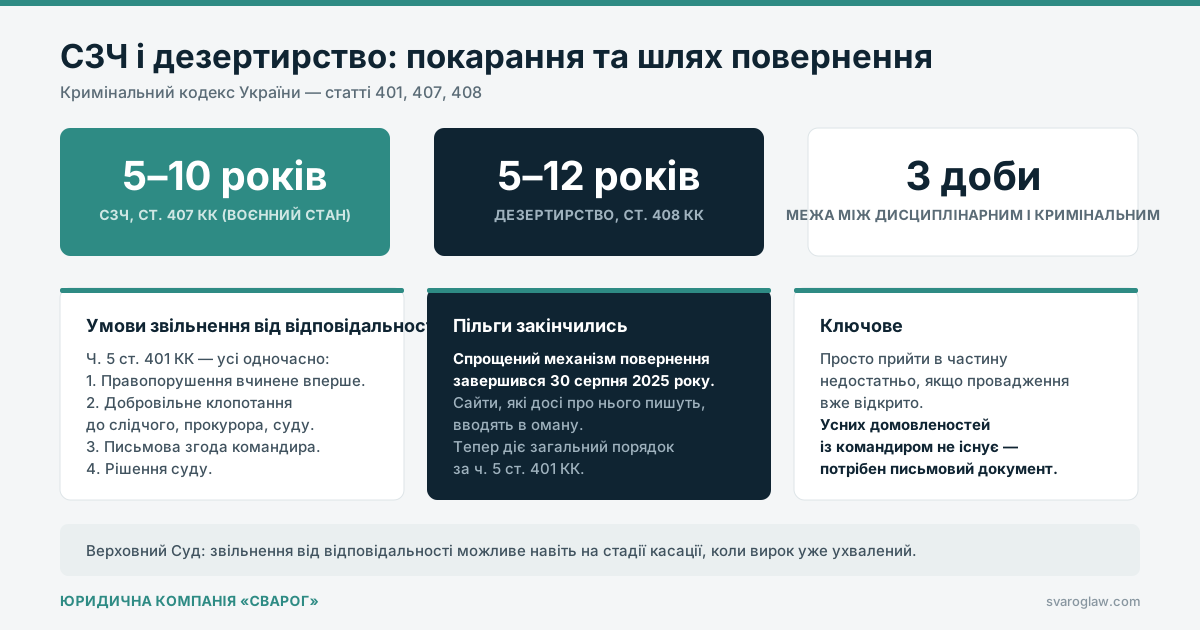
The penalty under Article 407 of the Criminal Code during martial law is imprisonment for a term of between 5 and 10 years, and under Article 408 (desertion) — between 5 and 12 years. These are actual, not suspended, sentences: the courts impose precisely these penalties, and the Supreme Court overturns sentences where the term was more lenient than that prescribed by law.
But the law provides a way out. Under paragraph 5 of Article 401 of the Criminal Code, a person who for the first time commits an offence under Article 407 or 408 during martial law may be exempted from criminal liability — provided all three of the following conditions are met simultaneously: a voluntary application, the intention to continue service and the written consent of the commander.
This is precisely where a lawyer specialising in military criminal law is needed: not for ‘repentance’ in court, but to bring these three elements together in the correct order and form. Verbal agreements with the commander are not sufficient — a written document is required.
+38 095 554-54-24 — legal advice
What changed in 2025–2026
The simplified return procedure ended on 30 August 2025. Law No. 4392-IX allowed service personnel to return to a designated unit and receive the commander’s decision within 72 hours. This ‘window’ no longer exists — and websites that still refer to it are misleading people.
The standard procedure under Part 5 of Article 401 of the Criminal Code (Law No. 3902-IX, in force since 7 September 2024) now applies: a voluntary application → written consent from the commander → a court decision on exemption from criminal liability.
The trend is clear: exemptions are being narrowed, whilst liability is being tightened. The longer a person delays, the fewer options they have.
Unauthorised absence or desertion: the difference is everything
Article 407 of the Criminal Code — unauthorised absence from unit. Temporary evasion: a serviceman is absent for more than three days without valid reasons, but did not intend to evade service permanently.
Article 408 of the Criminal Code — desertion. The key distinction is the direct intention to evade military service permanently. It is punished more severely.
This distinction is the main focus of the defence’s work. Proving the absence of intent to evade service permanently (the person was receiving medical treatment, caring for a relative, seeking a way to return, or maintaining contact) means keeping the case within the scope of Article 407 rather than 408.
Valid reasons (serious illness requiring hospitalisation, the death of a close relative, a natural disaster) may rule out the offence altogether — but only if they are documented. Claims of ‘compelling circumstances’ without evidence will not stand up.
Mechanism for exemption from liability
Conditions under Part 5 of Article 401 of the Criminal Code — all of the following must be met simultaneously:
- an offence under Articles 407 or 408 committed for the first time;
- a voluntary application to the investigating officer, prosecutor or court expressing the intention to return to service;
- written consent from the commander of a military unit (either their own or another) to continue service — the so-called letter of recommendation;
- a court decision on exemption from criminal liability.
Repeated military service — this mechanism does not apply. Here, the defence is based on other factors: reclassification of the offence, mitigating circumstances (Article 66 of the Criminal Code), and negotiating the severity of the sentence.
Important news from case law: The Supreme Court has recognised that acquittal is possible even at the cassation stage — when a verdict has already been handed down. In other words, the existence of a verdict does not always mean the end.
Algorithm for reinstatement
- Establish the procedural status — whether criminal proceedings are underway, whether a wanted notice has been issued, or whether a notice of suspicion has been served. This determines all subsequent steps.
- Find a unit willing to accept you — your own or another. Obtain written consent from the commander. Without this document, the process will not work.
- Submit a petition — to the investigator, prosecutor or court, stating your intention to continue service.
- Court hearing — the court verifies: that this is the first offence, that it is voluntary, and that the commander’s consent has been obtained.
- A ruling on exemption from criminal liability and the closure of proceedings.
- Actual arrival at the unit and the resumption of payments, status and social guarantees.
Simply turning up at the unit — is not enough if proceedings have already been opened. Arrival without a procedural application does not remove criminal risks.
Why delay is life-threatening
Whilst a person is ‘thinking’, the case follows the standard course: suspicion → search → preventive measure → indictment → verdict. At each subsequent stage, there are fewer options.
Voluntariness is a legal concept. It applies before the person is found. If a service member has been detained, ‘voluntary return’ no longer appears voluntary, and the court recognises this.
What a lawyer does
- establishes the person’s legal status through legal enquiries — often the person does not know whether proceedings have been initiated against them;
- ensures the charge remains within the scope of Article 407, preventing it from being reclassified under Article 408;
- seeks out the relevant section and obtains the commander’s written consent — this is a separate, often the most complex task;
- prepares a motion under Part 5 of Article 401 of the Criminal Code and represents the client in court;
- gathers evidence of valid reasons — medical documents, certificates, references;
- defends the client in the event of a retrial — reclassification, mitigating circumstances, dealing with the sentence;
- represents clients in appeal and cassation proceedings — even when a verdict has already been handed down.
When a lawyer is not required
If you have not exceeded three days of absence — this is a disciplinary offence, not a criminal offence. Return to your unit and resolve the matter with your commander. You do not need a criminal defence lawyer here.
You need a lawyer specialising in military criminal law when:
- the period of absence has been exceeded, and there is a risk of criminal proceedings;
- you are already under suspicion or a warrant has been issued;
- you wish to return, but do not know where to start;
- the commander refuses to give written consent;
- the actions are classified as desertion, rather than unauthorised absence;
- a sentence has already been handed down — but this is a first offence;
- this is a repeat offence of desertion.
Cost of services
| Service | Price |
|---|---|
| Consultation with a military lawyer | from 1,500 UAH |
| Legal opinion: analysis of status and strategy for return | from 5,000 UAH |
| Preparation of a motion under Part 5 of Article 401 of the Criminal Code, procedural documents | from 5,000 UAH |
| Lawyer’s participation in investigative proceedings | from 15,000 UAH |
| Participation in one court hearing | from 3,000 UAH |
| Legal representation in court | from 10,000 UAH |
| Comprehensive ‘turnkey’ representation in criminal cases | from 60,000 UAH |
Full price list · Lawyer specialising in the Commercial Code
Questions and answers (Lawyer specialising in the Specialised Criminal Court)
Is the simplified refund mechanism still in force?
No. It ended on 30 August 2025. Repatriation now takes place under the standard procedure: a petition, written consent from the commander, and a court ruling on exemption from criminal liability (Article 401(5) of the Criminal Code).
What are the penalties for desertion?
Under Article 407 of the Criminal Code during martial law – imprisonment for 5 to 10 years; for desertion (Article 408) – 5 to 12 years. These are actual prison sentences, not suspended sentences.
After how many days of absence does criminal liability arise?
More than three days’ absence without valid reasons. A shorter period constitutes a disciplinary offence.
Is it possible to return without facing criminal liability?
Yes, if this is a first offence and all the conditions of Part 5 of Article 401 of the Criminal Code are met: a voluntary application, the intention to continue service, the commander’s written consent, and a court ruling.
Is it enough simply to report to the unit?
No, if proceedings have already been initiated. Simply reporting for duty does not remove the risk of criminal liability — a procedural application and a court ruling are required.
What should I do if the commander does not give written consent?
Look for another unit: the law permits a return to either one’s own or another military unit. This is a separate process, and it is here that a solicitor most often determines the outcome.
I’ve already been sentenced. Is that the end of it?
Not necessarily. The Supreme Court has recognised that exemption from liability under Part 5 of Article 401 of the Criminal Code is possible even at the cassation stage — provided all conditions are met and the commander’s written consent is obtained.
How does unauthorised absence differ from desertion?
Intent. Unauthorised absence is a temporary evasion; desertion is a direct intention to permanently evade service. Keeping the charge within the scope of Article 407 is the defence’s main objective.
What documents should I bring to the consultation?
Your service record book or contract, any documents from your unit, a notice of suspicion (if applicable), medical records, and documents detailing the circumstances that led to your absence.
Contact a lawyer specialising in military service matters at Svarog
Describe your situation — we will establish your procedural status, assess whether any grounds for exemption from liability apply, and start with the most difficult part: locating your unit and obtaining the commander’s written consent. Every week of delay reduces the number of options available.
+38 095 554-54-24 · Kyiv, 7 Khoriva St, Office 2 (Podil) · Mon–Fri 9.00–18.00