A charge sheet is not yet a conviction. Only a court can find you liable, and it is in court that it is decided whether the police evidence is admitted at all. Article 130(1) of the Code of Administrative Offences carries one penalty: a fine of 17,000 UAH with a one-year driving ban, and the court cannot impose anything lighter. So the only way to avoid a year without a licence is to have the proceedings closed.
Do not count on the case dissolving by itself. Since 17 March 2021 the period for imposing a penalty under Art. 130 has been one year from the offence (Art. 38(7)), not the three months forums still advise. Courts hear such cases within weeks, so the “run out the clock” tactic does not work here.
Challenging an Art. 130 charge is built on the procedure: how the testing was carried out, what the video shows, whether driving is actually proved, and whether the times in the charge sheet, the testing record and the recording match. It is in those details that the police make the mistakes that lead to closure.
What Art. 130 carries
| Offence | Fine | In addition |
|---|---|---|
| Para. 1: driving while intoxicated, or refusing a test | 17,000 UAH | a one-year driving ban |
| Para. 2: a repeat within a year | 34,000 UAH or 10 days’ administrative detention | a three-year ban, with or without compulsory purchase of the car |
| Para. 3: a third time within a year | 51,000 UAH or 15 days’ administrative detention | a ten-year ban and confiscation of the offender’s car |
Refusing the test is treated the same as confirmed intoxication and carries identical consequences. “Just don’t blow” is the worst possible strategy: you deprive yourself of evidence in your favour and get the same penalty anyway. If you are sober, take the test and go straight afterwards for a blood test at a medical facility.
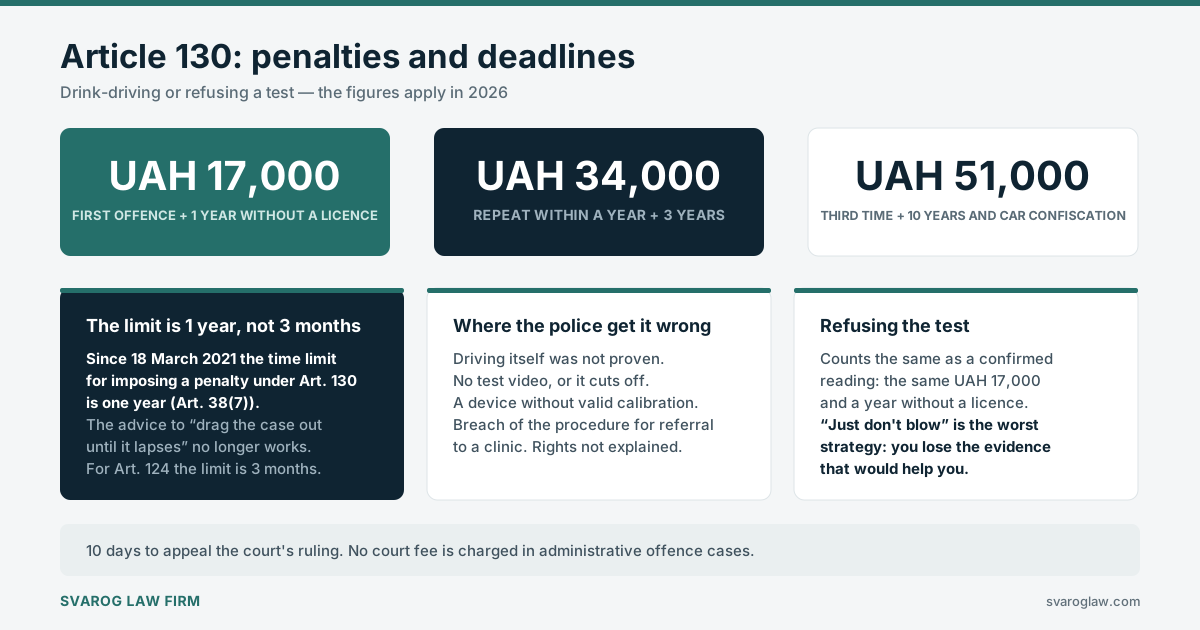
Where the police most often get it wrong
These breaches really do lead to cases being closed:
- Driving is not proved. You were standing beside the car or sitting in the passenger seat, the car never moved, and the charge was written anyway. The police must prove driving, and the video is decisive.
- The testing procedure was breached. Testing is carried out with video recording (Art. 266). If there is no video, it is cut short, or the procedure itself is not visible, the evidence is in doubt.
- A faulty or uncalibrated device. The breathalyser’s calibration certificate must be valid on the date of testing. This is checked, and not always in the police’s favour.
- The referral to a medical facility was mishandled. Drug intoxication is established only at a medical facility; a roadside rapid test is not proper evidence.
- Rights were not explained (Art. 63 of the Constitution, Art. 268). That is a ground to exclude the driver’s statements.
- The charge sheet is defective: unsigned, no copy served, incomplete data, times that differ between the sheet, the testing record and the video.
- A formulaic list of “signs of intoxication” with nothing objective behind it. “Smell of alcohol on the breath” is not evidence in itself.
What to do immediately after the charge is written
What you do in the first days matters more than what is said in court.
- Do not sign the charge sheet without comments. In the explanations box write that you do not accept the charge, consider the officers’ actions unfounded, and state exactly what was breached.
- Insist on copies of the charge sheet and the intoxication testing record: they must be given to you.
- Note the witnesses (passengers, passers-by, filling station staff) and take their contact details at once.
- Get an independent medical examination as soon as possible at the nearest facility, at your own expense. A blood test taken within a few hours is the strongest proof of sobriety.
- Instruct a lawyer before the first hearing, to obtain the case file and the body-camera footage and build the position while the deadlines are still open.
The deadlines to know
The Art. 130 case calendar
- 1 year from the offence: the period within which the court may impose a penalty (Art. 38(7)). If no decision is made, the proceedings are closed and the driver is treated as never having been charged.
- 10 days to appeal a court decision (Art. 294). The appeal goes through the court that made it; filed in time, it suspends enforcement.
- Up to 3 months for the temporary permit issued in place of the seized licence. If the court has not decided the ban question within that time, you may collect the seized licence (Art. 265-1).
- No court fee is payable for an appeal against a court decision in an administrative offence case. The fee of 0.2 of a subsistence minimum (665.60 UAH in 2026) is paid only for a claim to the administrative court against a decision made by the police, not by a court.
And if the charge is under Art. 124
Article 124 covers a traffic breach causing damage to vehicles or other property. The penalty is lighter: a fine of 20–25 tax-free minimums (340–425 UAH) or a driving ban of six months to a year.
Here what does not work under Art. 130 does work: the period for imposing a penalty is three months from the offence (Art. 38(2)). Courts hear Art. 124 cases slowly, and lawful procedural applications within that period often lead to closure. An Art. 124 decision also fixes your fault in the accident and is then used by the insurer and the victim in a civil claim, so it is worth challenging even for a “symbolic” fine. More on this on the page about Art. 124 cases.
What the court looks for on the testing video
Judges in Art. 130 cases watch the recording in full, and five things must be visible on it: the moment the car stopped and who was at the wheel; the offer of a roadside test; the device and its calibration certificate being shown; the breath test with the result on the screen; the explanation of the right to be tested at a medical facility and the driver’s response. The absence of any one of these becomes the basis of the defence.
Where the recording is complete, the device calibrated and the result plain, the chances of closure are minimal, and we say so at once. In that case it is more useful to apply for the fine to be deferred or paid in instalments (Art. 301) and to prepare for the licence to be returned when the ban ends, than to pay for a hopeless defence.
A case from our practice
In 2025 a driver came to us who had been stopped at night in Obolon: the charge sheet recorded a refusal to be tested — the same 17,000 UAH and a year without a licence. The client insisted he had asked to be taken to a medical facility and that the officers had written that down as a refusal. We obtained the footage from both officers’ body cameras. On it the driver can be heard twice saying “let’s go to the hospital”, after which the recording cuts off, and the refusal record was drawn up 40 minutes later with no video. The court excluded the record and closed the proceedings for want of an offence. Two and a half months passed from the charge to the decision, and the client paid our court representation rate from 10,000 UAH plus three hearings. (details changed)
How we work
- We analyse the material: the charge sheet, the testing record, the device’s calibration certificate, the footage from the body cameras and the patrol car.
- We look for procedural breaches: it is those, not assurances that “I was sober”, that close cases.
- We build the position: applications to obtain evidence, calling the officers as witnesses, bringing in a specialist.
- We appear in court; your attendance can be replaced by the lawyer’s.
- We appeal the decision if the first instance goes against you.
- We handle the return of the licence once the ban has run.
Cost of services
In an Art. 130 case heard by a court no fee is payable, either at first instance or on appeal. Where a police decision is challenged in the administrative court, the fee in 2026 is 0.2 of a subsistence minimum — 665.60 UAH, or 532.48 UAH through the Electronic Court. An independent medical examination or a specialist’s report may be needed on top.
Questions and answers (challenging an Art. 130 charge)
Can the officers be called to court as witnesses?
Yes; on a party’s application the court summons the officers who wrote the charge. In examination it emerges why the recording was cut, where the calibration certificate is, why the time in the record differs from the charge sheet. Discrepancies between the two officers’ accounts and the video are often the ground for closing the case.
I have already paid the fine and then found defects in the charge sheet. Can anything be done?
Paying the fine is not an admission. If the 10 days for appeal have not passed, file the appeal; if they have, the deadline can be restored only for a good reason — for example that the copy of the decision was never served on you. Once the decision is quashed, the fine is refunded on application.
Can I drive while the case is going on?
Yes; until the decision comes into force the right to drive remains. A temporary permit valid for up to three months is issued in place of the seized licence, and once it expires, if the case is undecided, the licence can be collected. An appeal filed in time also suspends enforcement.
Can the case be run remotely?
Yes. The consultation and the review of the footage are online, documents are filed through the Electronic Court, and the lawyer attends hearings without you. The driver’s presence is sometimes tactically useful, and we agree that separately.
I was stopped beside a parked car, not while driving. Is that still Art. 130?
No; the article penalises driving. If the video does not show the car moving with you at the wheel, only your presence beside it, driving is not proved. Such cases are closed, but proving it requires exactly those camera recordings and witnesses.
Contact Svarog about challenging an Art. 130 charge
Send us the charge sheet and the testing record. We will check the procedure, obtain the police camera footage and tell you whether there are grounds to have the case closed, or whether it is wiser to ask for the fine to be paid in instalments. The sooner you come, the more evidence can be preserved.