

Олександр Сич
4 August 2026
Privatisation requires the written consent of every adult family member permanently living in the flat, those temporarily absent included (Article 8(2) of Law No. 2482-XII). Anyone who does not want to become a co-owner signs a notarised waiver of participation and blocks nobody. But where a person has not lived in the flat for more than six months without valid reason, they are declared to have lost the right to use it by a court — court fee 1,331.20 UAH.
The Law “On the Fundamentals of Housing Policy” of 13 January 2026, No. 4751-IX, in force since 15 February 2026, has set the end of free housing privatisation: Law No. 2482-XII will cease to have effect one year after martial law ends or is lifted. There is no calendar date, only a link to an event nobody can plan, and because of that the “everyone agrees but one” conflict has become a legal problem with an open-ended deadline. While the flat remains municipal it cannot be sold, given away or left by will.
In our experience the “objector” is three different situations with three different answers: someone who does not want to own, someone who vanished years ago, and someone who lives in the flat and blocks the process. We look at each, and at what to do about children registered at the same address.
Why consent is essential: what the law says
Occupied flats are transferred into joint or shared ownership with the written consent of every adult family member permanently living there, including those temporarily absent who retain a right to the housing (Article 8(2) of Law No. 2482-XII). Article 5(1) of the same Law defines that circle: family members of the tenant are only those citizens permanently living in the flat with the tenant or retaining a right to the housing. From anyone absent when the papers go in, the privatisation authority requires a written statement of consent — a document expressly named in paragraph 18 of the Regulation approved by Order No. 396 of 16 December 2009.
The case law is consistent: privatisation without the written consent of even one adult family member is declared invalid, and the court sets aside both the authority’s order and the certificate of title. So “we will somehow file without them” is the worst strategy of all: even if the authority misses the defect, the result stays vulnerable for years.
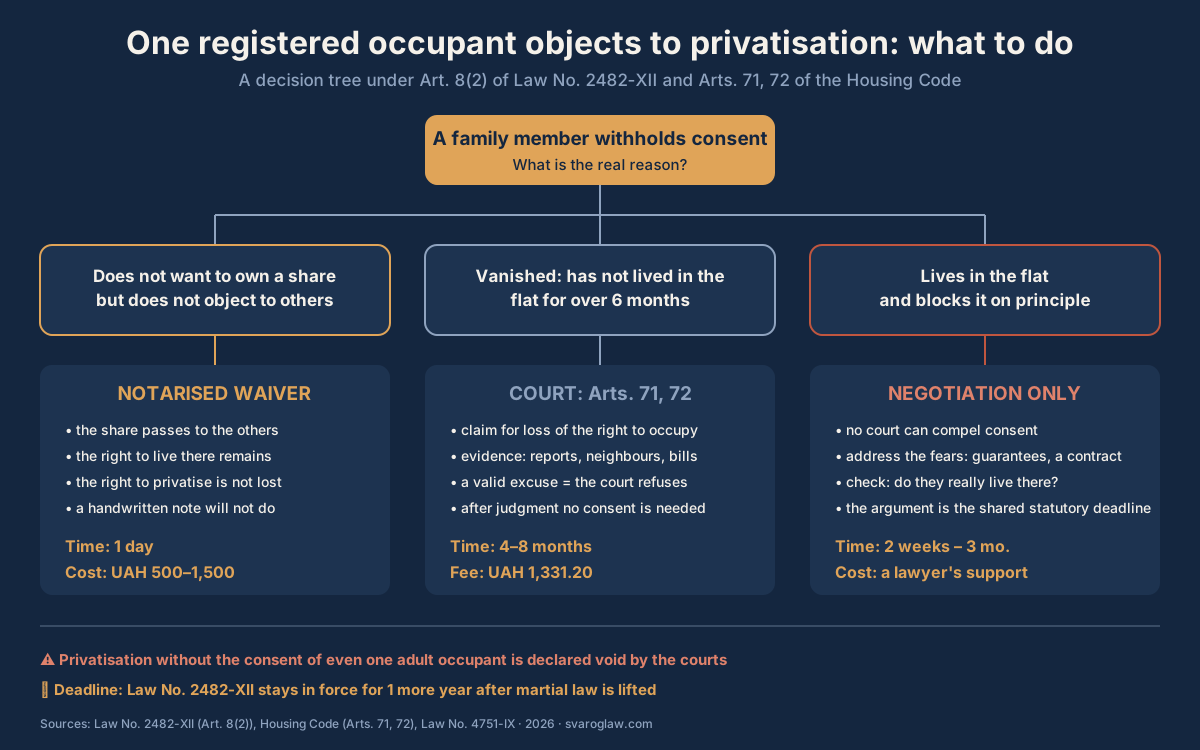
Situation 1. They do not object to the others but do not want to own
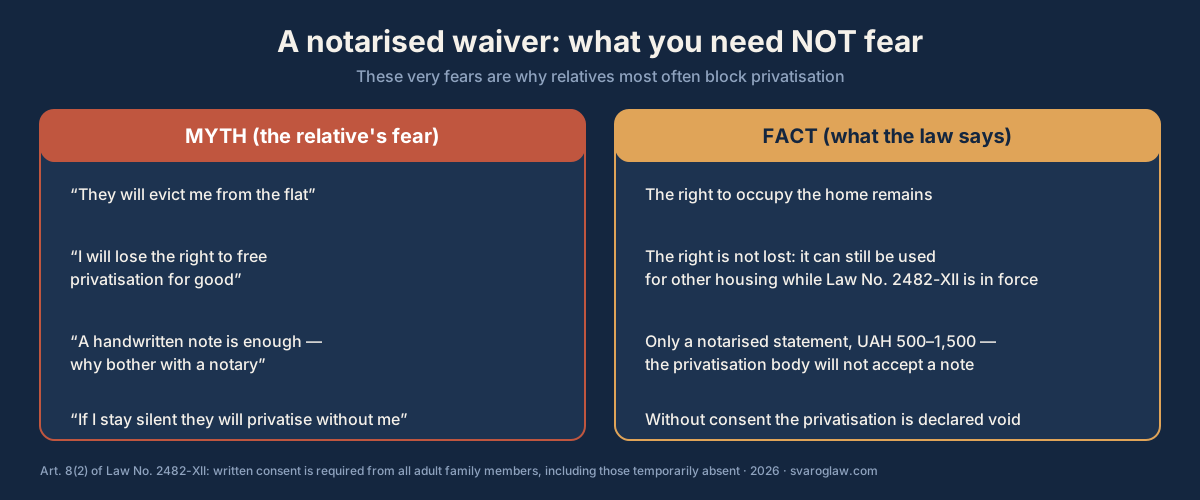
This is the simplest case, and it is often mistaken for obstruction. A family member who does not wish to become a co-owner signs a statement before a notary waiving participation in the privatisation. The consequences should be spelled out to both sides:
- the flat is privatised by the remaining registered occupants, and the share of the person waiving is divided among them;
- the person waiving keeps the right to live there: the new owner cannot simply evict them;
- their right to free privatisation is not lost: they acquire no ownership, so they can use their right on other state or municipal housing while Law No. 2482-XII remains in force;
- the waiver must be notarised — a handwritten note will not satisfy the privatisation authority.
The notarised statement costs roughly 500–1,500 UAH. The conflict often evaporates once these consequences are explained: the person fears losing the roof over their head, when in fact they lose nothing.
Situation 2. The registered occupant has vanished and cannot be reached
Where someone is registered in the flat but has long since stopped living there, Articles 71 and 72 of the Housing Code apply. Although Law No. 4751-IX repealed the Housing Code, both articles are on the list of those that remain in force until the Unified Housing Information System begins operating.
Under Article 71 the accommodation is retained for a temporarily absent tenant or family member for six months. Where the person was absent for valid reasons beyond that, the landlord extends it on their application, or the court does in a dispute. The article names seven cases where housing is retained beyond six months: military service, including call-up during mobilisation (and where the person is wounded, a prisoner of war or declared missing, until the day they are placed back on the military register after discharge); leaving for work or study, abroad included; placing a child with relatives, a guardian, a foster family or an institution; acting as a guardian; being in residential care; treatment; and detention or serving a sentence. Once the relevant period ends, the right of use is retained for a further six months.
But where a person is absent for more than six months without valid reason, the landlord or other family members may apply to have them declared to have lost the right to use the accommodation. Article 72 allows this only through the courts — the law provides for no “administrative de-registration”.
What we prove in court: that they do not live there (reports from the building manager or the residents’ association, neighbours’ evidence, unpaid utility bills, data on their actual address) and that there is no valid reason. Since 2022 the courts assess departures connected with hostilities separately. Once the judgment takes effect the person is removed from the register, and their consent is no longer needed.
The court fee on an individual’s non-monetary claim in 2026 is 1,331.20 UAH (0.4 of the 3,328 UAH subsistence minimum), with a 0.8 coefficient for electronic filing. First instance takes 4–8 months in practice.
Situation 3. They live in the flat and block the privatisation
The hardest variant, and it calls for honesty: someone permanently living in the flat cannot be compelled to consent. Neither a court nor the privatisation authority can supply their will, so a claim “to compel consent” has no prospect.
What works in practice:
- negotiation with a lawyer as mediator: most often the person blocks out of fear of losing the home or over a dispute about future shares, and written guarantees (a notarised statement, an agreement between family members on how the flat is used) remove the block;
- checking whether they really do retain a right to the housing: sometimes the “blocker” is registered only formally and has long lived elsewhere, in which case Situation 2 applies;
- waiting for circumstances to change — knowing that the deadline in Law No. 4751-IX works against every occupant at once.
The three routes compared
| Route | Condition | Time | Cost |
|---|---|---|---|
| Notarised waiver of participation | The person agrees not to own | 1 day | 500–1,500 UAH (notary) |
| Court under Arts. 71, 72 of the Housing Code | The person has been absent over 6 months without valid reason | 4–8 months plus appeal | court fee 1,331.20 UAH plus legal fees |
| Negotiation / mediation | The person lives there and blocks | 2 weeks – 3 months | consultations and a lawyer’s assistance |
Children in the flat: whose consent is needed
Minors take part in privatisation on the same footing as adults, so they cannot be left out of the application. The formalities are simpler than people assume: for children under 14 and minors aged 14–18 the decision is taken by parents, adoptive parents or guardians, who confirm the child’s participation by signing the application next to the child’s name (paragraph 18 of Regulation No. 396). The current Regulation requires no separate notarised consent: a notary is needed only where there is a family dispute or where someone other than a parent represents the child. For children under 14 a copy of the birth certificate is attached instead of a passport.
Step by step: what to do when consent is missing
- Order a certificate of registered residence for every occupant from an administrative service centre and compare the list with who actually lives there. It takes 1–3 days.
- Talk to the objector and find out the reason. If they simply do not want to own, go to a notary and close the question in a day.
- If the person cannot be reached, gather evidence that they do not live there: inspection reports from the building manager or residents’ association, certificates of unpaid bills, neighbours’ statements. That takes 2–4 weeks.
- Check whether the absence falls within the valid reasons in Article 71 (service, treatment, study, caring). If it does, it is too early for a claim under Article 72.
- File the claim to have the person declared to have lost the right of use with the local court where the flat is. The court fee is 1,331.20 UAH, less 20% for electronic filing.
- Once the judgment takes effect, have the person removed from the register and file the privatisation papers. The authority decides within a month of receiving the application (Article 8(3) of Law No. 2482-XII).
Typical mistakes
- Filing “without them” in the hope that the authority will not notice: privatisation without consent is declared invalid by the courts, along with the certificate of title.
- Taking a handwritten note instead of a notarised waiver. The authority will not accept it, and the time is lost.
- De-registering someone “through contacts” without a court. They will be reinstated by a court and will challenge the privatisation.
- Suing under Article 72 someone absent for valid reasons (service, treatment, study, leaving because of hostilities). The claim will fail and family relations will be damaged for good.
- Forgetting the certificate that housing vouchers were not used at previous addresses after 1992 (paragraph 20 of Regulation No. 396): without it the file is incomplete even when everyone agrees.
When you do not need a lawyer
If the objector simply does not want to own, it is enough to visit a notary together and sign the waiver: an hour and up to 1,500 UAH. A lawyer is needed where the person has vanished and a claim under Articles 71 and 72 is required, where the conflict has reached deadlock, or where privatisation has already gone through defectively and is being challenged.
Questions and answers
Can a flat be privatised without the consent of one of the registered occupants?
No, where that person is an adult, permanently lives in the flat and retains a right to the housing. Either a notarised waiver of participation or a court declaration that they have lost the right of use is required.
What is a notarised waiver of participation?
A statement by which an adult family member declines to take a share but does not object to the others privatising. It is signed before a notary and costs roughly 500–1,500 UAH. The person keeps the right to live in the flat.
Does waiving lose them the right to privatise in future?
No. Waiving participation is not acquiring housing, so the right to privatise free of charge once (Article 5(5) of Law No. 2482-XII) remains unused and can be exercised on other state or municipal housing.
A relative is registered but has not lived in the flat for years. What now?
File a claim under Articles 71 and 72 to have them declared to have lost the right of use. Where the person has been absent for more than six months without valid reason, the court grants the claim, they are removed from the register, and their consent is no longer needed.
Do Articles 71 and 72 still apply after the Housing Code was repealed in 2026?
Yes. Law No. 4751-IX repealed the Code but kept certain articles in force, Articles 71 and 72 among them — they apply until the Unified Housing Information System begins operating.
What does a court treat as a valid reason for absence?
Article 71 names military service (including mobilisation), treatment, study or work elsewhere including abroad, acting as a guardian, residential care and detention. Departure because of hostilities is assessed by the courts case by case.
What does a claim about loss of the right of use cost and how long does it take?
The court fee in 2026 is 1,331.20 UAH, or 20% less when filed electronically. First instance takes 4–8 months; if the defendant appeals, add another 3–6 months.
Is notarised parental consent needed if the child is 15?
Under the current paragraph 18 of Regulation No. 396, no. Parents, adoptive parents or guardians decide for the child and confirm consent by signing the application next to the child’s name. A notary is needed if the parents are in dispute or if someone else represents the child.
Sources
- Law of Ukraine “On the Privatisation of the State Housing Stock” No. 2482-XII, Arts. 5, 8 — zakon.rada.gov.ua/laws/show/2482-12
- Housing Code of Ukraine, Arts. 71, 72 (in force under the final provisions of Law No. 4751-IX) — zakon.rada.gov.ua/laws/show/5464-10
- Law of Ukraine “On the Fundamentals of Housing Policy” of 13 January 2026 No. 4751-IX — zakon.rada.gov.ua/laws/show/4751-20
- Regulation on the transfer of flats (houses) and rooms in hostels into citizens’ ownership, Order No. 396 of 16 December 2009 — zakon.rada.gov.ua/laws/show/z0109-10
- Law of Ukraine “On Court Fees” No. 3674-VI, Art. 4 — zakon.rada.gov.ua/laws/show/3674-17
Resolving a privatisation dispute with Svarog
Tell us who is registered in the flat and what the objection is — we will work out which route fits your case, prepare the notarial documents or the claim under Articles 71 and 72, and handle the discussions with your relatives so that both the flat and the relationships survive. Related material and services: privatising without the original allocation order, privatising a flat, court representation, pre-action settlement of civil disputes, full price list.
+38 095 554-54-24 · Kyiv, 7 Khoriva Street (Podil) · Mon–Fri 9.00–18.00