A fine for breaching the military registration rules is imposed by an official of the territorial recruitment centre (TCC) by a formal decision, and the law allows that decision to be challenged. The deadline is short: 10 days from service of the decision (Art. 286 CAP) or from the day it was issued (Art. 289 CAO). After that it takes legal effect, and challenging a TCC fine then requires a separate application to restore the deadline with evidence of a valid reason. So react as soon as you see the decision in the Reserve+ app, receive it by post, or learn of it from the enforcement service.
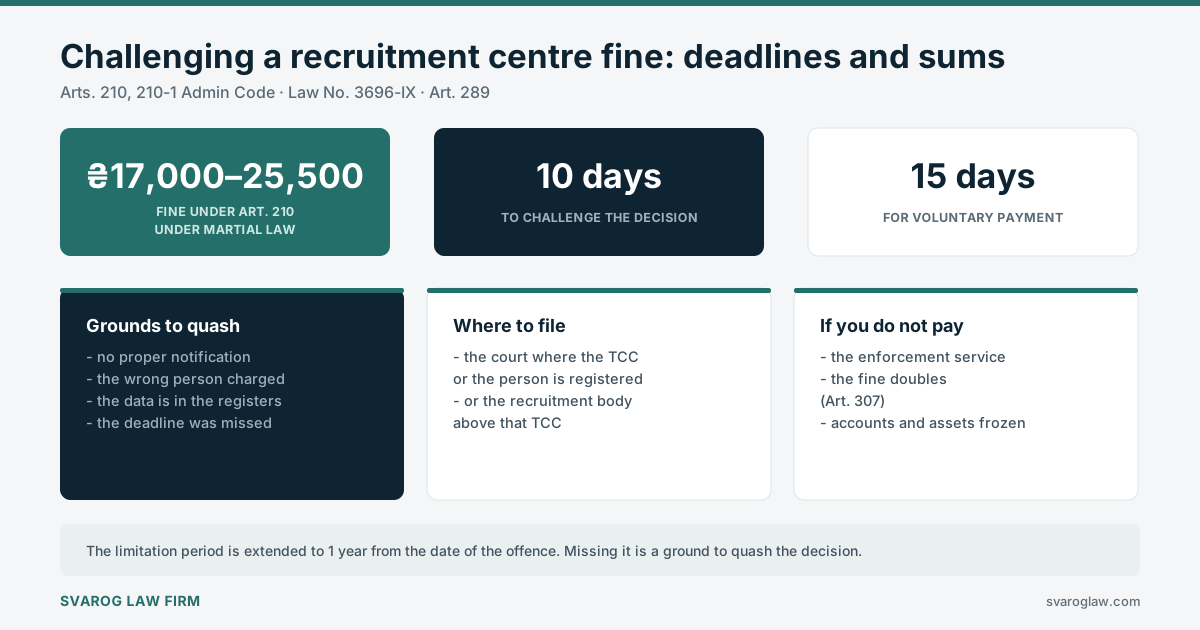
TCCs often issue such decisions in bulk: under Article 210 of the Code of Administrative Offences (breach of the military registration rules) or Article 210-1 (breach of the legislation on defence, mobilisation preparation and mobilisation), frequently without properly notifying the person and without establishing whether they were at fault. During the special period the penalty under Art. 210 for individuals is 17,000–25,500 UAH, and under Art. 210-1 for officials 34,000–59,500 UAH. Those figures were introduced by Law No. 3696-IX of 9 May 2024 (in force from 19 May 2024), and it is precisely their size that makes it worth checking every decision for procedural defects: a large proportion of them have such defects, and they are grounds for setting the decision aside.
We analyse the particular decision, establish whether the TCC followed the procedure, whether you were properly notified, and whether the time limit for imposing liability has expired, and build the case on that. Where there are grounds to set it aside, we prepare an administrative claim or a complaint to the superior body and see the case through.
What the TCC fines people for: Articles 210 and 210-1 CAO
Liability for military registration is split between two articles. Article 210 CAO covers conscripts, those liable for service and reservists: failing to attend when summoned without a valid reason, not updating personal data, not obtaining registration documents, changing address without telling the TCC. Article 210-1 CAO punishes breaches of the defence and mobilisation legislation, in particular by officials of companies responsible for registering and notifying employees. A company as such cannot be fined under the CAO; the penalty is addressed to a named official.
If your question concerns not the fine but the summons itself, see also our service on the TCC lawyer page.
The grounds on which TCC fines are set aside
Whether a fine falls depends on the defects in the decision, not on explanations that you were not evading anything. The grounds that usually work are these:
- the person was not properly notified and the TCC holds no proof that the summons or notice was served (Art. 258 CAO);
- the wrong person was held liable: the fine for an employee’s registration was imposed on someone who was not responsible for it;
- the TCC could have obtained the person’s data through electronic access to the state registers, in which case Arts. 210 and 210-1 CAO do not apply;
- the period for imposing liability under Art. 38 CAO has expired: three months from the discovery of the breach, and in any event no later than one year from when it was committed;
- the decision discloses no offence, or fault is not established — in particular, a valid reason for non-attendance has not been rebutted;
- the decision was issued with procedural breaches: rights under Art. 268 CAO not explained, no signature, errors in the details, no statement of exactly which act is alleged.
Where and within what time to challenge
A complaint to the superior body, that is the regional TCC.
More effective in practice: a claim to the district (local general) court where you live, which hears such cases as an administrative court under Art. 286 CAP.
Both routes can be used in parallel, but filing a complaint with the TCC does not suspend the court deadline.
The deadline for a claim is 10 days from service of the decision; if you only saw it in Reserve+ and the paper copy bears no signature of receipt, it is for the TCC to prove when it was served. A deadline missed for a valid reason (treatment, service, non-service of the decision) is restored on application with evidence. Watch a second deadline at the same time: under Art. 307 CAO the fine must be paid within 15 days of service, and if it is neither paid nor challenged, under Art. 308(2) CAO the enforcement service collects it at double the amount. Filing a claim suspends enforcement of the decision until the case is heard (Art. 291 CAO), so it pays to file before the 15 days run out.
What the court examines in a TCC fine case
The court does not ask whether you are a “good citizen” or assess your attitude to mobilisation. It checks four things: whether the conduct discloses an offence under the particular paragraph of Art. 210 or 210-1; whether you were properly notified and whether the file contains proof of service; whether the time limit in Art. 38 CAO was met; and whether the decision complies with Art. 283 CAO (reasons, the provision applied, the amount, how to appeal). A defect in any one of them means the decision is set aside and the case closed.
If, on the other hand, the summons was served against signature, you did not attend without a valid reason, and the decision is properly drawn up, a claim has little prospect, and it is then more sensible to pay within the 15 days rather than pay twice. We say so at the consultation once we have seen the decision. If the problem is wider than the fine and concerns mobilisation itself, we look separately at obtaining a deferral from mobilisation or at the medical board.
A case from our practice
In 2025 the director of a small Kyiv company came to us after the regional TCC fined him 34,000 UAH under Art. 210-1 CAO for failing to notify an employee, although a company order had placed military registration in the hands of the HR inspector. He saw the decision in Reserve+; no paper copy was ever served on him. We obtained the case file by lawyer’s request, and it contained neither a TCC instruction to notify anyone nor any proof that the director had been told of the hearing, so we filed a claim in the district court. The court set the decision aside for want of an offence and awarded the court fee against the TCC. The case took about three months, and the fine was never paid (details changed).
How we work on challenging a TCC fine
- we study the decision and the case file and establish whether there is proof that the summons or notice was served;
- we send lawyer’s requests to the TCC to obtain the documents the decision rests on;
- we check compliance with the time limits in Art. 38 CAO and with the procedure for issuing the decision;
- we choose the route — administrative or judicial — and determine jurisdiction;
- we prepare the claim or complaint citing the specific provisions and defects, and apply to restore the deadline where it has been missed;
- we represent you until judgment, on appeal if necessary, and secure repayment of any fine already paid.
Typical mistakes before people come to us
The most expensive is filing “in the wrong place” and losing the 10 days while jurisdiction is sorted out. People often argue the merits (“I was not evading anything”) and miss the procedural defect that would have set the decision aside without any dispute about the facts. Some ignore the decision hoping it will go away, and months later receive a doubled sum and frozen accounts from the enforcement service under Art. 308 CAO. Another mistake is failing to document a valid reason for not attending, leaving the court no basis either to restore the deadline or to find no fault. Each of these mistakes costs money, and each is avoidable.
Cost of services (challenging a TCC fine)
The cost depends on whether a consultation is enough or full court proceedings are needed. Indicative prices:
In 2026 the court fee for an individual’s claim to set aside a decision in an administrative offence case is 0.2 of the subsistence minimum — 665.60 UAH, or 532.48 UAH through the Electronic Court. If the decision is set aside, the fee and the legal costs are recovered from the TCC.
Questions and answers (challenging a TCC fine)
I only saw the decision in Reserve+. From what day do the 10 days run?
From service of the decision, not from the day it appeared in the app. If no paper copy was handed to you and you signed nothing, it is for the TCC to prove the date of service. Even so, do not wait: file within 10 days of the day you saw the decision, and we will deal with the deadline question in court.
I have already paid the fine. Is there any point in challenging it?
Yes, payment does not extinguish the right to challenge. If the court sets the decision aside, the sum is refunded from the budget on application, and the court fee and legal costs are recovered from the TCC. The deadline is still the same — 10 days from service.
Can the fine be challenged remotely if I am abroad or serving?
Yes. A power of attorney is certified by a notary or a consul, and for service personnel by the unit commander. We file through the Electronic Court, and hearings are held by video or without you. All you need do is send us a copy of the decision and any documents about a valid reason for not attending.
The TCC sent the decision to an enforcement officer even though I had filed a claim. What now?
Filing a claim suspends enforcement of the decision (Art. 291 CAO). We send the enforcement officer the ruling opening the case and an application to stay the enforcement proceedings; any freeze imposed in spite of that we challenge. Once the decision is set aside, the enforcement file is closed.
I was fined twice for the same breach. Is that lawful?
No. Under Art. 61 of the Constitution no one may face the same type of liability twice for the same offence. If the second decision concerns the same acts and the same period, it is set aside on exactly that ground; if the TCC alleges a fresh act after the first fine, that is a separate case and each decision must be examined on its own.
How long does a case to set aside a TCC decision take?
Cases under Art. 286 CAP are meant to be heard on shortened timescales, and in practice a first-instance judgment comes within one to three months. An appeal by the TCC adds another two to four months. Enforcement is suspended throughout.
Contact Svarog about challenging a TCC fine
At the consultation we will read your decision and tell you which defects are worth challenging, the deadlines and the cost — and if the decision is faultless, we will advise you to pay within the 15 days rather than spend money on court. Where there are grounds, we take the case on, from the requests to the TCC through to judgment. Military registration, mobilisation and TCC matters are handled by our military lawyer.