Debt restructuring means changing the terms of repayment: a new schedule, a smaller monthly payment, a deferral, partial write-off of penalties and fines. A creditor agrees to it on a simple calculation: better to get the money slowly than not at all.
Almost everyone gets the same step wrong: they negotiate without checking the amount of the debt. And it often contains things that cannot be recovered: unlawful commissions, penalties charged beyond the permitted limits, microfinance interest exceeding the statutory caps, charges added after the contract term ended.
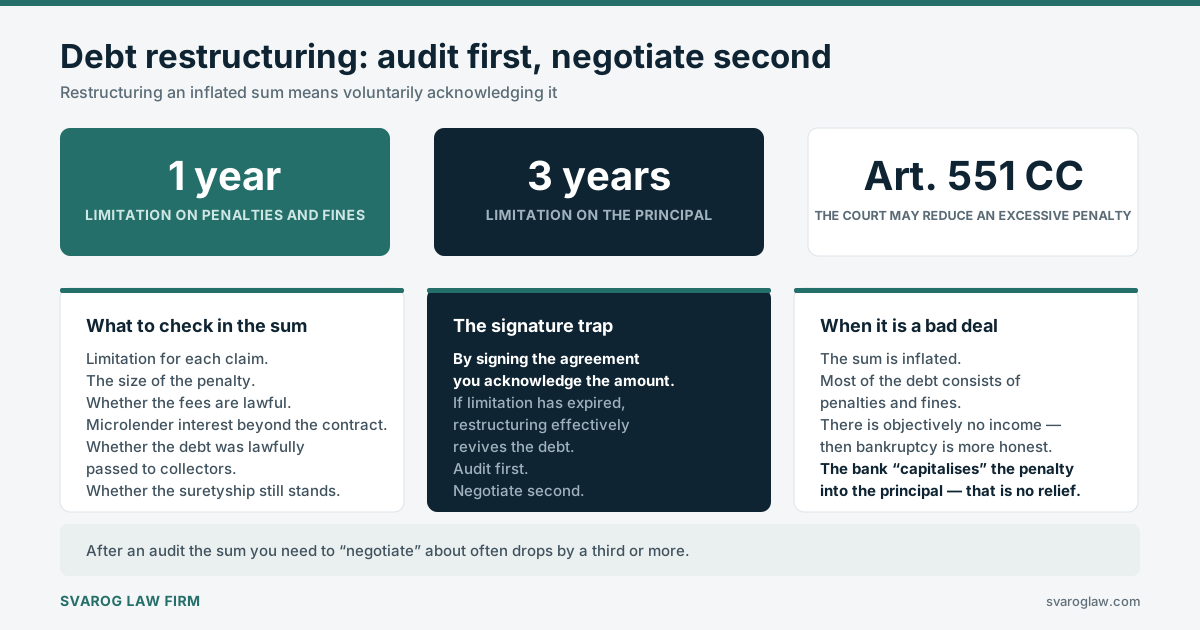
Audit the debt first, negotiate second. Restructuring an inflated figure means voluntarily acknowledging what a court could have struck out.
Three restructuring routes
1. By agreement — before court
1–2 weeksThe cheapest option. Creditor and debtor sign an addendum: a new schedule, a reduced payment, a payment holiday, partial write-off of penalties. It takes one or two weeks and costs no court fee.
What can usually be negotiated: a reduction of penalties and fines (creditors write these off readily, since they will not collect them anyway), a deferral of principal, an extension of the term.
What cannot: writing off the principal for no reason. That happens only in insolvency, or where the credit agreement is substantially defective.
2. Through the courts — within the dispute
6–10 monthsIf the creditor has already sued, the court may reduce the penalty where it is excessive compared with the creditor’s actual loss (Art. 551 CC). Courts regularly cut penalties and fines several-fold.
In the same proceedings you can challenge unlawful commissions, plead limitation against part of the claim, and strip out charges the contract never provided for. The result is the same restructuring, fixed by a judgment.
3. Through personal insolvency
120 days for the planThis is restructuring too, but through a court, with an insolvency practitioner. Penalties and fines stop accruing from the day the case is opened (Art. 121 of the Bankruptcy Code), and the debt restructuring plan must be approved by the creditors’ meeting and filed with the court within 120 days of the opening (Art. 124).
What to check in the amount
Before negotiating, we check:
The audit checklist
- limitation — three years on the principal (Art. 257 CC) and one year on penalties and fines (Art. 258 CC). A large share of old debts is time-barred at least in part;
- the size of the penalty — it is contractual, but capped by law and open to reduction by the court;
- the lawfulness of the commissions — servicing fees, drawdown fees, a “monthly commission” on the principal. Courts hold many of them to be unfair contract terms;
- microfinance interest — the worst offender: charges the contract never provided for, or interest still accruing after the term expired;
- whether the debt was lawfully passed to collectors and whether you were notified in writing of the assignment of the claim (Art. 516 CC);
- whether the surety is still valid — guarantors often pay on obligations they are already free of in law.
After such an audit the figure loses the parts the creditor could not prove in court: penalties beyond the one-year period, servicing commissions, charges after the end of the term. Negotiations then start from the recalculated figure.
We recalculate the deadlines separately. Limitation periods, suspended from 2 April 2020 for the quarantine and martial law, started running again on 4 September 2025. Debts that seemed frozen are expiring once more, and for some instalments the period has already passed.
Debts to microfinance lenders and collectors
This is a category of its own, and the most open to challenge.
Microfinance lenders charge interest and penalties that go beyond the law and even beyond their own contracts. Collectors press with a figure they could not substantiate in court: the assignment names one sum and the “demand” sent to the debtor a much larger one.
The logic here is: check first, discuss a schedule second. It is often better to let the matter reach court, where the creditor must justify every hryvnia, than to sign up to restructuring an unjustified sum.
Unlawful conduct by collectors — threats, calls to relatives, pressure at work — we record and challenge separately, up to complaints to the National Bank and the police. We also check the company in the National Bank’s register of debt collection companies: if it is not there, the demand in its name is unlawful in itself.
When restructuring is a bad deal
- the figure is inflated — challenge first, negotiate afterwards;
- much of the debt consists of penalties and fines that a court would reduce anyway;
- limitation has expired — by signing you create a newly acknowledged obligation where the creditor had no prospect in court;
- there is genuinely no income — then insolvency makes sense, since you will not meet the new schedule either;
- the bank offers “restructuring” that capitalises penalties and fines into the principal — that increases the debt rather than easing it.
A case from our practice
In 2025 a man came to us after his bank offered to restructure a consumer loan of 187,000 UAH: a three-year schedule with the penalties capitalised into the principal. We obtained the statement and the calculation of the debt and saw that the principal was 96,000 UAH, the rest being four years of penalties, a monthly servicing commission and interest charged after the term had ended. We sent the bank our objections with our own calculation and a plea that the one-year period for penalties had expired. After two rounds of negotiation the parties signed for 118,000 UAH with no capitalisation and a 24-month schedule. Seven weeks passed between the first consultation and signature, and our fee was 14,000 UAH. (details changed)
Typical mistakes before negotiating
Signing a “schedule” at the branch the same day
The manager produces a few pages in which the amount of the debt is already fixed and the penalties moved into the principal. Once signed, that figure is acknowledged.
Paying a “symbolic” 100–200 UAH to be left alone
A part payment interrupts limitation for the part of the debt it relates to, and a debt that could no longer have been enforced becomes enforceable again.
Ignoring the claim and the summonses
The court gives judgment in default, and it applies limitation only if a party pleads it (Art. 267(3) CC). Without your plea nobody will take the period into account, however long ago it expired.
Agreeing orally, by phone
A promise to write off the fines that is not in a written agreement does not exist: the bank’s next letter will show the original figure.
Not reading the acceleration clause
In many restructuring agreements a single missed payment entitles the creditor to demand the whole sum at once, with the penalties reinstated.
How we work
- We audit the debt — every component: principal, interest, penalties, commissions, limitation periods.
- We calculate the real figure the creditor could recover in court.
- We negotiate on the basis of that calculation.
- We draft the agreement so that you acknowledge nothing extra and get no hidden acceleration clause.
- We challenge unlawful charges in court if no deal is reached.
- We cost the alternative — whether insolvency would serve you better.
Cost of services
Restructuring by agreement carries no court fee. If the matter does reach court, in 2026 a claim to recover a debt costs an individual 1 % of the sum, but not less than 1,331.20 and not more than 16,640 UAH, and a company 1.5 % of the sum with a minimum of 3,328 UAH. A counterclaim to have particular terms of the credit agreement declared invalid is non-monetary: 1,331.20 UAH for an individual. Filing through the Electronic Court reduces the rate by 20 %.
What litigating instead of settling would cost
Restructuring by agreement carries no court fee at all.
Questions and answers (Debt restructuring)
Will restructuring damage my credit history?
Details of the change of terms, and of the arrears that preceded it, go to the credit bureaux, so the restructuring will appear in your history. That said, to the next lender it looks better than open court enforcement or a closed enforcement file with a certificate of no assets.
The bank refused to restructure. Can it be compelled?
No, a creditor is not obliged to change the terms, and a refusal breaches nothing in itself. Two routes remain: wait for the claim and reduce the figure in court (Art. 551 CC, limitation, unlawful commissions), or start insolvency proceedings, where the court approves the restructuring plan.
There is already a judgment and the enforcement officer is taking money from my card. Can payment be spread?
Yes. You apply to the court that gave the judgment to defer or spread its enforcement (Art. 435 CPC). The court looks at the debtor’s means, dependants and the realism of the proposed schedule, so income and expenditure certificates go with the application.
How long does reaching agreement with a bank take?
The audit takes 3–5 working days and negotiations usually 3–8 weeks, depending on whether the credit committee has to decide. The court route is longer: from claim to first-instance judgment in a civil case takes 6–10 months on average.
I signed a restructuring, and the loan has a guarantor. What happens to their liability?
If the change increased the guarantor’s exposure and they did not consent to it, the surety terminates (Art. 559(1) CC). That is precisely why banks ask the guarantor to sign alongside the debtor, and before signing they should work out separately what they are taking on.
Can it all be handled remotely?
Yes. You send the documents by messenger or email, we sign the engagement electronically, and we correspond with the bank in your name under a power of attorney. The only thing that may need you in person is signing the agreement at the branch — and not always even that.
Contact Svarog about restructuring a debt
Send us the credit agreement and the statement of arrears — we will calculate how much of that figure the creditor could actually recover in court and tell you which is better: negotiating, litigating, or going into insolvency. Sign nothing until the calculation has been checked.