Privatising the land under a house means acquiring, free of charge, ownership of the plot on which your house stands. The procedure is set out in Article 118 of the Land Code, and the free-transfer limits in Article 121: for building and servicing a house and outbuildings (a homestead plot) a citizen may receive up to 0.25 ha in villages, up to 0.15 ha in settlements and up to 0.10 ha in cities. The free transfer can be used once for each type of use.
During martial law the free transfer of state and municipal land into private ownership is generally prohibited, which is why most applications to councils are now refused. Plots under houses are the exception: the ban does not apply to land on which privately owned buildings stand. That is the ground on which a house owner can privatise the land beneath it in 2026, while a neighbour holding an empty plot “in use” has to wait for the ban to be lifted.
The law offers house owners one more simplification. If the house is already registered in your name, the land-surveying documentation is prepared at your request without a separate permit from the authority or the council — so the stage that usually delays privatisation the most is skipped.
We handle privatisation of the land under a private house from gathering documents to registering ownership: we check the status of the plot, commission the surveying documentation, complete the cadastral registration and obtain the decision transferring the land into ownership. If the authority refuses without grounds, we challenge the refusal in court.
Who is entitled to privatise the land under a house
The right to free privatisation of the land under a private house belongs to the owner of that house, and it is the registered ownership of the house that triggers the simplified procedure. If the house has not been registered or was built without permission, it must first be legalised, and only then can the land beneath it be privatised.
This concerns the homestead plot on which the house and outbuildings stand and which is in your use. Any area above the free limit (0.10 ha in cities, 0.15 ha in settlements, 0.25 ha in villages) is not transferred free of charge: that part is either bought or left under a lease.
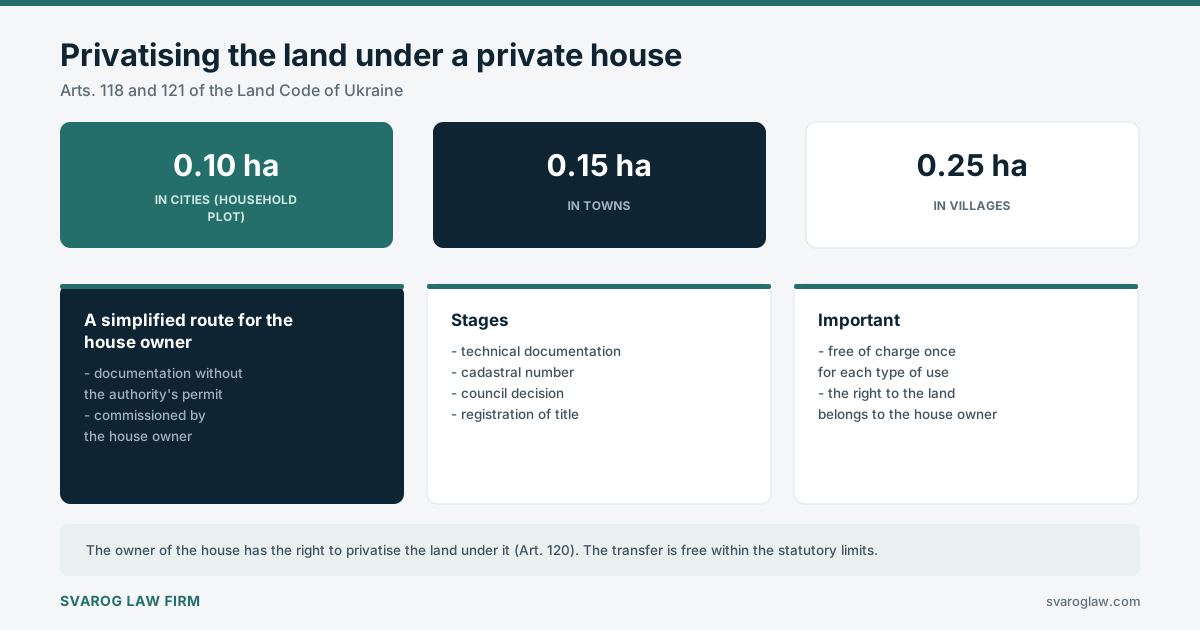
The stages of privatising land under a house
- checking the status of the plot: whether it has been privatised, whether there are overlaps, encumbrances or third-party rights;
- commissioning land-surveying documentation establishing (restoring) the boundaries on the ground — for a house owner, without a separate permit;
- registering the plot in the State Land Cadastre and obtaining the cadastral number and extract;
- filing the application and documentation with the body that administers the land (the village, settlement or city council, or an executive authority);
- the decision transferring the plot into ownership;
- state registration of ownership and receipt of the register extract.
The statutory periods look like this: the cadastral registrar enters the plot details within 14 days of the documentation being filed, the council considers the application within a month, and state registration of ownership takes five working days. The longest step in that chain is not the decision-making but the preparation of the surveying documentation: it takes several weeks and depends on the surveyor’s queue and the weather for the site visit. So an uncontested privatisation takes months rather than weeks.
Typical grounds for refusal and what to do about them
Overlapping boundaries
The plot partly overlaps a neighbouring one or land of a different designation. We establish whose documentation is wrong and correct the cadastral records; if the neighbour objects, the court decides.
The actual area exceeds the limit
Someone has used a plot larger than 0.10 or 0.15 ha for years and files documentation for the whole of it. The solution: take the plot free of charge up to the limit and buy or lease the excess.
Reliance on martial law
A refusal on that basis for a plot under a registered house is unfounded, because the ban does not extend to such plots. This is today’s most common ground for a challenge.
The house is not properly registered
Without registered ownership of the house the simplified procedure does not apply, so the order is always the same: the house first, then the land. In difficult cases recognition of ownership through the courts helps.
The rights of co-owners and heirs were not taken into account
If the house is in joint ownership, the plot is registered taking all co-owners’ shares into account, and an application from one of them without the others’ consent halts the procedure.
An unfounded refusal, or inaction, is challenged in an administrative court. The court usually orders the council to reconsider the application in accordance with the law; it orders the transfer itself only where the authority has already exhausted its discretion. If the plot has no house on it, a different procedure applies — it is described on the page about privatising a land plot.
A case from our practice
In 2025 the owner of a house outside Kyiv came to us: the council had refused to transfer the plot into his ownership, citing the martial law ban, and the surveyor had additionally reported an overlap of about 0.02 ha with the neighbouring plot. We showed that the ban does not extend to land under a registered house and, in parallel, agreed a boundary correction with the neighbour, after which the cadastral registrar amended the records for both plots. The repeat application to the council succeeded and the matter never reached court. About four months passed from the first consultation to the ownership extract, and the work cost the client 12,000 UAH. (details changed)
How we handle the privatisation
- we check the status of the house and the plot and look for overlaps and encumbrances;
- we arrange the land-surveying documentation and supervise the surveyor;
- we handle registration of the plot in the State Land Cadastre;
- we prepare the application and document pack for the relevant authority and track the decision;
- we challenge an unfounded refusal or inaction in an administrative court;
- we complete the process with state registration of ownership.
Cost of services
Separately from the fee you pay the surveying company, the State Land Cadastre extract and the administrative charge for state registration of the right.
Court fees in 2026: an administrative claim by an individual seeking a declaration that a council’s refusal or inaction was unlawful costs 1,331.20 UAH; for a company, 3,328 UAH. Filing through the Electronic Court reduces the rate by 20 %, and if you win the fee is recovered from the authority.
Questions and answers (privatising land under a house)
The plot under the house is leased. Can it be transferred into ownership?
Yes — a lease does not deprive the house owner of the right to free privatisation of the plot beneath it within the limits of Art. 121 of the Land Code. The procedure is the same: surveying documentation, an application to the council, a decision to transfer ownership, after which the lease ends. Any area above the free limit is usually kept under lease or bought.
What does the procedure itself cost, apart from legal fees?
The main cost is the surveying company’s fee for the technical documentation; they quote it after inspecting the plot, since it depends on the area, the shape and the region. You also pay for the State Land Cadastre extract and the administrative charge for registering the right, which is tied to the subsistence minimum and rises if you need registration faster than the standard period.
The council refuses because the community has no approved planning documentation. Is that lawful?
For a plot under a registered house such a refusal is usually unfounded: the boundaries of a built-up homestead plot are set by the surveying documentation, not by a new master plan. The refusal is challenged in an administrative court, and in the claim we stress that missing planning documentation is the authority’s problem, not a reason to restrict a citizen’s rights.
Part of the plot falls within a gas pipeline protection zone. What does that change?
It usually does not prevent privatisation, but the plot is transferred with an encumbrance: within the protection zone there are restrictions on building and earthworks. The encumbrance is entered in the cadastre and the property register and passes to every subsequent owner. Before filing it is worth checking whether such a zone makes the plot unsuitable for your plans.
Can everything be done through a representative without me attending?
Yes. Under a notarised power of attorney the lawyer files the applications, works with the surveyor, obtains the extracts and represents you in court. You only need to attend for notarial acts, and if you are abroad the power of attorney is certified by a Ukrainian consul. We accept documents electronically and file claims through the Electronic Court.
Can the plot be sold immediately after privatisation?
Yes, the law sets no minimum holding period for a homestead plot. Remember the principle that land and building share the same legal fate: the plot under a house is sold together with the house (Art. 120 of the Land Code) and cannot be disposed of separately. The tax consequences of a sale follow the general rules for real estate.
Contact Svarog about privatising the land under your house
Send us the documents for the house and whatever information you have about the plot: we will assess whether everything is ready for privatisation or preliminary steps are needed, and take the procedure through to the ownership extract. If the authority has already refused citing martial law, we will examine the reasoning — for land under a registered house that ground usually does not hold.