Where there is no will, the estate passes to the heirs by classes, and within a class the shares are equal (Art. 1267 of the Civil Code). While there is only one heir, the rule works by itself. Dividing an intestate estate becomes a problem when there are several heirs and the property is indivisible: one flat for three children, one car, one shareholding. A flat cannot physically be cut into three equal parts, and it is over this that families fall out for years.
The law offers two routes. An agreement between the heirs before a notary: two to three weeks, with costs limited to a valuation and the notary’s fee. Or the court: where no agreement can be reached, someone is hiding assets, or a deadline has been missed. On this page we go through both, the classes of heirs, and how indivisible property is divided.
The five classes of heirs
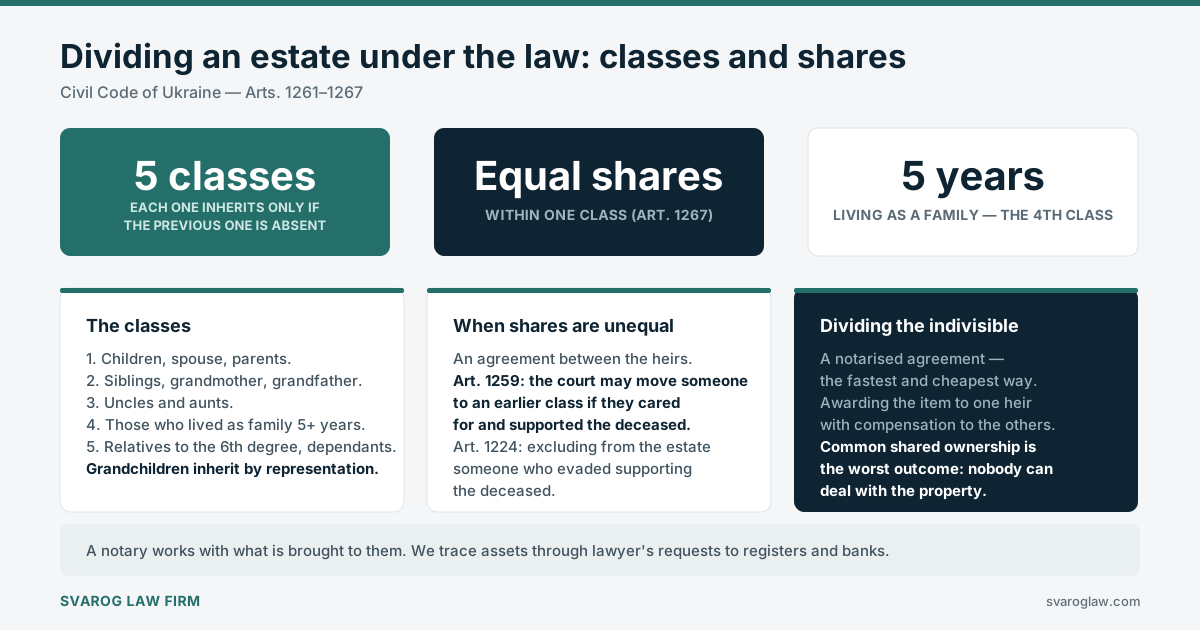
Each class inherits only if there are no heirs of the previous one, and also where all of the previous class renounced, did not accept the estate, or were excluded from inheriting (Arts. 1258, 1261–1265 of the Civil Code):
- the deceased’s children (including those conceived in their lifetime and born after their death), the surviving spouse, the parents;
- full brothers and sisters, grandparents on both sides;
- uncles and aunts;
- persons who lived with the deceased as one family for at least five years before the estate opened;
- other relatives up to the sixth degree of kinship, and the deceased’s dependants who were not members of their family.
Grandchildren inherit by representation (Art. 1266 of the Civil Code): they take the share of their father or mother who died before the deceased and divide it between them equally.
The fourth class is usually the least known: an unmarried partner who lived with the deceased as one family for at least five years inherits if there are no heirs in the first three classes. The fact of living together is established by the court. In our experience the court accepts it where there is joint registration of residence or a long-standing actual address, evidence from neighbours and relatives, shared expenses (utilities, purchases, medical treatment), and joint photographs and correspondence from those years.
When the shares are not equal
Equal shares are the rule, but there are exceptions:
- changing the order by agreement. The heirs may agree in writing before a notary on a different split, and that is quicker than court (Art. 1259(1) of the Civil Code). Such an agreement cannot affect the rights of an heir who is not party to it;
- changing the order by court order. A person may be recognised as an heir of the class that is already inheriting if they cared for the deceased over a long period, looked after them during illness, or supported them financially (Art. 1259(2)). This works for someone who spent years caring for an elderly relative and is now dividing the estate with relatives who never appeared. The evidence is medical records signed by the carer, receipts for medicines, and evidence from doctors and neighbours;
- exclusion from the right to inherit (Art. 1224): the court excludes a person who failed to support the deceased while they were helpless, or who intentionally took their life or obstructed the making of a will.
How indivisible property is divided
An agreement on dividing the estate
Under Art. 1278 the heirs agree among themselves who gets what, and not necessarily in equal shares: one takes the flat, another the money and a compensating payment. The agreement is notarised, which is mandatory for real estate. This is the quickest and cheapest route: the costs are the notary’s fee and the valuation.
Separating a share in kind
Where this is technically possible: a house with two entrances, a plot of land that can be split within the minimum size rules. Heirs who lived with the deceased for at least a year before their death have a preferential right to household furnishings (Art. 1279).
Awarding the item to one heir with compensation to the others
Through the court, with a mandatory valuation. The court considers who actually uses the flat or the car and who is able to pay the compensation.
Co-ownership in shares
This is what you get when nothing is decided: everyone becomes a co-owner, nobody can sell or mortgage without the others’ consent, and every sale of a share to an outsider gives the rest a pre-emption right (Art. 362). Families live like this for years and end up in court anyway, but by then with the relationships damaged and the valuation out of date.
What makes a case difficult
- an heir is out of contact or lives abroad;
- assets are concealed: the other heirs “forget” to mention part of them;
- the property was never registered to the deceased (an unfinished privatisation, a garage without papers, land without a title deed), and title has to be established in court first;
- the six-month deadline for accepting the estate has been missed;
- the valuation is too low, and whoever receives the compensation loses out;
- the estate includes a business: a holding in a company is valued on the balance sheet and the real value of its assets, and the other members may not want the heir among the owners.
Finding the assets: what we do, and the notary does not
What turns up most often: accounts and deposits, a holding in a company, a plot of land in another region, a car registered to the deceased, and sometimes property the other heirs deliberately concealed.
Deadlines: six months, and what comes after
An estate is accepted within six months of the death (Art. 1270 of the Civil Code). An heir who lived permanently with the deceased is treated as having accepted it unless they renounce in writing (Art. 1268). Everyone else files an application with the notary where the estate is opened, and that can be done remotely through any notary or by post with a notarised signature.
Limitation in disputes over dividing an estate already accepted (three years under Art. 257 of the Civil Code) runs separately; after being suspended for the quarantine it resumed on 4 September 2025.
A case from our practice
In 2025 one of three brothers came to us after their father’s death: there was no will, the estate consisted of a flat in Kyiv and an old car, and the brothers could not agree who should have the home. We sent lawyer’s enquiries to the Register of Estates, the companies register and the property rights register, and found a 25 % holding in a company that two of the brothers knew nothing about, plus a plot of land in the Kyiv region. Once everything had been valued we proposed a scheme: the flat to one brother, the land and the car to the second, the company holding plus a cash payment to the third. The division agreement was notarised two months after they came to us; our fee was about 15,000 UAH and there was no court fee (details changed).
How we work
- We establish who the heirs are and the classes, taking representation into account.
- We trace the assets through lawyer’s enquiries to the registers and the banks.
- We check the deadlines and have them extended where necessary.
- We negotiate: an agreement before a notary usually beats a year in court.
- We run the case in court: division, change of class, exclusion from the estate, establishing title.
- We register title to the inherited property.
Cost of services
Paid separately: the court fee, the valuation, and the notary’s charges.
Court fees in 2026: for a monetary claim to divide an estate, 1 % of its value, from 1,331.20 to 16,640 UAH for an individual; for each non-monetary claim (changing the class, exclusion from inheriting, granting an additional period) 0.4 of a subsistence minimum, that is 1,331.20 UAH. Through the Electronic Court the rate is multiplied by 0.8.
Calculate the court fee for dividing an estate
Non-monetary claims carry a flat fee of 1,331.20 UAH each.
Questions and answers (Dividing an intestate estate)
Can the division be handled remotely if one of the heirs is abroad?
Yes. The application to accept the estate can be filed through any notary where they are, or by post with a notarised signature, and a power of attorney for the division agreement can be given, including at a Ukrainian consulate. Court hearings can be attended by video.
Do the deceased’s debts pass to the heirs?
Yes, but only up to the value of what they receive (Art. 1282 of the Civil Code). A creditor must bring its claim within six months of learning of the death. If the debts exceed the estate, it can be renounced, and the share then passes to the other heirs of the same class.
What does the notarial procedure itself cost?
The certificate of inheritance and the division agreement are charged at the particular notary’s rates, plus the valuation. Heirs of the first and second classes pay no income tax (a 0 % rate); for the other classes the rate is 5 % personal income tax plus the military levy on the appraised value. We calculate the exact sum at the consultation once the valuation is in.
What if the deceased’s share in the flat was never separated and the home is in the couple’s joint names?
First the deceased’s share in the spouses’ joint property is determined, usually one half (Art. 1226 of the Civil Code, Art. 60 of the Family Code), and it is that share which forms the estate. The surviving spouse keeps their own half outside the estate and also takes a share of the estate equally with the children.
Can a child from a first marriage claim a share?
Yes; all the deceased’s children are in the first class regardless of which marriage they were born in and whether they were in contact with their father. Without a will they cannot be deprived of a share; the only exception is exclusion by the court under Art. 1224.
What if the other heirs have already obtained certificates without me?
File a claim to have the certificates declared partly invalid and your share recognised. If you missed the six-month deadline, we ask the court at the same time to grant an additional period for accepting the estate, which requires proof of a good reason for the delay.
Contact a Svarog lawyer about dividing an intestate estate
Tell us who the heirs are and what the estate consists of. We will check the classes and the shares, find assets you may not know about, and tell you whether the matter can be settled by agreement before a notary in two or three weeks instead of a year in court.