The commonest illusion among victims is that “the investigation will sort it all out by itself”. An investigator runs dozens of cases at once, and the one that is not moving quietly stalls and is then closed because no offence was made out.
Helping a victim in criminal proceedings comes down to three things: getting the case registered and investigated, getting the classification to match what actually happened, and getting you real money, not just a conviction.
Your rights as a victim
What the CPC allows a victim
- to produce evidence and apply for witnesses to be questioned, expert reports ordered and documents obtained;
- to be represented by a lawyer;
- to inspect the case file;
- to challenge the decisions, acts and omissions of the investigator and the prosecutor;
- to bring a civil claim within the criminal proceedings, free of court fees;
- to take part in the trial (Art. 56(3)(1) CPC). A victim may maintain the prosecution personally only where the prosecutor has dropped it (Art. 340 CPC) or in private prosecution cases;
- to state a position on a reconciliation agreement and on the sentence;
- to appeal the judgment if it does not satisfy you.
A victim’s rights are worth little unless they are used. A victim who files no applications and watches no deadlines becomes a spectator in their own case.
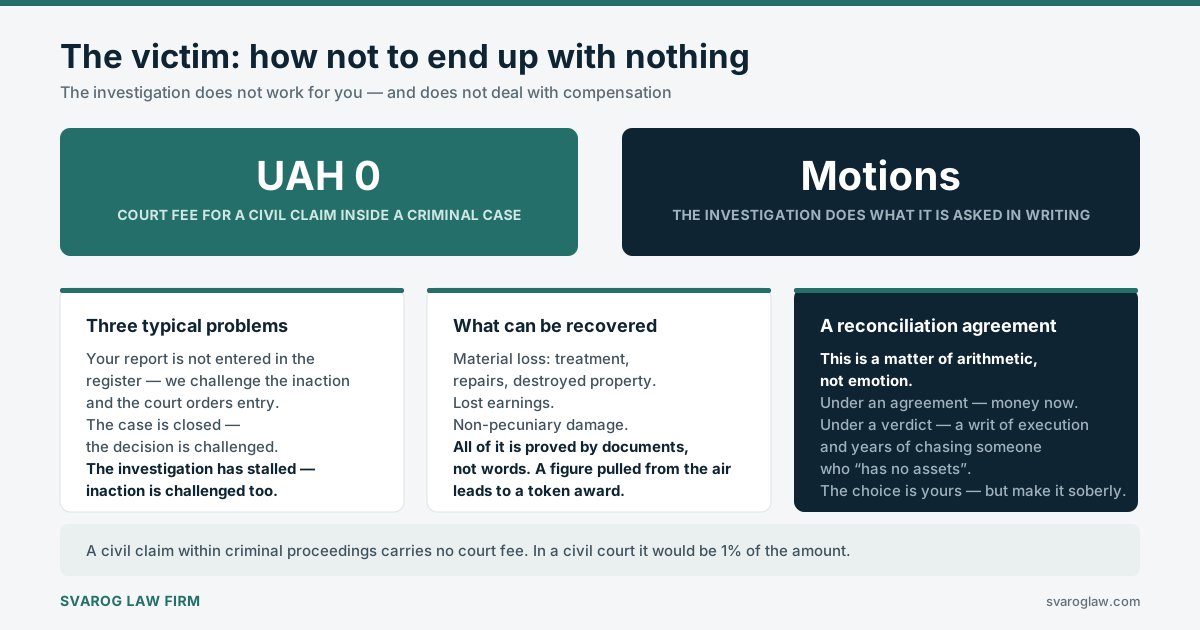
What usually goes wrong, and what to do about it
The report is not entered in the Register
24 hours to registerDetails of a criminal offence are entered in the Unified Register of Pre-Trial Investigations without delay, and in any event within 24 hours of the report (Art. 214(1) CPC). In practice what you hear instead is “we’ll look into it”, “write it differently”, “this isn’t our area”.
The case is closed
10 days to complainA decision to close the case is challenged before the investigating judge within 10 days of receiving it (Arts. 303, 304 CPC). The grounds for quashing it are usually plain from the file itself: witnesses not questioned, no expert report ordered, documents not obtained, camera footage not seized. Quashing the decision sends the case back for investigation.
The investigation has stalled
no deadlineAn investigator’s inaction — failing to take the steps required — can be challenged throughout the pre-trial investigation. Written applications work better than phone calls here: in one case about bodily injuries the expert report was ordered only after the fourth written application, the investigator having “seen no grounds” until then.
The civil claim: how to get the money
The civil claim is brought within the criminal proceedings before the trial begins (Art. 128(1) CPC), free of court fees. That is exactly why the documents needed to calculate the loss should be gathered while the investigation is still running.
What can be recovered:
- pecuniary loss: treatment, rehabilitation, repairs, the value of property destroyed, funeral expenses;
- lost earnings for the whole period of incapacity;
- non-pecuniary damage for physical and mental suffering (Art. 23 CC).
What determines the amount: medical records, receipts, income certificates, expert reports, evidence of the consequences. A figure plucked out of the air ends in a token award. The court sets non-pecuniary damage at its own discretion, and awards in similar cases differ several-fold, so we give a realistic figure after reviewing recent judgments in the register.
Against whom: against the accused, and in some cases against the person who is answerable in law for their acts, an employer for example (Art. 128(1) CPC).
A reconciliation agreement: how to do the arithmetic
The accused may offer a reconciliation agreement with full compensation. The first reaction is usually emotional: “no deals, let him serve his time”. Here is how to count it:
- under an agreement you get the money now, and on paper;
- under a judgment you get a writ of execution and then years of enforcement in which the convicted person “has no property”;
- the court may impose a sentence that does not involve imprisonment, and your consent will not be sought.
We set out both scenarios with the figures and the timescales; the decision is yours. The lawyer’s job is to see that the terms of the agreement are performed.
A case from our practice
In 2025 a woman came to us after being knocked down on a pedestrian crossing: a fracture, six weeks off work, and a driver who at first promised to “sort everything out” and then stopped answering. The case had been opened, but for two months nothing was done in it. We applied for a forensic medical report and for the camera footage to be obtained, and when that was refused we challenged the inaction before the investigating judge. The report was carried out, the degree of injury was confirmed, and the civil claim for treatment, lost earnings and non-pecuniary damage went in straight away. The case ended in a reconciliation agreement with payment before judgment; about seven months passed between the first approach and the money. (details changed)
Deadlines you cannot miss
- challenging a decision to close the case or to refuse victim status — 10 days from receiving the copy (Art. 304 CPC);
- a civil claim within criminal proceedings — before the trial begins; after that you must go to the civil court and pay the fee;
- an appeal against the judgment — 30 days from the day it is pronounced;
- a complaint about the investigator’s inaction has no deadline, but camera recordings survive only weeks, and injuries are recorded most accurately in the first few days.
How we work
- We get the case registered in the Register, through the investigating judge if there is no other way.
- We file written applications: expert reports, questioning, the production of documents and video. Every application is recorded in the case file.
- We watch the deadlines and challenge inaction by the investigator and the prosecutor.
- We prepare the civil claim with a full calculation of the loss, free of court fees.
- We represent you at trial and argue the classification and the amount of compensation.
- We see the case through to actual payment: an agreement with payment, or enforcement after the judgment.
Cost of services
There is no court fee for a civil claim within criminal proceedings (Art. 5(1)(6) of the Law “On Court Fees”). If the same claims have to be brought as a separate civil action, the fee is 1 % of the value of the claim for an individual, from 1,331.20 to 16,640 UAH, and 20 % less when filed through the Electronic Court.
Questions and answers (helping a victim in criminal proceedings)
From what moment am I a victim?
A victim’s rights arise from the moment you file a report that an offence was committed against you, or ask to be joined to the proceedings as a victim (Art. 55 CPC). No separate decision by the investigator is needed, so you can start making applications at once.
Can a relative of a person who died be the victim?
Yes. Where the offence caused a person’s death, one of the close relatives or family members who files the application is recognised as the victim (Art. 55 CPC). They have the full set of rights, including the civil claim for funeral expenses and non-pecuniary damage.
The offender has not been identified. What now?
The pre-trial investigation is suspended until the person is identified (Art. 280 CPC), but suspension is not closure: search activity must continue, and its absence can be challenged before the investigating judge. Where the harm was caused in a road accident, the motor insurance payout proceeds in parallel, and whatever the insurer does not cover is claimed from the person at fault once they are identified.
Who pays for the forensic medical report?
A report ordered by the investigator or the court and carried out at a state expert institution is paid for by the state. A report the victim commissions themselves — to challenge an understated degree of injury, for example — is paid for by them and then included in the civil claim.
Can I withdraw my report if we have settled with the offender?
In private prosecution cases (Art. 477 CPC) the proceedings are closed on the victim’s statement withdrawing the accusation. In other categories withdrawing the report does not by itself end the case, but reconciliation with compensation is taken into account by the court and, in less serious cases, can be a ground for release from criminal liability (Art. 46 CC).
Do I have to attend every step and every hearing?
No. The lawyer acts under the engagement and a warrant, files applications and complaints, and attends investigative actions and hearings. You need to be there in person for your own questioning, for an identification parade, and at the hearing where your position on an agreement or the sentence is considered; the lawyer covers the rest.
Contact a victim’s lawyer at Svarog
Tell us what happened and show us what stage the case has reached. We will tell you what to do right now so that it does not stall, and calculate the amount of your claim from the documents you already have. Helping a victim in criminal proceedings starts with one decision: bring your claim before the trial begins, while it still costs no court fee.