Land is the one class of property where the register entry can be correct and the title still open to challenge. A plot overlaps its neighbour in the cadastre, an old village council issued a deed with an error, an heir has used the land for twenty years without papers, and a council refuses citing martial law where the ban does not apply.
This is exactly where a land lawyer is needed. The task is to make the right to the plot stand up to scrutiny by a court, a buyer, a bank and an heir — not merely to look properly documented on paper.
We run land cases for individuals and businesses: from registering rights to litigation against councils, neighbours and public authorities.
Areas of work
Registering rights to land
- Privatisation of a land plot — taking account of the ban in force under martial law and the exceptions to it
- Privatising the land under a private house — the most workable route today
- Registering inherited plots and land shares, separating a share on the ground
- Re-registering old state title deeds and council decisions from the 1990s
Disputes
- Challenging refusals and inaction by local councils
- Boundary disputes with neighbours, overlapping plots in the cadastre
- Establishing title to a plot in court
- Challenging unlawful council decisions transferring land to third parties
- Cancelling register entries, recovering a plot that has been taken over
Transactions and use
- Support in land purchases, checking a plot before buying
- Lease, emphyteusis, superficies, easements
- Changing the designated use
- Disputes with tenants of agricultural land
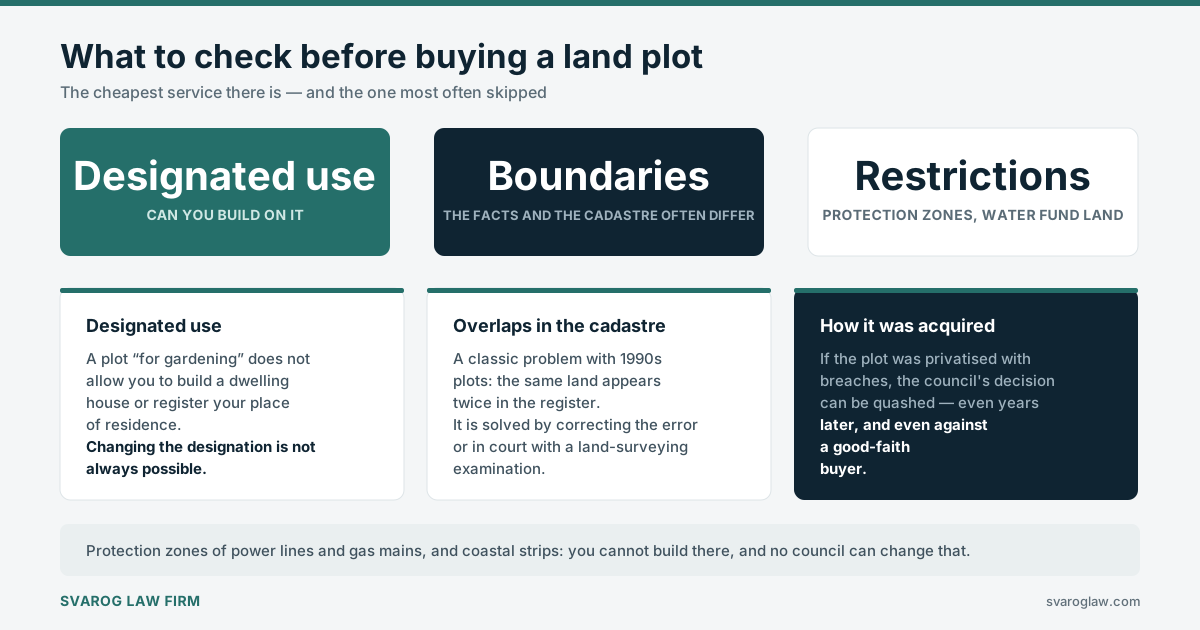
What to check before buying a plot
Checklist before the deal
- Designated use. It determines what may be built on the plot and whether a dwelling and a registered residence can be recorded there: land for gardening, for a personal smallholding and for building a house are on different regimes. The rules for garden plots have changed in recent years, so we check the particular plot against the current wording of Art. 35 of the Land Code and the community’s planning documents.
- Boundaries on the ground. The actual fence and the cadastral boundaries often do not match, and with the plot you buy a dispute with the neighbour.
- Overlap in the cadastre. The classic problem with plots registered in the 1990s: the same land entered twice.
- Restrictions and encumbrances: protection zones for power and gas lines, coastal protection strips, water fund land. Building there is not allowed, and no council can change that.
- How it was acquired. If the plot was privatised irregularly, the council’s decisions can be annulled years later, even against a buyer who acted in good faith.
- Third-party rights: lease, easement, heirs’ rights, the consent of the seller’s spouse.
The commonest land disputes
Overlapping boundaries
Two plots claim the same land. First we try to correct the cadastre by agreement; if the neighbour objects, the court decides with a surveying expert report, and it is that report which establishes whose boundaries match the original documentation.
A council’s refusal
The commonest ground today is a reference to martial law. The ban on free transfer of land does not extend to land under your own building, to plots granted for use before 1 January 2002, to separating a land share under a certificate, or to enforcing a court judgment. Refusals in those cases are unlawful and are overturned in the administrative court.
An inheritance without documents
The deceased used the plot but never registered the right, and the notary will not issue a certificate. The answer is establishing title in court on archive documents, village council decisions and entries in the household register.
A plot taken over
Someone else’s entry appears in the register, or the neighbour moves the fence. Speed decides it here: the more resales go through, the harder the land is to recover, because each successive contract has to be challenged separately.
A case from our practice
In 2024 the owner of a plot outside Kyiv came to us: while commissioning technical documentation she discovered that her land partly overlapped the neighbouring one, registered two years later by a decision of the same council. The neighbour refused to correct the error because some of his buildings stood on the disputed strip. We filed a claim to remove the obstruction and to invalidate the council’s decision as to the area, and the court ordered a land-technical expert report, which confirmed that our client’s boundaries came first. The claim succeeded, the cadastral data were corrected, and the neighbour moved the buildings at his own expense. With the expert report the case took about eighteen months, and our fee was 45,000 UAH. (details changed)
When you do not need a lawyer
Buying a plot with clean papers, established boundaries and a suitable designated use goes through a notary perfectly well. Privatising the land under a house, where the council works to time, goes through a surveying firm and the administrative services centre. In such cases we stop at a consultation and do not take the matter on.
A land lawyer is needed when:
- the council has refused or is saying nothing;
- the plot overlaps its neighbour in the cadastre;
- the documents are old or lost: 1990s state deeds, village council decisions, record books;
- the plot was inherited but the right was never registered;
- something was built on the land without documents;
- the matter concerns agricultural land, land shares or leases;
- someone else’s entry has appeared in the register against your property.
How we work
- Checking the plot: the cadastre, the property rights register, designated use, restrictions, how it was acquired.
- A legal opinion: whether the right exists, whether you fall within an exception to the ban, what the risks are and how long it will take.
- Registration: dealing with the surveying firm, the council, the administrative services centre and the state registrar.
- Litigation: challenging refusals and inaction, establishing title, boundary disputes, cancelling unlawful entries.
- Surveying expert reports: we bring these in where a boundary dispute cannot be resolved on the documents.
Cost of services
The surveying firm’s work, cadastre extracts, the surveying expert report, the administrative fee for registering title and the court fee are paid separately.
Court fees in 2026: an individual’s administrative claim against a council’s refusal or inaction costs 1,331.20 UAH, a company’s 3,328 UAH. A claim to establish title to a plot is a monetary one: 1 % of its value, but not less than 1,331.20 and not more than 16,640 UAH for an individual. Filing through the Electronic Court reduces the rate by 20 %.
Calculate the fee for establishing title to a plot
A claim against a council’s refusal or inaction costs a flat 1,331.20 UAH.
Questions and answers (Land lawyer)
Is a spouse’s consent needed to sell a plot?
Yes, if the land was acquired during the marriage. A contract for the sale of a plot is notarised, and for such transactions the law requires the other spouse’s written, notarised consent (Art. 65 of the Family Code). Without it the notary will not complete the deal, and if it was given as a formality the deal is later challenged. Check the same on the seller’s side when you are the buyer.
The plot has no cadastral number. Can it be sold?
No. Without a cadastral number the notary will not certify the contract and the registrar will not record the transfer. First you commission technical land management documentation establishing the boundaries, enter the data in the State Land Cadastre and obtain an extract, and only then go to the deal. That takes several weeks and is paid for separately from the lawyer’s work.
The council is hinting at a “voluntary contribution” for a favourable decision. What should I do?
Such demands are unlawful: only the payments provided for by law are due on a transfer of land. The effective approach is to file the application in writing through the administrative services centre or by post with a list of contents, wait for a written reply, and challenge the refusal or inaction in the administrative court. The court can order the council to consider the matter on its merits, and that is what decides the case, not private arrangements.
Does a land lease pass by inheritance?
As a rule, yes: a land lease forms part of the estate and passes to the heirs unless the contract says otherwise. The heir needs to obtain the certificate of inheritance and register the transfer of the lease. The contract is worth reading in advance: some provide for the lease to end on the tenant’s death.
The plot is in a front-line community. Can anything be registered now?
Registration actions in areas where hostilities are taking place or which were occupied are restricted, and in such communities registration is postponed until the registers work again. What can be done now: gather and digitise the title documents, order archive copies of the council’s decisions, record the condition of the plot. Disputes over such land are heard by the courts under the altered jurisdiction rules.
I live in another region or abroad. Can the case be run remotely?
Yes. The engagement letter is signed electronically, you send documents as scans, the claim is filed through the Electronic Court with the discount on the fee, and the lawyer attends hearings on a warrant or by video. Attendance in person is needed only for notarial acts, and even then they can be done through an advocate.
Contact a Svarog land lawyer
Describe the situation: we will check the plot against the cadastre and the property rights register, assess the risks and tell you what can realistically be done now and what has to wait until the ban is lifted. A 5,000 UAH check while you are still choosing the plot saves a year of applications to the council and a court expert report later.