Under martial law, discharge from the armed forces on family grounds, for ill health or for any other reason is possible only on the grounds listed in Art. 26(4) of the Law “On Military Duty and Military Service”. Exhaustion, a conflict with a commander or an offer of civilian work are not on that list.
Where a ground does exist, refusals happen for three reasons: the application was never registered, the medical board reached a different conclusion, or the relative’s disability certificate expired during the weeks of waiting. Discharge on health grounds rests on a single document — the board’s finding of unfitness. Discharge on family grounds rests on a set of documents proving the ground on the day the application is decided.
Grounds for discharge under martial law
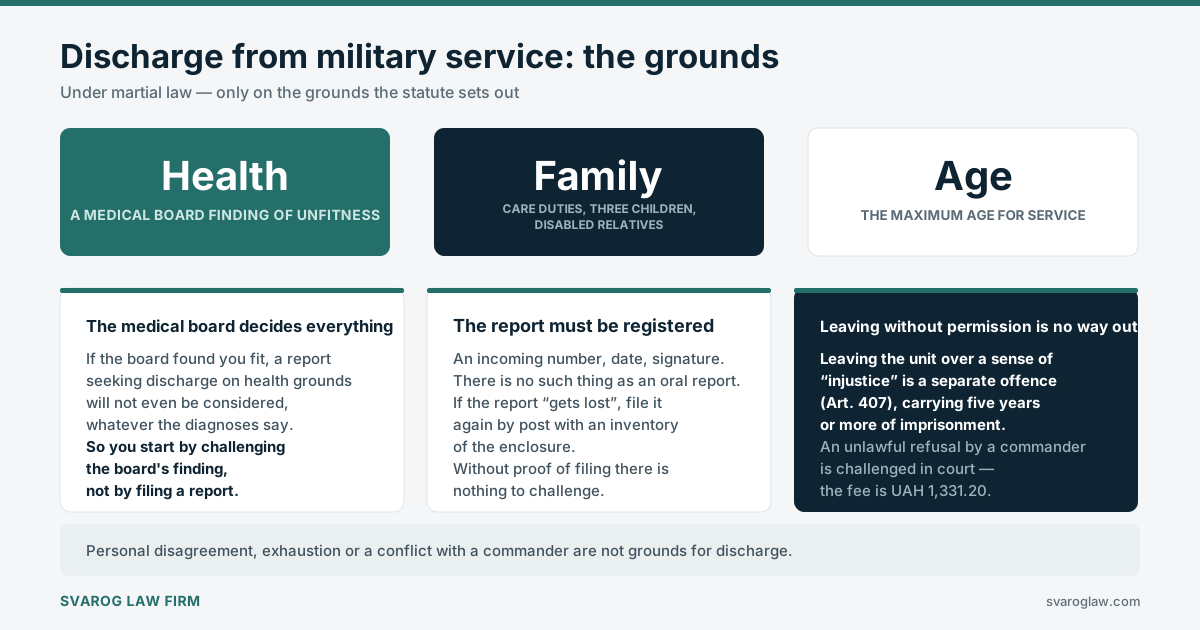
On health grounds: on the strength of a medical board’s finding of unfitness for military service with removal from the military register. A medical file alone produces no order, however serious the diagnoses. Likewise a disability rating does not by itself discharge anyone: the serviceman is referred to the board, and it is the board’s finding that becomes the ground.
On family grounds (Art. 26(4)) discharge is available, among others, where:
Family grounds
- there is a need to provide constant care for a close relative with a group I or II disability, and there is nobody else legally obliged to care for them;
- there are three or more children under 18;
- the serviceman is raising a child with a disability;
- the serviceman is raising a child under 18 alone (the other parent has died, been deprived of parental rights, gone missing and so on);
- the spouse has a group I or II disability;
- the serviceman is a guardian or carer of someone needing constant care.
Other grounds: reaching the age limit for military service, and a custodial sentence that has come into force.
Every ground has conditions, and most refusals hide in those conditions. Caring for a father with a group II disability, for instance, gives no right to discharge if he has other adult children who are legally obliged to support him.
The procedure: five steps
- Evidence the ground. For health: attend the medical board and obtain a finding of unfitness. For family grounds: gather current certificates, birth and marriage records, register extracts, and the assessment team’s report (since 2025 it replaced the old disability commission) that the relative needs constant care.
- File the application with the commander, and have it registered as an incoming document: number, date, clerk’s signature. There is no such thing as an oral application, and “I told him” cannot be proved later.
- The commander considers it. The law sets no specific period for a discharge application; in litigation the benchmark is the one-month period for dealing with citizens’ requests (Art. 20 of the Law “On Citizens’ Appeals”), after which silence is challenged as inaction.
- The discharge order and removal from the unit’s personnel list.
- Settlement: pay, compensation for unused leave, issue of documents.
The commonest mistake in the applications we see: filing without the documents, “just to fix the date”. Such an application is considered formally and refused.
If the commander refuses or says nothing
Recording the filing
The application must be registered: incoming number, date, signature. If it “gets lost”, we refile by post with a list of contents.
Going up the chain
Or applying to higher command.
The administrative court
A commander’s decisions and inaction are challenged under the Code of Administrative Procedure. The court fee for such a claim is 1,331.20 UAH (0.4 of a subsistence minimum in 2026), or 1,064.96 UAH through the Electronic Court. The court can declare the inaction unlawful and order the commander to decide the application on its merits within a set period.
A warning
Leaving the unit without permission because of an “unfair refusal” carries separate liability under Art. 407(5) of the Criminal Code (martial law conditions): five to ten years’ imprisonment.
Discharge on health grounds: the board decides everything
If the medical board has found you fit or fit with limitations, an application for discharge on health grounds will not be considered, whatever the diagnoses.
So the work starts not with the application but with challenging the board’s decision: a complaint to a higher-level board or an administrative claim. The court reviews the procedure of the examination (whether all the relevant specialists saw the person, whether the mandatory tests were done, whether the medical records were taken into account); it does not re-assess the medical substance itself. More on this: Medical board lawyer.
Separately, the causal link between the illness or injury and service has to be recorded correctly: the wording “yes, connected with the defence of the Motherland” determines the lump-sum payment, the status and the disability pension.
What the court checks in a case about a commander’s refusal
The court’s checklist
- whether the ground exists in law: the court does not weigh “my mother is ill”; it needs a finding that constant care is required and a certificate of the disability group;
- whether the ground was current on the day the application was decided: an expired certificate equals no ground at all;
- whether the application was registered and whether the commander replied within a reasonable time;
- whether the refusal is reasoned: courts do not accept “operational necessity” without a statutory provision;
- whether the deadline for going to court under Art. 122 has passed.
A case from our practice
In March 2025 a senior soldier whose wife has a group II disability came to us. He had filed his discharge application back in November 2024, but without registration, and had heard nothing in four months. We refiled by post with a list of contents, and after a month’s silence brought an administrative claim to have the inaction declared unlawful. The court ordered the commander to decide the application within ten days; the discharge order on family grounds came through two and a half months after the claim was filed. The court fee was 1,331.20 UAH, with our work within the comprehensive administrative case rate. (details changed)
How we work
- We check the ground under Art. 26(4) and the documents supporting it.
- We put the documents in order: certificates, statuses, and where necessary through the courts (guardianship, establishing facts).
- We work with the medical board: challenging its decision, securing a fresh examination.
- We draft the application and make sure it is registered, or send it by post with a list of contents.
- We challenge the commander’s refusal or inaction in the administrative court.
- We protect the money: payments on discharge, recalculation of the pension.
Cost of services
Court fees in 2026: a claim challenging a commander’s refusal or inaction, or a medical board decision, costs 1,331.20 UAH (0.4 of a subsistence minimum), or 1,064.96 UAH through the Electronic Court; an appeal is 150 % of that rate. If you win, the fee and the legal costs are recovered from the military unit.
Questions and answers (Discharge from military service)
My relative’s disability certificate expires while the application is being considered. What do I do?
Apply for the re-assessment at once, without waiting for the commander’s answer, and attach the confirmation of the appointment to the application. If the new certificate is in place on the day the application is decided, the ground is current; if the commander refused because the certificate had expired, we file a fresh application with updated documents and challenge the earlier inaction separately.
Can the discharge be arranged remotely while I am at the front?
Yes. The application is sent by post with a list of contents, in the serviceman’s name or through an advocate under a notarised power; the administrative claim is filed through the Electronic Court, and hearings can be attended by video.
What if the unit does not pay the final settlement after the discharge order?
Pay and compensation for unused leave are recovered through the administrative court; the amount is evidenced by the finance office’s certificate or, if that is withheld, obtained by the court.
The deadline for suing the commander has been missed. Can it be restored?
Yes, for good reasons: being on a combat mission, hospital treatment, captivity. The application to restore the deadline is filed with the claim and supported by the unit’s certificates or medical records.
What does the procedure itself cost the serviceman, apart from the lawyer?
The application, the medical board and the discharge order are free. Costs may arise for a notarised power of attorney, postal items with a list of contents, and the 1,331.20 UAH court fee if the matter reaches the administrative court.
Contact a Svarog lawyer about discharge from military service
At the consultation we look at three things: whether the ground is in Art. 26(4), whether there is a document for it, and whether the application was registered. Then we set out the steps and the realistic timeline. If there is no ground, you will hear that at the first meeting, without paying for support you do not need.