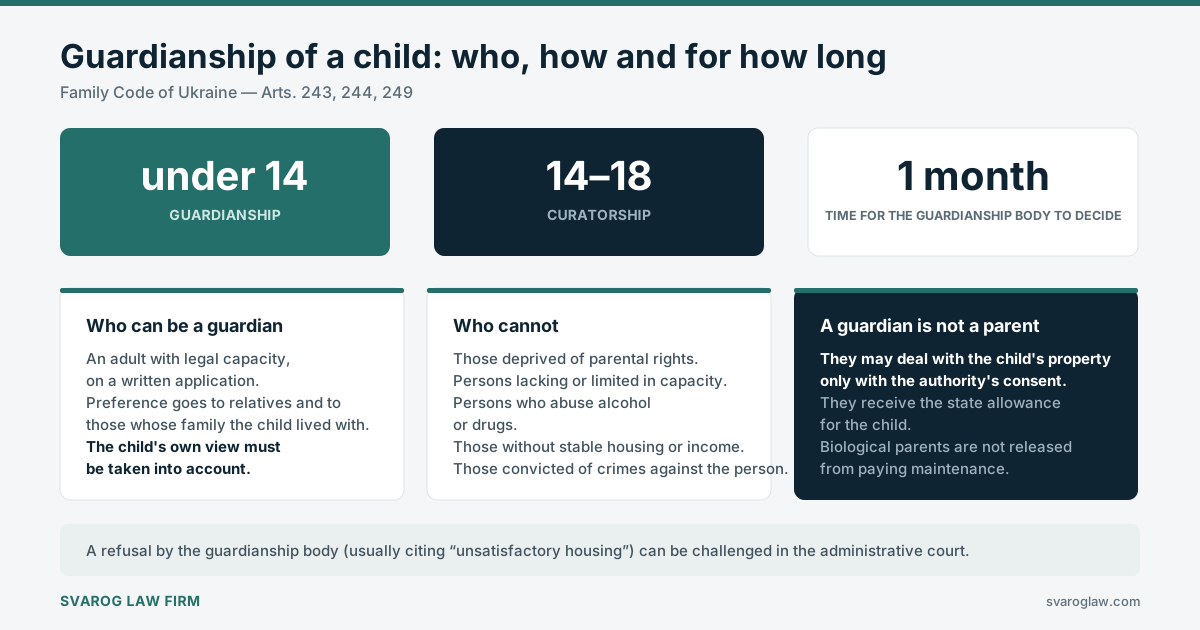
Guardianship and custody are not the same thing, and confusing them costs months. Guardianship is established over a child under 14, custody over a child aged 14 to 18 Art. 243 FC. The powers differ: a guardian acts on the child’s behalf, while a custodian consents to the child’s own actions.
Guardianship is needed where the parents have died, are unknown, have been declared missing or legally incapable, have lost their parental rights, are serving a sentence, or cannot raise the child for other reasons. Most often the guardians are grandmothers, grandfathers, aunts, or adult brothers and sisters.
The procedure is administrative, but it stalls regularly: because the guardianship authority refuses, because relatives disagree, because the parents’ status has to be settled first, or because the documents are in occupied territory.
Who can become a guardian
A guardian can be any adult with legal capacity who applies in writing. Preference goes to the child’s relatives and to people in whose family the child has lived Art. 244 FC.
Guardianship will not be granted to anyone deprived of parental rights, declared legally incapable or of limited capacity, or whose interests conflict with the child’s Art. 244(3) FC. A wider list of restrictions is set out in the Procedure for the activities of guardianship authorities relating to the protection of children’s rights, approved by Cabinet of Ministers Resolution No. 866 of 24 September 2008, and in Art. 212 of the Family Code:
- Abuse of alcohol or drugs.
- No permanent residence and no permanent income.
- Being registered at, or treated in, a psychiatric or addiction facility.
- An adoption revoked through that person’s fault.
- A conviction for a crime against life, health or sexual freedom.
The child’s view is taken into account if they are old enough and developed enough to express it Art. 171 FC. The authority takes written consent from a teenager, and in practice a child’s objection to a particular candidate decides the matter.
Two routes to guardianship
Through the guardianship authority
a few weeksThis is the main, administrative route. The decision is taken by the guardianship authority at the district administration or city council, after the children’s service has checked the documents.
What has to be filed:
- The prospective guardian’s application.
- Passport and taxpayer number.
- A document confirming the child’s status (parents’ death certificate, court judgment removing parental rights, certificate that a parent is missing).
- The child’s birth certificate.
- A medical certificate on the applicant’s health.
- An income certificate.
- A criminal record certificate.
- Housing documents and a report on living conditions.
- Consent of the applicant’s other adult family members living with them.
- The child’s written consent, where they are able to give it.
The deadlines for the children’s service are set by Procedure No. 866. In practice a few weeks pass between filing a complete package and the decision — longer if the authority sends additional enquiries.
Through the courts
monthsThe court route is needed when:
- The guardianship authority has refused: the decision is challenged in an administrative court.
- Several relatives are competing for guardianship of the same child.
- The parents have to be deprived of their rights, or declared missing or legally incapable, at the same time.
- The child has in fact lived with you for years but nothing has been formalised: then a fact of legal significance is established.
- Documents have been lost or remain in temporarily occupied territory.
A guardian’s rights and duties
A guardian does not become a parent, and that distinction matters:
- They represent the child’s interests without a power of attorney, including in court.
- They may deal with the child’s property only with the authority’s permission — a child’s flat cannot be sold at will.
- They receive state support for an orphan or a child deprived of parental care: 2.5 subsistence minimums for a child of the relevant age Art. 16-1 of the Law “On State Support for Families with Children”.
- They must provide for the child’s education, medical care and upbringing.
- They have no right to inherit from the child and acquire no maintenance rights.
- The biological parents are not released from maintenance: it is paid for the child’s upkeep even while the child lives with a guardian.
When the child turns 14, guardianship ends and becomes custody, and custody ends at 18 Art. 76 CC. Guardianship ends early if the child is adopted or returned to the parents.
What goes wrong in practice
Refusal over housing conditions
The inspection report calls them “unsatisfactory”. The refusal is challenged in an administrative court, and the court looks not at floor space but at whether the child’s needs are met.
Conflict between relatives
A grandmother and an aunt both seek guardianship. The court decides, taking the child’s attachment and the authority’s opinion into account.
The parents have not formally lost their rights
Guardianship will not be granted until their status is resolved. These are two separate proceedings and must be taken in order.
No documents on the parents’ death or disappearance
Separate court proceedings are needed.
A child from occupied territory
Documents are restored through the courts.
How long the procedure takes and what affects it
Where the child’s status is documented and the relatives do not disagree, the matter ends with the authority’s decision within a few weeks. Every additional stage adds months: removing parental rights or declaring a father missing is heard in ordinary adversarial proceedings, establishing a fact of legal significance in separate proceedings, and a refusal by the guardianship authority is challenged under administrative procedure.
There is only one real way to speed things up: assemble the documents in the right order. An application for guardianship filed before the parents’ status is settled is returned or refused, and the time spent on it is simply lost.
A case from our practice
In 2025 a woman came to us who was left with her nine-year-old grandson after her daughter died. There was no death certificate: the daughter had died in temporarily occupied territory, and the local guardianship authority refused to consider the application without a document confirming the child’s status. We prepared an application to establish the fact of death under Art. 317 of the Civil Procedure Code, gathered the evidence and handled the hearing, after which the civil registry issued the certificate. Guardianship was arranged about three months after the first consultation, together with the state support payment for the child. The work cost around 18,000 UAH. (details changed)
How we work
- We identify the right route — administrative or judicial — and the order of steps.
- We prepare the document package and handle the guardianship authority.
- We restore documents through archives and the courts where they are missing.
- We run the related cases: removal of parental rights, declaring a person missing, establishing facts of legal significance.
- We challenge a refusal by the guardianship authority in an administrative court.
- We protect the child’s property rights: inheritance, housing, state payments.
Cost of services (guardianship and custody of a child)
Court fees (2026): an application in separate proceedings — establishing a fact of legal significance, declaring a person missing or legally incapable — costs 665.60 UAH; a non-monetary claim by an individual, including for removal of parental rights, and an administrative claim against a refusal by the guardianship authority cost 1,331.20 UAH. Filing through the Electronic Court multiplies the rate by 0.8.
Questions and answers (guardianship and custody of a child)
How does guardianship differ from a foster family or patronage care?
Guardianship is an open-ended family status held by a relative or someone close to the child, with state support paid for the child. A foster family or family-type children’s home is created under a contract with the guardianship authority, while patronage care is a temporary arrangement lasting a few months while the child’s future is decided. For relatives it is almost always guardianship or custody.
Can a guardian take the child abroad?
Travel by a child under guardianship is agreed with the guardianship authority, so its decision has to be obtained before the trip. Carriers and border officers check the guardian’s status, so you take the appointment decision and the child’s birth certificate with you.
Does the child keep a survivor’s pension?
Yes. The pension is awarded to the child and paid to the guardian, who spends it in the child’s interests and reports to the guardianship authority. It does not cancel the state support for a child deprived of parental care — the question is only which of them applies in the particular situation.
Can a guardian give up their duties?
Yes. The guardianship authority releases a guardian on their application, and also in case of illness or inability to perform the duties (Art. 75 of the Civil Code). The child is not left without care: a new guardian or another arrangement is decided at the same time.
Can guardianship be arranged if I live in another region or abroad?
The application goes to the guardianship authority where the child lives, and what decides everything is where the child will actually live. We handle part of the work remotely: preparing documents, filing claims through the Electronic Court, attending hearings by video link. But the inspection of living conditions takes place where the child will live, and no decision is made without it.
Contact Svarog about establishing guardianship of a child
Tell us the situation and we will say whether the administrative route is enough or the courts will be needed, and in what order to act. The most expensive mistake here is starting with guardianship when the parents’ status has to be settled first.