

Олександр Сич
9 August 2026
You do not have to return to Ukraine. The application to accept an estate is sent to the notary by post with a certified signature, or filed with an electronic signature, and the rest of the case is handled by a representative under a power of attorney issued by a consulate or a foreign notary. What matters is meeting the six months: the Supreme Court has confirmed that martial law does not suspend that period.
Millions of Ukrainians are abroad, and when a relative dies in Ukraine the first question is: “do I really have to travel?”. You do not, because notaries and consulates handle such cases every day. The one way to lose is on the deadline. The widespread belief that “time limits are suspended for the war” has been rejected by the Supreme Court: Article 1270 of the Civil Code gives six months, and Cabinet Resolution No. 164 cannot set different rules because it contradicts the Code.
Below: the full route from the application to the registration of title, with the documents, the deadlines and the typical mistakes. On the amounts of tax there is a separate article on inheritance tax rates in 2026; here we concentrate on the procedure.
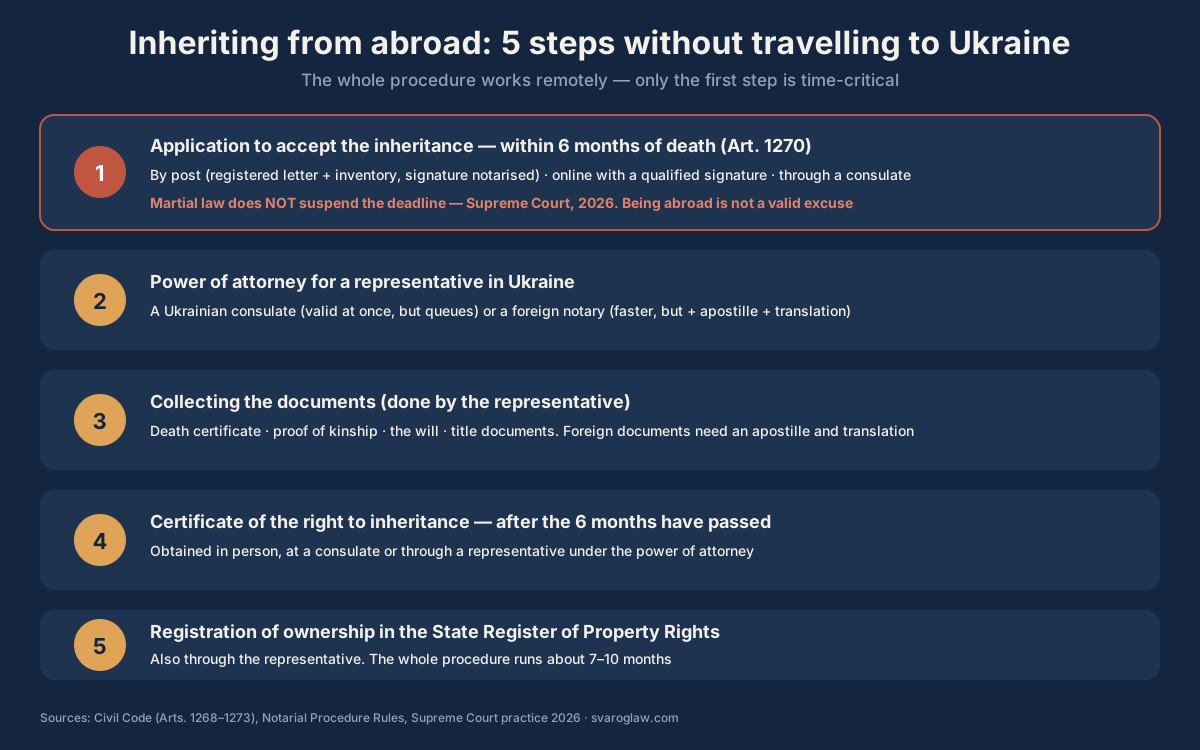
The whole procedure comes down to five steps:
- file the application to accept the estate with the notary at the place where the estate opened — within six months of the death;
- issue a power of attorney to a representative in Ukraine through a consulate or a foreign notary;
- gather the documents on the death, the family relationship and title to the property, with an apostille and a translation where required;
- obtain the certificate of the right to inherit — no earlier than six months on;
- register title in the State Register of Real Property Rights.
Step 1. File the application within six months
The application goes to the notary at the place where the estate opened, that is the deceased’s last place of residence (Article 1221 of the Civil Code). Where that was abroad, the place of opening is determined under the Law “On Private International Law”.
The key restriction is this: under Article 1269(2) of the Civil Code and sub-paragraph 3.3 of paragraph 3 of Chapter 10 of Section II of the Procedure for Notarial Acts, the application to accept an estate is filed by the heir in person. It cannot be filed by a representative under a power of attorney, which is why handling an estate remotely begins not with the power of attorney but with the application itself. There are three ways:
- by post — by insured letter with an inventory of the contents and confirmation of delivery; the signature is certified by a Ukrainian consul or a foreign notary;
- electronically — by an application signed with a qualified or advanced electronic signature and sent by electronic means;
- through a Ukrainian consulate in your country: a consul is empowered to certify signatures and take steps to safeguard estate property (Article 38 of the Law “On Notaries”).
One provision saves people who are out of time. Under sub-paragraph 3.5 of the same Procedure (as amended by Ministry of Justice Order No. 405/5 of 14 February 2025) the notary must accept an application sent by post without a certified signature, or one bearing an electronic signature: they open the estate file and tell the heir what properly executed document to supply. And sub-paragraph 3.21 provides that an application posted before the six months expire is treated as filed in time, even if it reaches the notary later; for an electronic application the cut-off is 11.59 p.m. on the last day.
If you were permanently living with the deceased when the estate opened, Article 1268(3) treats you as having accepted it, and no application within six months is needed. Living together is proved by an extract from the community register, a certificate of registered residence, or a court decision.
Step 2. Issue a power of attorney to a representative in Ukraine
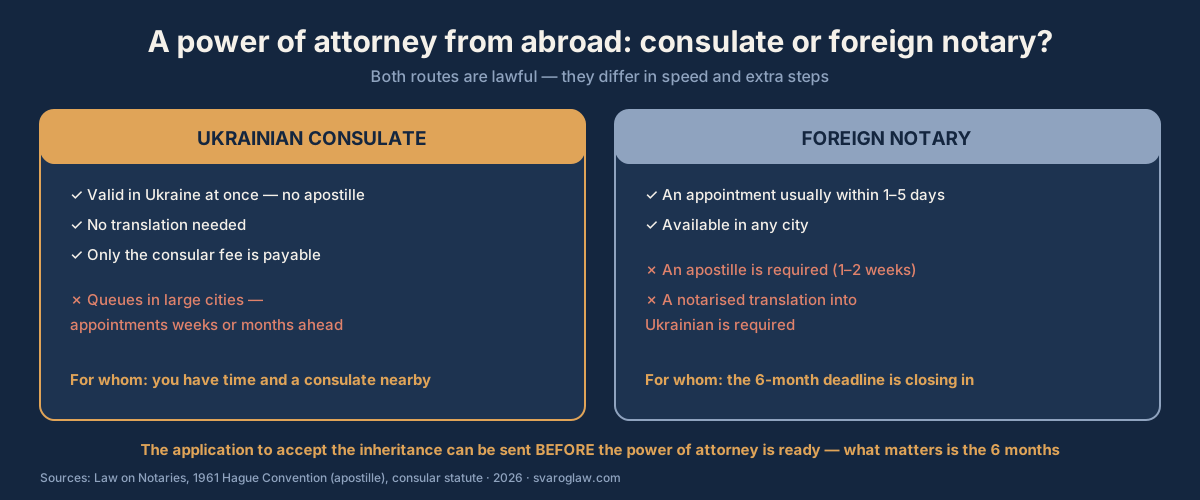
Gathering the documents, dealing with the notary and registering title are entrusted to a representative — a relative or a lawyer. The power of attorney is issued by one of two routes.
| Criterion | A Ukrainian consulate | A foreign notary |
|---|---|---|
| Legal effect in Ukraine | Immediate, with no legalisation | Needs an apostille and a certified translation, except in countries with a legal assistance treaty |
| How long it takes | Depends on the queue — weeks to several months in large cities | Usually 1–5 days, plus 1–2 weeks for the apostille |
| Indicative cost | The consular fee; around 80 US dollars for a power of attorney over property | The notary’s tariff plus the apostille and the translation |
| Who it suits | Those near a consulate with time in hand | Those who need speed, or are far from a consulate |
The consular fee is set by the Regulation on the Consular Fee of Ukraine (Ministry of Foreign Affairs Order No. 182 of 23 April 2018); the exact tariff and the list of documents are published on the particular mission’s website. A consul does not certify contracts disposing of or mortgaging property in Ukraine, but a power of attorney to handle an estate is not on that list of restrictions.
Step 3. Gather the documents
- the death certificate;
- documents on the family relationship: birth, marriage and name-change certificates, so that the chain is complete;
- the will, if there is one;
- the title documents for the property: contracts, certificates, register extracts, the technical passport;
- your passport and tax number.
Documents drawn up abroad are submitted with an apostille and a certified translation into Ukrainian. The exception matters: with countries with which Ukraine has legal assistance treaties in force, no apostille is needed at all. Article 15 of the 1993 Treaty between Ukraine and the Republic of Poland on legal assistance exempts official documents from legalisation, and the treaties with the Czech Republic, Lithuania, Latvia, Estonia, Hungary, Romania and Moldova do the same. The list and the Ministry of Justice’s guidance are published on zakon.rada.gov.ua. Documents held in Ukraine are gathered by the representative under the power of attorney, and lost ones are recovered through the civil registry or by lawyer’s requests.
Step 4. Obtain the certificate of the right to inherit
The certificate is issued once six months have passed since the estate opened (Article 1298) — in person, at a consulate, or through a representative under a power of attorney. Before issuing it the notary verifies the death, the basis of succession, the composition of the estate and the circle of heirs. Where the estate includes property subject to state registration, the heir is obliged to apply for the certificate (Article 1297). Before the six months are up a notary may only authorise the withdrawal of part of the deceased’s bank deposit, and then only in circumstances of substantial importance (Article 1298(3)).
Step 5. Register title
For property the certificate is not the end: title is entered in the State Register of Real Property Rights, and the representative does that too. Once registered, the property can be dealt with — sold, given away or let, under a separate power of attorney. The first sale of inherited housing in a calendar year is not taxed: the three-year ownership condition does not apply to inherited property (paragraph 172.1 of the Tax Code).
If the six months have already passed
There are two routes. The first is the written consent of all the heirs who accepted the estate to your filing the application (Article 1272(2)); that is the quickest route where there is no family conflict. The second is a claim to the court for an additional period sufficient for filing (Article 1272(3)). The court grants additional time only for a valid reason, and the case law remains strict: neither martial law nor living abroad is accepted as one in itself. What works is individual circumstances — prolonged treatment, being in occupied territory with no access to a notary, proven ignorance of the death. Evidence decides the outcome, so court representation is appropriate here.
Typical mistakes of heirs abroad
- Waiting for “the end of the war” in the belief that time limits are suspended. The six months under Article 1270 apply, and the Supreme Court has confirmed it.
- Asking a relative to file the application under a power of attorney. Article 1269(2) requires it to be filed in person, so the notary will not accept it — and the deadline passes meanwhile.
- Sending the application by ordinary letter with no inventory of the contents: neither the contents nor the date can be proved afterwards.
- Having a power of attorney drawn up by a foreign notary without an apostille and translation where there is no legal assistance treaty: the document will not work in Ukraine.
- Booking a consular appointment “for later”: in large cities the queue eats months out of the deadline.
- Not checking the deceased’s debts. An estate includes obligations too, up to the value of what is received (Article 1282), and a creditor has six months from the issue of the certificate to make a claim (Article 1281). Sometimes renouncing the estate under Article 1273 is the rational course, and that too can be done remotely.
- Forgetting the tax: a non-resident pays 18% income tax plus the 5% military levy, and must pay before the notarial formalities, because without proof of payment the notary will not issue the certificate (paragraph 174.4 of the Tax Code).
When you do not need a lawyer
If you are the sole heir in the first class, the documents for the flat are in order and there is a relative in Ukraine ready to act under a power of attorney, the procedure goes through without a lawyer: the application by post or through a consulate, the power of attorney, the representative, the registration. Help is needed where the deadline has passed, where the heirs are in conflict, where the documents on the property or the family relationship have been lost, or where there is nobody in Ukraine to entrust the matter to.
Questions and answers
Can an estate be handled without coming to Ukraine?
Yes, entirely. The application is sent by post, filed through a consulate or signed electronically; a representative under a power of attorney gathers the documents and registers title; and the certificate of the right to inherit can even be obtained at a consulate (Article 38 of the Law “On Notaries”).
Can my representative file the application to accept the estate?
No. Article 1269(2) requires the heir to file it in person, and the Procedure for Notarial Acts repeats that. A power of attorney works at every later stage, but not at this one.
How long do I have to file?
Six months from the death (Article 1270). Martial law does not suspend it: the Supreme Court has held that Cabinet Resolution No. 164 contradicts the Civil Code and is not to be applied.
I am abroad and have missed the six months. Is that a valid reason?
Not in itself. Neither the war nor living abroad restores the period automatically. What gives a chance is a combination of individual circumstances (treatment, occupation, proven ignorance of the death) or the written consent of the other heirs under Article 1272(2).
Where should I have the power of attorney issued — at a consulate or by a local notary?
A consular power of attorney takes effect in Ukraine immediately, but the queues are long. One from a foreign notary is quicker but needs an apostille and a translation, except in treaty countries. If time is short, the second route is usually faster.
How do I send the application by post correctly?
By insured letter with an inventory of the contents and confirmation of delivery, with the signature certified. If there is nowhere to have it certified, send it uncertified: the notary must accept it, open the estate file and tell you what to supply, and the date of posting fixes your compliance with the deadline.
I was registered at the same address as the deceased. Do I still need to file?
If you were permanently living with the deceased when the estate opened, you are treated as having accepted it (Article 1268(3)). Registration alone is not the same as living together, so the fact is proved by an extract from the community register or a certificate of registered residence — and the documents for the certificate still have to be submitted.
Is an apostille needed on documents from Poland or the Czech Republic?
No. Under Article 15 of the 1993 Ukraine–Poland legal assistance treaty official documents are accepted without legalisation, and equivalent treaties apply with the Czech Republic, Lithuania, Latvia, Estonia, Hungary, Romania and Moldova. A certified translation into Ukrainian is still required.
How long does the process take remotely?
The certificate is issued no earlier than six months after the death (Article 1298). Allowing for the power of attorney, gathering the documents and registering title, the realistic horizon is 7–10 months, and more than a year where the deadline has to be restored in court.
What tax will I pay as an heir abroad?
If you have kept Ukrainian tax residence and are in the first or second degree of kinship, 0%. If you have become a non-resident, 18% income tax plus the 5% military levy, payable before the notarial formalities. The full table of rates is in our article on inheritance tax.
Sources
- Civil Code of Ukraine, Arts. 1221, 1268–1273, 1281, 1282, 1297, 1298 — zakon.rada.gov.ua/laws/show/435-15
- Procedure for Notarial Acts by Notaries of Ukraine, Ministry of Justice Order No. 296/5, Chapter 10 of Section II (sub-paras. 3.3, 3.5, 3.20, 3.21) — zakon.rada.gov.ua/laws/show/z0282-12
- Law of Ukraine “On Notaries” No. 3425-XII, Art. 38 (notarial acts by consulates) — zakon.rada.gov.ua/laws/show/3425-12
- Ministry of Justice guidance on applying legal assistance treaties and dispensing with legalisation — zakon.rada.gov.ua/laws/show/v_291323-10
- Cabinet of Ministers Resolution No. 164 of 28 February 2022 “Certain Notarial Matters under Martial Law” — zakon.rada.gov.ua/laws/show/164-2022-п
- Tax Code of Ukraine, Art. 174, para. 172.1 — zakon.rada.gov.ua/laws/show/2755-17
- Regulation on the Consular Fee of Ukraine, Ministry of Foreign Affairs Order No. 182 of 23 April 2018 — zakon.rada.gov.ua/laws/show/z0610-18
Handling an estate remotely with Svarog
Tell us where you are and when the estate opened — we will work out how much time is left, advise the quickest way to obtain a power of attorney in your country, and run the whole matter in Ukraine for you: from the application to the notary through to the registration of title. If the deadline has passed, we will assess the prospects honestly before you spend anything. Related services: succession lawyer, court representation, immigration lawyer, full price list.
+38 095 554-54-24 · Kyiv, 7 Khoriva Street (Podil) · Mon–Fri 9.00–18.00