The commonest situation in our practice is this: the person has a ground for deferral, but it has not been documented. The certificate of the father’s disability has expired, guardian status has not been confirmed, the children’s details are not in the register, the employer never completed the reservation. The recruitment centre’s board works with what it sees in the registers.
From 1 November 2025 the procedure itself changed: applications for deferral are no longer brought to the recruitment centre. They are submitted through the Reserve+ app or on paper through an administrative service centre, and the centre merely takes the decision. As a result some refusals arise at the technical stage: the person applied through the wrong channel, or their ground does not appear in the registers Reserve+ draws on.
We begin with checking whether your ground exists in law and not only in fact. Then we turn it into documents, file through the right channel, and challenge an unlawful refusal in the administrative court.
The main grounds, and the conditions attached to them
The list is set out in Article 23 of the Law “On Mobilisation Preparation and Mobilisation” and is exhaustive. The commonest grounds are:
Grounds under Art. 23
- caring for a person with a group I or II disability, provided no one else is legally obliged to support them;
- raising a child with a disability;
- three or more children under 18. Condition: no maintenance arrears of more than three months;
- raising a child alone, where the other parent is absent;
- guardianship of a child;
- health, on the finding of a medical board;
- studying full time or on a dual programme. Condition: the level being studied is higher than the one already held;
- academic staff of higher education institutions on at least 0.75 of a full workload;
- reservation at a place of work classified as critically important for the economy;
- close relatives of service members killed or missing in action.
It is in these conditions that most refusals hide. Caring for a father with a disability gives no deferral if he has two other adult children; three children will not help if maintenance arrears are showing in the register.
How to apply in 2026
- Check the ground. Sometimes guardianship must first be established through the courts, a fact must be established, a disability finding renewed, or a reservation agreed with the employer.
- Update your registration data in the Oberih register, through Reserve+ or at an administrative service centre. If your data are not in the register, an application through the app will not go through.
- Apply through Reserve+ if your ground is among the digitised categories: the app pulls the data from the registers itself and no further papers are needed.
- Apply through an administrative service centre in all other cases: the administrator accepts the application with the documents and passes them to the recruitment centre. Take a receipt.
- The board’s decision. The board meets periodically, so confirmation does not appear on the day you apply. File in good time, not on the eve of the date you are summoned for.
A deferral that is granted shows in Reserve+ as an entry in the electronic registration document, with an expiry date.
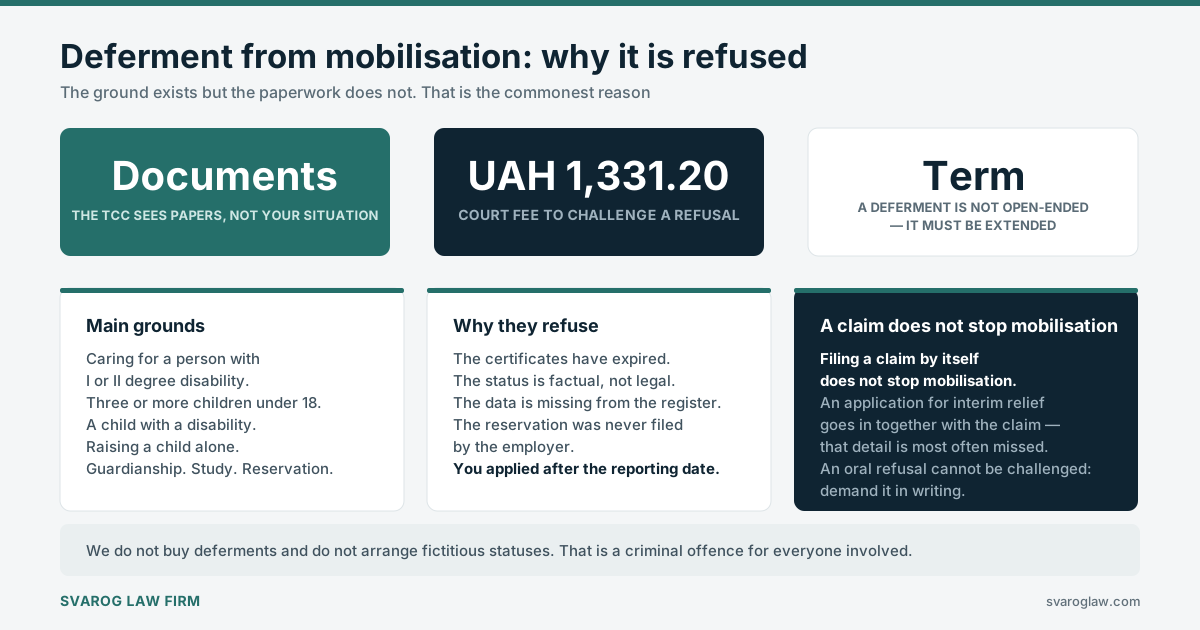
Why applications are refused
Refusals are rarely arbitrary; they usually come from defects in the documents and the data:
- the ground is not documented: the fact exists, the paper does not;
- documents have expired: old disability certificates, findings of the assessment team, certificates of household composition;
- the status has not been formalised: the guardianship is factual, not legal;
- the data are missing from the registers: Oberih, the central disability database, the civil status register;
- the reservation was not completed by the employer, or was completed with errors;
- the application went through the wrong channel, or without a document the service centre should have forwarded with it.
So most of a lawyer’s work here goes on documents and registers. The cases that reach court are those where the ground is proved and the decision is still negative.
If you are refused
- Obtain a written decision with reasons. An oral “you don’t qualify” cannot be challenged. You need the board’s decision or a written answer stating the reason.
- Analyse the reason. If the refusal was for want of documents, it is quicker to supply them and reapply. If the board rejected a proven ground, court is what remains.
- An administrative claim. Decisions and inaction of a recruitment centre are challenged in the administrative court under the CAP. The court fee is 0.4 of the subsistence minimum, that is 1,331.20 UAH in 2026.
- Interim relief. Filing a claim does not by itself halt mobilisation. Without an order for interim relief under Arts. 150–151 CAP the recruitment centre can complete the paperwork for despatch before the first hearing, so we file the application for interim relief together with the claim.
Inaction — where the application was filed and no decision follows — is challenged in the same way as a refusal. The court then orders the board to consider the application on its merits.
Extending a deferral
A deferral is granted for a fixed period.
For the categories whose ground is visible in the state registers (disability, three or more children, care), the extension happens without an application: the state checks the data itself and extends the period.
Everyone else must initiate the extension themselves, in good time and with an updated set of documents. This is where deferrals are most often lost: people assume the extension is automatic when their ground is not one of those. We track these dates for our clients and check that the entry in Reserve+ has been updated.
What we do not do
We do not buy deferrals, arrange sham guardianships, “come to arrangements” with recruitment centres or organise diagnoses that do not exist. These are criminal offences for everyone involved, the client included. A sham ground is also revoked retrospectively, taking the deferral with it.
Dates to keep an eye on
The deferral calendar
- The date on the summons. File before it: applying does not remove the duty to attend, but a proven ground changes the board’s decision.
- The validity of the certificates. The household certificate, the assessment team’s finding and the reservation document must be valid on the date the application is considered, not the date it is filed.
- The expiry of the deferral itself. A month before it runs out, check the status in Reserve+: if the extension is not automatic, apply in advance.
- Six months for an administrative claim from the day you learned of the refusal (Art. 122 CAP). The court restores the period only for valid, documented reasons.
- The term of the reservation. Leaving the company cancels it at once.
A case from our practice
In the spring of 2026 a man of 38 came to us who cares for his father, who has a group II disability. Reserve+ would not accept the application: the father was undergoing review by an assessment team and his old disability certificate no longer appeared in the register. We obtained an extract confirming the current finding, gathered the documents showing that the father has no other children obliged to support him, and filed through the administrative service centre with an inventory of the enclosures. The board granted the deferral about two weeks after filing. The client’s costs were the consultation and help with assembling and filing the papers; the case never reached court (details changed).
Cost of services
Court fees in 2026: an administrative claim to set aside a refusal or to have inaction declared unlawful costs 0.4 of the subsistence minimum, that is 1,331.20 UAH; filed through the Electronic Court the rate is multiplied by 0.8, giving 1,064.96 UAH. An appeal costs 150 % of the fee for the claim. Applying for a deferral through Reserve+ or a service centre is free. If the claim succeeds, the costs are recovered from the defendant.
Questions and answers (deferral from mobilisation)
What if Reserve+ does not recognise my ground?
The app works only with digitised categories and draws its data from the state registers. If the ground is not in the register, or the data are out of date, the application will not go through. In that case the register entry is updated first, and where that is impossible a paper application is filed through an administrative service centre with the original documents.
Can a deferral be arranged from abroad?
An application through Reserve+ can be made from any country, provided you have access to the app and the register data are current. The paper route through a service centre requires a representative under a power of attorney certified by a notary or a consul. Challenging a refusal is also handled remotely, through the Electronic Court and video hearings.
How long does an application take to decide?
The decision is taken by the recruitment centre’s board, which meets on its own schedule, so it usually takes anywhere from a few days to a few weeks for the entry to appear in Reserve+. If the decision is delayed without explanation, that is inaction and it can be challenged in court.
Will the deferral be revoked if the ground disappears?
Yes. When the ground ends, so does the deferral: the child turns 18, you leave the company that reserved you, or you are withdrawn from your course. You must report such changes yourself, or the register entry will be cancelled retrospectively.
Can I apply on behalf of my husband or son?
The application is made in the name of the person liable for service. Through Reserve+ only the account holder can do it; through a service centre a representative can file under a power of attorney. A relative without one can gather the documents but cannot file the application.
What does challenging a refusal in court cost?
The court fee is 1,331.20 UAH, or 1,064.96 UAH through the Electronic Court. The lawyer’s fee for the claim and the hearings is on top. If you win, the fee and the legal costs are recovered from the recruitment centre, though the court may reduce the fee to what is proportionate to the complexity of the case.
Contact Svarog about a deferral from mobilisation
Describe the situation and send us whatever documents you already have. We will tell you which ground in Article 23 it falls under, which documents are missing, which channel to file through and how long it will take. If there is no lawful ground, we will say so at the consultation.