A handwritten IOU is not “a scrap of paper” but a full loan contract (Arts. 1046–1047 CC). A court will uphold the debt if the text shows who the parties are, the amount, that the money was handed over, and bears the borrower’s signature. Notarisation is not required, and neither are witnesses.
The difficulties usually lie not in the evidence but in the deadlines: people wait for years “so as not to spoil the relationship”, and come when the limitation period is running out or the borrower has nothing left.
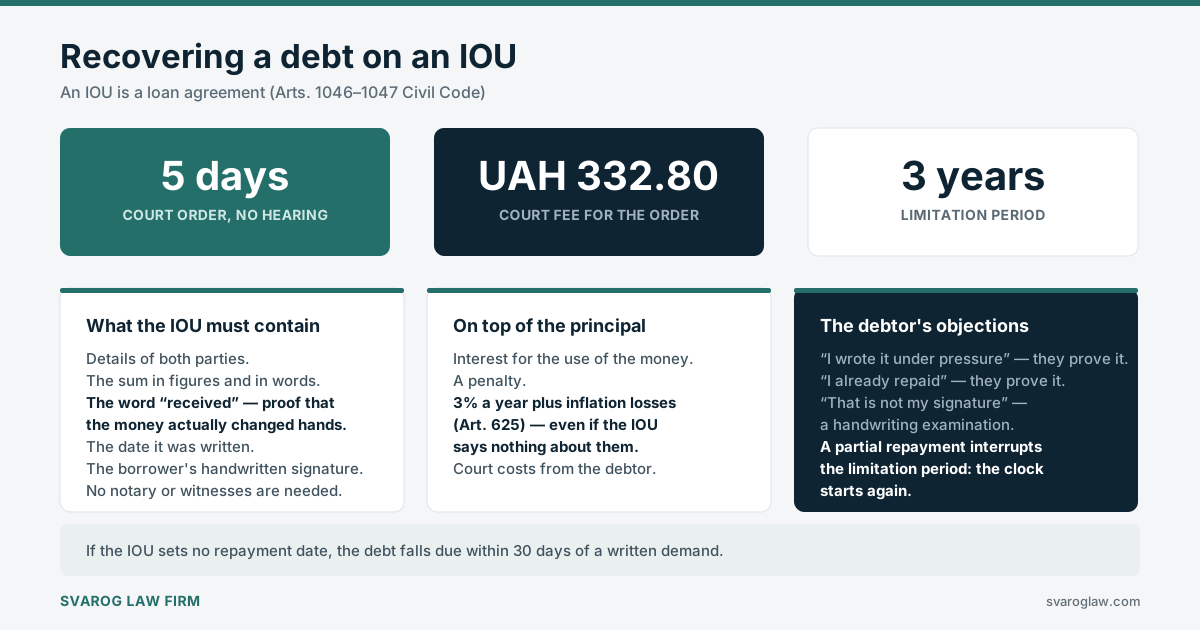
Recovering on an IOU covers more than the principal. The law allows you to claim 3 % a year plus inflation losses for the whole period of default (Art. 625 CC), even if the note says nothing about them.
What the court looks for in the note
The minimum on which a court will uphold the debt:
The essential details
- who lent and who received: full names, ID details, tax numbers, addresses;
- the amount in figures and in words;
- that the money was handed over: the wording “received”, not “undertake to take”;
- the date it was written;
- the borrower’s signature, in their own hand.
Desirable but not essential: the repayment date, the rate of interest, penalties for default.
The commonest fatal mistake is wording that does not show the money was actually handed over. A note saying “I undertake to repay”, without the word “received”, leaves the borrower room to say they never saw the money, and the transfer then has to be proved by bank records, witnesses and correspondence.
If the note sets no repayment date, the debt is repayable within 30 days of a demand being made (Art. 1049 CC). So the first step is a written demand, and time runs from it.
What can be recovered besides the principal
- The principal — the sum stated in the note.
- Interest for the use of the money. If the note is silent, the National Bank’s discount rate applies Art. 1048 CC. A loan between individuals is interest-free only where it is unconnected with either party’s business and does not exceed 50 tax-free minimums, that is 850 UAH.
- A penalty — only if the parties agreed one in the note itself and fixed its size. Without such a term no penalty is recoverable on a loan between individuals, so do not assume a “double discount rate” applies.
- 3 % a year and inflation losses Art. 625 CC for the whole period of default, whatever the note says. Inflation losses apply to a hryvnia obligation; a foreign-currency debt is not indexed.
- Costs: the court fee and legal fees are normally awarded against the debtor if you win Art. 141 CPC, but legal costs must be claimed and evidenced before the hearing ends.
On large sums and after several years of default, items 2–4 change the total substantially. They must be calculated before the claim is filed: increasing the claim later is harder.
Demand, court order, claim
The written demand
30 days to repayA demand is always needed where the note sets no repayment date: without it the debt is not yet legally overdue, so there is no basis for the 3 % a year or the inflation losses. We send it by registered post with an inventory of the contents to the borrower’s registered address and keep the receipt: it becomes the first piece of evidence. Sometimes the demand alone brings the money back without any court.
A court order: 5 days
5 days, fee 332.80 UAHThe quickest route, and the one most lenders forget. The conditions: the debt is evidenced by a written transaction (an IOU qualifies), there is no dispute as to the right, and the sum does not exceed 100 subsistence minimums — in 2026, 332,800 UAH (Art. 161 CPC).
- decided in 5 days, with no hearing and no summonses;
- the court fee is 332.80 UAH instead of 1 % of the sum;
- the order is itself an enforceable instrument.
A claim
several monthsA claim is filed where the debtor disputes the debt, says they “wrote it under pressure”, or where the sum exceeds the limit for a court order. The law allows 60 days from the opening of the case for a simplified hearing, and up to 60 days of preparatory proceedings plus the hearing on the merits in ordinary ones. In practice, with adjournments and judges’ leave, first instance takes several months, and longer with an appeal. The court fee is 1 % of the value of the claim (from 1,331.20 to 16,640 UAH for individuals in 2026).
The debtor’s standard defences, and how to meet them
“I wrote it under pressure”
The debtor must prove the pressure. A bare assertion is not accepted; it takes police reports, witnesses, expert evidence.
“I never got the money, it was a formality”
Here the wording decides. The word “received” closes the question; its absence is the main weakness, offset by a bank transfer on the same day and by correspondence.
“I already paid it all back”
The debtor must prove repayment: by the lender’s receipt or by bank statements. Assertions do not work.
“That is not my signature”
The court orders a handwriting examination, which needs the original note and specimen signatures of the debtor from the same period. Cost and timing depend on the expert institution and the number of specimens, so we give a figure at the consultation once we have the documents. If the debtor avoids providing specimens, the court may treat as established the very fact the examination was to determine (Art. 109 CPC) — so delay works against them.
“The limitation period has expired”
The most dangerous defence, since the court applies limitation only if a party pleads it. A part repayment or a written acknowledgment interrupts the period (Art. 264 CC) and time starts afresh — which is why a 500 UAH transfer “towards the debt” sometimes saves the whole claim.
Limitation on an IOU in 2026
The general period is 3 years (Art. 257 CC). From 2 April 2020 limitation did not run: first because of the quarantine, then because of martial law. Law No. 4434-IX ended that pause, and from 4 September 2025 time began running again.
For IOUs that means old debts from 2018–2021 have a deadline once more, and for some of them it falls in 2026–2027. Where the note names a repayment date, limitation runs from the day after it. Where it does not, from the 31st day after the written demand was served. Where the debtor repaid in instalments, the period runs separately for each payment, so part of the claim may be alive and part dead.
A case from our practice
In 2025 a man came to us who in 2019 had lent an acquaintance 380,000 UAH on a note with no repayment date. For several years the borrower “promised next month”, then stopped answering. We sent a written demand by registered post, waited out the 30 days and applied for a court order: the sum was within the limit and the note contained the word “received”. The debtor had the order set aside, so we filed a claim with a calculation of the 3 % a year and inflation losses for the period after the demand, and the court granted almost all of it. About seven months passed from the demand to the first-instance judgment; our fee was 18,000 UAH and the court awarded the court fee against the debtor. (details changed)
The lender’s typical mistakes
Waiting “a bit longer”
The most expensive mistake: as the time passes, limitation expires and the debtor’s assets disappear.
Filing without a calculation
Interest, the 3 % a year and inflation losses are calculated as at the date of filing; increasing the claim afterwards is harder, and on large sums the difference runs to tens of thousands of hryvnia.
Accepting a part payment without a document
Unless you record what and which period the payment covers, the debtor will tell the court they repaid the principal, and you lose the basis for interest.
Not checking for assets
A judgment against a debtor with nothing is just paper. The property register, the Unified Register of Debtors and the automated enforcement system show whether there is anything to recover from — before you pay the court fee.
Sending the demand by messenger
The 30 days under Art. 1049 CC run from proof of service, and a screenshot of a chat is not always accepted as such.
How we work
- We analyse the note: whether it will hold up in court and where its weaknesses lie.
- We calculate the full claim: principal, interest, 3 % a year, inflation losses.
- We check limitation for each sum separately.
- We check the debtor’s assets against the registers: whether there is anything to recover from.
- We choose the procedure: demand, court order or claim.
- We handle enforcement: freezing accounts and property, travel bans.
Cost of services
Court fees in 2026: an application for a court order costs 332.80 UAH; a claim costs 1 % of its value, but not less than 1,331.20 and not more than 16,640 UAH for an individual. Filing through the Electronic Court reduces the rate by 20 %. If you win, the fee is recovered from the debtor.
Calculate the court fee on a claim
Up to 332,800 UAH an IOU can go by court order, with a fee of 332.80 UAH.
Questions and answers (Recovering a debt on an IOU)
The note is in dollars. In which currency will the court award the debt?
The court awards the sum in the currency of the obligation, that is in dollars, stating the hryvnia equivalent at the National Bank rate on the day of judgment. Inflation losses under Art. 625 CC are not added to a foreign-currency debt, while the 3 % a year is awarded in the same currency. The enforcement officer pays out subject to currency legislation, so it is best to prepare the calculation both ways.
Can the debt be recovered if the debtor has gone abroad?
Yes. The court hears the case at the debtor’s last registered address in Ukraine and sends summonses there, and where necessary summons them through a notice on the judiciary’s website. Enforcement is harder: if there are no assets in Ukraine, the judgment has to be recognised in the debtor’s country of residence, which is a separate procedure with its own timescales and costs.
What if the three years have already passed?
First recalculate, allowing for the 2020–2025 pause: often the period has not in fact expired. If it truly has, two routes remain: obtain a written acknowledgment or a part payment from the debtor, which interrupts limitation, or file the claim and ask the court to accept the reasons for the delay as valid. Limitation applies only if the debtor pleads it, so the case is not automatically hopeless.
The debtor has died. Can the money be claimed from the heirs?
Yes, the debt forms part of the estate, and the heirs are liable up to the value of what they inherited (Art. 1282 CC). The creditor must make the claim within six months of learning that the estate has been opened, or within a year of the repayment date falling due — missing that period extinguishes the claim, so act at once.
The note is typed, with only the signature by hand. Is it valid?
Yes, the law does not require an IOU to be handwritten. But handwritten text gives more material for a handwriting examination if the debtor disputes authorship. Where the signature is the only handwritten element, back the position up with a bank transfer, correspondence, or video of the money being handed over.
Can the case be handled remotely, without coming to Kyiv?
Yes. You send the documents by messenger or email, we sign the engagement electronically, the claim goes through the Electronic Court at the reduced fee, and the lawyer appears on a warrant without you. You are needed in person only if the court calls you to give evidence or handwriting specimens.
Contact Svarog about recovering a debt on an IOU
Send us a photograph of the note: we will assess whether it will hold up in court, calculate the full claim with interest, the 3 % a year and inflation losses, check limitation and choose the procedure. If there is nothing to recover from the debtor, you will know before you pay the court fee, not after the judgment.