
Олександр Сич
10 July 2026
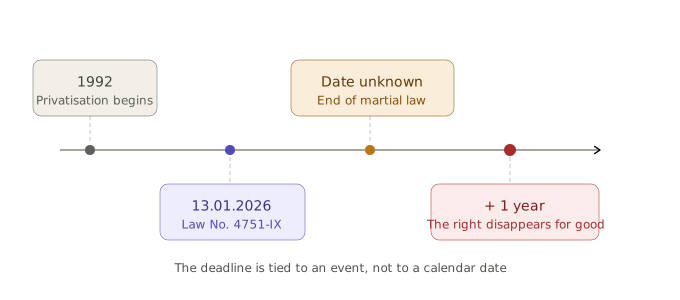
There is no calendar date for the end of free housing privatisation. Under clause 2 of Chapter IV of Law No. 4751-IX, the Law “On the privatisation of the state housing stock” No. 2482-XII ceases to have effect one year after the day martial law ends or is lifted. Until then the norm of 21 m² per person plus 10 m² per family applies, the paperwork costs 3,000–5,000 UAH and takes one to three months.
On 13 January 2026 parliament passed Law No. 4751-IX “On the fundamentals of housing policy”, the President signed it on 12 February, and on 15 February 2026 it took effect. It replaced the 1983 Housing Code of the Ukrainian SSR and started the countdown for the Law “On the privatisation of the state housing stock” No. 2482-XII, under which millions of families have taken ownership of their flats free of charge since 1992.
For anyone still living in state or municipal housing under an occupancy order or a tenancy agreement, one practical question remains: how much time is left. Neither a lawyer nor the privatisation authority can answer precisely, because the countdown is tied not to the calendar but to the day martial law ends or is lifted. That is why headlines about a “2027 deadline” are sound only as a forecast, not as a rule of law.
What Law No. 4751-IX changes
If you have already privatised your flat, nothing changes for you: the law has no retrospective effect, and your ownership right stays recorded in the State Register of Property Rights. Repealing the 1992 law concerns future procedures, not certificates already issued.
For everyone else the law builds a new housing architecture in three parts:
- the private stock — everything already owned by individuals and companies;
- the housing stock of territorial communities, that is municipal housing;
- the state housing stock.

The main innovation is that state and municipal housing will be let (as social or service housing) with no right to acquire it free of charge afterwards. The rent for social housing will depend on the family’s income, taking benefits and subsidies into account, with part of the cost covered by the budget.
Why the state is winding up free privatisation
The Confederation of Builders of Ukraine estimates that about 86 % of Ukrainians own their homes, against only 42.5 % in Switzerland. The flip side of that figure is that almost no state or municipal stock is left while demand has grown: according to the International Organization for Migration, 60 % of internally displaced people spend more than half the family income on rent. Housing reform was one of the conditions of the Ukraine Facility programme, so the state rolling it back is unlikely.
When free privatisation ends: what the law actually says
Clause 2 of Chapter IV “Final and transitional provisions” of Law No. 4751-IX provides that the Law “On the privatisation of the state housing stock” No. 2482-XII and the parliamentary resolution on bringing it into force cease to have effect one year after the day martial law in Ukraine ends or is lifted. There is no day or month in the provision, and that matters.
Three consequences follow for anyone planning to privatise:
- Nobody can name the exact day the window closes: it depends on the decision to end martial law.
- Martial law is extended by separate statutes for set periods, so the countdown may begin after any of them, and a year is all the time a person will get.
- That year is for completing the entire procedure including state registration of ownership, not merely for filing the application.
Difficult cases are therefore best resolved in advance: a lost occupancy order, discrepancies in who is registered, or a resident refusing to take part add anywhere from weeks to months, and litigation started at the last minute risks not finishing before the window shuts.
Who the changes will hit hardest
| Your situation | While Law No. 2482-XII is in force | A year after martial law ends |
|---|---|---|
| The flat is already privatised | nothing needs doing | ownership is not revisited, the law has no retrospective effect |
| Municipal or state flat under an order or tenancy | free privatisation within the 21 + 10 m² norm | only social tenancy, with rent tied to family income |
| Service flat | privatisation possible only after the flat is removed from the service category | the service stock becomes purely rental, for the duration of employment |
| A room in a hostel transferred to the community | privatisation under Law No. 500-VI | tenant status in the municipal stock |
| A hostel on a company’s books, not transferred to the community | the building must first be transferred, often through the courts | the chance of obtaining ownership all but disappears |
Service housing attracts the most illusions. Under clause 2 of Article 2 of Law No. 2482-XII, flats classified as service housing in the established manner cannot be privatised: the body that allocated the flat must first remove it from that category. Hostel residents proceed under Law No. 500-VI, which allows privatisation in buildings transferred, or due to be transferred, to the community, while disputes about the transfer itself are run by a housing lawyer.
The rules of privatisation in 2026: norms, money, timing
While Law No. 2482-XII remains in force, its rules apply. The free norm under Article 5 is 21 m² of total floor area for the tenant and for each family member, plus a further 10 m² per family.
| People registered | Free floor area norm | What happens to the excess |
|---|---|---|
| 1 person | 31 m² | the excess is bought out at the privatisation authority’s valuation |
| 2 people | 52 m² | the same, calculated from the residual value of the flat |
| 3 people | 73 m² | covers most typical two- and three-room flats |
| 4 people | 94 m² | an excess is rare |
Square metres above the norm do not block the procedure: they are bought out at the privatisation authority’s valuation, which starts from the flat’s residual value allowing for wear. Years of inflation make the sum symbolic — in practice it comes to kopecks per square metre, so it works as a formality rather than a real price for the flat.
The flat itself is transferred free; the supporting documents are not. A technical passport, archive certificates, register extracts and state registration of ownership add up to 3,000–5,000 UAH in straightforward cases, and the procedure takes one to three months. Guide prices for legal support are on the legal services price list page: a consultation from 1,500 UAH, a legal opinion from 5,000 UAH.
The right to free privatisation is given once in a lifetime. An important exception concerns those included in a privatisation as children: taking part before 18 does not burn the adult right, and the person can privatise their own home free of charge in their own name. For the generation whose parents took ownership of flats in the 1990s this is often decisive.

A step-by-step plan with timings
- Check the status of the flat with the body that holds it on its books: whether the building is on the list of properties that cannot be privatised, whether there are any attachments, and whether the flat is service housing. One visit, 1–3 working days.
- Order a technical passport. An engineer visits, measures the floor area and records the layout; it takes 3 to 10 working days to produce. Without it the application will not be accepted.
- Gather the package: passports and tax numbers of everyone registered, birth certificates for children under 14, the occupancy order or tenancy agreement, a certificate of family composition and one confirming the right to privatise has not been used. Allow up to 30 days for archive certificates.
- File the application with the privatisation authority or the administrative services centre where the flat is registered — in person or through a representative under a power of attorney. The service is not yet fully remote, although some centres accept preliminary applications online.
- Wait for the privatisation authority’s decision and obtain the certificate of ownership. The statutory time for consideration is one month from the date the documents are filed.
- Register the ownership in the State Register of Property Rights to Immovable Property. Without that entry the flat cannot be sold, gifted or passed on by inheritance without disputes.
Typical mistakes
- Waiting for an “official date”. There will not be one: the rule is tied to the end of martial law, and people will learn the countdown has begun only once the year is already running.
- Starting with the application rather than with checking the status of the flat. If it is service housing or the building has not been transferred to the community, the application will be returned and months lost.
- Ignoring someone registered there who lives in another city. Every adult must express their will: take part or give a notarised refusal. A court will restore the rights of a resident who was ignored and quash the certificate.
- Letting utility arrears build up. The debt itself does not bar privatisation, but it brings court orders and attachments, and an attachment blocks registration; the way out is restructuring the utility debt.
- Forgetting about childhood privatisation. People spend years assuming the right “burned up” back in the 1990s and never file, although the law does not restrict them.
When you do not need a lawyer
If the flat is municipal, you have the occupancy order, all the adult residents agree, the floor area fits the norm and there are no debts or attachments, the procedure is entirely manageable alone: technical passport, document package, services centre, registration. Legal help becomes necessary where the housing is service housing or a room in a hostel on a company’s books, where the occupancy order has been lost, where a resident has disappeared or refuses to sign, or where the privatisation authority has refused in writing or has stayed silent for over a month.
Questions and answers
Will an already privatised flat be taken away?
No. Law No. 4751-IX has no retrospective effect, the ownership right remains valid and needs no re-registration. It is worth checking whether your right is recorded in the State Register of Property Rights if the privatisation took place before 2013.
What is the exact date free privatisation ends?
There is no calendar date in the law. Law No. 2482-XII will cease to have effect one year after the day martial law ends or is lifted (clause 2 of Chapter IV of Law No. 4751-IX). Any “2027” or “mid-2027” in the press is a forecast by journalists and lawyers, not a rule.
How many times can housing be privatised free of charge?
Once in a lifetime. The exception is taking part in a privatisation before 18: that right is not treated as used, and as an adult the person can take ownership of a home free of charge in their own name.
Can a flat with utility arrears be privatised?
Formally the debt is not a ground for refusal: Law No. 2482-XII does not make privatisation depend on settling with suppliers. The risk lies elsewhere — a debt brings a court order and then an attachment on the property, and it is the attachment that stops registration.
What happens to those who do not make it in time?
The housing stays in state or municipal ownership, and the residents become tenants of social or service housing. The rent for social tenancy will depend on family income, but acquiring such a flat free of charge under the old procedure will no longer be possible.
Can a service flat be privatised?
While the flat holds service status, no — that is an express prohibition in clause 2 of Article 2 of Law No. 2482-XII. The body or company that allocated the flat must first remove it from the service category, and only then is the privatisation application filed.
Does the reform affect rooms in hostels?
Yes, and this is the riskiest category. Privatisation is possible under Law No. 500-VI for hostels transferred, or due to be transferred, to the community. If the building is still on a company’s books, the transfer has to be secured first, and that takes months.
What does privatising a flat cost in 2026?
The flat itself is transferred free within the norm. The technical passport, certificates, extracts and registration come to 3,000–5,000 UAH in straightforward cases. Excess square metres are bought out at the privatisation authority’s valuation from the residual value of the flat and in practice cost kopecks per square metre.
One of the registered residents refuses to take part. What now?
An adult can give a notarised refusal while keeping the right to use the flat. If the person neither refuses nor takes part, the privatisation will not go ahead without them; the courts resolve the question only where the person has lost the right to use the flat.
How long does privatisation take from application to the register entry?
With a complete package, one to three months: up to a month for the privatisation authority to consider the application, with the rest going on the technical passport, archive certificates and state registration of ownership.
Sources
- Law of Ukraine “On the fundamentals of housing policy” No. 4751-IX of 13.01.2026, Chapter IV — zakon.rada.gov.ua/laws/show/4751-20
- Law of Ukraine “On the privatisation of the state housing stock” No. 2482-XII, Arts. 2, 5 — zakon.rada.gov.ua/laws/show/2482-12
- Law of Ukraine “On securing the housing rights of hostel residents” No. 500-VI — zakon.rada.gov.ua/laws/show/500-17
- Law of Ukraine “On state registration of property rights to immovable property and their encumbrances” No. 1952-IV — zakon.rada.gov.ua/laws/show/1952-15
- Ministry for Communities and Territories Development of Ukraine, guidance on privatising state housing — mininfra.gov.ua
Privatising a flat with Svarog
Send us the address, the occupancy order or tenancy agreement and the list of registered residents — we will check whether the housing can be privatised and run the procedure from the technical passport to the register entry. If the privatisation authority has refused or is silent, we will prepare the claim. Related services: flat privatisation, housing lawyer, full price list.
+38 095 554-54-24 · Kyiv, 7 Khoriva Street (Podil) · Mon–Fri 9.00–18.00