

Олександр Сич
8 July 2026
Child maintenance is obtained through a notarial agreement or through the courts — by applying for a court order or by filing a claim. In 2026 the minimum guaranteed amount for one child is 1,408.50 UAH up to age 6 and 1,756 UAH from 6 to 18 (50 % of the subsistence minimum under Law No. 4695-IX). A claimant in a maintenance case pays no court fee, and arrears carry penalty interest of 1 % per day.
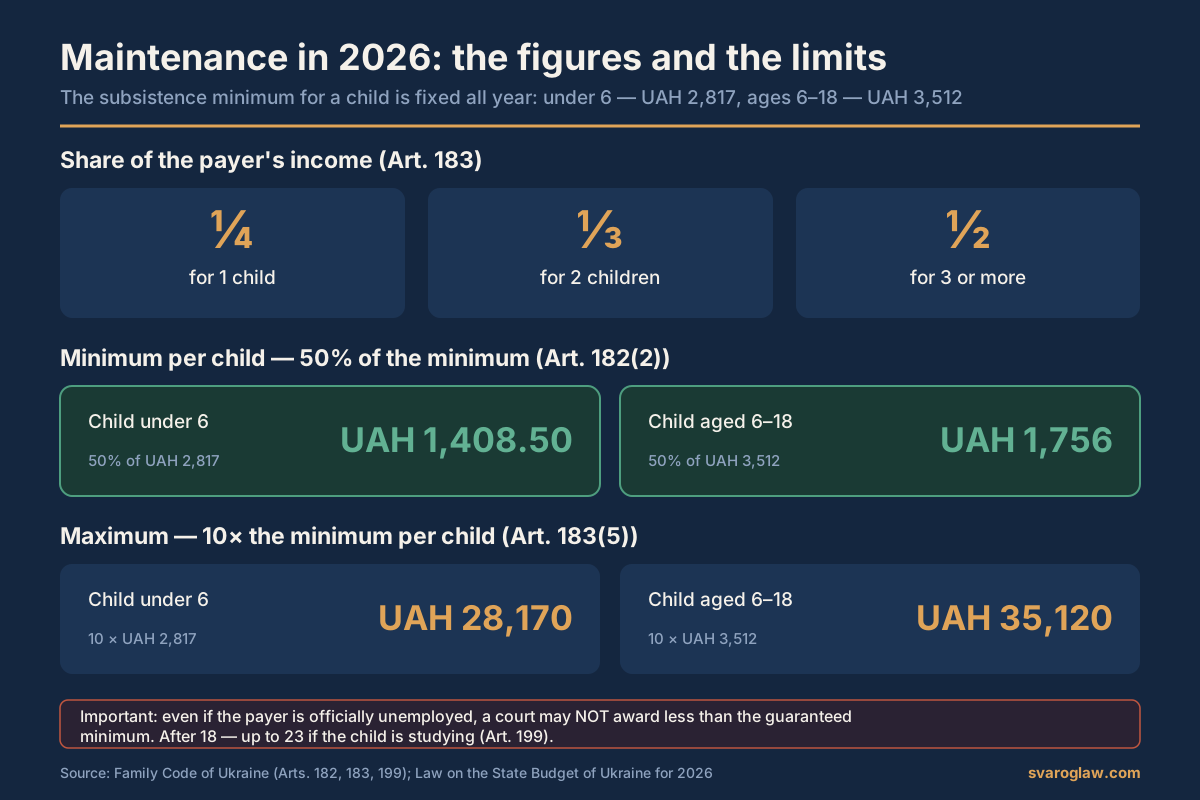
The subsistence minimum for a child in 2026 is set by the Law of Ukraine “On the State Budget of Ukraine for 2026” No. 4695-IX: 2,817 UAH for children under 6 and 3,512 UAH for children aged 6 to 18. These two figures set the floor for maintenance, because under part 2 of Article 182 of the Family Code the minimum guaranteed support for one child equals half the subsistence minimum for a child of that age.
Everything after that depends on how you enter the procedure: through a notary, through a court order or through a claim. That choice determines both the timing and how much money actually reaches the child.
How much maintenance can be obtained in 2026
The Family Code works with two benchmarks at once. The minimum guaranteed amount is 50 % of the subsistence minimum for a child of that age: the court cannot award less. The minimum recommended amount equals the full subsistence minimum — the court is not bound by it but takes it as a guide where the payer’s income allows.
| Child’s age | Subsistence minimum 2026 | Minimum guaranteed (50 %) | Minimum recommended (100 %) | Ceiling in order proceedings (10 minimums) |
|---|---|---|---|---|
| Under 6 | 2,817 UAH | 1,408.50 UAH | 2,817 UAH | 28,170 UAH |
| From 6 to 18 | 3,512 UAH | 1,756 UAH | 3,512 UAH | 35,120 UAH |
The subsistence minimum is not revised during 2026, so these figures hold all year. Having no official job does not entitle the court to go below the guaranteed minimum: under part 3 of Article 182 the court is not confined to declared income where the debtor’s actual spending plainly exceeds it.
A share of income or a fixed sum: where the quarter, third and half come from
The proportions “¼ for one child, ⅓ for two, ½ for three or more” are quoted as a general rule, although in the code they are tied to one particular procedure. Part 1 of Article 183 says only that the court determines the share of earnings. The fixed ¼, ⅓ and ½ appear in part 5 of the same article, which deals with an application for a court order, and that is where the ceiling of ten subsistence minimums per child applies.
In ordinary claim proceedings the court is not bound by those fractions: it weighs the health and means of the child and the payer, whether the debtor has other dependants, their property, and spending above ten times the subsistence minimum (clauses 3-1 and 3-2 of part 1 of Article 182). Where official income is high, a claim often yields more than an order; where income is unofficial, a fixed sum under Article 184 works better, because it is index-linked and does not depend on a salary certificate.
Two routes: a notarial agreement and the courts
An agreement between the parents
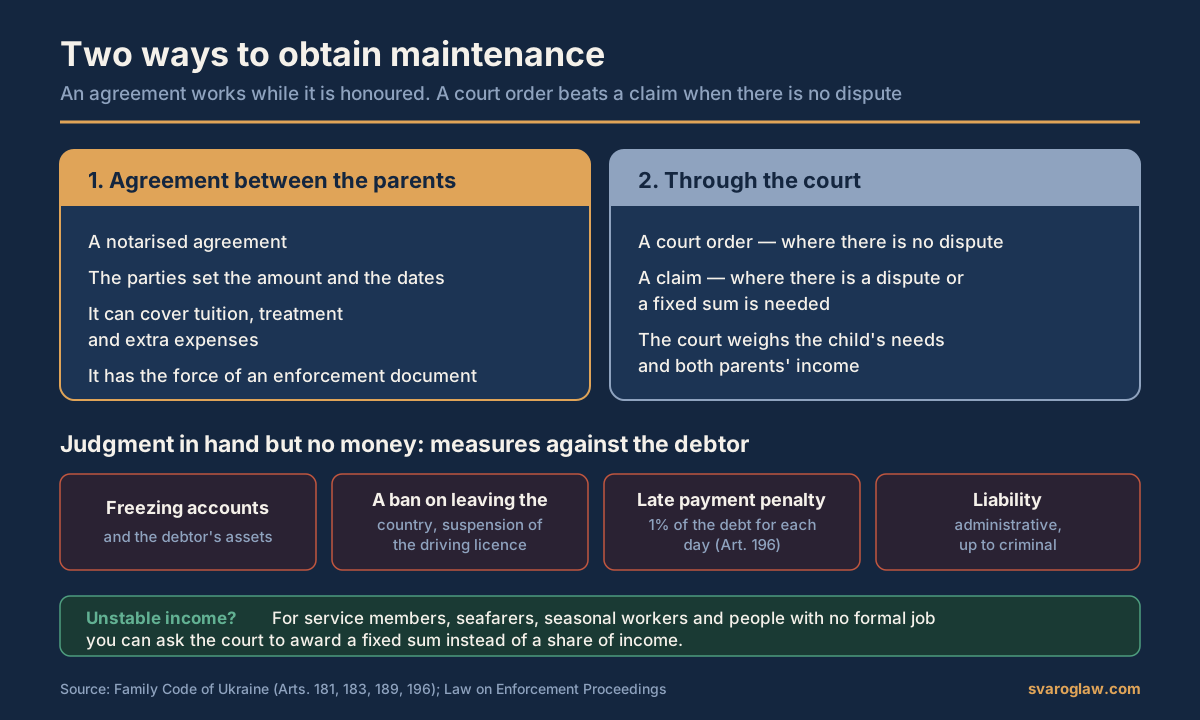
Parents can sign a notarised maintenance agreement (Article 189), setting the amount, the deadlines, how the money is transferred and how each contributes to education or medical costs. Such an agreement has the force of an enforceable instrument: if the payer stops paying, the recipient goes straight to an enforcement officer, bypassing the court. There is one condition — the agreed amount cannot be below the guaranteed minimum.
A court order
Order proceedings are designed for undisputed claims: the court decides without summoning the parties. The general fee for such an application is 0.1 of the subsistence minimum, that is 332.80 UAH in 2026, but in maintenance cases the claimant is exempt from the fee in every instance (clause 3 of part 1 of Article 5 of the Law “On Court Fees”). The weak point is that the debtor can apply to set the order aside within 15 days of service (Article 170 of the Civil Procedure Code), and then a claim has to be filed anyway.
Claim proceedings
A claim is needed where paternity is disputed, where you are seeking a fixed sum or additional expenses. It takes longer, but the court examines the evidence and the result is harder to undo. The details are on the child maintenance lawyer page.
What documents are needed
- the applicant’s passport and tax number;
- the child’s birth certificate — it is what establishes that the child descends from the defendant;
- documents showing where the child lives (a residents’ association certificate, a declaration with a family doctor, a letter from the school or nursery);
- evidence of what the child costs: medical receipts, the contract with the educational institution, doctors’ prescriptions;
- information about the defendant’s income, or an application for it to be obtained from the Pension Fund and the tax service.
Where the payer hides income, the court assesses their means from indirect data: vehicles and real estate in the registers, trips abroad, large purchases. Spending above ten subsistence minimums a month is expressly named by the law as a circumstance the court takes into account.
What to do: five steps
- Fix the starting facts: the child’s age, who they live with, whether the payer has official income, whether their address and place of work are known. The choice between an order and a claim depends on this.
- Try an agreement. A visit to a notary is cheaper and quicker than court, and the agreement is as enforceable as a judgment.
- File the application or claim with the court where you live or where the defendant lives: in maintenance cases the choice of venue belongs to the claimant. Pay no court fee, citing clause 3 of part 1 of Article 5 of the Law “On Court Fees”.
- Obtain the enforceable document and apply to open enforcement proceedings with a state or private enforcement officer.
- Check the accruals every month. Penalty interest runs from the first day of default, and after four months of arrears the restrictions on the debtor become available.
From what day maintenance is awarded and whether the past can be recovered
Under part 1 of Article 191 maintenance is awarded from the day the claim is filed, and in order proceedings from the day the application is filed. The months between support actually stopping and the application to court are, as a rule, lost, so delay costs money.
Part 2 of the same article gives the exception: maintenance for the past is awarded if the claimant proves they took steps to obtain it but could not because the defendant evaded them. The maximum period is ten years, and the evidence is correspondence, demands, approaches to the guardianship authority, bank statements showing no receipts.
Difficult payers: a service member, an unemployed person, a debtor abroad
Military service does not exempt anyone from maintenance: it is withheld from service pay. The structure of that pay changes with where the unit is, so a share of income produces an unstable figure, and in such cases a fixed index-linked sum is sought instead. The same solution works for seafarers, seasonal workers, sole traders and people in informal employment. A payer’s disability does not end the duty: the court considers their health and their real sources of income, pension and social payments included.
Where the debtor has left the country, a Ukrainian judgment is enforced abroad under the Convention on the International Recovery of Child Support and Other Forms of Family Maintenance (Hague, 2007). The documents go through the Ministry of Justice as the central authority, and the package is prepared to the requirements of the destination country — this is the stage at which cases begun without help most often stall.
What to do when the payer evades
- Penalty interest. Article 196 gives the right to 1 % of the unpaid maintenance for each day of delay, but not more than 100 % of the debt. The court may reduce it in light of the payer’s means and family circumstances, and no penalty is charged to a payer who is a minor.
- Enforcement against property. The officer inventories and sells the debtor’s property and levies execution against accounts and a share of income.
- Temporary restrictions. With arrears of more than four months (more than three where the child has a disability or serious illness) the officer restricts travel abroad, driving, weapons and hunting. The driving licence restriction is not applied where the car is the debtor’s main source of income or where they are performing military service (Article 71 of the Law “On Enforcement Proceedings”).
- Administrative liability. Arrears of six months (three months for a child with a disability or serious illness) constitute an offence under Article 183-1 of the Code of Administrative Offences: 120 to 240 hours of community service, and 240 to 360 for a repeat offence.
- Criminal liability under Article 164 of the Criminal Code arises for persistent evasion of a court judgment.
Typical mistakes recipients make
- Waiting “until he pays of his own accord”. Maintenance is awarded from the day of the application, and every month of waiting is simply unpaid.
- Relying on an oral arrangement. Without a notarial agreement or a judgment, a transfer “to the card” creates no obligation and does not count as performance.
- Asking for a share of income from a payer with no official salary. A quarter of nothing equals the guaranteed minimum, whereas a fixed sum allows the child’s real needs to be proved.
- Forgetting the penalty interest. It is claimed separately, and the longer the default lasts the larger the sum recoverable.
- Not applying to an enforcement officer after the judgment. Recovery begins when enforcement proceedings are opened, not on the date of the judgment.
When you do not need a lawyer
If the payer has an official salary, does not object to paying and both sides accept a share of income, the application for a court order is entirely manageable alone using the template on the court’s website: no fee is payable and the content requirements are few. A lawyer is needed where there is a dispute: the debtor hides income, lives abroad, challenges the order, or where penalty interest over several years has to be calculated and maintenance for the past proved. Prices for legal support are in the legal services price list, and related matters in the family law section and on the division of matrimonial property page.
Questions and answers
How much maintenance for one child in 2026?
At least 1,408.50 UAH for a child under 6 and 1,756 UAH for a child aged 6 to 18. In order proceedings a quarter of the payer’s income is awarded, but not more than ten subsistence minimums per child — 28,170 UAH and 35,120 UAH respectively.
How much maintenance for two children?
In order proceedings, a third of income for both together (part 5 of Article 183), subject to the guaranteed minimum for each child. In claim proceedings the court sets a single share.
Is a court fee payable on a maintenance claim?
No. Claimants in maintenance cases are exempt from the court fee in every instance under clause 3 of part 1 of Article 5 of the Law “On Court Fees”.
Can maintenance be recovered from an unemployed person?
Yes. Having no job does not remove the duty to support a child, and the court cannot award less than the minimum guaranteed amount. In such cases a fixed sum is usually sought.
Can maintenance be recovered for past years?
Yes, provided you prove your attempts to obtain support and the defendant’s evasion. The maximum period is ten years (part 2 of Article 191).
How much is the penalty for unpaid maintenance?
1 % of the unpaid maintenance for each day of delay, but not more than 100 % of the debt (Article 196). The court may reduce it in light of the payer’s means and family circumstances.
When is a debtor barred from leaving the country?
When the arrears exceed four months’ worth of payments, or three months in cases about supporting a child with a disability or a serious illness (Article 71 of the Law “On Enforcement Proceedings”).
Until what age is maintenance paid?
Until 18, and where an adult son or daughter continues in education and needs financial help, until 23 (Article 199).
Sources
- Family Code of Ukraine, Articles 181–184, 189, 191, 196, 199 — zakon.rada.gov.ua/laws/show/2947-14
- Law of Ukraine “On the State Budget of Ukraine for 2026” No. 4695-IX (subsistence minimum for a child) — zakon.rada.gov.ua/laws/show/4695-20
- Law of Ukraine “On Court Fees” No. 3674-VI, Articles 4 and 5 — zakon.rada.gov.ua/laws/show/3674-17
- Civil Procedure Code of Ukraine, Articles 161–170 (order proceedings) — zakon.rada.gov.ua/laws/show/1618-15
- Law of Ukraine “On Enforcement Proceedings” No. 1404-VIII, Article 71 — zakon.rada.gov.ua/laws/show/1404-19
- Code of Ukraine on Administrative Offences, Article 183-1 — zakon.rada.gov.ua/laws/show/8073-10
- Criminal Code of Ukraine, Article 164 — zakon.rada.gov.ua/laws/show/2341-14
- Convention on the International Recovery of Child Support and Other Forms of Family Maintenance — zakon.rada.gov.ua/laws/show/995_l12
Obtaining child maintenance with Svarog
Send us the child’s birth certificate and whatever you know about the payer’s income — we will assess what works better in your case: an order, a claim for a share of income, or a fixed sum. We also take on the hardest part: enforcement, penalty interest for past periods and dealing with a debtor abroad. Related services: child maintenance lawyer, divorce, full price list.
+38 095 554-54-24 · Kyiv, 7 Khoriva Street (Podil) · Mon–Fri 9.00–18.00