
A fine for breaching military registration rules is not a final decision, but a ruling which the law allows you to appeal against. Under Article 289 of the Code of Ukraine on Administrative Offences (CUAP), you have only 10 days from the date the ruling is issued to appeal against it in an administrative offence case. If you miss this deadline without a valid reason, the ruling becomes legally binding, and appealing against the fine imposed by the Territorial Military Registration and Enlistment Office (TMREO) becomes considerably more difficult. You should therefore act immediately as soon as you see the ruling in ‘Reserve+’, receive it by post or are notified of it by the enforcement service. In practice, the TCC and the SP often issue rulings in rapid succession: under Article 210 of the Code of Administrative Offences (breach of military registration rules) or Article 210-1 of the Code of Administrative Offences (breach of legislation on defence, mobilisation preparation and mobilisation), often without properly notifying the individual of the summons and without ascertaining whether they are actually at fault. Under martial law, the penalty under Article 210 of the Code of Administrative Offences for citizens ranges from 17,000 to 25,500 UAH, whilst under Article 210-1 for officials and legal entities it reaches 34,000–59,500 UAH. Following the tightening of liability under Law No. 3696-IX of 19 May 2024, the fines have increased significantly, which is precisely why every decision should be scrutinised carefully — they often contain procedural flaws that provide grounds for annulment. We analyse the specific decision, ascertain whether the Tax Control Committee followed the correct procedure, whether you were duly notified, and whether the limitation period for bringing proceedings has expired — and use this to build a case for an appeal. If there are grounds for annulment, we prepare an appeal or an administrative claim and see the case through to its conclusion.Call us on: +38 095 554-54-24. We will carry out an initial assessment of your decision and tell you straight away whether there is a chance of having it overturned.
Reasons for which the Military Registration and Enlistment Office imposes fines: Articles 210 and 210-1 of the Code of Administrative Offences
Liability for military registration is divided between two articles. Article 210 of the Code of Administrative Offences applies to conscripts, those liable for military service and reservists: failure to report when summoned without valid reasons, failure to update personal details, failure to complete military registration documents, and changing one’s place of residence during wartime without the knowledge of the Military Registration and Enlistment Office. Article 210-1 of the Code of Administrative Offences imposes penalties for breaches of legislation on defence and mobilisation — in particular, this applies to officials and organisations responsible for keeping records of employees. An important detail that the Territorial Military Commissariat usually fails to mention: under Part 5 of Article 258 of the Code of Administrative Offences, during a special period, a report on an offence under Articles 210 and 210-1 may not be drawn up only if the person was duly notified of the date, time and place of the summons and the TCC has supporting documents confirming that the person received the summons. If there is no evidence that the summons was served, there is no legal basis for a fine. This is one of the strongest grounds for appeal. If the issue concerns not the fine but the summons or notice itself, please also see the service TCK lawyer.
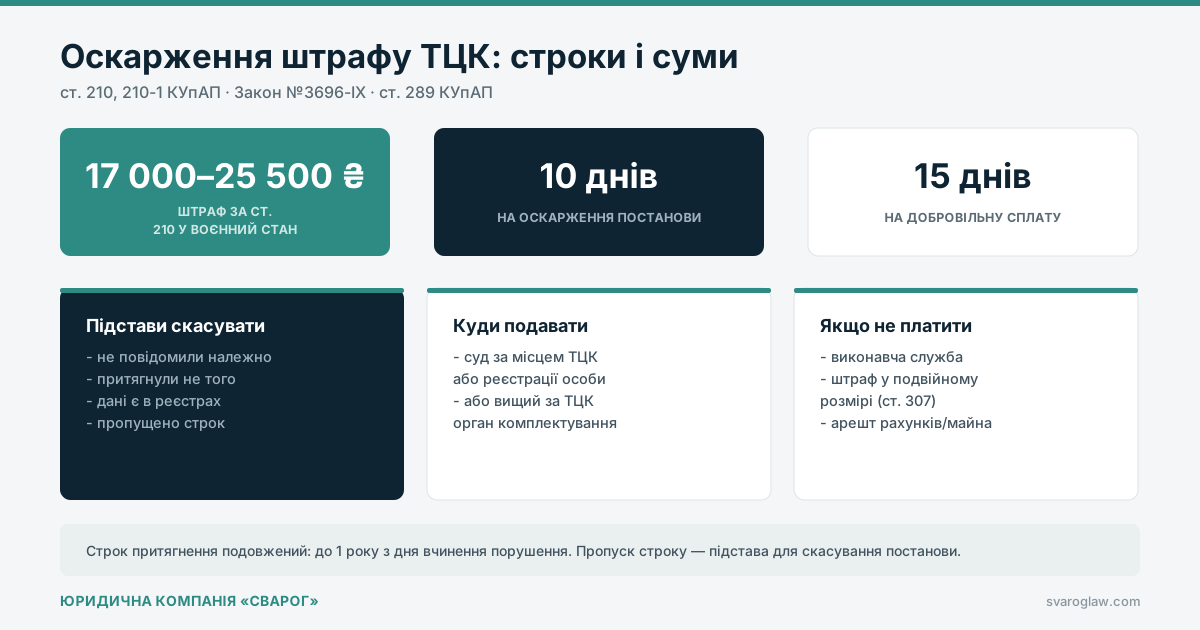
Grounds on which a TCC fine is actually set aside
Appeals against TCC fines are rarely based on emotion — they are based on specific defects in the decision. The following grounds are most commonly successful:
- the individual was not duly notified of the summons, and the TCC has no evidence of service (breach of Article 258(5) of the Code of Administrative Offences);
- the wrong person was held liable — for example, a fine for an employee’s registration was imposed on someone who was not responsible for them;
- the TCC may have obtained the individual’s details through electronic interaction with state registers — in which case Articles 210 and 210-1 of the Code of Administrative Offences do not apply;
- the limitation period for bringing proceedings has expired;
- the decision does not set out the elements of the offence or the person’s guilt has not been proven;
- the decision was issued with procedural irregularities (rights under Article 268 of the Code of Administrative Offences were not explained, there is no signature, or there are errors in the data).
Where and within what time limits to lodge an appeal
The law provides two avenues. The first is administrative (out-of-court): a complaint to a higher authority, namely the regional territorial recruitment centre. The second, and in practice more effective, is the judicial route. Depending on the procedure, the decision is appealed to the court; we determine the jurisdiction (the local general court under the Code of Administrative Offences or the district administrative court under the Code of Administrative Procedure) on a case-by-case basis for each specific decision, as this determines both the form of the appeal and the time limits. The key point is not to miss the 10-day deadline for appealing under Article 289 of the Code of Administrative Offences. If the deadline is missed for a valid reason (illness, being on duty, failure to serve the decision), it may be extended upon application. At the same time, bear in mind Article 307 of the Code of Administrative Offences: the fine must be paid within 15 days, and if enforced through the enforcement service, the amount may be doubled. Therefore, it is advisable to lodge an appeal at the same time as deciding whether or not to pay.
When you really need a solicitor — and when you don’t
Let’s be honest: not every fine is worth appealing. If the offence did indeed take place, the person was duly summoned, service was confirmed, and the deadlines were met — there is little chance of the fine being quashed, and it is wiser to pay the fine on time to avoid the amount being doubled. In such a situation, a consultation is sufficient, and we’ll tell you that straight away. However, if the decision was issued without proof of service of the summons, was imposed on the ‘wrong’ person, contained incorrect details, ignored a valid reason for non-appearance, or the limitation period for prosecution has expired — in these cases, an appeal has a real chance of success, and doing it on your own is risky: a single mistake regarding jurisdiction or the form of the appeal could result in missing the deadline. If, however, the issue goes beyond the fine and concerns the mobilisation itself, it is worth considering separately applying for a deferment from mobilisation</ a> or the issue of undergoing a medical examination.
How we handle appeals
Our procedure for cases involving a fine from the Military Registration and Enlistment Office is as follows:
- we examine the decision and the case file to establish whether there is evidence that the summons was served;
- we submit solicitors’ requests to the TCC to obtain the documents on which the decision is based;
- we check compliance with the time limits for bringing the case and the procedure for issuing the decision;
- we choose the route of appeal — administrative or judicial — and determine the jurisdiction;
- we prepare a complaint or an administrative claim, citing specific legal provisions and defects in the decision;
- we represent your interests until a decision is reached and, if necessary, during the appeal process.
What are the risks for someone appealing on their own?
The most common mistake is to lodge a complaint with the ‘wrong’ authority and miss the 10-day deadline whilst jurisdiction is being determined. The second is to challenge the substance of the decision (‘I did not evade my obligations’) without noticing a procedural defect that would have quashed the ruling without any dispute over the facts. The third is to ignore the fine in the hope that it will ‘blow over’, only to end up with double the amount and the freezing of bank accounts by the enforcement service under Article 307 of the Code of Administrative Offences. The fourth is to fail to document a valid reason for non-appearance, meaning the court has no grounds to extend the deadline. Each of these mistakes costs money, and each can be avoided.
Cost of services (appealing a fine issued by the Traffic Control Centre)
The cost depends on whether a consultation is sufficient or whether a full court appeal is required. Indicative prices:
| Service | Cost |
|---|---|
| Consultation and assessment of the prospects of an appeal | from 1,500 UAH |
| Legal analysis of the decision with a written opinion</ td> | from 5,000 UAH |
| Preparation of a complaint / administrative claim | from 5,000 UAH |
| Participation in a court hearing | from 3,000 UAH |
| Comprehensive ‘turnkey’ case support | from 30,000 UAH |
In addition to the fee, payments to third parties may arise: court fees for filing an administrative claim (for an individual, this is a small amount — approximately 0.2 times the minimum subsistence level for able-bodied persons; the current amount will be confirmed on the date of filing). If the decision is overturned, court costs may be recovered from the TCC.
Questions and Answers (appealing a TCC fine)
How long do I have to appeal a TCC decision?
10 days from the date the decision was issued (Article 289 of the Code of Administrative Offences). A deadline missed for a valid reason may be extended upon application, but you should not rely on this — it is better to meet the 10-day deadline.
Can you avoid paying the fine whilst the appeal is pending?
Lodging an appeal or a claim suspends enforcement of the decision pending consideration. However, if no appeal is lodged, the fine must be paid within 15 days (Article 307 of the Code of Administrative Offences), otherwise it will be collected by the enforcement service at double the amount.
The Traffic Control Centre issued a ruling, but I was not summoned. Is this grounds for annulment?
Yes, and one of the strongest grounds. Under Part 5 of Article 258 of the Code of Administrative Offences, during a special period, a fine without a report is only possible if there is evidence that a summons was served. If there is no confirmation of service, there is no legal basis for the fine.
I was fined for not updating my details, even though they are in the registers. What should I do?
If the Military Registration and Enlistment Office could have obtained your details via electronic interaction with state registers, the provisions of Articles 210 and 210-1 of the Code of Administrative Offences do not apply. This is a direct ground for contesting the fine.
What is the current fine for breaching military registration requirements?
Under martial law, pursuant to Article 210 of the Code of Administrative Offences, the fine for citizens is between 17,000 and 25,500 UAH; pursuant to Article 210-1, for officials and legal entities, it is between 34,000 and 59,500 UAH. These amounts apply following the amendments to Law No. 3696-IX of 19 May 2024.
Where should a complaint be lodged – with the court or the Territorial Military Registration and Enlistment Office (TMC)?
Either option is possible: with the higher-level (regional) TMC or with the court. In practice, the judicial route is more effective. We determine the form of the application and the jurisdiction based on the specific ruling.
Is there a time limit after which a fine can no longer be imposed?
Yes. For Articles 210 and 210-1, extended time limits for prosecution apply, but they are not unlimited — approximately up to one year from the date of the offence. Imposing a fine outside this time limit is grounds for setting aside the decision.
I’ve been fined on behalf of an employee whom I was supposed to notify. Is this lawful?
It depends on whether this obligation actually rested with you and whether the TCC’s order was duly communicated. Prosecuting the wrong party is a common mistake made by the Tax and Customs Service and grounds for annulment.
How much does an appeal cost?
From 1,500 UAH for a consultation to a bespoke fee for full legal representation. We will quote the exact cost after reviewing the decision — once it is clear how much work is required.
Can a fine that has already been paid be refunded?
Yes, if the decision is overturned after payment — the amount paid is refundable, and legal costs can be recovered from the TCC.
Contact a solicitor at ‘Svarog’ to appeal a TCC fine
During the consultation, we will review your decision, advise you whether it contains any defects that can be challenged, provide realistic timelines and costs, and will not advise you to take legal action where there is no prospect of success. If there are grounds for an appeal, we will take on the case from the initial enquiries to the TCC right through to the court’s decision. Our military lawyer practice specialises in matters relating to military registration, mobilisation and the TCC. Telephone: +38 095 554-54-24, +38 096 554-54-25 (Telegram, Viber, WhatsApp). Address: 7 Khoriva Street, Office 2, Kyiv (Podil). Opening hours: Mon–Fri, 9.00–18.00.