Parole is a court decision made on two conditions at once: the prisoner has served the minimum part of the sentence and has proved their rehabilitation (Art. 81 of the Criminal Code). The first is a matter of the calendar; the second has to be evidenced, and it is on the second that most applications fail.
Having no disciplinary sanctions does not by itself prove rehabilitation. The court weighs everything together: attitude to work and study, participation in rehabilitation programmes, attitude to the offence, compensation paid to the victim, whether there is housing and a job after release, and the family’s support.
The lawyer gathers the evidence of rehabilitation, works with the prison administration on the character reference, and prepares the file so the court has something to rely on. There are no “arrangements” here: there is a calculation of the sentence, a preparation plan and a set of documents.
How much must be served
The minimum part depends on the gravity of the offence (Art. 81(3)):
| Category | Must be served |
|---|---|
| A criminal misdemeanour, a less serious offence, a serious offence committed negligently | at least 1/2 of the sentence |
| An intentional serious offence; a particularly serious offence committed negligently; and the case of someone who previously served a prison sentence for an intentional offence and, before the conviction was spent, again committed an intentional offence carrying imprisonment | at least 2/3 of the sentence |
| An intentional particularly serious offence; a new intentional offence committed during the unserved part of a sentence after an earlier parole | at least 3/4 of the sentence |
Serving the minimum part only gives the right to apply. The court can refuse even after 3/4 of the sentence if rehabilitation is not proved. Time spent on remand counts towards the sentence day for day (Art. 72).
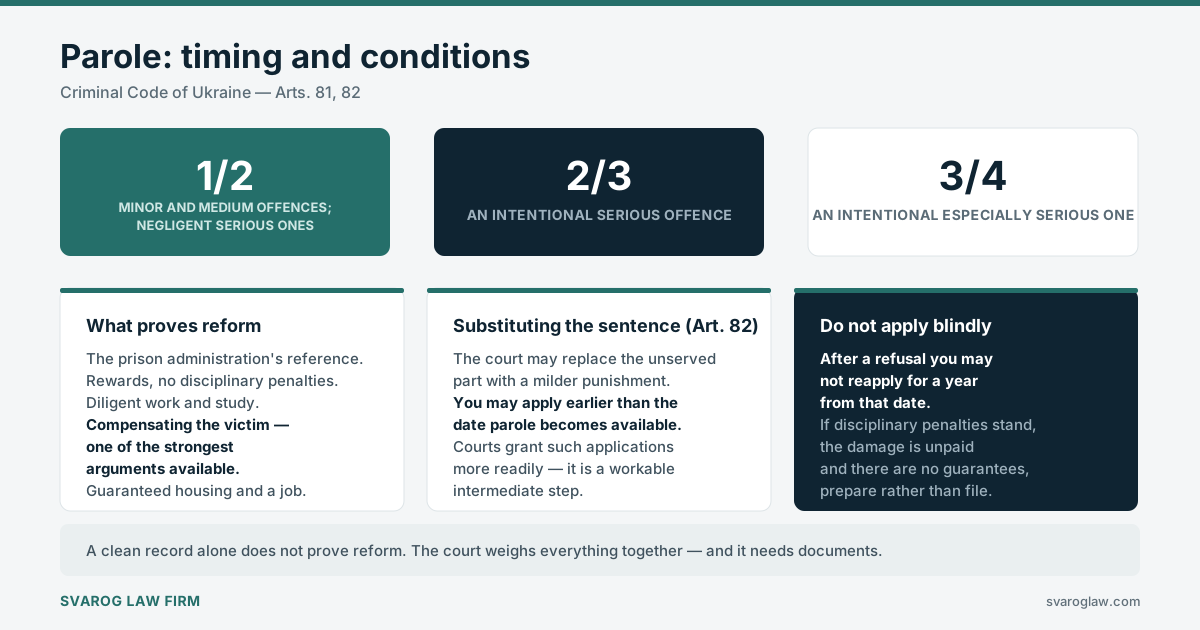
Substituting a lighter punishment for the unserved part
This tool is often forgotten, yet it works where parole is not yet available.
If parole has been refused, this route is worth considering. It is less drastic from the court’s point of view, because the person remains under punishment, and such applications are granted more often.
What proves rehabilitation
The court decides on the papers. What works is:
Evidence of rehabilitation
- the prison administration’s character reference: the basic document, whose content can and should be improved in advance;
- no current sanctions and the presence of commendations;
- a conscientious attitude to work: work records, performance;
- study and participation in programmes of rehabilitative work;
- compensation to the victim: one of the strongest arguments, and partial payment counts too. It is evidenced by the victim’s receipt, a bank transfer marked “compensation under the judgment”, or a settlement agreement;
- the victim’s position: their view is taken into account;
- arrangements for after release: proof of an address, a letter from an employer, family support;
- state of health and dependants.
The commonest reason for refusal is a formal, empty file. The reference is neutral, no compensation has been paid, there is no job offer, and the court cannot see what rehabilitation rests on.
The procedure
- Calculating the sentence: when the right to apply arises. A mistake here costs extra months.
- Preparing the material in advance, months before filing.
- Filing: the application can be made by the prisoner, their lawyer or the prison administration (Art. 539 of the Criminal Procedure Code).
- The hearing in the court for the place of detention, with the prison’s representative and the prosecutor present.
- The court’s ruling granting release or refusing it.
- An appeal if it is refused.
After a refusal a fresh application can be made no sooner than 6 months later, and for those sentenced for serious and particularly serious offences to five years or more, no sooner than a year (Art. 154 of the Penal Code). So a “trial” application without preparation pushes the real chance back by six months or a year.
What the lawyer does
- calculates the sentence and decides when to file;
- sends a lawyer’s enquiry to the prison about commendations and sanctions, so as to know what the file looks like;
- works on the material in advance, so the reference and the documents are ready when the right arises;
- arranges compensation to the victim and documents it;
- collects the arrangements: housing, work, family support;
- appears in court, where the prosecutor often opposes release;
- appeals a refusal.
When it is better to wait
Where there are current sanctions, the reference is negative, no compensation has been paid and there are no arrangements for release, filing is almost certain to end in refusal — and a refusal blocks any fresh application for six months or a year.
In that situation the right strategy is to prepare first — have sanctions lifted, work, pay compensation, gather documents — and to file when the file answers every question the court will ask.
A case from our practice
In 2025 the wife of a man serving five years for robbery under Art. 186(2) of the Criminal Code (an intentional serious offence) came to us. Seven months remained until two thirds of the sentence, and the prison reference was neutral: no sanctions, but no commendations and no work either. Over four months we secured him a job in the prison workshop, arranged partial compensation to the victim by bank transfer, and obtained a letter from an employer and proof of an address. We filed as soon as the right arose, and the court granted it first time. About five months passed from the first approach to the ruling, and our fee was around 15,000 UAH (details changed).
Cost of services
No court fee is payable for a parole application, an application to substitute a lighter punishment, or an appeal against the ruling: fees are not charged in criminal proceedings. The outlay is limited to the lawyer’s work.
Questions and answers (Parole)
Does time on remand count towards the part served?
Yes. Pre-trial detention counts towards the sentence day for day (Art. 72), running from the day of arrest. So the right to parole is calculated from the date liberty was actually lost, not from the date of the judgment.
Can the prisoner take part in the hearing remotely?
Yes. The court hears the application with the prisoner present, and in most cases that is by video link from the prison. The lawyer attends in the courtroom, files the documents and answers the prosecutor’s objections.
What happens if a new offence is committed after release on parole?
If the new offence falls within the unserved part of the sentence, the court sentences cumulatively (Art. 71): the unserved part of the earlier sentence is added, in whole or in part, to the new one. That is precisely why the release is conditional.
Is parole possible for life prisoners?
There is no parole directly from a life sentence. But since 2022 Art. 82 has allowed a life sentence to be replaced with a fixed term of 15 to 20 years where the prisoner has actually served at least 15 years. After that substitution, parole under the general rules of Art. 81 becomes possible.
How long does an application take?
From filing to the court’s ruling usually takes from a few weeks to two or three months, depending on the court’s workload and how quickly the prison supplies the material. An appeal adds another one to two months. Document preparation starts six months before the right arises.
Contact a Svarog lawyer about parole
Send us the judgment and the certificate of time served: we will calculate when the right to apply arises and show what the file is missing. If it is weak, we will draw up a preparation plan over several months and file once the reference, the compensation and the arrangements are all in place.