Mobilisation reaches a person through three documents: their registration data, the summons, and the medical board’s finding. Each has its own deadline and its own route of challenge. Offers to “sort it out for money” do not change that procedure: money to a fixer is Art. 369 of the Criminal Code, a bought certificate is Art. 358, and failing to attend after an “arrangement” adds Art. 336 on top.
A mobilisation lawyer works with what the law provides: the grounds for deferral in Art. 23 of the Law “On Mobilisation Preparation and Mobilisation”, medical records, and the right to reservation. The task is to turn those grounds into official documents and to keep the recruitment centre’s actions and the medical board within the procedure. No lawyer can release you from military obligation.
We run such cases in Kyiv and across Ukraine, mostly remotely: applications and complaints go through Reserve+, administrative service centres and the Electronic Court.
Your obligations — and your rights
Obligations not worth ignoring
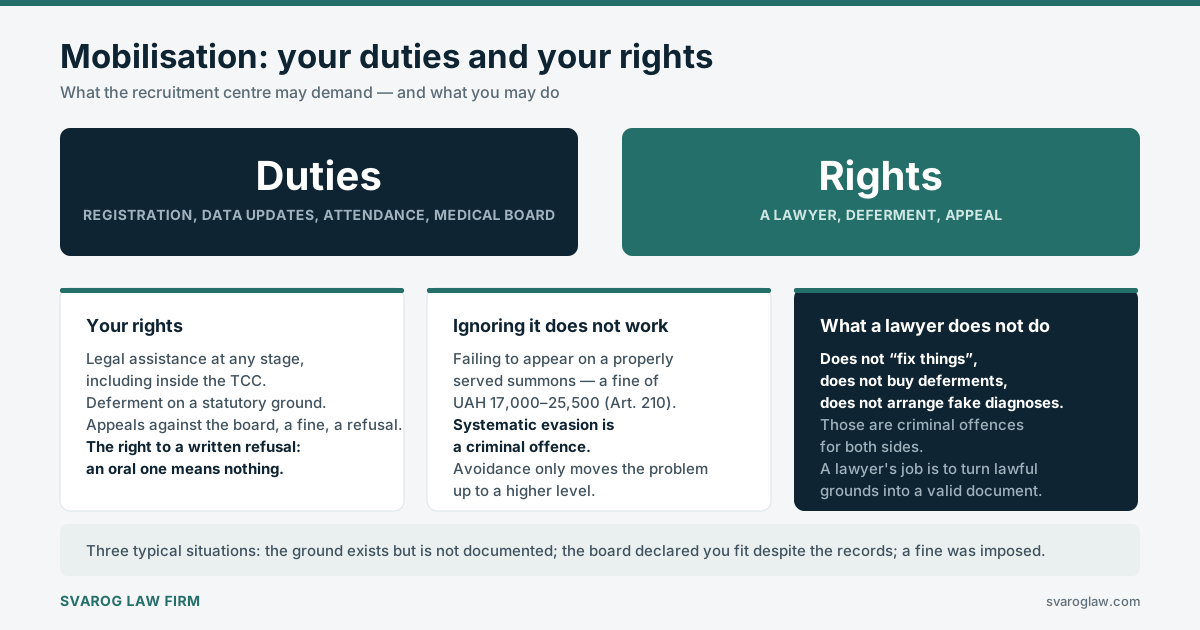
- to be on the military register;
- to keep your personal data updated through Reserve+, a service centre or the recruitment centre;
- to attend on a summons that has been properly served;
- to attend the medical board when referred.
Rights people often do not know about
- the right to legal assistance at any stage, including inside the recruitment centre;
- the right to a deferral where a lawful ground exists;
- the right to challenge the medical board’s finding, a fine, or a refusal of deferral;
- the right not to sign documents whose content you do not understand;
- the right to demand a written refusal citing the provision relied on: an oral answer from a staff member is not a decision and cannot be challenged in court.
Breaching the military registration and mobilisation rules carries a fine of 17,000–25,500 UAH (Arts. 210, 210-1 CAO), and 34,000–59,500 UAH for officials. Systematic evasion of the call-up during mobilisation is charged under Art. 336 of the Criminal Code.
The three situations people come to us with
1. The ground for deferral exists but is not documented
about a monthThe commonest situation and the easiest to fix. A relative’s disability certificate has expired, the guardianship is factual only, the children’s details never reached the Oberih register. The ground exists in life but not on paper, so the recruitment centre cannot see it.
What we do: check the ground against Art. 23 of the Mobilisation Law, assemble the papers, and file through Reserve+ or an administrative service centre (since 1 November 2025 filing directly with the recruitment centre is not provided for). Where necessary we first establish the status through the courts: guardianship, a legal fact, a declaration that a relative lacks capacity. The degree of a relative’s loss of function is determined by the assessment team that replaced the old disability boards in 2025; a court does not issue such a finding.
2. The medical board found you fit despite the records
3–6 monthsThe status “fit with limitations” has been abolished. The board assigns one of four categories: fit; fit for service in support units; temporarily unfit; unfit with removal from the register.
The challenge is built on procedural breaches: the mandatory investigations were not carried out, no relevant specialist sat on the board, the medical records were not put on the file. The decision must cite the article of the Schedule of Diseases (Ministry of Defence Order No. 402), and its absence is often ground enough to set the finding aside.
3. A fine has been imposed
10 days to challengeThe decision is issued by the head of the recruitment centre, often in your absence, and a copy is posted. You have 10 days from the date it was issued to challenge it (Art. 289 CAO), and 15 days after service an unpaid fine doubles.
What to do once you receive a summons
- Record the date and the manner of service. A summons sent by registered post to your declared address counts as served on the day of delivery, even where the addressee refused it or the letter came back.
- Check the details. The summons must show your details, the date, time and place of attendance, the reason for the call-up and the signature of an authorised official. Errors do not cancel the call-up, but they matter in a case about a fine.
- Assess your grounds — deferral, health, reservation — and document them before the date of attendance. An application filed afterwards no longer affects the record of non-attendance.
- Gather the medical records in advance. Discharge summaries, test results and specialists’ opinions must be in hand before the medical board: telling the board about it is not evidence.
- Consult a lawyer before attending. Once documents have been signed at the recruitment centre, only challenging the decisions taken remains.
What to check in Reserve+ before visiting the recruitment centre
The Oberih register data are visible in the Reserve+ app: your fitness category, any current deferral and its date, unpaid fines, and a “wanted” status. A mismatch between the register and reality is a typical source of trouble: the birth of a child or the establishment of guardianship does not reach it automatically, and a deferral does not extend itself once its term runs out. A “wanted” status is lifted once the data are updated and you attend the recruitment centre, and it does not bar you from applying for a deferral.
Typical mistakes before people come to us
The summons is left uncollected at the post office, the fine goes unchallenged within the ten days, the deferral application is filed after the date of attendance. Another common mistake is dealing with the recruitment centre without written evidence: the refusal is given orally, and there is nothing to challenge afterwards. Repairing such cases takes a mobilisation lawyer longer and costs more than running an application filed on time.
A case from our practice
In 2025 a Kyiv resident came to us who was caring for his mother, who has a group I disability. The care was factual, the documents were in his sister’s name, and no deferral appeared in the register. After the summons the recruitment centre drew up a report for non-attendance. We filed the deferral application with a complete set of documents through an administrative service centre and at the same time challenged the fine: the file contained no proof that the summons had been served. The deferral was entered in the register in about a month, and the court set the fine aside. The client’s costs: a court fee of 665.60 UAH and the fees for the documents and one hearing. (details changed)
Cost of services
The 2026 court fee is payable on top: 665.60 UAH for a challenge to a fine and 1,331.20 UAH for an administrative claim about the medical board, a refusal of deferral or the recruitment centre’s inaction. Filing through the Electronic Court reduces the rate by 20 %, and if you win, the fee and the legal costs are recovered from the defendant (Art. 139 CAP).
Questions and answers (mobilisation lawyer)
Does filing a deferral application excuse me from attending on a summons?
No. Until the deferral has been granted and entered in the register, the duty to attend at the stated time remains. Take a copy of the application with proof of filing: it records that the ground has been raised and counts in any case about a fine.
My deferral is running out. How do I keep it from lapsing?
File for the new term in advance, roughly a month before it expires. A deferral does not extend itself: once the term ends you return to the general regime, even if the circumstance (care, study, a relative’s disability) has not changed.
My employer will not file for reservation. Can anything be done?
Reservation is arranged solely by the company, under the Procedure approved by Cabinet Resolution No. 76; an employee cannot file for themselves. The lawyer sends the employer a written demand, checks whether the company meets the criticality criteria, and assesses in parallel whether the employee has another ground for deferral.
I am abroad. Can I be fined, and how do I challenge it?
Yes; the decision is issued on the register data and posted to your address in Ukraine. Registration data are updated remotely through Reserve+, and the lawyer files the challenge under a power of attorney through the Electronic Court. Neither requires you to be present.
What does arranging a deferral cost in the state bodies?
Filing through Reserve+ or a service centre is free. Costs arise on the supporting documents: notarised copies, register extracts, certificates from medical institutions. A court fee is payable only where a refusal has to be challenged: 1,331.20 UAH for an administrative claim.
Contact a Svarog mobilisation lawyer
Describe the situation at the consultation: we will tell you which lawful grounds you have, which deadlines are already running, and what documents need to be gathered this week.