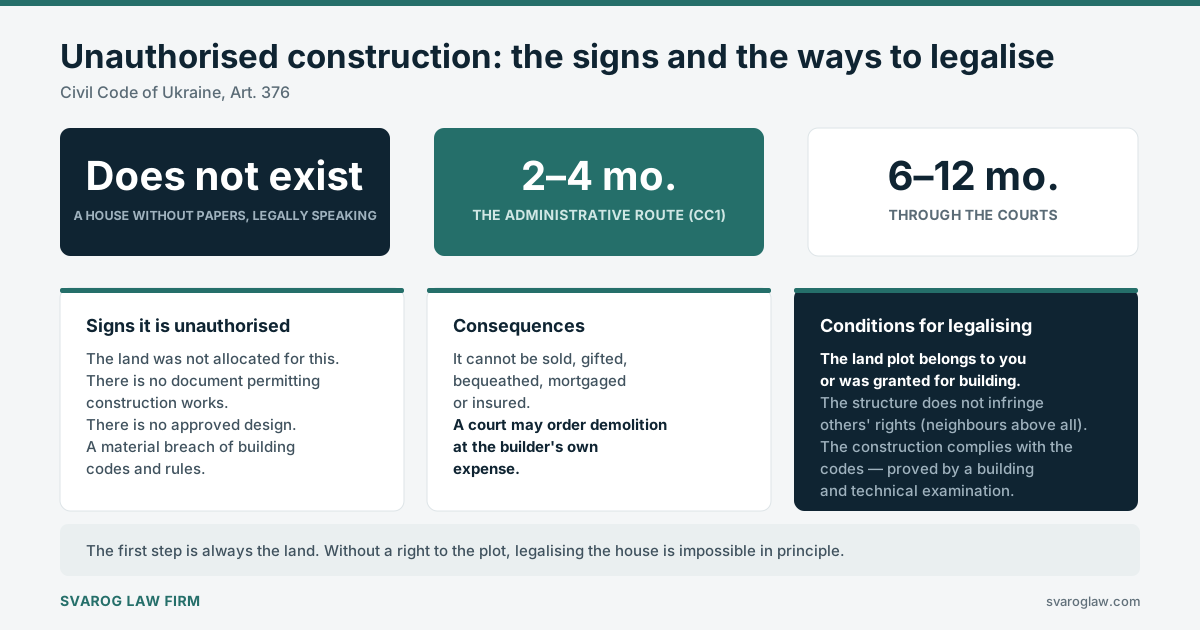
A house built without documents does not legally exist. It cannot be sold, given away, inherited, mortgaged or insured. More than that, under Art. 376 of the Civil Code a court may order whoever built without authorisation to demolish it at their own expense, if the landowner objects to the building or it was erected in serious breach of the rules.
Regularising a house consists of three acts: accepting the building into use, assigning a postal address, and registering title in the State Register of Property Rights. Only after the third step do you become the owner, and only then does the house become property you can deal with.
Most often we are approached by owners of houses built by eye in the 2000s, by heirs who discover that a father or grandfather never registered the house, and by people who added a storey or a loft conversion without documents. Regularisation takes a different route in each of these cases.
What counts as unauthorised construction
Under Art. 376(1) of the Civil Code construction is unauthorised if at least one of these applies:
- The building stands on land not allocated for that purpose.
- There is no document entitling the works to be carried out (a notification or permit).
- There is no approved design where one is mandatory.
- The building seriously breaches construction rules and standards.
If the only failing is the absence of documents, while the land is yours and the house meets the standards, regularisation of that kind of house is entirely realistic. If the building went up on someone else’s land, or on land not allocated for it, you have to start with the land.
Two routes to legalisation
Administrative: through the electronic system
2–4 monthsThe main route. Documents are filed through the Unified State Electronic System in Construction, with oversight by the State Inspectorate of Architecture and Urban Planning.
For private houses in consequence class CC1 (most private housing) the procedure is:
- Checking the land: designated use, ownership, restrictions and encumbrances.
- Technical inventory: a new technical passport for the building as actually constructed.
- A technical report on the building’s soundness and fitness for use, from a certified engineer.
- Filing the declaration that the building is ready for use.
- Assignment of an address.
- State registration of title.
The simplified “technical report plus declaration” scheme (the so-called construction amnesty) is designed for houses built between 5 August 1992 and 9 April 2015. For a house erected later without a notification of works, the administrative route is usually closed and regularisation goes through the court. Whether your house falls within the simplified procedure we check at the consultation, from the construction date in the technical passport.
Buildings in higher consequence classes need a design, an expert appraisal and a commissioning certificate.
Court: when the administrative route does not work
6–12 monthsThe court recognises title to an unauthorised house under Art. 376(3) and (5) of the Civil Code: under para. 5 for the owner or user of the land, and under para. 3 for someone who built on land not allocated to them, if the land was later granted to them. The conditions are:
- The plot belongs to you or was allocated for building.
- The building does not infringe other people’s rights, above all the neighbours’.
- The construction complies with the building standards (proved by a construction expert report).
The court route is needed where the inspectorate has refused, the land documents are in a deceased person’s name, the house stands partly on the neighbouring plot, or the administrative procedure is blocked by discrepancies between registers. Get the refusal in writing: the court asks whether you tried the administrative route.
The commonest obstacles
The land
Land holds up more cases than anything else. A house on a plot designated “for gardening” is harder to regularise as a dwelling than one on a plot for building and servicing a house, and sometimes the land has to be privatised or its designated use changed first, and only then the house legalised.
Distances from boundaries
The second commonest problem. The house stands closer to the boundary than the building standards allow. Either the neighbour’s written consent or proof in court that their rights are not affected is needed.
Inheritance
Adds another stage. The deceased built the house but never registered it, so the notary will not issue a certificate: the property does not legally exist. Either legalisation first and inheritance second, or both in a single claim to establish title by inheritance.
Breach of standards
If the construction expert finds the building unsafe, it cannot be regularised. We assess that prospect before filing, so the client does not pay for an expert report and a court fee with no chance of a result.
What it costs and how long it takes
Regularising a house administratively, with the land documents in place, takes 2–4 months; through the court, 6–12 months; with an expert report, longer.
The main cost falls on the technical side: the inventory, the technical report, and where needed a design and a construction expert report. We give an indicative total at the consultation, before any work starts.
What the court checks in unauthorised construction cases
The court checks four things, and the absence of any one of them ends in refusal: the right to the land (an extract from the property rights register or a state deed, not merely a village council decision “on allocation”); conformity with the plot’s designated use; an expert report confirming that the house meets the building standards and endangers nobody; and an attempt at the administrative procedure, with the reason it failed.
A typical mistake: the owner spends a year “coming to an arrangement” with the inspectorate and reaches a lawyer only after a demolition order, when there are fewer options and each costs more.
A case from our practice
In 2025 the heir to a house in the Bucha district of the Kyiv region came to us. Her father had built it in 2004 on a privatised plot designated for housing, but never had it commissioned or the title registered; the notary refused to issue a certificate of inheritance because the property was not in the register. We commissioned the inventory and the technical report, gathered the evidence that the estate had been accepted, and filed a claim to establish title by inheritance. The construction expert confirmed that the house met the standards, the court granted the claim, and once title was registered the client sold the house. The case took about 9 months; the technical work, the expert report and the court fee came to roughly 40,000 UAH, and our fee fell within the comprehensive civil case rate (details changed).
How we work
We start by checking the land and assessing the prospects, including the risk of a demolition order. Then we organise the technical side (inventory, technical report, and a design where needed), go through the administrative procedure or, if the inspectorate refuses, challenge that refusal or file a claim to establish title. We finish with registration of title and hand over the complete file.
Cost of services
Paid separately: the technical inventory, the technical report, design documentation, the construction expert report, the court fee, and the administrative fee for registering title.
Court fees in 2026: a claim to establish title to a house is a monetary one, so the fee is 1 % of the appraised value, but not less than 1,331.20 and not more than 16,640 UAH; through the Electronic Court the rate is multiplied by 0.8. Challenging the inspectorate’s refusal in the administrative court costs an individual 1,331.20 UAH.
Calculate the court fee
Based on the appraised value of the house. Challenging the inspectorate’s refusal costs a flat 1,331.20 UAH.
Full price list · Building permit
Questions and answers (Regularising unauthorised construction)
Can a house be regularised remotely if I am abroad?
Yes. The engineer needs access to the house for the inventory; everything else the lawyer does under a notarised power of attorney: filing in the electronic system, representing you before the inspectorate and in court, registering the title. The power of attorney is certified at a Ukrainian consulate or by a foreign notary with an apostille.
What if the house was built after April 2015 without a notification?
The simplified technical-report procedure does not cover such a house, and a notification cannot be filed retrospectively. We normally go to court under Art. 376 of the Civil Code with a construction expert report. If the plot is yours and the house meets the standards, the prospects are the same as for older houses — it simply takes longer.
What state fees are payable on regularisation?
The administrative fee for registering title at the standard speed is 0.1 of a subsistence minimum, about 330 UAH in 2026. The court fee for a claim to establish title is 1 % of the value of the house, within 1,331.20–16,640 UAH. The inventory, the technical report and the expert report are paid separately, depending on the size of the building.
What if the first-instance court refuses to recognise title?
The judgment can be appealed within 30 days of being handed down. The commonest reason for refusal is the absence of an expert report or of land documents. We then prepare the missing evidence for the appeal, or file a fresh claim once the gaps have been filled.
Can the house be registered if the plot has not been privatised yet?
No, not until the land is yours. The land question comes first — privatisation, purchase or lease — and only then the legalisation of the house. Both procedures can run in parallel.
Contact a Svarog lawyer about regularising unauthorised construction
Describe the building and send us the land documents. We will tell you whether your house can be regularised, by which route, how long it will take and what it will cost including the technical work. If there are no prospects, you will hear that at the first consultation, before paying for an inventory and an expert report.