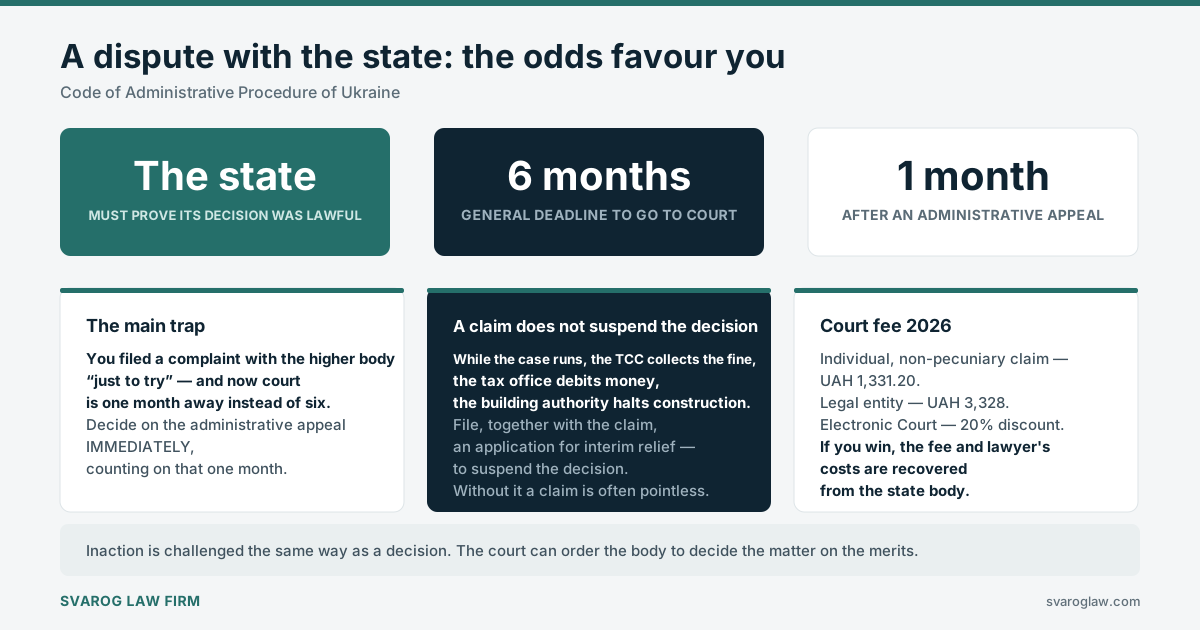
Administrative proceedings have a rule found in no other process: the burden of proving that a decision was lawful rests on the state authority (Art. 77(2) CAP). You do not have to show the authority was wrong: it has to show it acted lawfully, on the grounds and in the manner prescribed by law.
That is why the state loses in court more often than people assume. An administrative lawyer is there to use that advantage: to frame the claims, meet the deadline and stop the authority substituting new reasons once the case is in court.
We handle disputes with the tax authority, customs, recruitment offices, the migration service, the Pension Fund, local councils, the construction inspectorate and other bodies, at every instance.
Areas of work
- Tax disputes: challenging tax notices-decisions, blocked tax invoices, audits
- Customs disputes: customs value adjustments, classification of goods
- Challenging recruitment-office fines and medical board decisions
- Pension cases: Pension Fund refusals, recalculation, service record
- Immigration cases: migration service refusals, entry bans
- Land disputes: council refusals, privatisation
- Construction permits: refusals and inspectorate orders
- Compensation for harm caused by the state
We also handle: challenges to local council decisions, to bailiffs’ actions, to refusals of administrative services, to inspection orders and to rulings in administrative offence cases.
What can be challenged
Decisions
An order, a ruling, a tax notice-decision, a council decision, a refusal to issue a document.
Actions
What the authority did — for example carried out an inspection unlawfully, seized assets, removed documents.
Inaction
What the authority failed to do although it was obliged to: did not consider an application, did not reply, did not act within the set period.
Inaction is challenged in the same way as a decision. The court can declare it unlawful and order the authority to consider the matter on the merits (Art. 245 CAP), and after such a judgment cases that have been stuck for years usually start moving.
Deadlines for going to court: where cases are most often lost
A missed deadline is the most common reason administrative cases never reach the merits. The main deadlines under Art. 122 of the Code of Administrative Procedure and special laws:
| Situation | Deadline for going to court |
|---|---|
| General rule | 6 months from the day the person learned, or should have learned, that their right was infringed (Art. 122(2) CAP) |
| After administrative (pre-court) appeal | 3 months from service of the decision on the complaint (Art. 122(4) CAP) |
| Tax notices-decisions after a complaint to the tax service | 1 month from the end of the administrative appeal procedure (Art. 56.19 of the Tax Code) |
| Public service disputes | 1 month from the day the person learned of the infringement (Art. 122(5) CAP) |
| A ruling in an administrative offence case (recruitment-office fines, traffic fines and the like) | 10 days from the date of the ruling (Art. 289 of the Code of Administrative Offences, Art. 286 CAP) |
The trap is that a pre-court complaint replaces the general deadline with a new and shorter one. Someone complains to a higher authority “just to try”, receives a refusal two months later, calmly prepares a claim — and finds that in a tax dispute only a month was left. So we decide on pre-court appeal immediately, having first calculated the court deadline that follows a refusal.
Court fees in 2026
The subsistence minimum for able-bodied persons is 3,328 UAH. The rates are calculated from it:
| Claimant and type of claim | Rate | Amount |
|---|---|---|
| Individual, non-monetary claim | 0.4 of the subsistence minimum | 1,331.20 UAH |
| Company, non-monetary claim | 1 subsistence minimum | 3,328 UAH |
| Individual, monetary claim | 1 % of the value of the claim | from 1,331.20 to 16,640 UAH |
| Company, monetary claim | 1.5 % of the value of the claim | from 3,328 to 33,280 UAH |
| Challenging a ruling in an administrative offence case | 0.2 of the subsistence minimum | 665.60 UAH |
| Appeal / cassation | 150 % / 200 % of the claim rate | — |
Filing through the Electronic Court means the rate × 0.8: a non-monetary claim by an individual costs 1,064.96 UAH. If you win, the court fee and legal costs are recovered from the state authority (Art. 139 CAP).
Interim relief: suspending a decision
Filing a claim does not by itself suspend the decision being challenged. While the case runs, the recruitment office can enforce a fine, the tax authority can debit accounts, the construction inspectorate can halt building work and the migration service can start removal proceedings.
So an application for interim relief is filed with the claim: suspending the individual act or prohibiting the authority from taking certain steps until the case is decided (Art. 150–151 CAP). The court grants it where otherwise the future judgment would become impossible or much harder to enforce, so the application sets out precisely which funds would be debited or which project halted.
A case from our practice
In 2025 a businessman from Kyiv came to us after the tax authority assessed around 640,000 UAH of VAT and penalties following a documentary audit. He had complained to the tax service himself, been refused, and arrived four days before the one-month deadline for filing. In two days we prepared the claim and the interim relief application; the court suspended the tax notices-decisions and, on the merits, annulled the assessment because the audit procedure had been breached. First instance took eight months and the appeal another four; the court awarded part of the legal costs against the authority (details changed).
When you can manage without a lawyer
If the refusal is purely formal and the authority is missing a single document, supply it yourself: that is faster and cheaper than any dispute. A complaint against a ruling imposing a fine of a few thousand hryvnias can also be filed without us after a consultation.
An administrative lawyer is needed when:
- the authority refused on the merits and has no intention of changing its decision;
- the deadline is running out, or it is unclear when it started;
- you need to suspend the decision for the duration of the case: debits, halted works, removal from the country;
- inaction has continued for months and a court order to act is required;
- the consequences are significant: tax assessments, confiscation, a halted business, a lost pension;
- the other side is the legal department of a state authority.
How we work
- We calculate the deadline from the date the decision was served, taking special rules into account.
- We analyse the decision: was there authority, was the procedure followed, is it reasoned.
- We choose the route: pre-court appeal or straight to court, given the deadlines.
- We prepare the claim with correctly framed relief (declare unlawful and annul, order the authority to act).
- We apply for interim relief so the decision is not enforced while the dispute runs.
- We run the case at every instance and recover costs from the authority.
Cost of services
The court fee is paid separately: 1,331.20 UAH for a non-monetary claim by an individual, 3,328 UAH for a company, 665.60 UAH to challenge a ruling in an administrative offence case; if you win, the authority reimburses it.
Questions and answers (Administrative lawyer)
What if the six months have already passed?
File the claim together with an application to restore the deadline and evidence of good reasons (Art. 121 CAP): illness, being abroad or in a combat zone, late service of the decision. Without that application the court will leave the claim without consideration (Art. 123 CAP). If the decision was never properly served on you, time may not have started running at all — and that is the first thing we check.
Can the claim be filed and hearings attended remotely?
Yes. The claim, applications and evidence are filed through the Electronic Court with a discount on the fee, and you can attend the hearing by video link from your own device. For clients in other cities and abroad we run administrative cases without them coming to Kyiv.
Will the authority’s costs be awarded against me if I lose?
The risk is limited: an authority can claim legal costs only where it engaged an advocate under a contract, not for the work of in-house lawyers, and in practice such claims are rare. The court fee you paid is not refunded if you lose, which is why we assess the prospects before it is paid.
What documents should I bring to the consultation?
The decision being challenged, your application to the authority and its reply, documents confirming your right, and proof of when the decision was received (the envelope, the delivery note): the deadline runs from that date.
Contact an administrative lawyer at Svarog
Send us the authority’s decision and the date you received it. The lawyer will first calculate the deadline, then assess the prospects and tell you whether the decision needs to be suspended for the duration of the case and what the matter will cost.