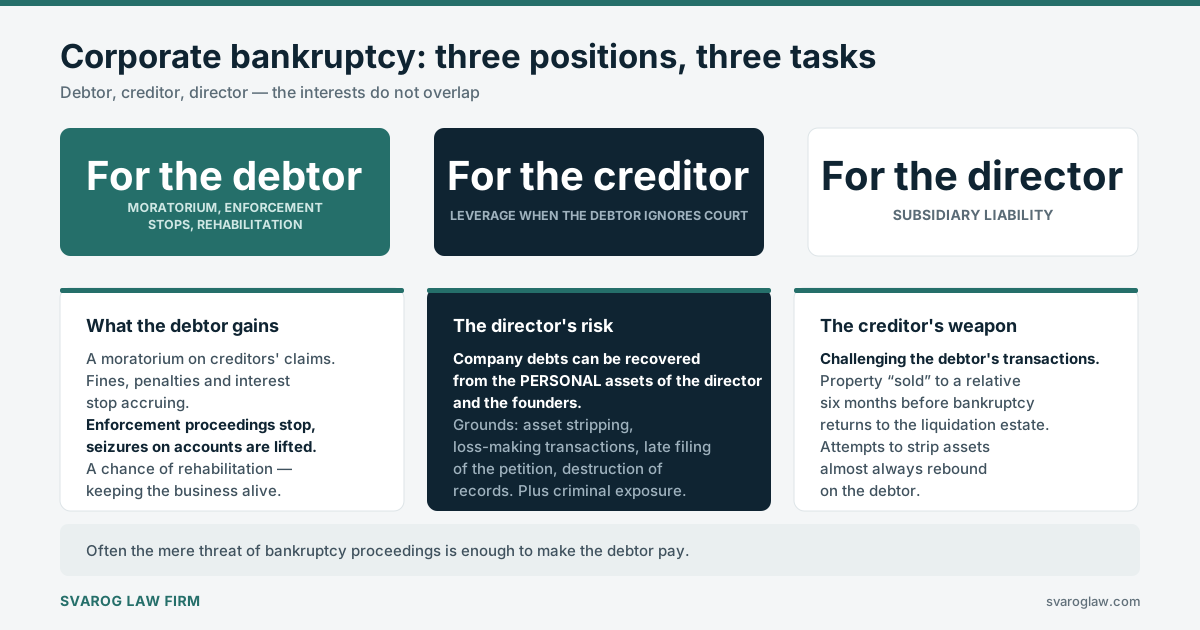
Support in the insolvency of a legal entity is needed by three different participants, and each has their own task. For the debtor, the opening of proceedings is a protective tool: from the day they open a moratorium applies to creditors’ claims, penalties and interest stop accruing, and enforcement under writs is suspended (Art. 41 of the Bankruptcy Code of Ukraine).
For a creditor it is the opposite — a recovery tool: where a debtor ignores a judgment and moves its assets around, an insolvency petition opens the way to challenging its transactions over the previous three years and to the director’s personal liability.
And there is a third side that people remember too late: the director and the owners. A company’s insolvency does not mean they lose nothing. The liquidator may ask the court to impose subsidiary liability on them (Art. 61(2) of the Bankruptcy Code), and then the company’s unpaid debts are recovered from their personal property.
Three positions: three different tasks
We defend the debtor
Restoring solvency, a rehabilitation plan, keeping the business alive, protecting the director and the owners from subsidiary liability, objections to creditors’ claims.
We act for the creditor
Initiating insolvency, entry in the register of claims, challenging the debtor’s transactions, appealing the insolvency officeholder’s actions, supervising the sale of assets.
We defend the director and the owners
Against subsidiary and joint liability, and in criminal proceedings under Art. 219 of the Criminal Code (driving a company into insolvency).
These positions are incompatible, so your own position has to be settled before someone else starts the procedure.
What the opening of proceedings gives the debtor
The effect of the moratorium
- a moratorium on satisfying creditors’ claims takes effect;
- penalties, interest and other financial sanctions stop accruing on the obligations the moratorium covers;
- enforcement under writs and enforcement proceedings are suspended;
- attachments on the property are not lifted at once: the moratorium only suspends enforcement, and attachments are cancelled when the liquidation procedure opens (Art. 59 of the Bankruptcy Code);
- rehabilitation becomes possible — restoring solvency while keeping the business.
Court procedures under the Bankruptcy Code
The Code provides three court procedures for a legal entity (Art. 6), and the separate “settlement agreement” that existed until 2019 is gone: a deal with the creditors is now documented in a rehabilitation plan.
Administration of assets
The court appoints an administrator, the register of creditors’ claims is compiled and the financial position is analysed. The procedure runs for up to 170 days (Art. 44), and it is here that it is decided whether there is anything to save.
Rehabilitation
A plan to restore solvency, approved by the creditors and confirmed by the court: restructuring and deferral of debts, sale of some assets, a change of management, bringing in an investor. The business survives.
Liquidation
The assets are sold at auction, the proceeds are distributed among the creditors in order of priority, and the company ceases to exist.
The deadlines that shape the case
Ordinary creditors file their claims within 30 days of the official publication of the notice opening the proceedings; a latecomer may still file, but loses the right to a decisive vote at the creditors’ meeting (Art. 45). The debtor’s director must apply to the court within one month from the moment when satisfying one creditor would make settlement with the others impossible (the threat of insolvency); breaching that duty makes the director jointly liable for the unsatisfied claims (Art. 34(6)). The debtor’s transactions can be challenged if they were made within three years before the proceedings opened (Art. 42).
Subsidiary liability: the director’s main risk
The usual grounds: stripping assets on the eve of insolvency, entering into transactions that were bound to make a loss, destroying or falsifying accounting records, failing to hand the records to the liquidator. Separately, a director who does not apply to the court when insolvency threatens is jointly liable (Art. 34(6)).
Criminal liability exists only for driving a company into insolvency (Art. 219 of the Criminal Code). “Fictitious bankruptcy” and concealing assets during the procedure have been administrative offences since 2011 (Arts. 166-16, 166-17 of the Code of Administrative Offences). We run the director’s defence in parallel with the main procedure.
Challenging the debtor’s transactions
Transactions made by the debtor within three years before the proceedings opened are declared invalid by the court on the application of the officeholder or a creditor if they harmed the creditors (Art. 42): sales of property at an undervalue, gifts, early repayment of a “friendly” creditor, taking on obligations without anything in return.
The practical consequence: property “sold” to a relative or a related company six months before the insolvency comes back into the liquidation estate; and the sale itself becomes evidence for subsidiary liability.
The cost of the procedure
The applicant’s budget
- the court fee for a petition to open proceedings: 10 subsistence minimums, which in 2026 is 33,280 UAH; a creditor’s claim filed after the proceedings open: 2 subsistence minimums, 6,656 UAH;
- advance payment of the officeholder’s remuneration: three minimum wages for each of three months, that is 77,823 UAH in 2026 (Art. 34(2)); without proof of the advance the petition is returned;
- the cost of valuing and selling the assets;
- the lawyer’s fee.
So starting an insolvency costs the applicant from 111,000 UAH before the first hearing, and that has to be weighed against the size of the debt.
A case from our practice
In 2025 the director of a trading company came to us with debts of about 4 million UAH to suppliers and a bank: the accounts had been attached in enforcement proceedings, and one creditor was already preparing an insolvency petition. We reviewed the transactions of the previous three years, found two contracts the creditors could have challenged, and prepared a rehabilitation plan. The company filed the petition itself with a draft plan attached: an 18-month deferral, the sale of a warehouse and partial write-off of the penalties. During the administration procedure the creditors’ committee approved the plan, the court confirmed the rehabilitation, and the company carried on trading. About seven months passed from the first consultation to confirmation of the plan; the client’s outlay on the court fee, the advance and our support came to about 200,000 UAH (details changed).
How we work
- We settle the position — debtor, creditor or director — and build the strategy from it.
- We analyse the financial position and the transactions of the last three years, so we know what can be challenged.
- We prepare the petition or the response to it, and the draft rehabilitation plan.
- We run the procedure: the register of claims, creditors’ meetings and committee, dealings with the officeholder.
- We protect the director from subsidiary and joint liability in parallel with the main procedure.
- We challenge the debtor’s transactions where we act for a creditor.
Cost of services
Separately from the fee you pay the court fee (33,280 UAH for a petition to open proceedings, 6,656 UAH for a creditor’s claim; through the Electronic Court × 0.8), the advance on the officeholder’s remuneration (77,823 UAH), and the cost of valuing and selling the assets.
Questions and answers (Insolvency of a legal entity)
What do we do if a creditor has already petitioned for our company’s insolvency?
Before the preliminary hearing, file a response objecting to the size of the claims and to their being undisputed: if the debt is contested or has been partly paid, the court may refuse to open proceedings. In parallel, review the transactions of the last three years and gather the accounting records, because those are the first thing the administrator will ask for.
Can a debtor’s insolvency be started without a judgment for the debt?
Yes; since 2019 a creditor needs neither a judgment nor a minimum debt threshold: documented monetary claims the debtor has not met are enough. But the court checks at the preliminary hearing that the claims are undisputed, so the contract, the acceptance acts and a reconciliation statement are needed.
Can the company keep trading during the procedure?
At the administration stage the director keeps their powers but clears major transactions and disposals with the administrator; current obligations arising after the proceedings open are outside the moratorium and are paid as usual. In rehabilitation management passes to the rehabilitation manager, and in liquidation to the liquidator.
How long does an insolvency take?
Administration runs up to 170 days, rehabilitation usually from one to several years under the plan, and liquidation up to 12 months by law — though in practice it is extended by the sale of assets and disputes over transactions.
The director resigned a year before the insolvency. Are they liable?
Yes, if it was their decisions that made the company insolvent: subsidiary liability turns on fault, not on holding office when the proceedings opened. A former director should keep the documents recording the handover.
Can the case be run remotely?
Yes; insolvency cases are heard by the commercial court where the debtor is located, documents are filed through the Electronic Court, and hearings can be attended by video.
Contact a Svarog lawyer about the insolvency of a legal entity
Send us the financial statements, the list of debts and the contracts of the last three years. We will tell you whether the business can be saved through rehabilitation, whether the director faces a risk of subsidiary liability, and which transactions may be challenged.