Registering a factoring company means obtaining the right to provide factoring as a financial service, which requires a licence from the National Bank of Ukraine. Setting up an LLC is only the first step here: the licence is issued by the National Bank, which since the “split” reform has regulated the non-bank financial services market together with the National Securities and Stock Market Commission, and finance companies fall within its remit. Since 1 January 2024 the Law of Ukraine “On Financial Services and Finance Companies” No. 1953-IX has been in force, setting out the authorisation procedure for such institutions and the requirements they must meet. Factoring is financing against the assignment of a monetary claim, and only an institution with the appropriate licence may provide that service on a regular basis.
The difficulty is not in registering the legal entity but in getting through the National Bank’s authorisation. The regulator examines the financial standing of the institution and its founders: you must evidence the owners’ business reputation, a transparent ownership structure and the sources of the funds used to form the share capital, which is contributed in money only. Add to that the requirements for premises, software, internal policies and the qualifications of the managers. An incomplete file means the application is returned or refused.
We handle the registration of a factoring company end to end: we set up the legal entity, prepare the file to the National Bank’s requirements, draft the internal policies and see the authorisation through to the licence.
What is needed to register a factoring company
To obtain a finance company licence for factoring you need to have in place:
The National Bank’s requirements for the institution
- share capital contributed in money only: its minimum size for finance companies is set by the National Bank’s Authorisation Regulation No. 199, and we check the current figure as at the date of filing;
- evidenced and lawful sources of the founders’ funds;
- a transparent ownership structure disclosing the ultimate beneficial owners;
- an unblemished business reputation of the owners and managers;
- premises, equipment and software for recording transactions;
- internal documents: anti-money-laundering rules, a risk management system, an accounting policy.
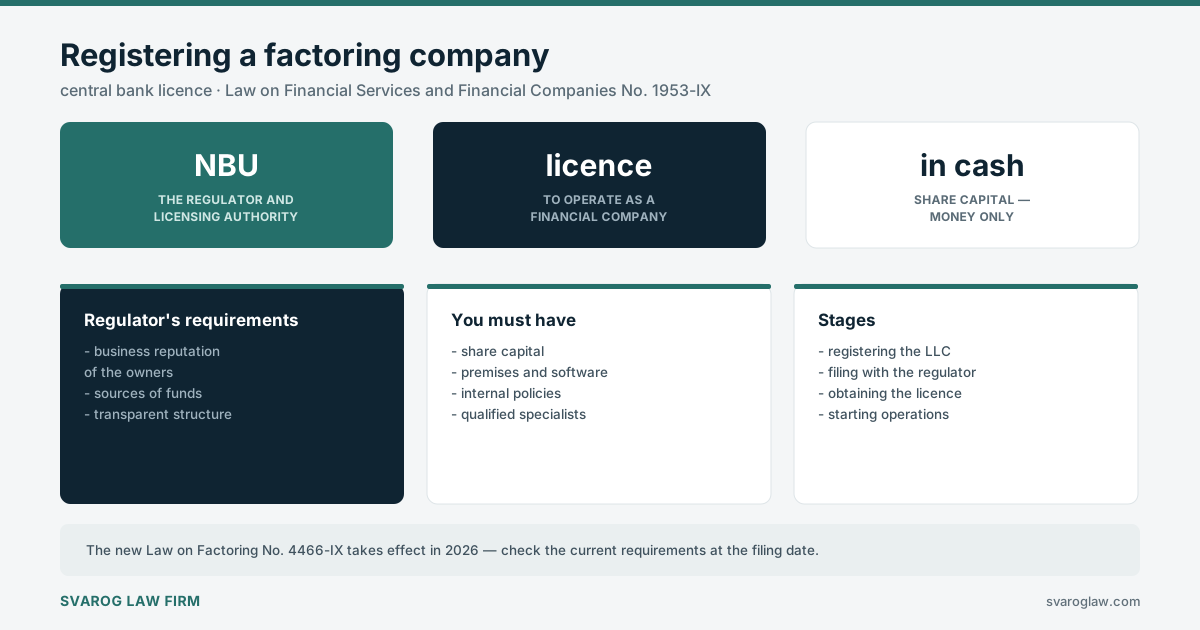
Stages of registration and authorisation
The process runs through several consecutive steps:
- structuring: choosing the corporate form, agreeing the ownership structure;
- state registration of the legal entity and contribution of the share capital in money;
- drafting internal policies to the National Bank’s requirements;
- preparing and filing the authorisation package: the application, questionnaires for owners and managers, the ownership structure chart, source-of-funds documents, the business plan, the internal policies;
- supporting the review of the application and responding to the regulator’s queries and comments;
- obtaining the licence and starting operations.
Before launching the business model it is worth checking it against the regulator’s requirements and the tax risks — in effect running legal due diligence.
The Law “On Factoring” No. 4466-IX: what has changed
On 30 July 2026 a separate Law of Ukraine “On Factoring” No. 4466-IX took effect, bringing the field into line with international standards together with amendments to the Civil Code. It refines the definition of factoring and the content of the agreement, and separates trade factoring from the assignment of consumer loan claims. Agreements made before the Law took effect remain under the previous regime, while new business models we check against the current rules from the outset, so that the file does not have to be redone.
Why the National Bank most often returns an application
The commonest reason is sources of funds for the share capital evidenced only in part: the regulator asks for documents on every element of the contribution, and a gap of a few percent stops the review just as surely as a gap of half. The second reason is an ownership structure in which the chain of ownership stops at a foreign company without the ultimate beneficial owner being disclosed.
Next come internal policies copied from public sources and not adapted to the institution’s actual processes, and managers who do not meet the qualification and business reputation requirements. Every query from the National Bank stops the clock on the review period, so a complete and coherent file saves more time than any attempt to file faster.
A case from our practice
In 2025 a group of entrepreneurs came to us having already registered an LLC and filed for authorisation themselves, only to have the application returned: the National Bank did not accept the evidence for the source of part of the capital contribution and found discrepancies in the ownership structure chart. We redrew the chart with the ultimate beneficial owners disclosed, assembled documents on the founders’ income for previous years, rewrote the anti-money-laundering rules to match the company’s real processes, and refiled. The company received its licence roughly four months after we came on board, and the full support cost 45,000 UAH. (details changed)
How we work
- we analyse the business model and ownership structure and assess the authorisation risks;
- we register the legal entity and handle the contribution of the share capital;
- we draft internal policies to the National Bank’s requirements;
- we prepare and file the licensing package;
- we deal with the regulator’s queries through to the licence;
- we advise on running the business afterwards and on reporting to the National Bank.
Cost of services (registration of a factoring company)
Court fees (2026): if a National Bank decision has to be challenged, an administrative claim with a non-monetary demand costs 3,328 UAH for a company and 1,331.20 UAH for an individual; filing through the Electronic Court multiplies the rate by 0.8. The cost of full support depends on the ownership structure, whether there is a foreign element, and the volume of internal documentation. Related areas — bank factoring, factoring with recourse and legal support for finance companies — are handled by the same practice.
Questions and answers (registration of a factoring company)
Can a ready-made licensed company be bought?
Yes, a market for such companies exists, but a change of owner is not an ordinary sale of corporate rights: acquiring a qualifying holding in a financial institution is cleared with the National Bank, and the new owner goes through the same checks on business reputation and source of funds as at authorisation. Before the deal we always check whether the company is subject to enforcement measures or unfulfilled orders from the regulator — otherwise you buy someone else’s problems along with the licence.
The National Bank refused. What next?
First we read the reasons: most of them can be cured, and the file is resubmitted with the documents corrected. If the regulator applied a rule wrongly, the decision is challenged in the administrative court, and then what the company said in reply to the queries during the review matters — the court assesses the procedure on the materials that were before the National Bank.
Are premises and staff needed at the time of filing?
Yes. The institution evidences that it has premises, equipment and software for recording transactions, as well as managers and an officer responsible for anti-money-laundering compliance who meet the qualification requirements. An agreement to rent in future or an intention to hire does not satisfy the regulator.
Can a factoring company buy the debts of individuals?
These are different regimes. Trade factoring serves monetary claims between businesses, whereas assigning claims under consumer loans requires compliance with the rules on dealing with debtors under the Law “On Consumer Lending” and entry in the register of collection companies kept by the National Bank. A model mixing the two is cleared with the regulator in advance.
What does the National Bank check after the licence is issued?
Regular reporting, compliance with anti-money-laundering requirements, the continued transparency of the ownership structure, and managers’ continued compliance with the reputation requirements. Changes of owners, managers and address are notified to the regulator within set deadlines, and a breach brings enforcement measures — from an order to remedy the failings to withdrawal of the licence.
Contact a Svarog lawyer about registering a factoring company
Describe your business model and ownership structure. We will assess the authorisation risks, draw up a road map and register the factoring company through to the National Bank licence. This area is handled by our finance company support practice.