A criminal case is usually decided during the pre-trial investigation. By the time the file reaches a judge, the prosecution has gathered its evidence and locked in the statements, and at trial all of that has to be rebutted — far harder than preventing such evidence from appearing in the first place.
Court representation in criminal cases at Svarog begins with the first contact with law enforcement: a detention, a search, a summons to an interview. We travel to the police station, to the scene of a search and to the investigator, obtain a meeting with the client before the first interview, and then run the case through to judgment, appeal and cassation.
We defend suspects and accused persons, and we also represent victims. These are two different tasks with different tools, and both strands are set out on this page.
Areas of work
The first hours
Pre-trial investigation
Trial and after
If you are the one who was harmed
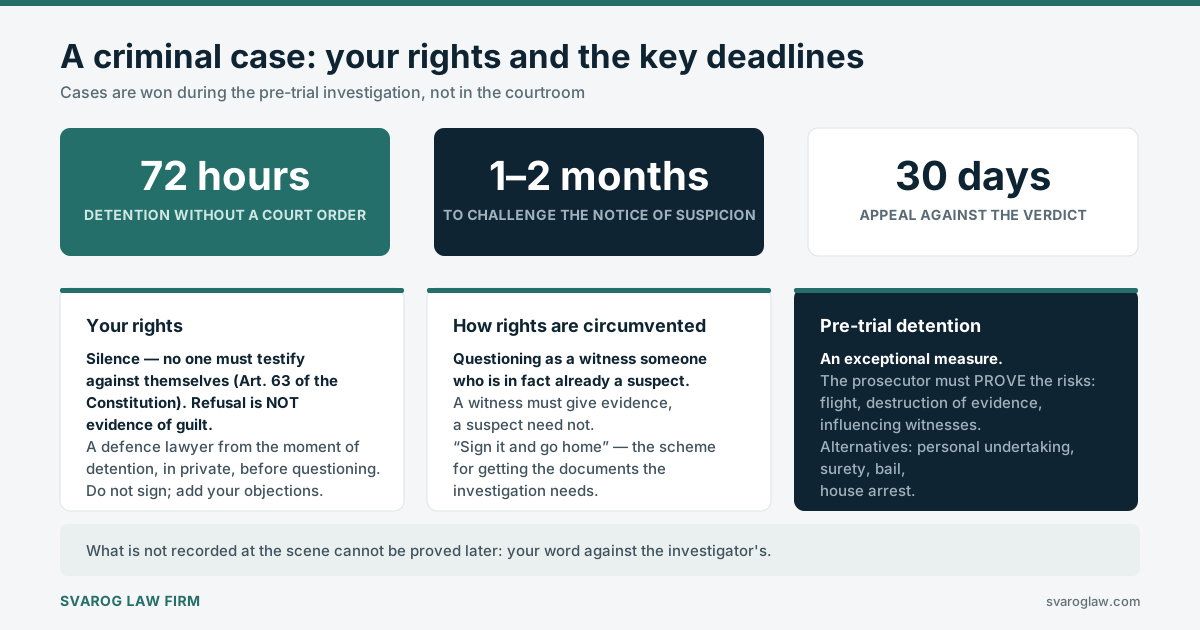
The rights the CPC guarantees, and how they are got round
The right to stay silent
No one is obliged to testify against themselves, their family or close relatives Art. 63 of the Constitution, Art. 42(3) CPC. Refusing to give evidence is not proof of guilt, yet most prosecutions rest on explanations given in the first hours without a lawyer.
The right to a defence lawyer
It arises from the moment of detention Arts. 208, 213 CPC: the detained person must be told at once of the right to a lawyer, and the free legal aid centre learns of the detention whether the investigator wishes it or not. A defence lawyer must be admitted to a search or an interview at any stage (Art. 236(1) CPC), although the law does not oblige the investigator to wait for them.
The right not to sign documents
Whose contents you do not accept, and to enter objections on records before signing Art. 104 CPC.
The right to challenge
Detention, a search, the suspicion, a preventive measure, the freezing of property, the investigator’s inaction Arts. 303, 309 CPC. A complaint to the investigating judge must be filed within 10 days Art. 304 CPC.
The commonest way round these guarantees is to summon as a witness someone against whom the material has in fact already been gathered. A witness must give evidence and is liable for refusing Art. 385 CC, though even a witness may decline to testify about themselves and their close family Art. 66(1)(3) CPC. If you are asked in “just for a chat”, go with a lawyer.
The deadlines to know
| What | Deadline |
|---|---|
| Detention without a court order | up to 72 hours from actual detention; the person must be brought before the investigating judge within 60 hours (Art. 211 CPC) |
| Service of the notice of suspicion on a detained person | within 24 hours of detention, failing which they are released immediately (Art. 278 CPC) |
| Complaint to the investigating judge about the investigator’s acts or inaction | 10 days from the decision or act (Art. 304 CPC) |
| Challenging the suspicion before the investigating judge | after 1 month from the notice for a criminal misdemeanour; after 2 months for a crime of any gravity; but before the case is closed or the indictment is sent to court (Art. 303(1)(10) CPC) |
| Appeal against a judgment | 30 days from its pronouncement (Art. 395 CPC) |
Remand in custody is an exceptional preventive measure Art. 183(1) CPC. The prosecutor must establish, with specific facts, the risks set out in Art. 177 CPC: absconding, destroying evidence, influencing witnesses. The gravity of the charge alone is not enough, and the defence at the hearing is built on that: references, documents about family, work and health, and a realistic offer of bail.
The first hours, in brief
Detailed guidance is on the pages Defence on detention and Defence during a search and questioning. In short: give your name and explain nothing, demand a lawyer in writing, note the time of actual detention, sign nothing without a lawyer, and enter your objections on the record. Every objection entered the same day later becomes the basis for an application to exclude evidence Art. 87 CPC.
A case from our practice
In 2025 we were contacted by the wife of a man detained one evening on suspicion of causing bodily harm during a fight outside a café. The record put the time of detention three hours later than it really was, and he gave his first explanation without a lawyer. Our lawyer reached the station that same evening, obtained a meeting in private and entered in the record the real time of detention, established from call logs and the cameras of a nearby shop. The prosecutor asked for custody; the court imposed house arrest at night. Seven months later the parties made a reconciliation agreement with the treatment costs paid, and the court approved it. The fee for the whole matter was about 80,000 UAH (details changed).
When you can manage without a lawyer
Such situations exist, though not many. If you have been called as a witness in a case you are not involved in (you saw a road accident, you were at the next table), two rules suffice: say only what you saw yourself, and read the record before signing. If a report has been drawn up against you under the Code of Administrative Offences with no criminal case, see Challenging police actions.
You need a lawyer when:
- You have been detained or served with a notice of suspicion.
- Officers have come to search your home or office.
- You are summoned as a witness in a case where you are a party to the conflict.
- The prosecutor asks for custody, or for bail you cannot pay.
- You are the victim and the case is not being registered, is being closed, or has stood still for months.
- You are offered a plea or reconciliation agreement and need the consequences worked out.
Cost of services
The price depends on the gravity of the charge, the stage of the proceedings, the number of episodes and the need for expert reports. Court fees add nothing in 2026: no rate is set by law for a complaint to the investigating judge or for an appeal or cassation appeal against a judgment, and a victim’s civil claim within criminal proceedings is exempt under Art. 5 of the Law “On Court Fees”. A fee arises only for a separate civil claim outside the criminal case: 1 % of the value of the claim, from 1,331.20 to 16,640 UAH.
Questions and answers (Court representation in criminal cases)
Can relatives engage a lawyer without the detained person’s consent?
Yes. Under Art. 48 CPC the defence lawyer is engaged by the suspect themselves or by others at their request or with their consent. The relatives sign the engagement, the lawyer goes to the station, and the detained person confirms their consent at the meeting. The relatives need only give the person’s name and the body that detained them.
How long does a pre-trial investigation take?
After a notice of suspicion of a crime the investigation has two months; the period is extended to six months for less serious crimes and to twelve for serious and especially serious ones (Arts. 219, 294 CPC). If the period has expired and no indictment has been sent to court, the case must be closed — and that usually has to be pointed out by application.
What if the 30 days for an appeal have already passed?
File the appeal together with an application to restore the deadline and documents showing a valid reason: sick leave, late receipt of the copy of the judgment, being abroad (Arts. 117, 395 CPC). The more time has passed, the harder it is to persuade the court, so act at once.
What happens if I do not attend when the investigator summons me?
Failing to appear without a valid reason can bring a financial penalty (Art. 139 CPC) and being brought in by force (Art. 140 CPC). For a suspect, a second absence also becomes the prosecutor’s argument for a stricter preventive measure. The right course is to give the reason in writing and agree a new date.
Contact a Svarog criminal lawyer
Call the moment officers arrive, you are summoned, or a document is served on you. An explanation given without a lawyer stays in the file for good, and a breach not entered in the record can never be proved afterwards. We travel to the station, to searches and to the investigator, and then take the criminal case through to judgment and appeal.