Let us start with what most websites leave out: during martial law the free transfer of state and municipal land into private ownership is prohibited (subpara. 5, para. 27 of Chapter X of the Transitional Provisions of the Land Code). The ban also covers the granting of permits to prepare land management documentation.
This means that an application along the lines of “give me 2 hectares for a smallholding” or “0.10 hectares for building in the city” cannot succeed at present: a refusal would be lawful. That applies to everyone, including combat veterans, despite the separate rules on their priority right.
But the ban is not absolute. Privatisation of a plot is still possible in at least four situations, and those are the ones we work with.
The four exceptions that work now
- Land under your own building. If the plot has a house, garage, summer house or other structure on it whose title is registered in your name, the plot can be privatised. This is the commonest workable route. No permit to prepare documentation is required here: technical documentation is drawn up establishing the boundaries on the ground (Art. 118(1) of the Land Code).
- A plot granted for use before 1 January 2002 — before the current Land Code took effect. Old state title deeds, village council decisions from the 1990s, agreements granting the use of land, and sometimes entries in a village council’s household registers all serve as proof.
- Separating a land share (pai) on the ground under a certificate. This is not a free transfer within the meaning of the ban, so authorities that refuse citing martial law are mistaken. Such refusals are overturned successfully.
- Enforcing a court judgment that has come into force.
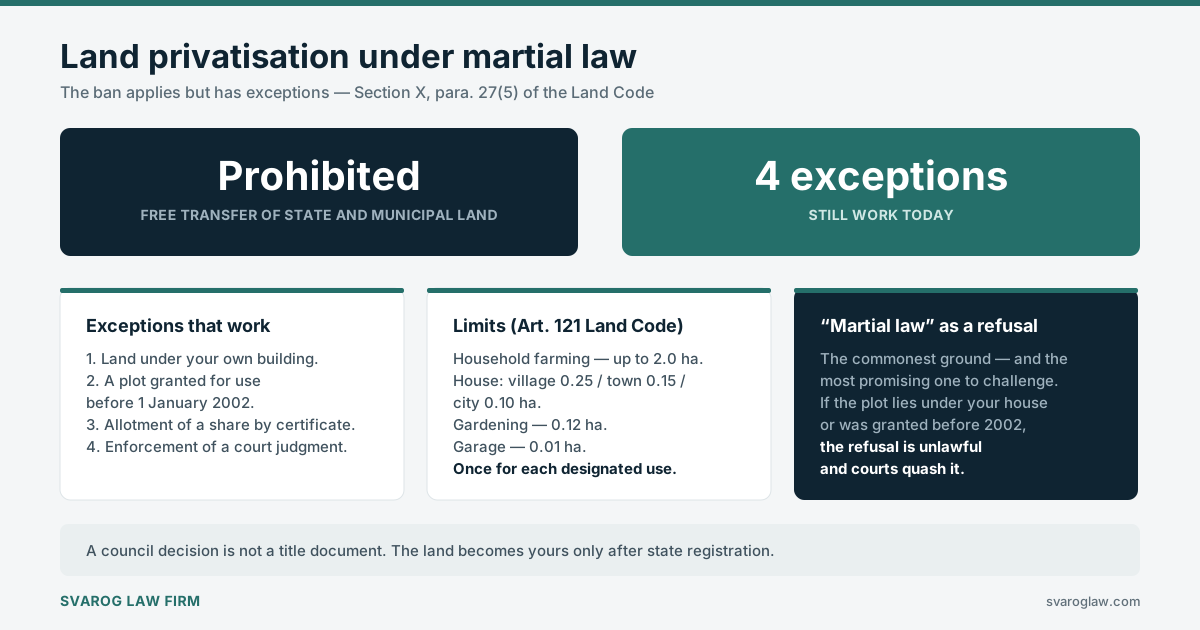
Free transfer limits (Art. 121 of the Land Code)
These limits will apply once the ban is lifted, and already apply to the exceptions listed above:
| Designated use | Maximum area |
|---|---|
| Running a personal smallholding | up to 2.0 ha |
| Building a house — in a village | up to 0.25 ha |
| Building a house — in a settlement | up to 0.15 ha |
| Building a house — in a city | up to 0.10 ha |
| Gardening | up to 0.12 ha |
| Building a private garage | up to 0.01 ha |
The right to free privatisation may be used once for each designated use (Art. 116(4) of the Land Code). Taking a plot for a garage does not cost you the right to a plot for a smallholding.
The steps where the plot is under your own building
- Checking the status of the land — who owns it, whether a neighbouring plot overlaps it, and whether there are restrictions: protection zones, defence land, water fund land, historic areas. In our experience most refusals are born at this step, and finding the problem before filing is cheaper than challenging a refusal.
- Commissioning technical land management documentation establishing the boundaries on the ground. No council permit is needed for this.
- Approval of the documentation by the local council.
- The decision transferring the plot into ownership. The council’s decision is not itself a document of title.
- State registration of title — through an administrative services centre or a notary. Only after this step is the land yours.
With the documents in place it takes 3–6 months. Challenging a refusal adds another 6–12 months.
Typical grounds of refusal and how to overcome them
- “Martial law, it is prohibited” — applied to a case the ban does not cover. The most promising refusal to challenge: the ban does not extend to a plot under registered real estate.
- Overlapping boundaries with a neighbouring plot in the cadastre — resolved by correcting the error in the State Land Cadastre or in court.
- The plot is land that cannot pass into private ownership — public land, defence land, transport land, nature reserve land. Here the refusal is lawful and litigation is pointless.
- The council says nothing — the application was filed, the deadline passed, there is no decision. Inaction is challenged just as a refusal is, and the court can order the council to consider the matter on its merits.
- Restricted access to the cadastre. In front-line districts access to the State Land Cadastre is closed, which makes checking harder. That is not a ground for refusal, but allow more time for the procedure.
A case from our practice
In 2025 a man came to us who had inherited a house built in 1978 in a village near Kyiv: he had registered title to the house, but the land under it remained municipal. The village council refused to transfer the plot, citing the martial law ban. We prepared an administrative claim, showing that the ban concerns the free transfer of vacant land while a plot under registered real estate falls within the exception, and that no permit to prepare documentation was needed in this case at all. The court ordered the council to consider the application on its merits; the council then resolved to transfer the plot, and title was registered at the administrative services centre. The whole story from the first consultation to the register extract took about ten months; our fee was 22,000 UAH, and the client paid the surveyor for the technical documentation separately. (details changed)
What to do if your case is not within an exception
A vacant plot cannot be privatised at present, and no lawyer will get around that ban. But preparation is worth doing now.
Check the status of the plot you have in mind
It often turns out to be already formed, to have a cadastral number and to be under lease, so joining a queue achieves nothing.
Register the building already standing on the plot
Once title to the house or garage is registered, your case falls into the first exception and stops depending on when martial law is lifted.
Finish the inheritance
If the house is in a deceased relative’s name, the certificate of inheritance comes first and the land only afterwards.
Gather the old documents
State title deeds, village council decisions, extracts from household registers — these are what will later prove the right of use, and archives are better searched without haste.
Cost of services
Court fees in 2026: a non-monetary administrative claim costs an individual 1,331.20 UAH and a company 3,328 UAH, with a 20 % reduction through the Electronic Court. The surveyor’s work, the cadastre extracts and the administrative fee for registering title are paid separately.
Questions and answers (Privatisation of a land plot)
The house is in my late father’s name. Can the land under it be privatised?
The inheritance has to be completed first: obtain the certificate of inheritance and register title to the house in your own name. Along with the house the heir also takes the right to use the plot it stands on (Art. 1225 of the Civil Code), and from there the ordinary procedure for land under one’s own building applies. If the deadline for accepting the estate was missed, it has to be extended through the court, which adds several months.
The house is built but not registered. Can the land be dealt with straight away?
No. The exception to the ban works for plots under real estate whose title is registered in the State Register of Property Rights. So the order is: first commissioning and registration of the house, then the technical documentation for the land. Trying to proceed with an unauthorised building ends in a refusal that is hard to defend in court.
The house belongs to two co-owners. How is the land privatised?
All the co-owners apply together, and the plot is transferred into co-ownership in shares matching their shares in the house. If one co-owner refuses to take part, the matter goes to court, and another 6–12 months should be allowed for that.
Can the privatisation be handled without my being present?
Yes. The applications, approvals and registration are handled by the lawyer under a notarised power of attorney, which can be executed at a consulate if you are abroad. Attendance in person is needed only for certain surveying work on the ground, and even there a representative will do.
What does the procedure cost besides the lawyer’s work?
The main outlays are the technical land management documentation, prepared by a certified surveyor, the cadastre extracts and the administrative fee for state registration of title. The fee depends on the registration speed chosen: standard is cheapest, expedited costs several times more. We draw up an exact budget once the plot has been checked.
Does the ban only cover free transfer? Can I buy the plot under my own house?
The ban in subpara. 5, para. 27 of Chapter X of the Transitional Provisions is framed specifically for the free transfer of state and municipal land. Purchase of a plot by the owner of the real estate on it is a separate mechanism, but councils’ practice varies, so we check whether a purchase is possible under the particular community’s decisions before you incur any cost.
Contact a Svarog lawyer about privatising a land plot
Describe the situation and send us the documents for the house and the land — we will check the plot’s status against the cadastre and the property rights register, tell you whether you fall within an exception to the ban, and set out the route to take. If there are no prospects, you will hear that at a consultation costing 1,500 UAH, rather than after a year of paying a surveyor and a court.