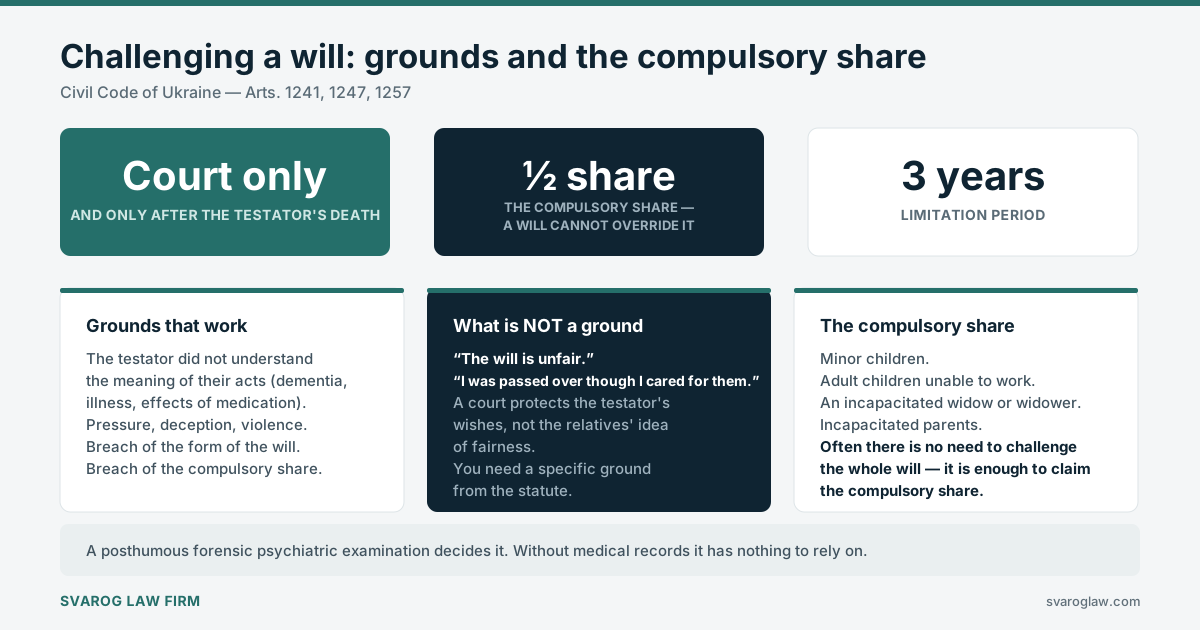
A will being unfair is not a ground for setting it aside. “Father left everything to the neighbour”, “they passed me over even though I was the one caring for him” are not legal arguments: a will is a free expression of intention, and that is exactly what the court protects.
A will can be challenged only on the specific grounds the law lays down: the testator did not understand the nature of their acts, they were put under pressure, the form of the will was breached, or the right to a compulsory share was infringed.
A claim is possible only after the estate opens, that is after the testator’s death: while the testator is alive no right to inherit yet exists (Arts. 1220, 1257 of the Civil Code). And a testator may revoke or change their will at any time.
The grounds that work
The testator did not understand what they were doing
Dementia, Alzheimer’s disease, the after-effects of a stroke, the influence of strong medication, mental illness. This is decided by a posthumous forensic psychiatric report, based on the medical records, witness evidence and the case file. It is the commonest and most promising ground, and it depends entirely on the medical documentation.
Pressure, deception, violence
From the person in whose favour the will was made. Proved by witness evidence, correspondence, reports to the police, and evidence that the testator was cut off from the family.
Breach of the required form
A will must be in writing and notarised (Art. 1247 of the Civil Code). The exception is certification treated as equivalent to notarisation (by a chief physician, a ship’s master, the head of a penal institution), but the conditions are strict. A breach of the certification procedure is a ground of invalidity in itself.
The will was made by a person lacking capacity
Or by someone who did not have full civil capacity when it was made.
The right to a compulsory share was infringed
The ground people remember least often, although it is the one that succeeds most often; it is set out separately below.
The will was made on behalf of several people
Other than a spouses’ joint will over joint property, or it was signed by another person in breach of the rules.
The compulsory share: a will cannot take it away
Whatever the will says, half the share they would have taken under the law goes to (Art. 1241 of the Civil Code):
Who is entitled to a compulsory share
- the testator’s minor children;
- adult children unable to work (disability, pension age);
- a widow or widower unable to work;
- parents unable to work.
A will cannot remove this right. Even if you are not mentioned in the will at all, if you fall within this list half of what you would have received under the law is yours.
Often there is no need to challenge the whole will: a claim for the compulsory share is enough. That case is simpler, cheaper and far more likely to succeed, so it is where we start the analysis.
What we prove in court
Documents decide the case:
The evidence
- the testator’s medical records: the outpatient file, discharge summaries, prescriptions, hospital admissions. This is the basis for the expert report;
- the posthumous forensic psychiatric report, on which the outcome turns;
- evidence from relatives, neighbours, social workers and doctors about the testator’s condition;
- evidence of pressure or isolation: correspondence, reports to the police, witnesses;
- documents establishing your entitlement to a compulsory share: pension certificate, disability certificate, birth certificate.
The medical records are gathered before the claim is filed. Obtaining someone else’s medical file yourself is virtually impossible, so we send lawyer’s enquiries to the medical institutions, and if they refuse we apply to the court to order disclosure.
Deadlines
There is no special period for challenging a will; the general three-year limitation period applies (Art. 257 of the Civil Code) from the moment the person learned, or could have learned, that their right had been infringed (Art. 261). Usually that is when the estate file is opened or when they are told about the will.
For claims to invalidate a transaction made under violence or deception a longer period applies (Art. 258(3)). So the ground of the claim is settled before filing: it determines both the deadline and what has to be proved.
There is another reason not to delay: the estate gets sold. After several resales recovering the property is far harder, so we file an application for interim relief with the claim — an order barring registration actions.
What follows if the will is set aside
If the court declares the will invalid:
- the estate passes under the law, by classes of heirs (Arts. 1261–1265 of the Civil Code);
- if there is an earlier will that was never revoked, that one takes effect;
- transactions made by the heir under the invalid will (sale, gift) can themselves be set aside; the outcome depends on whether the buyer acted in good faith, and every further resale makes recovery harder.
When it is not worth going to court
The prospects are weak if:
- there are no medical records showing the testator’s condition: the experts will have nothing to base a report on;
- the will is impeccably drawn and the testator was of sound mind to the end;
- you are not among those entitled to a compulsory share and are not an heir of the class that would inherit under the law;
- the value of the disputed property does not cover the cost of the case: the expert report, the court fee, the lawyer’s fee.
In such cases the consultation ends with a calculation of what the case would cost and what could realistically be recovered — and often with a move to a claim for the compulsory share instead.
A case from our practice
In 2024 the testator’s daughter came to us having learned that six months before his death her father had left his flat in Obolon to the neighbour who cared for him. Through lawyer’s enquiries we obtained the outpatient file: two months before the will was made he had been under a neurologist’s care with a diagnosis of vascular dementia, and before that had twice been hospitalised after a stroke. The court ordered a posthumous forensic psychiatric report, which confirmed that he could not have understood the nature of his acts, and the will was declared invalid. At the same time we had secured the claim with an order barring registration actions, so the flat had not been resold. The case took about a year; the client’s outlay was a court fee of 1,331.20 UAH plus the expert report and our fee from 10,000 UAH. (details changed)
How we work
- We assess the prospects: whether there is a ground, whether there is evidence, and whether claiming the compulsory share would be simpler.
- We gather the medical records through lawyer’s enquiries — the decisive stage.
- We block any disposal of the estate with an application for interim relief.
- We apply for the posthumous expert report and frame the questions for the experts.
- We run the case in court, including the appeal.
- We complete the inheritance after the win, through to registration of title.
Cost of services
The court fee, the posthumous forensic psychiatric report and any valuation are paid separately. Court fees in 2026: a claim to declare a will invalid is a non-monetary one, so an individual pays 1,331.20 UAH; if a monetary claim is brought with it (establishing title to the estate), 1 % of its value is added, within the range 1,331.20 to 16,640 UAH. Through the Electronic Court the rate is 20 % lower.
Calculate the fee for the monetary claim
The claim to invalidate the will itself is non-monetary: 1,331.20 UAH. This calculation is for establishing title.
Questions and answers (challenging a will)
The will was certified by a hospital’s chief physician. Can it be challenged?
Yes. Certification treated as equivalent to notarisation (by a chief physician, a ship’s master, the head of a penal institution) is valid only on strict conditions: the testator was genuinely receiving treatment or held in such an institution, the will was signed in the presence of two witnesses, and the document was properly registered. A breach of any of these is a ground of invalidity in itself. Wills certified by an official of a local council are checked the same way.
The notary has already issued a certificate of inheritance to another heir. What now?
A certificate of inheritance is declared invalid by a court (Art. 1301 of the Civil Code). Together with the claim to invalidate the will you bring claims to declare the certificate invalid and to cancel the state registration of title. They should be filed together, otherwise after the will is set aside a second case has to be started.
What does the posthumous expert report cost and who pays for it?
The cost depends on the institution and the volume of medical records, and it is not included in the lawyer’s fee. It is paid by the party that applied for it, and after a win those costs, along with the court fee, are recovered from the defendant by the court’s order. At the consultation we work out an indicative budget for the case including the report.
Can only part of a will be challenged?
Yes. The invalidity of part of a transaction does not invalidate the rest if it could have been made without that part (Art. 217 of the Civil Code). For example, where a will disposes both of the testator’s own property and of the spouse’s share, the court invalidates only the part that goes beyond what the testator could dispose of.
I live abroad. Can the case be run without my coming?
Yes. The claim and the evidence are filed through the Electronic Court, and the lawyer attends hearings under a power of attorney certified at a consulate or by a local notary with an apostille. You need to attend in person only if the court summons you to give evidence, and we warn you of that in advance.
Contact a Svarog lawyer about challenging a will
Tell us about the testator’s condition before the will was made and show us what medical records exist: we will name the ground for the claim, the limitation period that goes with it, and an indicative budget. Often the better strategy turns out to be a claim for the compulsory share — simpler, cheaper and faster.