The first thing we do with any debt is check how large it really is. Not “negotiate”, not “write off”, but calculate how much of the sum the creditor could actually recover in court.
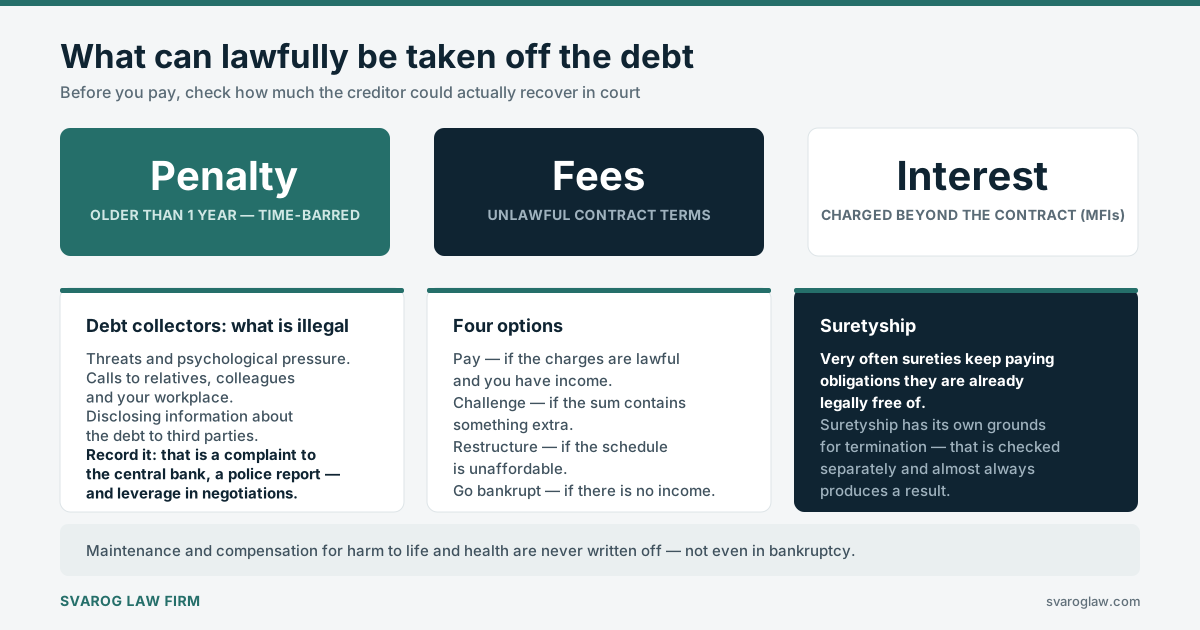
Very often it turns out that the penalty exceeds the permitted limits, the account servicing commissions are unlawful, part of the claim is time-barred (one year for penalties rather than three), and the microfinance lender has charged interest that does not appear even in its own contract.
A credit lawyer proves one thing, in negotiation and in court: that you pay what the law requires, and no more. The work starts with a calculation, and the strategy — pay, challenge, restructure or go insolvent — follows from its result.
Our areas of debt work
If you owe
- Debt restructuring — a new schedule, reduced penalties, negotiations with the figures in hand
- Personal insolvency — writing debts off, the moratorium, halting enforcement proceedings
- Corporate insolvency
- Defence against debt collectors and challenges to unlawful microfinance charges
- Defending guarantors and property guarantors
If you are owed
- Debt recovery — demand, court order, claim, enforcement
- Recovering a debt on an IOU
- Buying debt
What can almost always be stripped out of a debt
This is where the audit earns its keep:
What comes off lawfully
- penalties and fines older than a year — the shortened limitation period applies to them (Art. 258 CC);
- an excessive penalty — the court may reduce it where it is disproportionate to the creditor’s loss (Art. 551 CC);
- unlawful commissions — account servicing fees, a “monthly commission” on the principal and the like; courts hold many of them to be unfair contract terms;
- interest charged after the contract term expired, where the contract does not provide for it;
- time-barred claims — three years on the principal, bearing in mind that since 4 September 2025 limitation is running again after the quarantine and wartime pause;
- claims against a guarantor where the surety has already terminated.
What the real-figure calculation looks like
A typical microfinance demand: 14,000 UAH as a single figure, with no breakdown. The statement of arrears splits it up: principal 5,000 UAH, interest 6,200 UAH, penalty 2,800 UAH.
We check each element separately. The principal stands. The interest we recalculate at the rate and for the term in the contract, not the ones that appeared in the statement: if the contract ran for 30 days and provided for no automatic extension, six months of charges do not follow from it. Penalties older than a year come off by limitation, and the rest the court may reduce under Art. 551 CC.
We put the calculation in writing: it becomes both the position in the defence and the argument in negotiations.
Debt collectors: what is lawful and what is not
Reminding you of the debt, sending demands, going to court, buying the debt under an assignment of the claim.
Threats, calls to relatives, colleagues and your workplace, psychological pressure, coming to your home uninvited, posing as law enforcement officers. The rules for dealing with a debtor are set by Art. 25 of the Law “On Consumer Lending”: the creditor and the collection company must identify themselves, record their calls, refrain from contacting you at night or at weekends, and not discuss the debt with third parties without your written consent.
Such conduct is recorded (call recordings, screenshots, witnesses) and challenged: a complaint to the National Bank, which maintains the register of collection companies, and a report to the police. The breach itself then becomes an argument in negotiations over the amount.
We check separately whether the debt was lawfully passed to collectors and whether you were notified of the assignment. A breach here is a reason to challenge the claim altogether.
Pay, challenge, restructure or go insolvent
The logic we use at the consultation:
Pay
Where the debt is small, the charges are lawful and you have income. Litigating would cost more than paying.
Challenge
Where the sum contains unlawful charges or part of it is time-barred. How far the claim falls depends on the share of penalties, fines and commissions: in microfinance debts it is usually larger than in bank ones.
Restructure
Where you have income but the schedule is unmanageable. Audit first: restructuring an inflated figure means voluntarily acknowledging it.
Go insolvent
Where there is no income to repay from. Maintenance and compensation for injury to life or health are never written off.
A case from our practice
In 2025 a woman came to us who four years earlier had borrowed 5,000 UAH from a microfinance lender for two weeks and stopped paying because of illness. Collectors were demanding more than 40,000 UAH, and the lender eventually sued. The statement showed interest charged for the entire period of default, although the contract had run for 14 days and provided for no extension, and a penalty accrued over three years. In our defence we set out our own calculation, pleaded limitation against the penalty and asked the court to reduce it under Art. 551 CC. The court granted the claim in part: it awarded the principal and the interest for the contract term, and refused the penalty and the commissions. The case took about seven months and our fee was around 11,000 UAH. (details changed)
When you do not need a lawyer
If the debt is small, the statement breaks it down into principal and contractual interest, no penalty has been charged and your income covers the sum, it is cheaper simply to pay: the legal fees would exceed the saving. We say so at the consultation and explain there how to handle it yourself.
You need a credit lawyer when:
- you do not understand what the figure is made of;
- the debt is with collectors or a microfinance lender;
- penalties and fines make up a large part of the sum;
- the bank has sued or enforcement proceedings have been opened;
- your wages are being deducted and your accounts frozen;
- you are a guarantor on someone else’s loan;
- a debt owed to you is not being repaid and has to be recovered.
Cost of services
The last line refers to the minimum value of dispute at which that arrangement is possible.
Court fees (2026): 332.80 UAH for an application for a court order; a monetary claim by an individual costs 1 % of its value, from 1,331.20 to 16,640 UAH; a debtor’s application to open insolvency proceedings costs 1,331.20 UAH. Filing through the Electronic Court multiplies the rate by 0.8.
Calculate the court fee on a monetary claim
An application for a court order costs 332.80 UAH, an insolvency application 1,331.20 UAH.
Questions and answers (debts, microfinance, collectors)
The court issued an order and I learned of it from the enforcement officer. What now?
File an application to set the order aside — you have 15 days from service of the copy (Art. 170 CPC). The court sets it aside without assessing your reasons, and the creditor must then bring an ordinary claim, where you file a defence with the calculation. If the deadline has passed, the application goes in together with a request to restore it.
Can a debt stop me leaving the country?
Yes, but that is decided neither by the creditor nor by the enforcement officer. A temporary travel ban is imposed by a court on the application of a state or private enforcement officer where the debtor is evading the judgment. It is lifted once the debt is paid, or if you show there was no evasion: you are contactable and paying part of the debt.
What happens if I simply ignore the court and do not answer the claim?
The court will hear the case without you and award the whole sum claimed together with the court fee, since no defence or calculation was filed. Enforcement proceedings follow, a 10 % enforcement fee is added to the debt, the accounts are frozen and part of your wages is withheld.
What does personal insolvency cost besides the legal fee?
The court fee on a debtor’s application is 1,331.20 UAH. In addition the debtor pays into the court’s deposit account an advance on the restructuring manager’s remuneration under the Bankruptcy Code; we calculate that sum at the consultation, along with the cost of the public notices and the valuation of the property.
Contact a Svarog credit lawyer
Send us the credit agreement and the statement of arrears. We will calculate how much of that sum the creditor could actually recover in court and tell you which is better: paying, challenging, restructuring or going insolvent. If it is you who is owed, we will choose the route to recovery — a court order or a claim.