An acquittal or the closure of a case is not the end of the story. The state is obliged to compensate the harm caused by unlawful acts of the bodies conducting operational-search activity, the pre-trial investigation bodies, the prosecution service and the courts. It does so regardless of the fault of the particular investigator or prosecutor (Art. 1176(1) CC), and the mechanism itself is set out in a separate Law No. 266/94-VR.
Compensation for harm caused by state bodies is a procedure of its own, with its own deadline, which starts running as soon as you are cleared. The state does not remind you twice: the notice of the right to compensation is sent once, and the six months for applying are counted from that date.
When the right to compensation arises
Exonerating grounds
- an acquittal that has taken legal effect;
- closure of the criminal case on exonerating grounds: no criminal event took place, no offence was made out, or the person’s involvement was not proved;
- the quashing of an unlawful conviction followed by closure of the case;
- a finding of unlawfulness in respect of detention, remand in custody or a search;
- the unlawful imposition of administrative arrest or corrective labour, unlawful confiscation of property, an unlawfully imposed fine.
Where the case is closed on non-exonerating grounds (expiry of the limitation period, amnesty, reconciliation, release from criminal liability), the right to compensation usually does not arise. So the first thing we check is which sub-paragraph of Art. 284(1) CPC the case was closed under: a single number in the decision determines whether there is any money in the case at all.
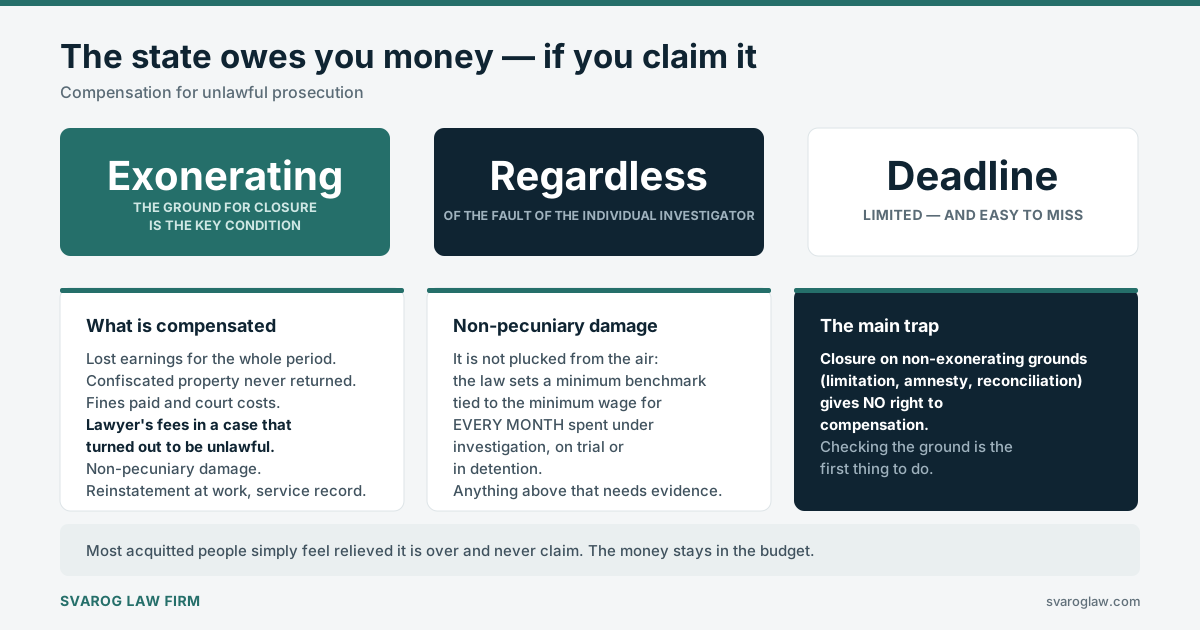
What the state pays for
Earnings and other income
Lost as a result of the unlawful acts, for the whole period of the prosecution.
Property
Confiscated, seized and not returned, or forfeited to the state. If the item no longer exists, its value is paid.
Fines and court costs
Recovered in enforcement of an unlawful conviction.
Legal costs
The lawyer’s fee paid in a case that turned out to be unlawful. They are proved by the engagement letter, the statement of work and the payment documents, so keep those papers from day one.
Non-pecuniary damage
For the suffering caused by unlawful prosecution: loss of reputation, broken relationships, stress, the effects on health, time spent in pre-trial detention.
Restoration of employment, pension and housing rights
Reinstatement at work, crediting the period to your insured service record, the return of housing.
How much non-pecuniary damage comes to
Above that floor the sum is justified by evidence: medical records, certificates showing loss of work and reduced income, media coverage and notices of suspicion published by the authority’s press office, evidence of broken family relationships, documents about the conditions of detention. The courts also weigh the gravity of the offence charged, the length of the preventive measure and how public the case was.
Six months: the deadline most often missed
After an acquittal or the closure of the case the authority must send the person a notice of the right to compensation. The six months for filing the claim (Art. 12 of Law No. 266/94-VR) run from the date that notice was sent, not from the day the person “felt ready”.
Missing the deadline does not mean there is no money at all: the claim can be brought as a civil action within the limitation period, but the position then has to be argued separately. So we calculate the deadline at the very first consultation, from the dates in the decision or judgment and in the postal documents.
Where to apply and how to get the money
- Check the ground: whether it is exonerating, and under which sub-paragraph of Art. 284 CPC the case was closed.
- Calculate the sums: earnings from income certificates, the value of the property, fines, the lawyer’s fee, non-pecuniary damage for each month.
- File the claim with the body that closed the case, or with the court that acquitted you. The body considers it and issues a decision naming a figure.
- Go to court if compensation is refused, delayed, or set at a figure you do not accept. Non-pecuniary damage is in most cases awarded by a court.
- Payment from the state budget through the State Treasury Service. This is a stage of its own: the decision goes to the treasury with a full set of documents, and this is where cases most often stall for months.
Harm caused by other state bodies
The right to compensation is not limited to criminal cases. Harm caused by unlawful decisions, acts or omissions of any body of state power or local self-government is likewise compensated by the state or by the local authority (Arts. 1173–1174 CC).
Typical situations: an unlawful refusal to issue a permit or licence, the unjustified blocking of tax invoices, a decision later quashed by a court that cost you money, inaction that wrecked construction or supply deadlines. The logic of proof here is different: first the decision or act is declared unlawful in the administrative court, and only then are the losses recovered, with a calculation and documents showing the actual expenditure.
A case from our practice
In 2024 a businessman came to us after a case was opened against him on his former partner’s complaint. He spent four months under house arrest, the business stopped, and a year later the investigation closed the case because no offence had been made out. The notice of his right to compensation went to an old address, and he learned of it by chance. We gathered income certificates for the two years before the prosecution, the engagement letter and payment records for his previous lawyer, and medical documents, filed the claim with the authority and, after it was refused, sued. The court awarded the lost earnings and non-pecuniary damage above the statutory floor. The case took about ten months and our fee was 30,000 UAH. (details changed)
Typical mistakes after being cleared
Saying nothing
The commonest outcome: the person is relieved it is over and never applies. Money owed by law stays in the budget.
Not keeping the records of expenditure
Without the engagement letter with the previous lawyer, the statements of work and the receipts, the fee will not be repaid even if it really was paid.
Claiming only non-pecuniary damage
Lost earnings, fines and court costs often make up the larger part of the sum, but they go unclaimed because they take certificates and calculations.
Accepting the first figure offered
A modest figure in the authority’s decision is not final: it can be challenged in court.
Stopping at the court judgment
Enforcement through the treasury is a separate stage, and without someone pursuing it the judgment easily sits still.
How we work
- We check the ground on which the case was closed, from the text of the decision or judgment.
- We calculate the deadline from the date of the notice and move fast if it is running out.
- We work out every element: earnings, property, fines, legal fees, non-pecuniary damage for each month.
- We prepare the application with the full calculation and the evidence.
- We run the case in court if compensation is refused or understated.
- We see the money actually paid from the budget through the treasury.
Cost of services
Court fees in 2026: an individual’s claim for compensation is a monetary one and costs 1 % of the value of the claim, but not less than 1,331.20 and not more than 16,640 UAH. If a decision or omission of a state body has first to be declared unlawful, that claim in the administrative court costs an individual 1,331.20 UAH and a company 3,328 UAH. Filing through the Electronic Court reduces the rate by 20 %, and we check case by case whether an exemption under Art. 5 of the Law “On Court Fees” applies.
Calculate the court fee for a compensation claim
The value of the claim is the earnings, the value of the property, the fines and the non-pecuniary damage taken together.
Questions and answers (Compensation for harm caused by state bodies)
The case was closed during the pre-trial investigation and never reached court. Is there a right to compensation?
Yes, no judgment is needed. What matters is the ground for closure: if the decision says there was no event, no offence was made out, or the person’s involvement was not proved, the right arises just as it does after an acquittal. Most of the cases in our practice are exactly these.
What if the six months have already passed?
First check when the notice of the right to compensation was actually sent: often it was never sent at all, or went to an old address, in which case time never began to run. If the deadline really has passed, the claim is brought as a civil action within the limitation period, with reasons given for the delay.
The seized property was sold or has deteriorated. What then?
If the item no longer exists in kind, the state pays its value. The amount is proved by the purchase documents, or, where there are none, by a certified valuer’s report, which we commission before filing. The value is taken as at the date of compensation, not the date of seizure, and the difference can be substantial.
Can I apply to the European Court of Human Rights at the same time?
Yes, but domestic remedies must be exhausted first, which means going through the Ukrainian courts. If the state has paid adequate compensation, you cease to be a victim of the violation and an application to the ECtHR becomes hopeless. So the order matters, and it is worth planning from the outset.
Can the case be handled remotely if I live in another city or abroad?
Yes. You send the documents electronically, we sign the engagement remotely, the claim to the authority and the court claim go through the Electronic Court, and the lawyer appears at hearings on a warrant. Your own presence is usually needed only if the court decides to hear you on the suffering you went through.
Contact Svarog about compensation for harm caused by state bodies
Send us the judgment or the decision closing the case, together with the envelope or the notice from the authority: we will check the ground, calculate the deadline, and draw up the figures for every element — earnings, property, fines, legal fees and non-pecuniary damage for each month. The sooner you come, the more options remain.