A court does not “work it out for itself”. It assesses what the parties put before it and gives judgment within the arguments made. A passive stance in the courtroom amounts to agreeing with the indictment.
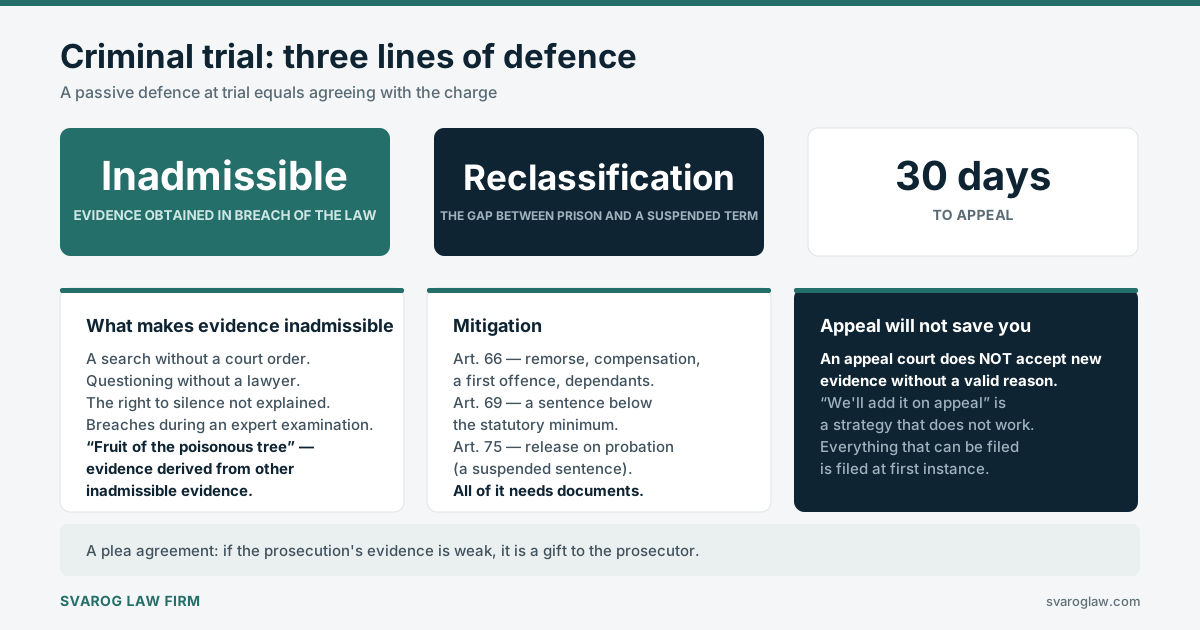
Defence at trial runs along three lines: excluding inadmissible evidence, dismantling the prosecution case, and, where guilt is proved, working towards the lightest sentence. The prosecutor comes to court with material the investigator spent months collecting, and the only thing that answers it is a case prepared just as thoroughly.
Inadmissible evidence and how it is excluded
The usual grounds for ruling evidence inadmissible:
- a search without an investigating judge’s order, or going beyond what the order allowed;
- questioning without a lawyer where a lawyer’s presence was mandatory, or where the defence lawyer was kept out;
- failure to explain the right not to incriminate oneself;
- breaches in the expert examination — incomplete source data, an unqualified expert, departures from the methodology;
- evidence derived from other inadmissible evidence — the “fruit of the poisonous tree”;
- breaches during identification — where the victim was effectively prompted;
- pressure and ill-treatment — anything so obtained is inadmissible without qualification.
The application to rule evidence inadmissible is made at trial, and the more carefully the breaches were recorded during the investigation, the stronger it is.
Working on the prosecution evidence
Witness testimony
The point of cross-examination is to show the court the contradictions in the testimony, the witness’s interest, the influence of the investigation, and the physical impossibility of seeing what they describe.
Expert reports
Challenging the report, bringing in a specialist, applying for a repeat or supplementary examination: in many cases the expert report decides the outcome.
Physical evidence
We check the chain of custody: when it was seized, by whom, how it was kept, whether the packaging was intact, and whether the descriptions in the record and in the expert’s report match.
Statements given “under pressure”
Where someone gave statements without a lawyer and later retracted them, that is a strand of work in itself: a complaint about the officers’ conduct, medical records, data on how long the person was held at the station.
Classification and sentence
Even where the facts are not in dispute, two fields of work remain.
Reclassification
To a less serious article or paragraph. The difference between paragraphs of the same article is often the difference between a custodial and a suspended sentence.
Mitigating circumstances
Under Art. 66 CC. The law expressly names sincere remorse, active assistance in solving the offence and voluntary compensation. Other circumstances are for the court: a first offence, dependants, health, character references.
A lighter sentence than the law prescribes
Under Art. 69 CC — where the mitigating circumstances substantially reduce the gravity of what was done and the offender’s character justifies it. Article 69 does not apply to corruption offences or offences connected with corruption.
A suspended sentence
Under Art. 75 CC. Possible where the court has imposed restriction of liberty or imprisonment for no more than five years.
These tools work only when they are documented: character references, certificates, proof of compensation, papers about family and health.
A plea agreement
Predictability, a sentence agreed with the prosecutor, and a quick end to the case without the evidence being examined.
You admit guilt, and a judgment based on an agreement can be appealed only on a narrow list of grounds (Art. 394 CPC). Before approving it the court checks that the agreement was voluntary, so arguing pressure or misunderstanding afterwards is pointless.
We take on an agreement only after assessing the strength of the prosecution case: whether the evidence gathered would survive examination at trial, and whether there is a chance of acquittal or reclassification without one. Where the evidence is weak, an agreement closes the case in the prosecutor’s favour.
Appeal and cassation
An appeal against a judgment is filed within 30 days of its pronouncement, and against a court ruling within 7 days (Art. 395 CPC). A missed deadline is restored only for valid reasons.
Cassation reviews only the correct application of the law and material procedural breaches; it does not reassess the facts (Art. 433 CPC).
Typical mistakes before the first hearing
The costliest is skipping the inspection of the case file once the prosecution discloses it: whatever is not studied before the preparatory hearing has to be caught up on during the trial. The second is failing to record breaches during the investigation: complaints, objections noted on the records and timely applications become the basis for excluding evidence, whereas recollections of breaches do not. Trying to “come to an arrangement” with the investigator or the victim without a lawyer also does damage: what counts at sentencing is documented compensation.
A case from our practice
In 2024 a man came to us charged with theft from business premises. The main evidence was the items seized during a search, together with his own statements given at night without a defence lawyer. The investigating judge’s order, it turned out, authorised the search of different premises, and the record bore no attesting witnesses’ signatures on the page listing what was seized. The court questioned the attesting witnesses and excluded the record; the prosecution was left with statements the client had retracted, and the case ended in an acquittal eleven months later. The defence work cost about 60,000 UAH. (details changed)
How we work
- We analyse the file and look for the breaches that make evidence inadmissible.
- We prepare applications on inadmissibility and for expert examinations.
- We prepare the cross-examination of the prosecution witnesses.
- We gather the mitigation documents — references, certificates, proof of compensation.
- We assess any agreement and advise against it where the prosecution case is weak.
- We appeal the judgment to the appellate and cassation courts.
Cost of services
Court fees (2026): in criminal proceedings complaints, applications and the civil claim are filed free of charge (Art. 128 CPC). A fee arises only if the compensation claim has to be brought separately as a civil action: 1 % of the value of the claim, from 1,331.20 to 16,640 UAH for an individual, multiplied by 0.8 when filed through the Electronic Court.
Questions and answers (defence at trial in a criminal case)
How long does a criminal trial take?
From a few months to a few years: it depends on the number of witnesses, the need for expert reports and the court’s workload, and every non-appearance by a witness or the prosecutor puts the hearing off. We give a realistic estimate for your case after reading the indictment and the witness list.
What happens if I do not attend a hearing?
The court can have you brought in by the police, impose a financial penalty, and change an accused person’s preventive measure to a stricter one. If you cannot travel because of illness or work, the defence lawyer files the documents in advance with an application to adjourn or to appear by video link.
Can I change defence lawyer in the middle of the trial?
Yes, the right to choose your defence lawyer applies at any stage. The new lawyer files a warrant and asks for time to study the file, and the court grants it, since otherwise the right to a defence is infringed.
Can the court close the case on limitation grounds?
Yes, if the periods in Art. 49 CC have expired and the accused does not object. They run from the day of the offence until the judgment takes legal effect and are suspended if the person evaded the investigation. It is a non-exonerating ground, so you may instead press for the case to be heard on the merits and for an acquittal.
When does the defence get access to the whole file?
After the pre-trial investigation ends, when the prosecutor discloses the material to the defence (Art. 290 CPC). Material not disclosed at that stage cannot be admitted in evidence, so that is when we record what is missing from the case.
Contact Svarog about defence at trial
Send us the indictment. We will find the breaches that make the evidence inadmissible and tell you what can realistically be fought for: an acquittal, reclassification, or the lightest sentence.