

Олександр Сич
3 August 2026
Losing the allocation order does not lose you the right to privatise. The right to occupy is proved by the tenancy agreement, the certificate of registered residence, an extract from the house register, archive certificates and utility receipts. If the privatisation authority refuses, the refusal is challenged in the local court under civil procedure: the court fee on an individual’s non-monetary claim in 2026 is 1,331.20 UAH.
The Law “On the Fundamentals of Housing Policy” of 13 January 2026, No. 4751-IX, took effect on 15 February 2026 and repealed the Housing Code under which allocation orders were issued. Certain articles survive (31–42, 43–46, 47–49, 51–53, 57–60, 71, 72, 127–132-2), and only until the Unified Housing Information System begins operating. The Law “On the Privatisation of the State Housing Stock” No. 2482-XII will cease to have effect one year after martial law ends or is lifted: there is no calendar date for the end of free privatisation, only a link to an event nobody can plan.
That is why “what if I have no order” has stopped being a theoretical question. In our experience it is the commonest reason people put off privatising a flat for years: the order was lost in a move, it stayed among deceased parents’ papers, or it was never handed over at all.
Why the authority asks for the order, and whether refusing without it is lawful
A copy of the allocation order is expressly named among the documents a citizen files with the privatisation authority (paragraph 18 of the Regulation approved by Order No. 396 of 16 December 2009). That is why the official asks for it automatically: the list is in front of them.
But the order is only one way of proving that you moved in lawfully. Under Article 8(10) of Law No. 2482-XII, privatisation authorities have no right to refuse occupants the privatisation of the housing they occupy, save in the cases the law provides for. The absence of an order is not among them: Article 2 excludes museum flats, service accommodation, buildings in disrepair and housing in the unconditional resettlement zone. Disputes about privatisation are referred by the Law to the courts (Article 8(11)).
What replaces the order: six groups of evidence
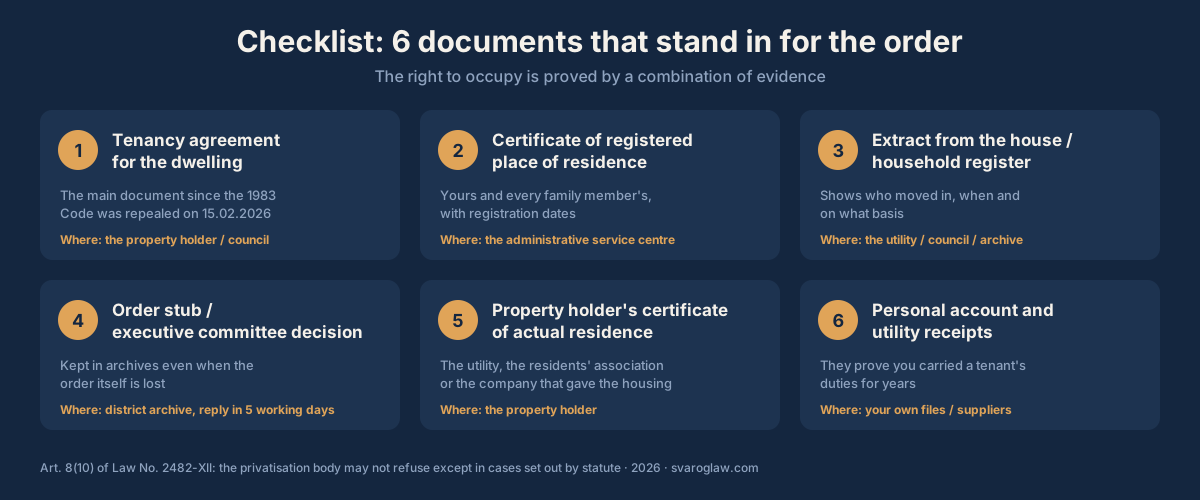
The right to occupy is proved cumulatively:
- the tenancy agreement — since the repeal of the old Housing Code it is the principal document for occupying state or municipal housing;
- a certificate of registered residence — yours and every family member’s, with the registration dates; it is issued by the registration authority under the Rules approved by Cabinet Resolution No. 207 of 2 March 2016;
- an extract from the house or household register — showing who moved in, when and on what basis;
- the counterfoil of the order or the executive committee’s decision allocating the housing — kept in the local authority’s archive or by the building’s holder, even where the order itself is lost;
- certificates from the housing office, the residents’ association or the building’s holder confirming actual occupation and that there are no arrears;
- the account and utility receipts for the whole period of occupation — proving you bore a tenant’s obligations.
None of them alone “equals” the order, but together they build a body of evidence the authority must work with and a court must accept as establishing the right to privatise.
The rest of the file: what else is asked for
Even with the order question closed, the application will not be accepted without the other documents in paragraph 18 of Regulation No. 396: copies of the passports and tax numbers of the applicant and every family member (birth certificates for children under 14), documents on the family relationship, the flat’s technical passport and a certificate that housing vouchers were not used. The last is issued by the privatisation authority for each previous address after 1992 (paragraph 20), so for anyone who has moved between cities it becomes the second surprise after the order. Temporarily absent family members must file a statement of consent; for children and minors the decision is taken by parents, adoptive parents or guardians, who confirm consent by signing the application next to the child’s name, and the Regulation requires no separate notarised document.
One calculation is rarely mentioned while the papers are being gathered: 21 sq m per tenant and per family member plus 10 sq m per family are transferred free of charge (Article 3 of Law No. 2482-XII); anything above that is paid for, while one-room flats pass free of charge whatever their size (Article 6). Each citizen may privatise housing free of charge once (Article 5(5)).
Three scenarios: from an archive certificate to court
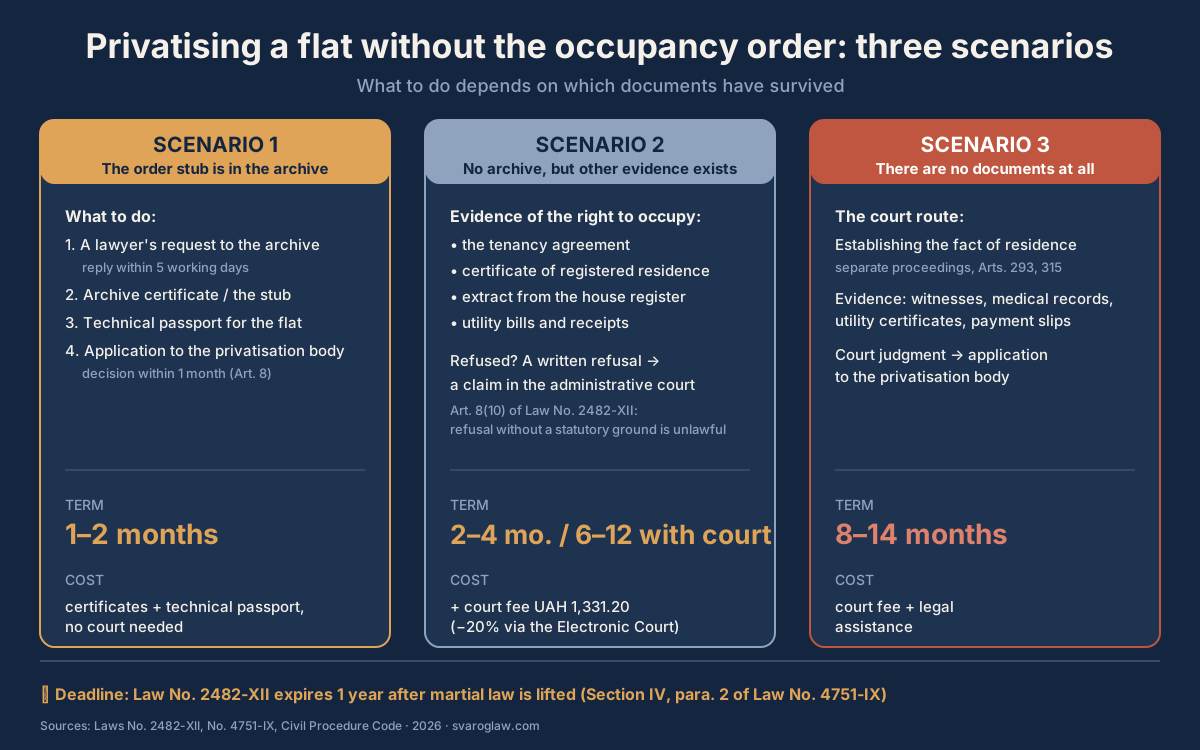
| Situation | What to do | Time | Cost |
|---|---|---|---|
| The order is lost but the archive holds the counterfoil or the executive committee decision | A lawyer’s request to the archive, obtaining the certificate, filing the application with it | 1–2 months | archive certificates, technical passport, registration of title 330 UAH |
| No archive documents survive, but there is registration, a tenancy agreement and utility records | File with the cumulative alternative evidence; if refused, sue | 2–4 months, 6–12 with court | plus court fee 1,331.20 UAH |
| There are no documents at all and the basis of occupation cannot be traced | Establish occupation and the right of use in court, then privatise | 8–14 months | plus court fee 665.60 UAH and legal fees |
Step by step: privatising without the order
- Gather what you have: passport, certificate of registration, tenancy agreement (if one was made), utility receipts, an extract from the house register. That takes 1–2 weeks.
- Send requests to the archives: order counterfoils and executive committee decisions are held in district archives and by building holders. A lawyer’s request under Article 24 of the Law “On the Bar and Advocacy” is answered within five working days (extendable to twenty where the search is substantial), whereas an ordinary citizen’s enquiry takes up to 30 days.
- Order the flat’s technical passport if there is none: it is produced by a technical inventory operator and takes 1–3 weeks.
- Obtain the certificate that housing vouchers were not used at each address since 1992: if you have moved, this is the longest part of gathering the file.
- File the application with the privatisation authority (in Kyiv, the district administration’s privatisation department; filing through an administrative service centre is possible). The decision is taken within a month of receiving the application (Article 8(3) of Law No. 2482-XII).
- If refused, insist on the refusal in writing with reasons. An oral “come back with the order” is not a decision and cannot be challenged, while time runs on.
- Once the certificate is issued, register your title. The administrative fee for registering title in 2026 is 330 UAH for five working days; an electronic extract from the register costs 40 UAH.
Court: which claim to bring and what it costs
The Grand Chamber of the Supreme Court has classified housing privatisation disputes as private law matters: they are heard under civil, not administrative, procedure (its position in case No. 826/6244/15). A claim to establish the right to privatise and to compel the authority to transfer the housing is filed with the local court where the flat is. The court fee on an individual’s non-monetary claim in 2026 is 0.4 of the subsistence minimum, that is 1,331.20 UAH; electronic filing applies a 0.8 coefficient (Article 4 of the Law “On Court Fees”).
A separate route is establishing a fact of legal significance in special proceedings (Articles 293 and 315 of the Civil Procedure Code). The court confirms the fact of permanent residence and occupation as a tenant, and its judgment becomes a document the privatisation authority cannot ignore. The fee is lower — 0.2 of the subsistence minimum, that is 665.60 UAH. But there is a restriction that gets such applications returned: if the application discloses a dispute about a right, the judge refuses to open proceedings, and on discovering one during the hearing leaves the application without consideration (Article 315(4)). Where the authority has already refused in writing, special proceedings will not work and an ordinary claim is needed.
The evidence in either case is witness testimony (neighbours, housing office staff), correspondence with utilities, medical records at the address, certificates from a school or employer, and receipts. Occupation alone does not prove that a person was a member of the tenant’s family, so the case is built on the basis of moving in and on running a common household.
Typical mistakes that cost months
- Treating an oral refusal as final: without a written decision there is nothing to challenge, and the window for free privatisation is closing.
- Filing “with what you have” without searching the archives. A single archive certificate often closes the question without court.
- Searching only one archive. The order counterfoil may be in the district administration’s archive and the allocation decision in the archive of the enterprise that held the building.
- Applying to establish a fact once a refusal has already been issued: the court will see a dispute about a right and leave the application without consideration.
- Skipping registration of title after privatisation. Without an entry in the Register of Real Property Rights the flat cannot be sold, given away or left by will.
When you do not need a lawyer
If the district archive turns up the order counterfoil or the executive committee decision, every registered adult agrees and the documents are consistent, you can manage alone: the archive request, the technical passport, the vouchers certificate, and the application through a service centre. A lawyer is needed where the archives answer “no documents survive”, where the authority refuses despite the evidence filed, or where the basis of occupation has to be established in court.
Questions and answers
Can a flat be privatised if the allocation order is lost?
Yes. The order is not the only proof of lawful occupation. It is replaced by an archive certificate with the order counterfoil, the executive committee decision, the tenancy agreement, the certificate of registered residence and the utility payment records.
Where should I look for a copy or the counterfoil of the order?
In the archive of the district state administration (executive committee) where the housing is, and in the archive of the building’s holder — the enterprise or organisation that allocated the flat. The quickest way is a lawyer’s request, answered within five working days.
What if the privatisation authority refuses because there is no order?
Insist on a written refusal with reasons and file a claim in the local court. Under Article 8(10) of Law No. 2482-XII the authority has no right to refuse privatisation save in the cases the law provides for, and the absence of an order is not one of them.
Which court do I file in — administrative or general?
The local general court, under civil procedure. The Grand Chamber of the Supreme Court has held housing privatisation disputes to be private law matters, so an administrative claim will be returned or the proceedings closed, and the time lost.
What does challenging a refusal in court cost?
An individual’s non-monetary claim in 2026 costs 1,331.20 UAH (0.4 of the 3,328 UAH subsistence minimum), and an application in special proceedings 665.60 UAH. Electronic filing reduces it by 20%. If you win, the fee and legal costs are recovered from the defendant.
What is establishing the fact of residence, and when is it needed?
It is a special proceeding under Articles 293 and 315 of the Civil Procedure Code in which the court confirms permanent residence and occupation. It works only while there is no dispute with the privatisation authority: where a dispute about a right exists, the application is left without consideration.
How long does privatising without the order take?
Where the archive documents are found, 1–2 months, as in the standard procedure. With documents to be recovered, 2–4 months. Where residence has to be established or a refusal challenged in court, 6 to 14 months.
How long is there left?
Law No. 2482-XII will cease to have effect one year after martial law ends or is lifted. There is no exact calendar date, so with lost documents delay is risky: the court stage alone can consume the whole margin.
Can a room in a hostel be privatised without an order?
Yes, under the separate Law No. 500-VI, which has its own list of documents: additionally an extract from the Register of Real Property Rights about any housing owned, a copy of the tenancy agreement and a medical opinion confirming the absence of tuberculosis.
Sources
- Law of Ukraine “On the Privatisation of the State Housing Stock” No. 2482-XII, Arts. 2, 3, 5, 6, 8 — zakon.rada.gov.ua/laws/show/2482-12
- Law of Ukraine “On the Fundamentals of Housing Policy” of 13 January 2026 No. 4751-IX — zakon.rada.gov.ua/laws/show/4751-20
- Regulation on the transfer of flats (houses) and rooms in hostels into citizens’ ownership, Order No. 396 of 16 December 2009 — zakon.rada.gov.ua/laws/show/z0109-10
- Civil Procedure Code of Ukraine, Arts. 293, 315 — zakon.rada.gov.ua/laws/show/1618-15
- Law of Ukraine “On Court Fees” No. 3674-VI, Art. 4 — zakon.rada.gov.ua/laws/show/3674-17
- Law of Ukraine “On the Bar and Advocacy”, Art. 24 — zakon.rada.gov.ua/laws/show/5076-17
- Law of Ukraine “On Securing the Housing Rights of Hostel Residents” No. 500-VI — zakon.rada.gov.ua/laws/show/500-17
Privatising a flat without the order, with Svarog
Send us whatever you still have — we will work out whether the evidence is enough to file, send lawyer’s requests to the archives and, if the authority refuses, establish your right in court. If the housing cannot be privatised at all, we will say so at the first consultation. Related material and services: what privatising a flat costs, establishing title, court representation, full price list.
+38 095 554-54-24 · Kyiv, 7 Khoriva Street (Podil) · Mon–Fri 9.00–18.00