A search of a home or other premises belonging to a person is carried out only on an investigating judge’s order (Art. 234 CPC). The exception is urgent cases (Art. 233 CPC), but even then the investigator must apply to the investigating judge for the search without delay. If the court refuses, everything obtained becomes inadmissible.
The second thing to know: the investigator must admit a lawyer at any stage of the search (Art. 236(1) CPC). At the same time the law does not require them to wait for one, so the demand to call your lawyer must be made at once and written into the record — together with the time it was made.
Defence during a search and questioning rests on what is recorded at the scene: most breaches happen in the first few minutes, while people are confused and do not know what to insist on.
What to do when they arrive with a search warrant
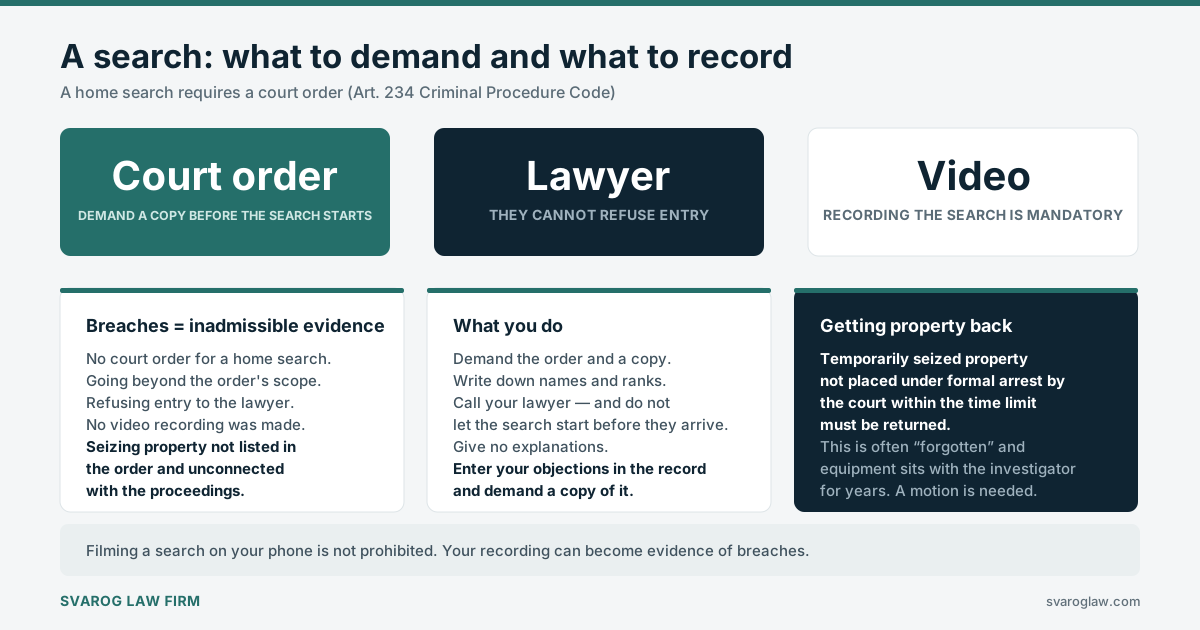
- Ask for the investigating judge’s order and a copy of it. Read it: whose address, which premises, what exactly is being looked for, how long the order is valid.
- Check the service IDs of everyone present and write down names and ranks.
- Call your lawyer immediately and state your demand for their participation, so that it goes into the record.
- Do not resist physically — that is an offence in its own right.
- Give no explanations, orally or in writing. You have the right to stay silent.
- Watch the video recording: a search of a home must be filmed (Art. 107(1) CPC), and the absence of a recording is a serious breach.
- Check the attesting witnesses. A search of a home is conducted with at least two attesting witnesses regardless of any technical recording (Art. 223(7) CPC). Their absence is a breach in itself, even where video is being taken.
- Film it yourself. The defence has the right to record the search on video without hindrance (Art. 107(1) CPC).
- Read the record carefully and enter your objections. Do not sign it “as is” if anything happened differently.
- Get a copy of the record with an inventory of everything seized.
The first minutes, while the lawyer is on the way
A search can begin before your lawyer arrives. While they are travelling, simple rules apply: start recording video on your phone, copy names and ranks from the service IDs, check the address and the list of premises in the order against what is happening, and explain nothing. If you were not allowed to read the order, or there are no attesting witnesses, write that in your own hand in your objections to the record — the investigator’s agreement is not required. In Kyiv our lawyer sets out the moment you call; they must be admitted at any stage, and the time of admission is also recorded.
Breaches that make evidence inadmissible
- there is no investigating judge’s order for the search of a home;
- they went beyond the order: looked for things it does not mention, or searched different premises;
- the lawyer was kept out (Art. 236(1) CPC);
- no video was taken, or there were not two attesting witnesses;
- no copy of the order was handed over before the search began;
- property not listed in the order and unconnected with the case was seized: equipment, phones, business documents;
- no copy of the record was provided;
- force was used without lawful grounds.
Each breach is recorded on the spot and then becomes the basis for an application to rule the evidence inadmissible (Art. 87 CPC). Without a lawyer they are hard to prove: what is left in the case is the occupier’s word against the investigator’s, and a record written by the investigator.
Getting seized property back
Searches often take away things with no bearing on the case: family members’ phones, computers, company documents, cash, equipment.
How it is recovered:
- an application to the investigator for the return of temporarily seized property (Art. 169 CPC);
- an application to the investigating judge where the investigator does not respond or refuses;
- a challenge to the freezing of property where it has already been imposed.
The prosecutor must apply to freeze temporarily seized property no later than the next working day after the seizure. If that is not done, or the court refuses, the property must be returned. This deadline is often “forgotten”, and equipment sits with the investigator for years.
More on this: Recovering seized property.
Questioning: the main rules
You have the right to stay silent
No one is obliged to testify against themselves or their close family (Art. 63 of the Constitution). Refusing to give evidence is not proof of guilt.
The right to a lawyer
It applies to any questioning, of a suspect and of a witness alike.
Be careful with witness status
A witness is liable for refusing to testify (Art. 385 CC), but even a witness may decline to answer questions about themselves, their family and close relatives (Art. 66(1)(3) CPC). The defence is built on exactly that line when someone is summoned as a witness in a case that in reality concerns them.
Read the record
Before you sign: the investigator’s wording often differs from what was said. Write your objections in your own hand.
Do not “make arrangements”
Promises that “give a statement and you will stay a witness” have no legal force.
A search at a business
Here the price of a mistake is weeks of stoppage. Besides the general rules: check the limits of the order, do not let servers and documents unconnected with the case be taken, and make sure the director and the lawyer are present.
A case from our practice
In 2025 the owner of a small Kyiv company came to us: during a search of the office four desktop units and two servers were taken, although the order concerned documents relating to a single contract. We attended the scene, entered objections in the record about going beyond the order and about seizing the hardware without any attempt to copy the data, and filed an application for the return of the property the next day. The prosecutor did not apply to freeze it in time, and the equipment came back about two weeks later. The client’s costs: the lawyer’s attendance at the investigative actions and the preparation of two applications. (details changed)
Cost of services
Applications and complaints to the investigating judge in criminal proceedings carry no court fee. A fee arises when an unlawful seizure has to be followed by a civil claim for losses: a non-monetary claim by an individual costs 1,331.20 UAH, a monetary one 1 % of the value of the claim within a range of 1,331.20 to 16,640 UAH, and 20 % less through the Electronic Court. Full price list
Questions and answers (defence during a search and questioning)
The search took place while I was out. Is that lawful?
The law requires a copy of the order to be handed to the person who occupies the home, or, if they are absent, left in a visible place (Art. 236 CPC). Your absence alone does not invalidate the search, but in that situation we check carefully the attesting witnesses, the completeness of the video and the list of seized items in the record.
Can the search order itself be appealed?
An investigating judge’s order authorising a search is not separately appealable: it is not in the list in Art. 309 CPC. Breaches committed during the search are raised differently — through an application to rule the evidence inadmissible and complaints about the investigator’s conduct.
They took my wife’s phone, and she has nothing to do with the case. What now?
File an application for the return of temporarily seized property in the owner’s name. If the prosecutor did not apply to freeze it in time, or the court refused, the property is returned. In the objections to the record we note at once that the item is not mentioned in the order.
Can a search be carried out at night?
Investigative actions at night (from 10 p.m. to 6 a.m.) are not allowed except in urgent cases where delay could lose evidence (Art. 223(4) CPC). If there was no urgency, the start time recorded in the record becomes an argument for inadmissibility.
The investigator suggests “a chat off the record”. What does that mean?
Such a conversation has no legal weight: only what is recorded procedurally becomes evidence. But what you say turns into the investigation’s working theory and into the questions at your next interview. There is one answer: communicate through your lawyer and on the record.
Calling a Svarog lawyer to a search
Defence during a search and questioning starts with the call you make the moment they arrive. State your demand for a defence lawyer, start recording, and wait for them: whatever is not recorded during the search cannot be proved afterwards.