
Олександр Сич
16 October 2026
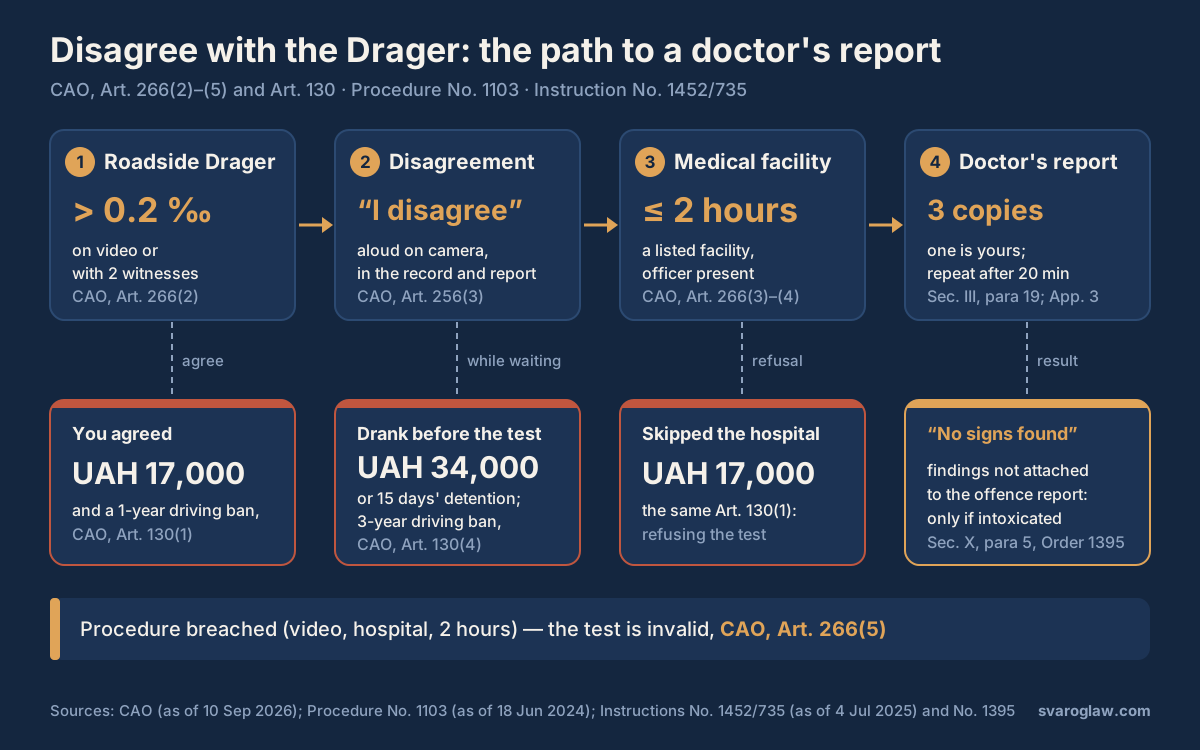
If the Drager shows more than 0.2 per mille and you disagree, say so out loud on bodycam and add your disagreement in writing to the test record and the administrative offence report. The police officer must then refer you to a medical facility and take you there, and the examination must be carried out no later than two hours after the grounds for it were established (CAO, Art. 266(3), (4); paragraph 6 of the Procedure approved by Cabinet of Ministers Resolution No. 1103). The device reading alone is enough for liability only when the Drager has confirmed intoxication and the driver has agreed with the result (paragraph 5 of Procedure No. 1103). Do not refuse the trip to the hospital: refusing the test is punished in the same way as drink-driving (CAO, Art. 130(1)).
In the court of appeal rulings we rely on, the outcome was often decided by what the driver said and signed immediately after the test. Those who agreed with the reading on video lost (No. 375/2304/25), while cases were closed when a driver who disagreed was not taken to hospital or was talked out of going, even at 2.16 ‰ (No. 145/767/23).
What to check and ask for before you blow into the Drager
The grounds for an intoxication test are signs of intoxication: for alcohol, Instruction No. 1452/735 lists six, from the smell of alcohol on the breath to behaviour that does not fit the situation (paragraph 3, Section I). Only police officers holding special ranks may test drivers with a Drager (paragraph 2, Section II), and the test is recorded on video, which must be attached to the report. Only if video recording is impossible is the test carried out in the presence of two witnesses (CAO, Art. 266(2)), and police officers cannot be among them (paragraph 4 of Procedure No. 1103). You can film on your phone too: a driver’s video can also be evidence (CAO, Art. 251(1)).
Before the test, the officer must explain how to use the device (paragraph 5, Section II of the Instruction). After that, what matters is what you ask for and what the camera records:
- Documents for the device. At your request, the officer must provide the verification certificate, as well as a certificate of conformity or type examination, or a declaration of conformity (paragraph 5, Section II). The verification interval for breathalysers is 1 year (paragraph 13 of the Verification Intervals approved by Order No. 1747 of the Ministry of Economic Development), so if, on the day of the test, more than a year has passed since verification, the certificate is no longer valid. The exception is communities on the Ministry of Development’s list of territories where hostilities are taking place: there, verification results that expired during martial law remain valid for another six months after hostilities end or are no longer possible (paragraph 1 of Cabinet of Ministers Resolution No. 440 of 7 April 2023).
- Mouthpiece and control air sample. The test is carried out in accordance with the device’s operating manual (paragraph 4, Section II). There is no separate rule on the mouthpiece, but courts check on the video whether the officer opened the packaging in front of you and took a control air sample before the test.
- Time of the stop and of the test. Say it out loud or write it down: the two hours for the hospital examination are counted from the moment the grounds are established.
- Printout and test record. If the device prints the result, the printout is attached to the report (third indent of paragraph 10, Section II). The test record is drawn up in two copies, and one of them is handed to you (paragraph 5 of Procedure No. 1103).
Device documents are shown to those who ask for them. The Sumy (No. 592/44/26), Kyiv (No. 760/18460/25) and Odesa (No. 505/2290/23) Courts of Appeal rejected drivers’ arguments that they had not been shown the verification certificate: none of them had asked for it at the scene. Ask for the documents so that the bodycam records your request.
The Kyiv Court of Appeal assesses verification as of the day of the test: gaps in previous years do not matter if the certificate was valid on that day (No. 759/15117/25). The Khmelnytskyi Court of Appeal also checked the laboratory: the verification certificate for a Drager Alcotest 7510 had been issued on 3 October 2024 by the state enterprise Kyivoblstandartmetrolohiia, whose authorisation to carry out verification had already expired on 7 June 2024. The verification was found invalid, the 0.27 ‰ reading was ruled inadmissible evidence, and the case was closed (No. 676/7008/25). The defence gathered this information through advocate’s requests.
How to state your disagreement with the Drager so that the court sees it
The test record form (Appendix 2 to the Instruction) has only a box headed “I agree with the results” for the driver’s signature or a note that the driver refused to sign, and there is no separate box for disagreement. So add your disagreement to the record by hand. If you do not sign the record, the officer will only note your refusal to sign, and such a note does not record disagreement, so say “I disagree” on camera. Set out your explanations and comments on the report, or your reasons for not signing it, in writing: under Part 3 of Article 256 of the CAO they are attached to the report. A note such as “I disagree with the test result and demand an examination at a medical facility” will do. The Odesa Court of Appeal held that a signature on the Drager printout and under the report without comments does not in itself prove agreement with the result (No. 505/2290/23), but it is better not to rely on that interpretation.
Courts of appeal differ on whether the officer must offer the hospital option on their own initiative. The Kyiv (No. 760/20508/25) and Lviv (No. 450/2135/26) courts consider that the police must explain to the driver the right to an examination at a medical facility and offer it. On 1 October 2026 the Sumy court ruled that the duty to refer a driver to hospital arises only when the driver has refused the roadside test or has disagreed with its results (No. 592/44/26). A court of appeal ruling is final (CAO, Art. 294(10)), and the Supreme Court will not resolve this divergence in the ordinary course. That is why we advise you to say “I disagree” yourself, out loud and on camera.
While you wait for the hospital, do not take alcohol, drugs or medicines based on them, except those from a first-aid kit or prescribed by a medical professional. After you have been stopped at a police officer’s request and before the medical examination, this is a separate offence under Part 4 of Article 130 of the CAO: a fine of UAH 34,000 (2,000 tax-free minimum incomes) or detention for 15 days, together with a 3-year driving ban (deprivation of the right to drive). The other Article 130 sanctions, including for a repeat offence within a year, are summarised in an article with a table of drink-driving fines.
Agreement, hospital or “no signs of intoxication found”: three scenarios after the test
You agreed with the Drager result
report on the spotYour agreement with the result is enough for the officer to draw up a report under Part 1 of Article 130 of the CAO (paragraph 5 of Procedure No. 1103). The officer attaches the test record and the printout, if there is one, to the report (Section X of the Instruction approved by MIA Order No. 1395).
Changing your mind once you are in court is difficult. The Kyiv Court of Appeal upheld the ruling in the case of a driver who had agreed with the result on video and noted that if he had doubts about the reading, he had the right to be examined at a medical facility (No. 375/2304/25).
You disagreed and are going to a medical facility
up to 2 hoursThe officer issues a referral stating the device and the test result (Appendix 1 to the Instruction) and takes you to the nearest facility authorised to carry out such an examination (paragraph 7, Section I). The list of these facilities is approved by local health departments, and examinations at other facilities are prohibited (CAO, Art. 266(3)). It is the officer who must ensure the examination takes place within two hours, so you do not need to get there on your own (paragraph 7 of Procedure No. 1103).
The examination is carried out by a doctor who has completed specialised advanced training or, in a village without a doctor, by the medical assistant at the rural health post. Examinations take place at any time of day or night and in the presence of the officer (paragraph 2, Section III of the Instruction).
Not going to the hospital after disagreeing with the Drager means refusing to undergo the test under the established procedure, and the sanction is the same: UAH 17,000 and a year without a licence. A separate report is drawn up for such a refusal (paragraph 8 of Procedure No. 1103; Kyiv Court of Appeal, No. 759/4795/26).
The doctor did not confirm intoxication
doctor's report, officer presentIn their report, the doctor writes either “is intoxicated” or “no signs of intoxication found” (Appendix 4 to the Instruction); the wording “normal” is prohibited (paragraph 17, Section III). The doctor’s report is announced in the officer’s presence and drawn up in three copies, one of which you receive (paragraphs 16 and 19, Section III). It is attached to the administrative offence report only when intoxication has been confirmed (paragraph 5, Section X of Instruction No. 1395). The Volyn Court of Appeal closed a case in which the Drager showed 0.24 ‰, the driver wrote down his disagreement, and he was not offered a hospital examination. Within two hours he went to a doctor himself, and she found him “sober” on a reading of 0.11 ‰ (No. 161/3389/24).
It is better not to count on an examination you arrange yourself without an officer present: Part 4 of Article 266 of the CAO requires the officer’s presence. The same court rejected a “sober” finding that a driver had obtained without police officers and more than two hours later, although at the scene he had agreed with the Drager (No. 161/17542/25). The Vinnytsia Court of Appeal, by contrast, accepted a certificate from an addiction specialist showing 0.18 ‰ against 1.53 ‰ on the Drager: the driver went to the doctor himself, but in the presence of a police officer (No. 127/11852/25).
How the two hours for the hospital examination are counted
Part 4 of Article 266 of the CAO requires the examination at a medical facility to be carried out no later than two hours after the grounds were established, while paragraph 9, Section II of the Instruction speaks of delivery to the nearest facility within two hours of the grounds being detected. Courts of appeal differ on what exactly had to fit within this period:
- The Kyiv Court of Appeal (a case of drug intoxication after a road accident) counted the two hours from when the driver had received emergency medical care. It was enough for the court that the driver had been delivered on time, and it did not consider the examination at 11:30 invalid, because the delay was beyond the police’s control (No. 756/14072/24).
- The Khmelnytskyi Court of Appeal declared invalid a doctor’s report showing 0.92 ‰, because the examination was carried out 4 hours 05 minutes after the grounds were established (No. 671/1005/26).
- The Dnipro Court of Appeal closed a case in which the driver was stopped at 07:00 and the Drager test was completed at 08:54: in the court’s view, this made a timely hospital examination impossible (No. 183/7231/22).
If you blew into the Drager after a crash, a case over the accident itself may run alongside the Article 130 case, and then your defence in a case under Article 124 of the CAO will have to be built separately. What to do in the first hours after a collision is covered in our guide to a lawyer’s help after a road accident.
Violations for which courts of appeal have closed Article 130 cases
Apart from a missed two-hour deadline, cases were closed in the following situations:
- The driver disagreed but was not taken to hospital. An e-scooter rider said on bodycam that he disagreed with the 0.27 ‰ reading, and the Odesa Court of Appeal pointed out that in that situation the officer is not yet entitled to draw up an Article 130 report: an examination at a medical facility must be offered first (No. 522/5560/26).
- The driver was talked out of going to hospital or told to go alone. A driver with 2.16 ‰ was told that “nobody gets taken to the doctor” and that he had to go on his own, and was left without a referral in Sutysky during curfew; the Vinnytsia Court of Appeal found such a test invalid under Part 5 of Article 266 of the CAO (No. 145/767/23). Another driver was told by the officer: “what’s the point… if you’re pinning your hopes on the hospital, you’ll be blowing into the same Drager there”, and instead of the printout showing 0.61 ‰, a photo of the device without a number, date or time was attached to the report (Dnipro Court of Appeal, No. 207/8156/25).
- The right to disagree with the result was not explained. The officer drew up the report straight away, and the video shows no refusal to go to hospital (Lviv Court of Appeal, 0.89 ‰, No. 450/2135/26).
- The test was not carried out in line with the device manual. The control air sample was taken without a mouthpiece, which was inserted only afterwards, and the driver was not asked whether he agreed with the result (Zaporizhzhia Court of Appeal, 0.42 ‰, No. 314/3459/25). Do not count on such a decision: according to the report, that driver had also refused the medical examination. Where the mouthpiece was unwrapped in front of the driver and the control sample was taken before the test, the same court upheld the penalty (0.88 ‰, No. 333/10363/25).
- The case file contains no documents for the device. Neither a certificate of conformity nor a verification certificate for the Alcotest 6820 had been added to the file, the video did not show the test procedure being explained to the driver, and the referral to hospital was not proven (Dnipro Court of Appeal, 0.56 ‰, No. 203/2975/24).
- The case file contains no video. The CD-R discs attached to the file turned out to be blank (Kyiv Court of Appeal, No. 752/6133/25).
The courts saw most of these violations on video. A bodycam must record continuously from the start of the officer’s shift (paragraph 5, Section II of the Instruction approved by MIA Order No. 1026). Recordings are kept for 30 days unless the head of the unit extends the period, and are released on a reasoned request (paragraphs 3, 4 and 7, Section VIII). In case No. 183/7231/22 the archive copy no longer existed, so submit your request within the first few days, yourself or through a lawyer who handles driver defence in road accident cases. When we take on a case to challenge a report under Article 130 of the CAO, we first check the video, the device documents, the times in the report and the date of the offence: if the court has not issued a ruling within a year, the case must be closed because the time limit under Part 6 of Article 38 of the CAO has expired.
When an appeal is unlikely to change anything. If you agreed with the result on camera, the verification certificate was valid on the day of the test, and the video and the printout are in the case file, your chances are slim. In 2025, local courts imposed penalties on 108,764 of the 125,259 people whose Article 130 cases they heard (86.8%, State Judicial Administration (SJA), Form No. 1-p), and courts of appeal upheld the rulings in 11,556 of the 13,882 cases they reviewed (83%, Form No. 2-p). In such a situation, the cost of a defence will most likely not pay off.
Instruction No. 1452/735, Procedure No. 1103 and rulings from the Unified State Register of Court Decisions
- CAO, Art. 130, 251, 256, 266, 294 (as amended on 10 September 2026) — zakon.rada.gov.ua; Procedure approved by Cabinet of Ministers Resolution No. 1103 of 17 December 2008 (as amended on 18 June 2024) — zakon.rada.gov.ua
- Instruction approved by Order No. 1452/735 of the MIA and the Ministry of Health of 9 November 2015 (as amended on 4 July 2025), with Appendices 1–4 — zakon.rada.gov.ua
- Instructions approved by MIA Orders No. 1395 (Section X) — zakon.rada.gov.ua and No. 1026 (Sections II, VIII) — zakon.rada.gov.ua; Verification Intervals approved by Ministry of Economic Development Order No. 1747, paragraph 13 — zakon.rada.gov.ua; Cabinet of Ministers Resolution No. 440 of 7 April 2023 (as amended on 6 June 2025), paragraph 1 — zakon.rada.gov.ua
- Kyiv Court of Appeal: No. 375/2304/25, No. 759/15117/25, No. 371/921/22, No. 760/20508/25, No. 760/18460/25, No. 759/4795/26, No. 756/14072/24, No. 752/6133/25
- Other courts of appeal: Khmelnytskyi No. 676/7008/25, No. 671/1005/26; Sumy No. 592/44/26; Lviv No. 450/2135/26; Odesa No. 505/2290/23, No. 522/5560/26; Dnipro No. 207/8156/25, No. 203/2975/24, No. 183/7231/22; Vinnytsia No. 145/767/23, No. 127/11852/25; Volyn No. 161/3389/24, No. 161/17542/25; Zaporizhzhia No. 314/3459/25, No. 333/10363/25; Kropyvnytskyi No. 404/3694/25; Chernivtsi No. 723/787/24
- Statistics: SJA, Forms No. 1-p and No. 2-p for 2025
Blood, a nurse and the Alcotest 6810: three more questions about the test
Can I demand a blood test?
The Instruction does not give drivers a separate right to demand a blood test as such. To determine the alcohol concentration, at least 20 ml of urine and blood is taken for a second set of samples; this set is stored for 90 days at −20 °C for a confirmatory analysis (paragraph 9, Section III). At the same time, paragraph 11, Section III names saliva, urine and swabs from the lips, face and hands as the material to be analysed, and under paragraph 12 blood is taken if other samples cannot be obtained. The Instruction does not describe how a driver can initiate analysis of the second set, and we have found no case law on this. In case No. 671/1005/26, blood was taken from a female driver at the first medical facility, but the police officer objected and did not issue a referral; the samples were destroyed, and the court placed the consequences of the lost evidence on the police.
A nurse carried out the hospital examination: is that a violation?
Not necessarily: the Kropyvnytskyi Court of Appeal held that the examination is organised and supervised by an addiction specialist, while individual procedures may be performed by nursing staff under his supervision. In that case, according to the doctor’s testimony, a nurse operated the Drager, and the court upheld the penalty (No. 404/3694/25). But this is the position of a single court, and under paragraph 2, Section III the examination is carried out by a doctor with specialised advanced training. If the hospital has not confirmed the doctor’s training, and the record lists tests that do not appear on the video, the case may be closed, as the Chernivtsi Court of Appeal did (No. 723/787/24, drug intoxication).
Is it true that the “Drager 6810” has been banned since 2015?
The Kyiv Court of Appeal called this argument groundless: according to an explanation by the Ukrainian Medical Certification Centre of the Ministry of Health dated 11 December 2014, Alcotest 6810 devices that were imported into Ukraine and put into service while their state registration certificate was valid (until 10 February 2015) may also be used after that date, provided that the conditions for operation, maintenance, calibration and verification are met (No. 371/921/22). It makes sense to argue about the verification of the particular device: in this case the court noted that a verification certificate issued after the test does not confirm verification on the day of the test. The court did close the case, but because of a breach of Article 266 of the CAO: the driver, who had stated his disagreement, was not taken to a medical facility.
Test record, referral, doctor’s report: check the times before the hearing
Lay out side by side your copy of the test record, the doctor’s report and a copy of the referral, if you have them, and compare the times in each document with what you remember. A local court ruling can be appealed within 10 days of the day it was issued, and a court of appeal ruling is final (CAO, Art. 294(2), (10)), so there will be no second attempt. We will submit requests for the bodycam footage and the device documents, check the verification and the two-hour deadline, and prepare objections or an appeal: this is part of our defence in Article 130 CAO cases.