
Олександр Сич
19 October 2026
Refusing an intoxication test is covered by the same Part 1 of Article 130 of the Code of Administrative Offences (CAO) as drink-driving, and it is punished in the same way: a fine of 1,000 tax-free minimum incomes (UAH 17,000) and a driving ban (deprivation of the right to drive) for one year. It is a separate offence, so the court does not try to establish how many per mille the device would have shown. It only needs to establish four things: you were driving the car, the police officer had lawful grounds for the test, you were offered the test in the established manner, and you refused (Mykolaiv Court of Appeal, case No. 484/4699/26). At the same time, refusing to blow into the Drager breathalyser does not in itself make you an offender: if you do not agree to be tested with the officer’s device, the test must be carried out at a medical facility (CAO, Art. 266(3)), and refusing there will be that very same offence.
The Drager records intoxication when the reading exceeds 0.2 per mille (paragraph 7, Section II of Instruction No. 1452/735 of the MIA and the Ministry of Health), and the law treats a refusal the same way as a reading of 0.3 or 2 per mille. Open data does not show how many drivers refuse the test: the Patrol Police cited 138,047 administrative offence reports under Parts 1–4 of Article 130 for 2025 but does not give a separate figure for refusals, and neither does the State Judicial Administration (SJA) report. We covered the penalties for drink-driving in general and the line where criminal liability begins in our article on what a drunk driver faces; here we deal only with refusal.
Myths about refusing the test and how the courts answer them
“If I don’t blow, nobody can prove I was drunk”
Nobody needs to prove it. Refusing an intoxication test is a conduct offence: it is complete the moment you refuse. The refusal can be active or passive, and your reasons for it do not matter (Odesa Court of Appeal, 18 August 2026, No. 495/10018/25). The Grand Chamber of the Supreme Court, in a judge’s disciplinary case, noted that intoxication is not among the facts to be proved in a refusal case (No. 990SCGC/11/26).
“I’ll blow just for show, or play for time”
A driver agreed to the test and then several times only pretended to blow, even though the police officer had warned him not to do that. The Khmelnytskyi Court of Appeal held this to be a refusal (18 September 2026, No. 679/810/26). The Sumy Court of Appeal rejected the argument that the Drager was faulty: there was no result because the driver kept interrupting his exhalation, and at the hospital he did the same, which the doctor treated as a refusal (29 September 2026, No. 591/7157/26).
“Tomorrow I’ll get tested myself and bring a clean result”
At a medical facility the test is carried out in the presence of a police officer and within two hours of the grounds for it being established (CAO, Art. 266(4)). The facility must be on the list approved by the local health authorities (Art. 266(3)). A doctor’s report that the driver obtained on his own from a regional addiction treatment centre does not rebut the refusal (Poltava Court of Appeal, 24 September 2026, No. 552/10344/25; the Kyiv Court of Appeal ruled the same way, No. 378/53/26). The Mykolaiv Court of Appeal found a test result from a private laboratory to be irrelevant and inadmissible evidence, because the laboratory is not on the list and the identity of the person who gave the sample was not established (No. 484/4699/26). How to state that you disagree with the Drager and get to the hospital in time together with the police officer is explained in our article on a hospital test after the Drager.
“For a first refusal I’ll get off with a reprimand”
Under Article 130 the court cannot release you from liability because the offence is minor and limit itself to a verbal reprimand: the note to Article 22 of the CAO prohibits this. For a driver, the sanction under Part 1 combines a fine and a driving ban, so the court is not entitled to choose just one of them. The driving ban applies even to people who use a car because of a disability: the exception that the law generally makes for them does not extend to evading an intoxication test (CAO, Art. 30(4)).
How the court checks a refusal: four questions for the video and the report
- Were you actually driving the car? The report alone does not prove it. The Khmelnytskyi Court of Appeal closed the case of a man found in a courtyard next to a locked, parked car: he did not have its key, and neither video nor any other evidence confirmed that he had been driving (7 January 2026, No. 686/25994/25).
- Were there lawful grounds for the test? Instruction No. 1452/735 lists six signs of alcohol intoxication: the smell of alcohol on the breath, impaired coordination, impaired speech, marked trembling of the fingers, a sharp change in the colour of the facial skin, and behaviour inappropriate to the situation (paragraph 3, Section I). Courts differ on whether the police officer has to substantiate them: the Khmelnytskyi Court of Appeal regards assessing the signs as the officer’s exclusive power, for which neither witnesses nor video are needed (No. 686/21253/25), while the Dnipro Court of Appeal checked the signs against the recording (No. 210/2875/26). In the disciplinary case mentioned above, the Grand Chamber of the Supreme Court did not accept that signs not confirmed on video were a sufficient reason to close a refusal case (No. 990SCGC/11/26).
- Were you offered the test in the established manner? The test is recorded on video or, if that is impossible, carried out in the presence of two witnesses, who cannot be police officers or persons whose impartiality is in doubt (CAO, Art. 266(2); paragraph 6, Section II of the Instruction). A driver who refuses the roadside test is referred by the officer to a medical facility (paragraph 6 of the Procedure approved by Cabinet of Ministers Resolution No. 1103), and the officer must take the driver there within the same two hours (paragraph 9, Section II of the Instruction).
- Was a refusal actually expressed? The report on a refusal at a medical facility is drawn up on video or in the presence of two witnesses, and it must record the signs of intoxication and exactly how you evaded the test (paragraph 8 of Procedure No. 1103). An officer saying on camera that the driver “is also refusing” does not prove a refusal if the recording does not show the driver himself expressing that decision (Chernivtsi Court of Appeal, 13 August 2026, No. 720/1038/26).
Courts deal separately with cases where the driver refused only the Drager. The Odesa Court of Appeal closed proceedings against a driver who did not want to blow into the breathalyser but agreed on video to go to the hospital (“we can go”), and the police never referred him there (10 August 2026, No. 509/661/26). The Ivano-Frankivsk Court of Appeal found a referral to be a mere formality where no test at a medical facility had actually been offered (29 May 2026, No. 354/1461/25). But when a driver flatly refuses both the device and the hospital, a written referral is not required: it is issued only if the driver agrees to be tested at a medical facility (Khmelnytskyi Court of Appeal, No. 682/2173/21; the Ivano-Frankivsk Court of Appeal took the same view in the case mentioned above).
Case No. 766/152/26: thirteen minutes without an answer
In the case reviewed by the Kherson Court of Appeal on 13 July 2026, patrol officers stopped a car that was weaving along the road, and the court found the stop lawful (Law “On the National Police”, Art. 35(1)(3)). On the bodycam footage, at 20:49 the driver is offered a test on the spot or at a medical facility, and later the permitted limit, the right to disagree with the device’s result and the consequences of refusing are explained to him. The driver avoids answering, and at 21:02 refuses outright several times. The court held that the delay in answering from 20:49:33 to 21:02:56 “shows a deliberate evasion of the test”, and upheld the UAH 17,000 fine, the one-year driving ban and the UAH 665.60 court fee.
What this means for you: if the recording shows that you were offered both the Drager and the hospital, that the consequences were explained and that you refused, an appeal is unlikely to change anything. There is room for argument where one of these elements is missing from the video.
Misleading explanations, the wrong charge, an unlawful stop: what else the court of appeal checks
In 2025 local courts heard cases under Article 130 against 125,259 people and closed the proceedings against 14,481 of them (11.6%) on the ground that there was no event and no elements of an offence (SJA report on Form No. 1-п; refusals are not shown separately). In cases specifically about refusal, courts of appeal have also closed proceedings where:
- the officer misstated the driver’s rights: a driver who had twice agreed to the test was told that he could get tested on his own within two hours, although under Article 266 of the CAO such a test is invalid (Dnipro Court of Appeal, 9 September 2026, No. 210/2875/26);
- the report charged the wrong act: the driver blew into the Drager (0.58 per mille), disagreed with the result, went to a medical facility and refused the test there, but the report recorded drink-driving (paragraph 2.9(a) of the Road Traffic Rules) instead of refusing the test (paragraph 2.5 of the Road Traffic Rules). The court cannot change the description of the offence in the report (Chernivtsi Court of Appeal, 30 September 2026, No. 715/2318/26).
The argument that the stop was unlawful does not work in every court. A police officer must tell the driver the specific reason for the stop (Law “On the National Police”, Art. 35(3)). The Kharkiv Court of Appeal closed a case against a woman driver: instead of a reason, the officers referred to a “notification” which, as an advocate’s request revealed, did not exist in the police system (No. 641/139/25). The Mykolaiv Court of Appeal, by contrast, considers that the lawfulness of the stop is not an element of the offence under Part 1 of Article 130 (No. 484/4699/26). In the same disciplinary case, the Grand Chamber of the Supreme Court did not decide which of these approaches is correct; it only required the judge to apply the chosen one consistently (No. 990SCGC/11/26).
There is no cassation appeal in such cases: a local court’s ruling can be appealed within 10 days of being issued, while the decision of the court of appeal is final (CAO, Art. 294(2), (10)), and the Constitutional Court has held that this is consistent with the Constitution (Decision No. 5-р(II)/2021). If the deadline was missed for a good reason, the court of appeal may restore it on application. So it is better to show the video and the report to a road accident lawyer before the first hearing and go through the recording together using the four questions above, because an appeal against an administrative report under Article 130 of the CAO begins as early as the local court.
What refusing an intoxication test costs: the first, second and third time
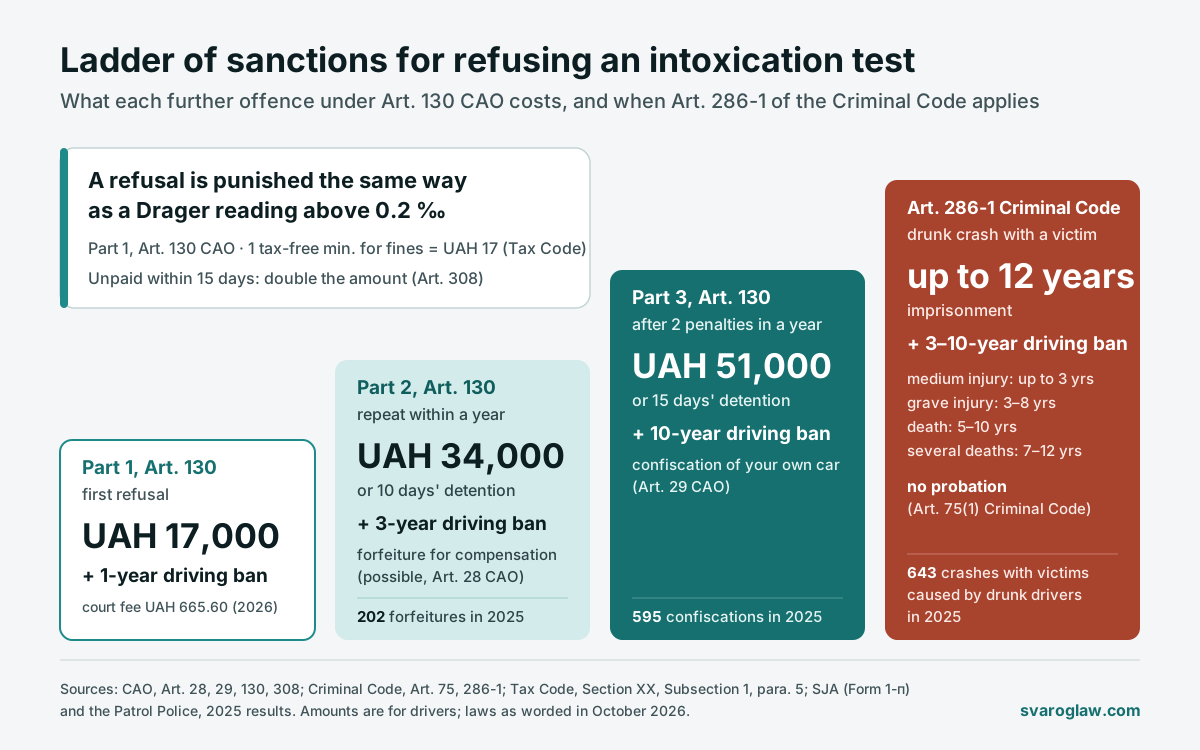
For fines, the tax-free minimum income is UAH 17 (paragraph 5, Subsection 1, Section XX of the Tax Code), so 1,000 minimums come to UAH 17,000. The court will also recover UAH 665.60 as a court fee (Law “On Court Fee”, Art. 4(2)(5), for 2026). The fine of 1,000 minimums has applied since 17 March 2021, when Law No. 1231-IX took effect, while the court fee is calculated from the subsistence minimum as of 1 January, so it changes every year. For a repeat offence under Part 2, any of the offences under Part 1 counts: a second refusal and a refusal after drink-driving are punished in the same way. Article 130 does not specify the date from which the year is counted, so check the dates of your rulings with a lawyer.
| Part of Art. 130: offence | Fine | If not paid on time | Driving ban | Instead of the fine and in addition |
|---|---|---|---|---|
| Part 1: a driver’s first refusal | UAH 17,000 | UAH 34,000 | 1 year | — |
| Part 1: refusal by a person who was driving without a driving licence (“other persons” in the sanction) | UAH 17,000 | UAH 34,000 | — | — |
| Part 2: any offence under Part 1 repeated within a year | UAH 34,000 | UAH 68,000 | 3 years | 10 days’ administrative detention; with or without forfeiture of the car for compensation |
| Part 3: the person has already been penalised twice within a year for intoxication or refusal | UAH 51,000 | UAH 102,000 | 10 years | 15 days’ administrative detention; confiscation of the car if it is the offender’s private property |
| Part 4: drinking after an accident or after being stopped, before the test | UAH 34,000 | UAH 68,000 | 3 years | 15 days’ administrative detention |
| Part 5: a boat operator, including on a small vessel or a jet ski | UAH 17,000 | UAH 34,000 | 1–3 years, all types of watercraft | 40–60 hours of community service or 10 days’ administrative detention |
The fine must be paid no later than 15 days from the day the ruling is served or, if it was appealed, from the day you are notified that the appeal was dismissed (CAO, Art. 307(1)). If it is enforced, double the amount is recovered (Art. 308(2)). Only a small share is paid voluntarily: in 2025 courts imposed fines under Article 130 totalling UAH 2.32 billion, while UAH 523.7 million, or 22.6%, was paid without enforcement. That year 97,728 people were banned from driving (SJA report).
You are considered banned from driving from the day the ruling becomes final, and if your licence has not already been seized, you must hand it in to the police immediately (CAO, Art. 317-1). Driving during this period costs UAH 20,400 (Art. 126(4)). When the ban expires, the licence is returned only after you pass the theory and practical tests at an MIA service centre. A licence obtained for the first time is not returned at all: you will have to undergo a medical examination, retrain at a driving school and pass both tests (paragraph 20 of the Regulation approved by Cabinet of Ministers Resolution No. 340). What to do if the service centre refuses is explained on our page about the return of a driving licence after a ban under Article 130 of the CAO.
Forfeiture of the car, confiscation and Article 286-1 of the Criminal Code: what you risk beyond the fine
- For a repeat refusal the court may order forfeiture of the car for compensation (Art. 130(2)). The car is sold compulsorily, and the former owner receives the proceeds minus the costs of the sale (CAO, Art. 28). Administrative detention instead of a fine is not imposed on pregnant women, women with children under 12, minors, people with Group I–II disabilities (Art. 32(2)) or military personnel (Art. 15).
- Confiscation under Part 3 comes without compensation. The car passes to the state, but only if it is your private property (CAO, Art. 29). In 2025 courts confiscated cars 595 times under Article 130 and ordered forfeiture for compensation 202 times (SJA).
- An accident with an injured victim while intoxicated already means Article 286-1 of the Criminal Code. It applies when an intoxicated driver has broken road safety rules and the victim has suffered bodily injury of at least medium severity: up to 12 years’ imprisonment, depending on the consequences. According to the Patrol Police, in 2025 drunk drivers caused 643 accidents with victims, in which 73 people were killed and 857 injured. Release on probation is prohibited here (Criminal Code, Art. 75(1)), and on 22 September 2026 the Supreme Court upheld a driver’s sentence of one year of actual imprisonment (No. 191/1444/25). The Supreme Court does not accept refusal of the test as evidence of intoxication in a criminal case, because that would contradict the presumption of innocence (No. 153/134/22). The court did not conclude that refusing exempts you from Article 286-1: intoxication is proved by other evidence, and in that same case an expert examination found 1.0‰ alcohol in the driver’s blood.
If proceedings have been opened after an accident with an injured victim, a lawyer for Article 286 of the Criminal Code needs to check the testing procedure and the evidence that traffic rules were broken: whether intoxication is proved determines the legal classification (Article 286 or Article 286-1 of the Criminal Code) and whether release on probation is possible.
Temporary permit, a year to decide the case and a 17-year-old driver
My licence was taken on the spot. Can I drive until the court decides?
Yes, with the temporary permit that the police officer issues when seizing the licence. It is valid until the ruling becomes final, but for no longer than three months, and in Article 130 cases it can be extended for a further three months by applying to the police. If, within a year of the temporary seizure, the court has not banned you from driving or has not heard the case in time, you can demand the licence back (CAO, Art. 265-1).
How long does the court have to impose a penalty for refusal?
One year from the date of the offence (CAO, Art. 38(6)). For most cases heard by courts this period is three months, but Article 130 is an exception.
A 17-year-old was driving. Is he liable in the same way?
Persons aged 16 to 18 are liable under Article 130 on general grounds (CAO, Art. 13(2)). However, taking into account the nature of the offence and the offender’s character, the court may choose the measures for minors under Article 24-1 instead of a penalty, and administrative detention is never imposed on minors.
Laws, decisions from the Unified State Register of Court Decisions and statistics
- CAO, Art. 13, 15, 22, 28–30, 32, 38, 126, 130, 265-1, 266, 294, 307, 308, 317-1 — zakon.rada.gov.ua; Criminal Code, Art. 75, 286-1 — zakon.rada.gov.ua; Law No. 1231-IX — zakon.rada.gov.ua
- Tax Code, paragraph 5, Subsection 1, Section XX — zakon.rada.gov.ua; Law “On the National Police”, Art. 35 — zakon.rada.gov.ua; Road Traffic Rules, paragraph 2.5 — zakon.rada.gov.ua
- Procedure for Referring Vehicle Drivers for an Intoxication Test (Cabinet of Ministers Resolution No. 1103) — zakon.rada.gov.ua; Instruction of the MIA and the Ministry of Health No. 1452/735 — zakon.rada.gov.ua; Regulation on the Procedure for Issuing Driving Licences (Cabinet of Ministers Resolution No. 340) — zakon.rada.gov.ua
- Courts of appeal: No. 766/152/26 (court register), No. 484/4699/26 (court register), No. 495/10018/25 (court register), No. 679/810/26 (court register), No. 591/7157/26 (court register), No. 552/10344/25 (court register), No. 378/53/26 (court register), No. 686/25994/25 (court register), No. 686/21253/25 (court register), No. 210/2875/26 (court register), No. 720/1038/26 (court register), No. 509/661/26 (court register), No. 354/1461/25 (court register), No. 682/2173/21 (court register), No. 715/2318/26 (court register), No. 641/139/25 (court register)
- Supreme Court: Grand Chamber No. 990SCGC/11/26 (court register), Criminal Cassation Court No. 191/1444/25 (court register) and No. 153/134/22 (court register); Constitutional Court Decision No. 5-р(II)/2021 — zakon.rada.gov.ua
- Statistics: Patrol Police, 2025 results; SJA, report on Form No. 1-п for 2025 (line 166)
The court has scheduled a hearing in your refusal case
Send us a photo of the report, a copy of the ruling (if it has already been issued) and your dashcam recording, if you have one. We will check whether the video captures the offer of a hospital test, your refusal and the fact that you were driving, and tell you plainly whether you have a case worth taking to court.