
Олександр Сич
25 August 2026
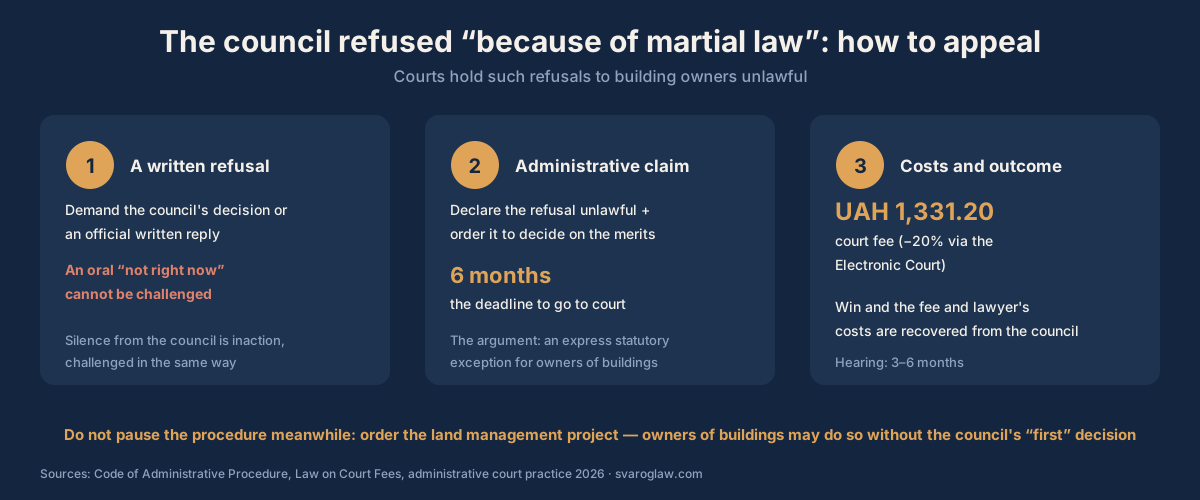
The free transfer of state and municipal land is prohibited during martial law, but a direct exception applies to owners of buildings standing on the plot (sub-paragraph 5 of paragraph 27 of Chapter X of the Land Code). Land under your own house, garage or other registered property can be privatised, and refusals by councils “because of martial law” are held unlawful by the courts. With a complete set of documents the procedure takes about three months.
Sub-paragraph 5 of paragraph 27 of Chapter X, “Transitional provisions”, of the Land Code prohibits, during martial law, the free transfer of state and municipal land into private ownership, the issue of permits to prepare land management documentation for such a transfer, and the preparation of that documentation itself. In the same sub-paragraph the legislature made an exception: the prohibition does not extend to transferring plots to the owners of the properties standing on them.
The exception rests on the principle that a plot of land and the building on it share a single legal fate (Article 120 of the Land Code): a house cannot “hang in the air” above someone else’s land. Below: who exactly falls within the exception, what the procedure costs, and what to do when a council refuses. The step-by-step service is described on the page about privatising the land under a private house.
Who falls within the exception to the moratorium
There are two conditions, and both are essential:
- a building or structure stands on the plot — a dwelling house, a garage, outbuildings;
- title to that property is registered in the State Register of Real Property Rights.
If the house is in your name (bought, inherited or recognised as yours by a court), you are entitled to have the plot beneath it and the land servicing it transferred to you, within the limits set by Article 121 of the Land Code. The exception does not cover unauthorised buildings without registration, unfinished construction not yet commissioned, or plots that cannot be privatised at all: land in common use, forest and water fund land, and plots under defence facilities.
Free transfer limits under Article 121 of the Land Code
| Purpose | Limit per person | Comment |
|---|---|---|
| Building and maintaining a dwelling house in a village | up to 0.25 ha | the homestead plot together with the outbuildings |
| The same in a settlement | up to 0.15 ha | the council determines the settlement’s status |
| The same in a city | up to 0.10 ha | anything above the limit — only purchase or lease |
| Individual country-house construction | up to 0.10 ha | a separate limit, not added to the homestead one |
| Building an individual garage | up to 0.01 ha | the exception applies to a registered garage too |
| Running a personal farming holding | up to 2.0 ha | caught by the moratorium if there are no buildings on the plot |
The limits apply to each citizen separately and to each purpose separately. Anything above the limit is not transferred free of charge: the excess is either bought at the standard valuation or leased. Registering a vacant plot with no buildings is covered on the page about privatising a plot of land.
The procedure: five steps and about three months
- Documents for the house and the land. An extract from the State Register of Real Property Rights for the building, the technical passport, and the old state act or decision granting the plot, if they survive. The extract is issued the same day; allow up to 30 days for archive requests.
- An application to the council for permission to prepare a land management allocation project, or directly for approval of the documentation where it already exists. Article 118 of the Land Code gives the council one month to consider it.
- The land management project from a certified provider: 1–3 months, from around 10,000 UAH. For owners of buildings, preparation under the wartime exception can begin without a separate prior council decision, which shortens the route noticeably.
- Registration of the plot in the State Land Cadastre and the assignment of a cadastral number. The state cadastral registrar enters the details within 14 days of the documentation being filed.
- The council’s decision to transfer ownership and state registration of title in the State Register of Real Property Rights. The decision is taken within a month of the project being filed, and registering the title takes five working days.
What it costs
The land itself is transferred free of charge; what you pay for is the work and the registration steps. The main expense is the land management project from 10,000 UAH, to which are added the technical passport for the house, register extracts and the administrative fee for registering title. A court fee arises only in a dispute with the council: an individual’s non-monetary administrative claim costs 1,331.20 UAH in 2026, or 1,064.96 UAH through the Electronic Court. Our fees are on the page of legal service prices: a consultation from 1,500 UAH, procedural documents from 5,000 UAH, comprehensive handling of an administrative case from 30,000 UAH.
The council refused “because of martial law”: what to do
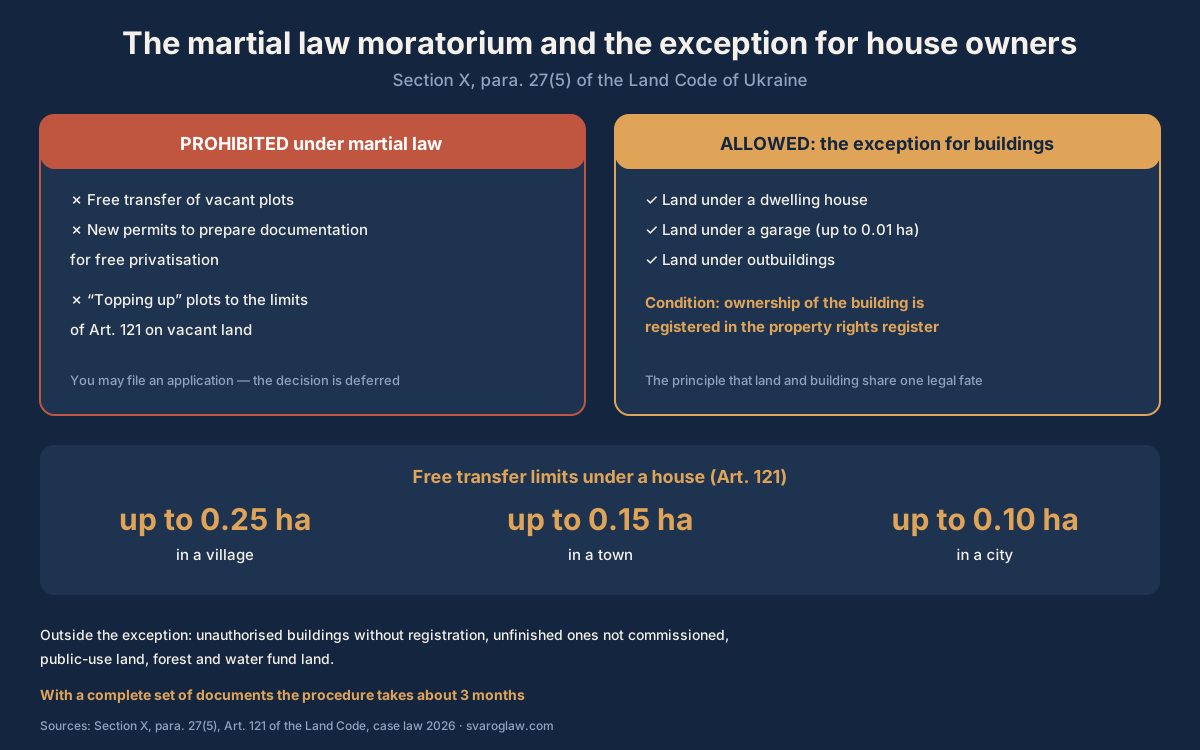
This is the commonest scenario, and the case law here favours owners: refusals justified by martial law alone are held unlawful, because a direct statutory exception applies to property owners. The sequence is:
- insist on a written refusal or an extract from the council’s decision, since an oral “not at the moment” cannot be challenged;
- file an administrative claim to have the refusal declared unlawful and to compel the council to consider your application and decide; the deadline is six months from the day you learned of the breach (Article 122 of the Code of Administrative Procedure);
- inaction — where the application has been “under consideration” for months — is challenged in the same way, and the six months run from the expiry of the council’s one-month period.
A separate line of disputes is competition between claimants to adjoining land: here the Supreme Court’s position on priority in forming a plot applies, which we examined in our article on the rules of land disputes. How we run such cases is set out on the page of our administrative law lawyer.
Six situations: will the exception work
| Situation | Does the exception apply | First step |
|---|---|---|
| House bought, title registered | yes | apply to the council for permission for the land management project |
| House inherited, certificate in hand, title not registered | no, not until the entry exists | register title to the house |
| A garage with registered title | yes, within 0.01 ha | register extract and an application to the council |
| Unauthorised construction with no documents | no | legalise the building, through the courts if necessary |
| Unfinished construction not yet commissioned | no | complete the building and register title |
| A vacant plot with no buildings | no, the moratorium applies | wait for the restrictions to end |
If the house came by inheritance or was built without documents, the property question has to be closed first: legalising dwelling houses or establishing title through the courts, and only then the land.
Why not to put it off
The exception applies today, but the wartime restrictions have already been changed several times, and there is no guarantee they will not tighten. The second reason is housing reform. Law No. 4751-IX “On the Fundamentals of Housing Policy” is winding down the free privatisation of housing, though it names no calendar date: under paragraph 2 of Chapter IV the Law “On the Privatisation of the State Housing Stock” will cease to have effect one year after martial law ends or is lifted. That concerns flats rather than land, but it shows the direction the legislature is taking.
The third reason is the most practical: an unprivatised plot constrains you every day. A house with unregistered land is harder to sell or pass on without disputes, its boundaries are not protected from the neighbours, and compensation for damaged property is calculated differently when the land is not yours.
Owners’ typical mistakes
- Treating an oral refusal as final and waiting for “the end of the war”. Without a written decision there is nothing to challenge, and the six-month deadline runs out.
- Starting with the land when the house is not registered. Title to the building is registered first, through the courts if necessary, and only then is the application for the plot made.
- Claiming more than the Article 121 limit. The excess is not transferred free of charge; it can only be bought or leased.
- Not checking the designated use and the restrictions. Utility protection zones may run beneath the plot and change the shape of the boundaries and the area.
- Losing momentum after the permission. The council’s permission does not reserve the land for you: until the project is prepared and the plot entered in the cadastre, your position remains vulnerable.
When you do not need a lawyer
If the house is registered, the council works to the statutory timescales and the neighbours make no claim on your boundaries, the procedure can realistically be done yourself with a land surveyor: the application, the project, the cadastre, the council’s decision, registration. A lawyer becomes necessary on a written refusal or the council’s silence, where the house is unregistered or unauthorised, in boundary disputes with neighbours, and where the documents for the plot have been lost in the archives and must be recovered by formal requests.
Questions and answers
Can land under a house be privatised during martial law?
Yes. The general prohibition on the free transfer of land has a direct exception for owners of buildings and structures standing on the plot (sub-paragraph 5 of paragraph 27 of Chapter X of the Land Code). The one condition is registered title to the property.
How much land can be obtained free of charge under a house?
Within the Article 121 limits for building and maintaining a dwelling house: up to 0.25 ha in a village, up to 0.15 ha in a settlement, up to 0.10 ha in a city. Anything above that — only purchase or lease.
The house came by inheritance but title is not yet registered. Can I privatise the land?
First complete the administration of the estate and register title to the house, because the exception works precisely for registered property; after that the procedure is no different from the usual one.
How long does it take and what does it cost?
With a complete set of documents, about three months, and most of that is waiting for the council. The main costs are the land management project from 10,000 UAH, the technical passport and the register extracts. What is free is the land itself, not the work that goes with it.
The council says “we are not transferring land during the war”. Is that lawful?
For owners of buildings it is not. Insist on a written refusal and challenge it in the administrative court: the case law treats such refusals as unlawful. The court fee is 1,331.20 UAH and the deadline is six months.
Can land under an unauthorised building be privatised?
No, not until the building is legalised and title to it registered. The route is: legalise the construction, through the courts if necessary, register title, then the land.
There is only a garage on the plot. Does the exception work?
Yes, the exception covers buildings and structures generally, garages with registered title included. The free transfer limit for a garage is up to 0.01 ha.
What if the old documentation for the plot has been lost?
Title to the building lets you use the exception without the old land documents, and decisions granting the plot or state acts can be recovered from the archives. A lawyer’s request is answered within five working days.
How long do I have to challenge the council’s refusal?
Six months from the day you learned of the breach (Article 122 of the Code of Administrative Procedure). If the council says nothing, time runs from the expiry of its one-month period for considering the application.
Is there a risk the exception will be repealed?
There is no guarantee: the wartime restrictions have been adjusted repeatedly, and housing reform has already established that free privatisation of housing will end a year after martial law ends or is lifted. While the provision stands, going through the procedure is wiser than waiting for better conditions.
Sources
- Land Code of Ukraine, Arts. 118, 120, 121, sub-paragraph 5 of paragraph 27 of Chapter X — zakon.rada.gov.ua/laws/show/2768-14
- Law of Ukraine “On Land Management” No. 858-IV — zakon.rada.gov.ua/laws/show/858-15
- Law of Ukraine “On the State Land Cadastre” No. 3613-VI — zakon.rada.gov.ua/laws/show/3613-17
- Code of Administrative Procedure of Ukraine, Art. 122 — zakon.rada.gov.ua/laws/show/2747-15
- Law of Ukraine “On the Fundamentals of Housing Policy” No. 4751-IX, Chapter IV — zakon.rada.gov.ua/laws/show/4751-20
- Law of Ukraine “On Court Fees” No. 3674-VI — zakon.rada.gov.ua/laws/show/3674-17
Privatising the land under your house with Svarog
Send us the register extract for the house and the address — we will check whether your situation falls within the exception, whether any restrictions affect the plot, and take the procedure from the application through to registration of title. If the council has already refused, we will challenge the refusal with a predictable outcome. Related services: privatising the land under a house, land lawyer, full price list.
+38 095 554-54-24 · Kyiv, 7 Khoriva Street (Podil) · Mon–Fri 9.00–18.00