
Олександр Сич
23 August 2026
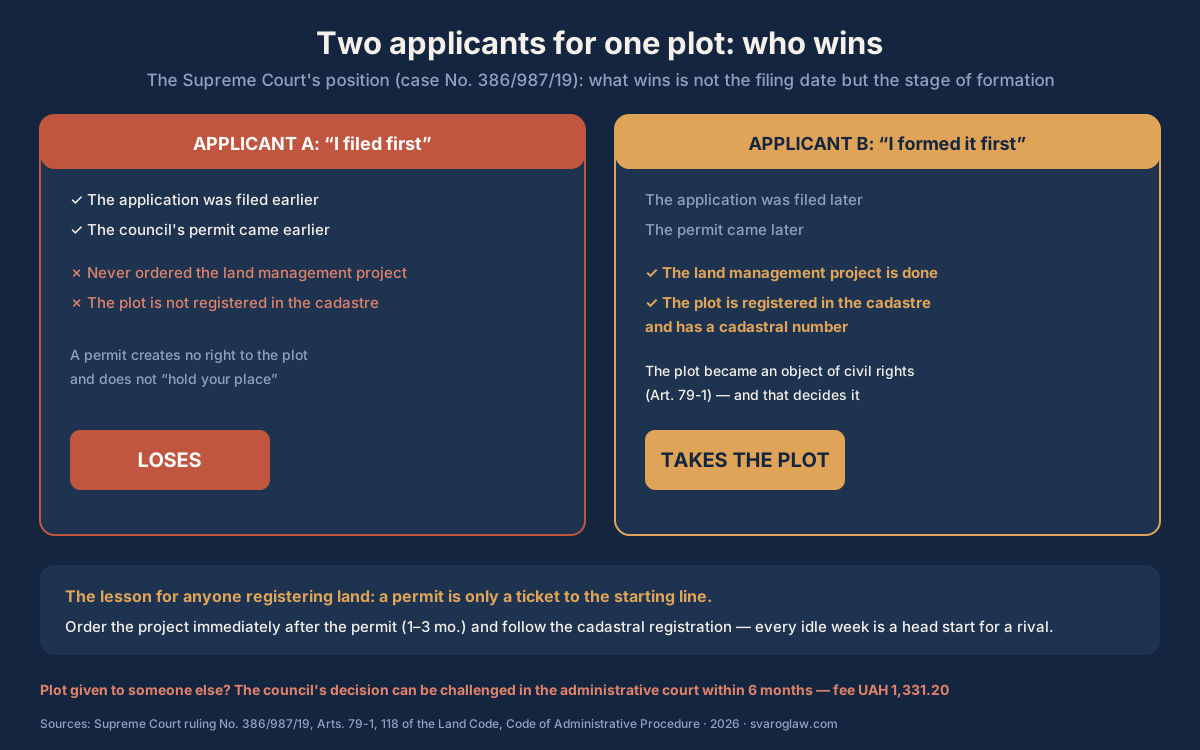
Where two people claim the same plot of land, priority goes not to whoever applied first or obtained a permit first, but to the one on whose land management project the plot was formed as an object of civil rights. So held the Supreme Court in its judgment of 15 October 2025 in case No. 386/987/19. A council’s permit is an opening stage of the procedure that creates no protected expectation in respect of a particular plot.
A classic land dispute runs like this: two people claim the same vacant plot, both have permits to prepare the documentation, and each considers themselves “first”. For years the courts decided such cases differently: some looked at the date of the application, others at the date of the permit. On 15 October 2025 a panel of the Second Judicial Chamber of the Civil Cassation Court within the Supreme Court settled the point, and that reasoning changes the tactics in every competing-claimant case.
Below: what the ruling says, what it means for anyone registering a plot now, and the typical shapes these disputes take. If your situation is already contested, our service page: land lawyer.
What exactly the Supreme Court said
The facts of case No. 386/987/19 are simple. In May 2018 a woman applied to the State Geocadastre’s Kirovohrad regional office for permission to prepare a land management project allocating a plot for a personal farming holding, commissioned the project and applied to register the plot. In August 2019 her application to enter the details in the State Land Cadastre was refused because the plot overlapped another: the same land had already been registered by a rival claimant whose project had been approved by an order of 9 August 2018.
The court of appeal sided with the woman, taking the view that issuing permits to two citizens for the same plot was contrary to the land management rules. The Supreme Court disagreed. The plot with its defined boundaries had been formed on the basis of the second claimant’s project, and it was he who had taken the legally significant steps earlier: he finished the project earlier, the plot was formed on his application earlier and, as a result, the decision approving the project came earlier. The conclusion: where two or more people wish to receive a plot of state or municipal land free of charge within the limits of Article 121 of the Land Code, priority belongs to the person on whose land management project that plot was formed.
What the law means by a “formed plot”
Forming a plot of land means defining it as an object of civil rights, which requires determining its area and boundaries and entering the information about it in the State Land Cadastre (Article 79-1(1) of the Land Code). Formed plots are subject to state registration in the cadastre, and the provision that decides these disputes is paragraph 4 of the same article: a plot is deemed formed from the moment a cadastral number is assigned to it.
Until there is a cadastral number, no object of civil rights exists, and so there is nothing to “queue” for. That is why a permit to prepare a project does not legally reserve the territory for the applicant: it allows the documentation to be prepared, and no more.
The deadlines that work in your favour
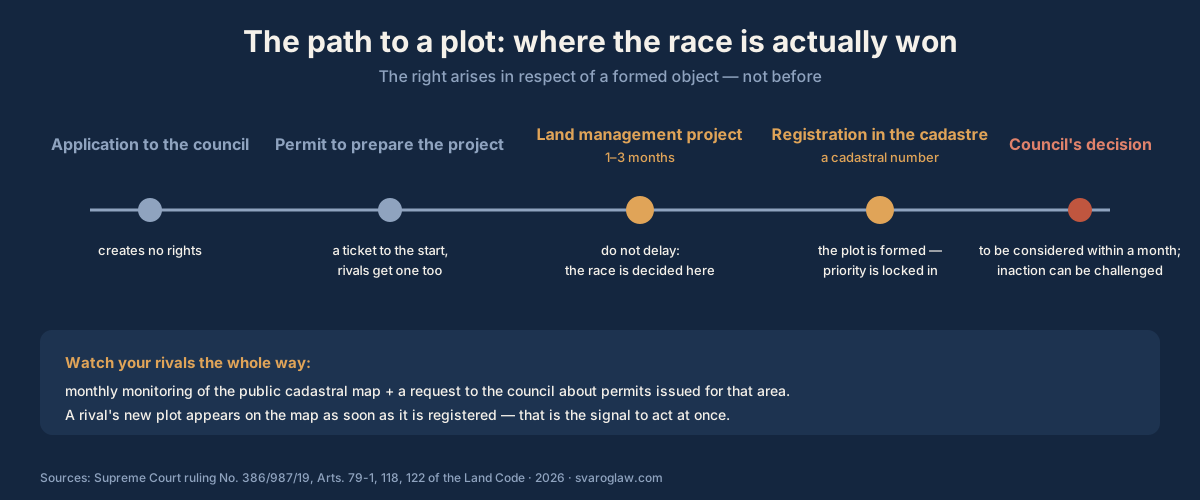
The free privatisation procedure is set out in Article 118 of the Land Code, and it contains three deadlines every claimant should know:
- the authority considers the application for a permit and grants it or gives a reasoned refusal within one month (paragraph 7). The only lawful ground for refusal is that the location does not comply with the laws, the master plan or other planning documentation;
- if the plot is occupied by your own house or another building and the authority has given neither a permit nor a refusal within the month, you may commission the project without a permit during the following month, notifying the authority in writing (paragraph 7). This is in effect tacit consent;
- the authority approves the completed project and transfers the plot into ownership within two weeks of receiving it (paragraph 9).
Since February 2024 Article 118 has contained a further rule (paragraph 10): the application for a permit and the documentation itself are registered on the day they arrive and considered in order of receipt. That order affects the sequence in which papers are dealt with but creates no right to the plot — and it is exactly that distinction the Supreme Court drew.
What this changes in 2026
During martial law the free transfer of state and municipal land into private ownership is prohibited, as are permits to prepare land management documentation for that purpose and the preparation of such documentation (sub-paragraph 5 of paragraph 27 of Chapter X of the Land Code). The prohibition does not extend to three categories:
- owners of real property — buildings and structures — standing on the plot;
- former owners of property destroyed by the armed aggression whose title was extinguished by that destruction (an exception added by Law No. 4625-IX of 8 October 2025);
- citizens of Ukraine in respect of plots granted to them for use before the Land Code took effect, that is before 1 January 2002.
On these narrowed tracks competition for usable plots has only grown, and the Supreme Court’s position has become the main argument in “two permits” disputes. Once the restrictions lift and councils begin issuing new permits in bulk, the race to form plots will unfold in full.
Typical shapes of dispute, and who wins
| Situation | Who has priority under the ruling |
|---|---|
| Both have permits, neither has registered the plot in the cadastre | Nobody automatically: whoever completes the formation first wins; the race continues |
| The first has the older permit, the second has the plot registered in the cadastre | The second: a formed object beats an earlier application |
| The first registered the plot and the authority transferred it to the second | The first has a strong position to challenge the transfer decision |
| The council formed the plot itself and set the allocation procedure | The claimants are equal; statutory priorities decide (for example the priority for combat veterans) |
What to do if you are registering a plot now
- Do not stop at the permit. As soon as the authority decides, commission the land management project from a certified surveyor; preparation usually takes 1–3 months, and every idle week is a head start for a rival.
- Follow the registration in the cadastre. A project without registration does not complete the formation: press for the details to be entered in the cadastre and a cadastral number assigned.
- Check whether anyone else is claiming the same territory. An extract from the cadastre about a plot costs 170 UAH (0.05 of the subsistence minimum, rounded to 10 UAH) and is issued on the day the request is registered; add an enquiry to the council about permits issued for that territory.
- Watch the two-week deadline for approving the completed project (Article 118(9)). If the authority delays, record it in writing: inaction can be challenged in the administrative court within six months of the day you learned of the breach (Article 122(2) CAP).
If the plot is “taken from under you”
Where the authority has transferred a plot you formed to someone else, both the transfer decision and the subsequent registration of title are challenged. It matters not to get the procedure wrong: a dispute with a rival over the right to a particular plot is a dispute about a right and is heard under the rules of civil procedure — case No. 386/987/19 was decided by the Civil Cassation Court. Inaction by a council or the Geocadastre where there is no rival, by contrast, is challenged in the administrative court.
Success depends on a documented chronology: the date of the contract with the surveyor, the date the project was completed, the date the application to register the plot was filed, the date of the approval decision. A related line of defence from 2026 practice concerns refusals “because of martial law” to owners of property standing on the plot: such refusals run contrary to the express exception in sub-paragraph 5 of paragraph 27 of Chapter X, which we covered in detail in our piece on privatising the land under a house.
Claimants’ typical mistakes
- Treating the permit as a guarantee. The Supreme Court expressly called it an opening stage of the procedure that creates no protected expectation in respect of a particular plot.
- Dragging out the project: while you are “getting round to it”, the rival registers the plot in the cadastre and wins the race.
- Not checking for rivals. People learn about a second claimant when the registrar refuses because the boundaries overlap — exactly what happened in case No. 386/987/19.
- Missing the deadlines: for an administrative claim that is six months from the day the person learned of the breach.
- Litigating “over the queue” instead of “over the object”. The argument “I applied first” without a formed plot loses; build the case on the formation stage.
When you do not need a lawyer
If you are the only claimant, the authority raises no objection and the surveyor is working to schedule, the procedure runs its course without a lawyer. One is needed where there are two or more claimants, where the authority has transferred the plot to someone else or is delaying approval, and where the evidential chronology of the formation has to be built for court.
Questions and answers
I applied for the plot first. Does that guarantee anything?
No. On the Supreme Court’s position in case No. 386/987/19 the date of the application confers no priority: the advantage lies with the person on whose land management project the plot was formed and registered in the cadastre.
What does a “formed plot” mean?
A plot with defined boundaries, an area and a cadastral number, whose details are entered in the State Land Cadastre. Under Article 79-1(4) it is deemed formed from the moment the cadastral number is assigned; until then it is not an object of civil rights.
We were both issued permits for the same territory. Is that lawful?
A permit does not reserve the territory for the applicant, so in practice authorities issue them to several people for the same land. The court of appeal in case No. 386/987/19 treated that as a breach, but the Supreme Court decided the dispute not on the lawfulness of the permits but on whose project completed the formation of the plot.
The authority gave the plot I formed to someone else. What now?
Challenge the transfer decision and the subsequent registration of title with a documented chronology: the dates of the project, of registration in the cadastre, and of your application for approval. A dispute with a rival over the right to a plot is heard under civil procedure.
How long does preparing a land management project take?
Typically 1–3 months; the timescales are agreed with the surveyor and are not fixed by law. The cost depends on the area and the region and starts at roughly 10,000 UAH. Then come registration in the cadastre and approval of the project by the authority within two weeks.
Does this ruling apply during martial law?
Yes, it applies to every dispute between competing claimants. The wartime restrictions narrow the situations in which land can be obtained, but they do not change the priority rule about forming the plot.
I have priority as a combat veteran. Is that stronger than formation?
These operate on different planes: priority applies when the authority is choosing between equal claimants to a defined plot. If a rival has already formed the plot as an object, priority alone does not overcome that, so even a combat veteran should not stop at the permit stage.
What if the council says nothing and grants no permit?
If your property stands on the plot, after a month of silence you may commission the project without a permit, notifying the authority in writing (Article 118(7)). Otherwise the inaction is challenged in the administrative court within six months.
Where can I check whether someone has formed a plot on “my” territory?
On the Public Cadastral Map (new plots appear once registered), by an extract from the cadastre, and by an enquiry to the council about permits issued for that territory. It is worth checking monthly throughout the preparation of the project.
Sources
- Judgment of the Civil Cassation Court within the Supreme Court of 15 October 2025 in case No. 386/987/19 (from the Supreme Court’s review of land dispute practice for the second half of 2025) — unba.org.ua
- Land Code of Ukraine, Arts. 79-1, 118, 121, 122, sub-paragraph 5 of paragraph 27 of Chapter X — zakon.rada.gov.ua/laws/show/2768-14
- Law of Ukraine “On the State Land Cadastre” — zakon.rada.gov.ua/laws/show/3613-17
- Code of Administrative Procedure of Ukraine, Art. 122 — zakon.rada.gov.ua/laws/show/2747-15
- Law of Ukraine of 8 October 2025 No. 4625-IX (the exception for owners of destroyed property) — zakon.rada.gov.ua/laws/show/4625-20
Registering a plot with Svarog
Tell us what stage your matter has reached and whether there are rivals — we will check the territory against the cadastre and the permits issued, plan the formation so that you finish first, and, if the plot has already gone to someone else, challenge the decision with a documented chronology. Related material and services: privatising a plot of land, land lawyer, administrative cases, full price list.
+38 095 554-54-24 · Kyiv, 7 Khoriva Street (Podil) · Mon–Fri 9.00–18.00