
Олександр Сич
17 June 2026
The short answer. Having children does not by itself change the shares: property acquired during the marriage is divided equally (Art. 60 of the Family Code). Children do not become co-owners of their parents’ property merely by being related (Art. 173). But the court may depart from equal shares (Art. 70) — including in favour of the parent the children live with, and only where the maintenance is shown to be insufficient for their development and medical care. Property can be divided by a notarised agreement or through the courts: the fee is 1 % of the value of the claim, from 1,331.20 to 9,984 UAH.
The court fee on a claim to divide property on the dissolution of a marriage in 2026 is 1 % of the value of the claim, but no less than 1,331.20 UAH and no more than 9,984 UAH. That is the only fixed figure in this area: what the property consists of, what it is worth and how the shares fall are all established by the court from the parties’ documents. Children add the child’s housing rights and the question of whether maintenance is adequate, but they do not act as a multiplier on a parent’s share.
The commonest misconception is that a child gets a share in the parents’ flat, or that the mother the children stay with automatically takes two thirds. Below: when shares really do depart from equality, what evidence that takes, and how long each route to division lasts.
How property is divided on divorce when there are children
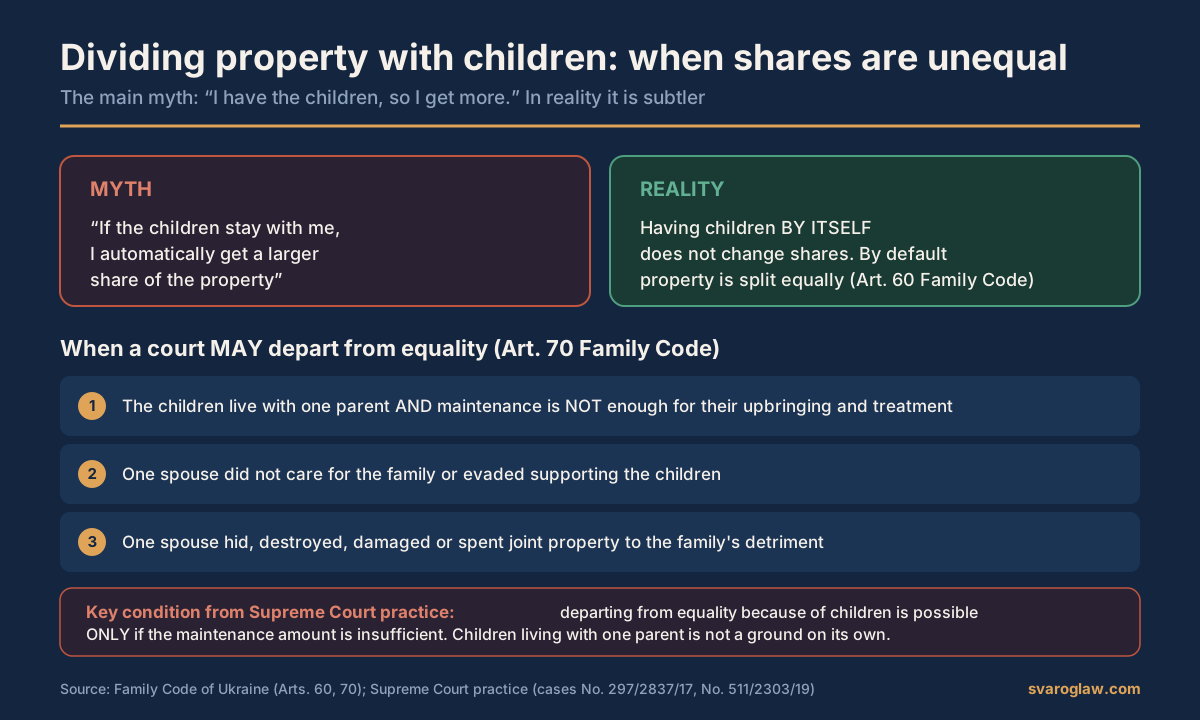
Property bought during the marriage is the spouses’ joint common property, and as a rule it is divided equally (Art. 60), whoever it is registered to and whoever earned more. Children under 18 do not change that rule: the court can depart from equal shares only on weighty grounds that are proved.
Dissolving the marriage does not end joint common ownership (Art. 68): a flat bought during the marriage is still joint five years after the divorce, until the couple divide it by agreement or in court.
What counts as the spouses’ joint property
Joint property covers a flat or house bought during the marriage, plots of land, cars, bank deposits, valuable movables, corporate rights and business shareholdings, and income received during the marriage. Not divided is property that belonged to one spouse before the marriage was registered, and property received by inheritance or by deed of gift (Art. 57).
Do children have a right to their parents’ property
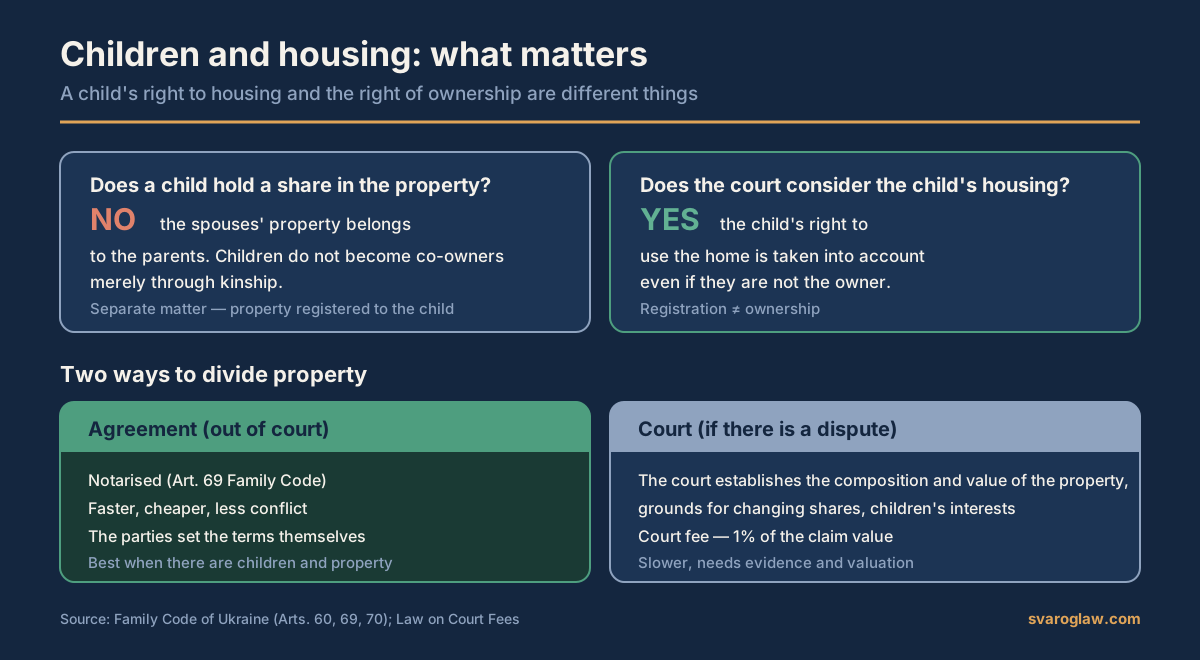
Article 173 establishes that the property of parents and children is separate: a child has no right to the parents’ property, and the parents none to the child’s. So children take no share in the division of the spouses’ joint property and are not a party to the dispute. One separate case is housing bought and registered in a child’s name: it stays out of the pool and remains the child’s.
When the court may depart from equal shares
Under parts 2 and 3 of Article 70 the court may depart from equal shares where circumstances of substantial significance exist. The Supreme Court’s case law has mapped out the specific grounds:
- the children live with one parent and the maintenance is insufficient to provide for their physical and moral development and their medical care;
- one spouse did not provide for the family materially;
- one spouse avoided contributing to the children’s maintenance;
- one spouse concealed, destroyed or damaged joint property, or spent it against the family’s interests.
Here is the point that decides these cases: the mere fact that the children live with one parent is not a ground in itself for increasing that parent’s share. Courts depart from equality only where it is proved that the maintenance falls short of the child’s needs. “The children are with me, so I get more” works only with a calculation of the actual outgoings and documents to back it.
| Family situation | What happens to the shares | What has to be proved |
|---|---|---|
| The children live with the mother and the father pays court-ordered maintenance | Equal shares (Arts. 60, 70) | Nothing: equality is presumed |
| The children live with the mother and the maintenance does not cover the child’s treatment | The court may increase the share (part 2 of Art. 70) | Medical records, receipts, the outgoings set against the maintenance |
| One spouse failed for years to support the family without good reason | The court may reduce their share (part 3 of Art. 70) | Income certificates, statements, enforcement records |
| The joint car was sold on the eve of the claim | Its value is counted into the pool | The sale contract, register data |
| A flat bought and registered in the child’s name | Not part of the division between the spouses | Title documents in the child’s name |
| Housing given or inherited by one spouse during the marriage | Personal private property (Art. 57) | The deed of gift or the certificate of the right to inherit |
Dividing a flat, a house and other real property
Where the home was bought during the marriage, several outcomes are possible: allocating shares between the spouses, monetary compensation to one co-owner, selling the property and dividing the proceeds, or a settlement.
The court does not always award compensation instead of a share: under parts 4 and 5 of Article 71 it may do so only with the consent of the spouse losing the share, and on condition that the other has paid the corresponding sum into the court’s deposit account in advance. “I will keep the flat and pay the money later” does not work in court. The details of registering title after a division are on the page of our property lawyer.
If children are registered at or live in the home
Registering a child at a flat creates no ownership right for them, but it does affect dealings with the home. Under Article 177 of the Family Code and Article 17 of the Law “On the Fundamentals of Social Protection of Homeless Persons and Street Children”, transactions concerning property in which children have ownership or a right of use require the prior consent of the guardianship authority. That authority reviews the documents within a month and refuses where the child’s housing conditions would worsen.
Division by agreement or through the courts
Spouses may decide the division themselves by making an agreement on the division of property; for real property it must be notarised (Art. 69). Where there is no compromise, the court establishes what the joint property consists of, when and from what source it was acquired, what the assets are worth, and whether there are grounds to change the shares.
| Parameter | Agreement before a notary | Claim in court |
|---|---|---|
| Timeframe | 1–3 days once the documents are gathered | from 2 months, longer if the valuation is disputed |
| Essential condition | both parties agree | the other side’s agreement is not needed |
| Payment to the state | state duty of 1 % of the agreement’s value before a state notary; a contractual tariff before a private one | court fee of 1 % of the value of the claim: 1,331.20–9,984 UAH |
| Form | notarised for real property (Art. 69) | a judgment plus registration of title in the register |
Where the division is combined with the question of maintaining the children, the agreement may provide for transferring real property into the child’s ownership instead of maintenance (Art. 190): such an agreement is notarised and requires the guardianship authority’s consent. Maintenance amounts and how they are enforced are covered in detail on the page of our maintenance lawyer.
Step by step: dividing property when there are children
- List the property and check the registers (1–2 weeks): extracts from the State Register of Real Property Rights, vehicle records, account statements covering the marriage.
- Have the property valued (3–10 days). A valuer’s report is needed both for the value of the claim and for calculating compensation.
- Try to settle in writing (2–4 weeks). A draft agreement records who takes what and who pays the balance; for real property it must be notarised (Art. 69).
- Gather the evidence for departing from equality: medical records, tuition contracts, receipts, a bailiff’s certificate of maintenance arrears.
- File the claim — for real property, at the court where it is located. Pay the court fee (1 % of the value of the claim, 1,331.20–9,984 UAH); through the Electronic Court a factor of 0.8 applies.
- Register your title once the judgment takes effect: without the entry in the State Register of Real Property Rights the share cannot be dealt with.
What documents you need
Documents about the property: the marriage certificate or the judgment dissolving the marriage, sale contracts, extracts from the state registers, technical documentation, the valuation report and documents on any loans.
Evidence of what the child costs (if you are asking for a departure from equal shares): receipts, tuition contracts, medical records, and certificates showing maintenance paid or unpaid. These decide whether the court will change the shares.
Typical mistakes when dividing property with children
- Counting on “a share for the child”. A claim naming the child as a co-owner of the parents’ flat will be dismissed under Article 173, and the court fee paid is not returned.
- Relying on where the children live, with no figures. Without a calculation of the child’s costs set against the maintenance, the court applies equal shares even where the children really do live with the claimant.
- Understating the value of the claim. Saving on the court fee gets the claim stayed, and once the claim is clarified the fee has to be topped up anyway.
- Selling the joint home before the division. Where a child lives there, a transaction without the guardianship authority’s consent is set aside, and the buyer returns the flat while the seller returns the money.
- Waiting “for things to settle”. After the marriage is dissolved a three-year limitation period runs (Art. 72), and its running, suspended for the quarantine and martial law, resumed on 4 September 2025.
When you do not need a lawyer
Where the spouses agree on what the property is and what the shares are, the agreement is drawn up by a notary directly: they check the documents, explain the consequences and certify the deed. No representative is needed either where one flat bought during the marriage is being divided and both sides accept equal shares. Help is needed where property has been put into third parties’ names, where there is a business or loans, where a party is seeking a departure from equal shares, or where the division is combined with a dispute about where the child lives. The cost of individual services is in the legal services prices section.
Questions and answers
Do children affect the division of property on divorce?
Not in themselves — the property is divided equally. The court may depart from equal shares where the children live with one parent and the maintenance is shown to be insufficient to provide for them.
Do children have a right to a share in their parents’ property?
No. Article 173 keeps parents’ and children’s property separate. The exception is property bought and registered in the child’s name, which stays out of the division.
How is a flat divided if children are registered there?
Registration creates no ownership right, so the flat is divided between the spouses. But disposing of such a home needs the guardianship authority’s prior consent.
What does filing a claim to divide property cost in 2026?
The court fee is 1 % of the value of the claim, within a range of 1,331.20 to 9,984 UAH. Filing through the Electronic Court multiplies the sum by 0.8.
Can property be divided without a court where there are children under 18?
Yes, by an agreement on the division of property. Real property requires notarisation, and where the transaction affects a child’s housing rights, the guardianship authority’s consent.
Can a flat be transferred to the child instead of maintenance?
Yes; under Article 190 a notarised agreement is made ending the right to maintenance in exchange for transferring real property to the child. The guardianship authority’s consent is required.
How many years are there to divide property after a divorce?
Three years from the day the person learned, or could have learned, that their right had been infringed (Art. 72). While the marriage subsists, no limitation period applies to a claim for division.
What if a former husband has transferred joint property to relatives?
Such transactions are challenged in court together with the claim for division. The ground is the absence of the other spouse’s consent to dealing with joint property (Art. 65).
What does a property-division lawyer cost?
A consultation from 1,500 UAH, preparing the claim or the agreement from 5,000 UAH, appearing at one hearing from 3,000 UAH, full handling of a civil case from 25,000 UAH.
Sources
- Family Code of Ukraine, Arts. 57, 60, 65, 68, 69, 70, 71, 72, 173, 177, 190 — zakon.rada.gov.ua
- Law of Ukraine “On Court Fees” No. 3674-VI, Art. 4 — zakon.rada.gov.ua
- Law of Ukraine “On the Fundamentals of Social Protection of Homeless Persons and Street Children” No. 2623-IV, Art. 17 — zakon.rada.gov.ua
- Civil Procedure Code of Ukraine — zakon.rada.gov.ua
- Supreme Court reviews of the case law on Articles 70 and 71 of the Family Code — supreme.court.gov.ua
Dividing property with Svarog
When children are involved in a divorce, the division of property becomes entangled with maintenance and housing rights, and a mistake is measured in flats. Svarog’s lawyers will assess the prospects, build the evidence, draft the agreement or the claim and defend your family’s interests in court. More on the pages of our property-division lawyer and divorce lawyer, and in the family law section.
+38 095 554-54-24 · Kyiv, 7 Khoriva Street (Podil) · Mon–Fri 9.00–18.00