

Олександр Сич
19 June 2026
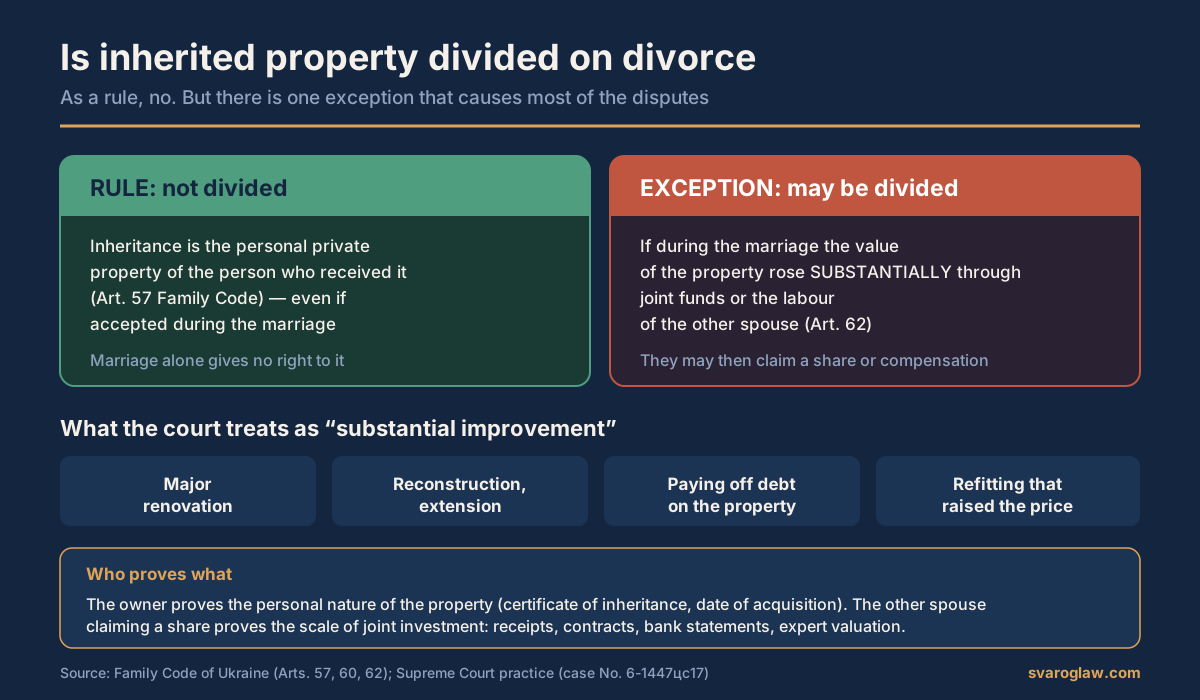
The short answer. As a rule an inheritance is not divided: property received by inheritance is the personal private property of the spouse who inherited it — even where the inheritance was accepted during the marriage (Art. 57 of the Family Code). Marriage alone gives the other spouse no right to it. There is one exception: where during the marriage the value of the inherited property rose substantially thanks to joint funds or the other spouse’s labour (major repairs, reconstruction), they may claim a share or compensation (Art. 62).
Article 57 of the Family Code treats inherited property as one spouse’s personal private property, and that rule has no exception for how long the marriage lasted or for living together in the inherited flat. A dispute arises only where joint funds went into the property: Article 62 then comes into play, and the case turns on the valuer’s report and the receipts for the building work.
Two conflicts recur in practice. The first: a former husband or wife demands half the inherited flat simply because they lived in it for ten years. The second, harder one: during the marriage the inherited house was extended, and now it has to be worked out how much the value rose and whose doing that was. Both situations are set out below, along with the deadlines, the costs and the evidence that works in court.
The general rule: an inheritance is not joint property
Article 57 of the Family Code treats as one spouse’s personal private property whatever they received by inheritance or by deed of gift, and whatever they acquired before the marriage or with their own money. So a flat, a house, a plot of land or any other property inherited by one spouse (under a will or on intestacy) is not divided on divorce. The other spouse does not acquire ownership of it merely by being married.
The date the papers were issued makes no difference. Under part 5 of Article 1268 of the Civil Code an inheritance belongs to the heir from the time it opens, that is from the day of the deceased’s death, regardless of when they accepted it and when the certificate was issued. So if a father died a year before the wedding and the certificate of the right to inherit was issued during the marriage, the property is still personal.
The exception: when an inheritance can become joint
The main exception is in Article 62. Where one spouse’s personal property rose substantially in value during the marriage as a result of joint labour or money, or of the other spouse’s expenditure, the court may recognise it as joint common property — in whole or in part. The Supreme Court has consistently stressed that joint ownership does not arise automatically, but only over the part whose value rose substantially through the joint contribution.
In practice such disputes arise from:
- major repairs to inherited housing;
- reconstruction or extension of a house, including with subsequent commissioning;
- conversion works that substantially raised the market value;
- paying off, with joint funds, debts connected with the property.
The decisive word here is “substantially”. Cosmetic repairs or small outlays are not enough. The court compares the value before and after the works, and then assesses how much of the increase the joint funds produced. A valuation is ordered for that, and in contested cases a forensic construction report, which costs money of its own and adds several months to the case.
| Situation | How the property is treated | What is proved in court |
|---|---|---|
| A flat inherited before or during the marriage, with no alterations | Personal private property (Art. 57) | The certificate of the right to inherit, a register extract |
| The estate opened before the marriage, the certificate was issued during it | Personal property (part 5 of Art. 1268 of the Civil Code) | The deceased’s death certificate with its date |
| An inherited house reconstructed with joint funds, value up substantially | The court may treat it as joint, wholly or in part (Art. 62) | Building contracts, receipts, a valuer’s report, an expert report |
| Cosmetic repairs done to inherited housing | Remains personal property | A comparison of value before and after the works |
| The inherited flat was sold and another bought with the proceeds | Personal property if the source of the money is proved (Art. 57) | Contracts, bank statements, matching sums and dates |
| The other spouse is registered as living in the inherited home | No ownership right arises | A question of use, not of ownership |
How inherited real property is divided
Where inherited real property has not been substantially altered during the marriage, it stays the heir’s. That covers flats, houses, plots of land, garages and commercial property. Even if the whole family lived in the inherited home, living there creates no ownership right for the other spouse. Registering rights to inherited assets is covered in more detail on the page of our inheritance lawyer.
If children or the other spouse are registered in the inherited home
Registering a family member’s residence in inherited housing does not automatically create a right to a share in it. At the same time, in deciding housing questions the court takes account of the interests of children under 18 and of how the family actually lives — a child’s right to use the home, for instance. That is a question of use, not of ownership.
What a dispute over inherited property costs
A claim to have inherited property recognised as joint is a monetary claim, so the court fee is calculated on the value of the share claimed: 1 % of the value of the claim. Where the claim is brought within the division of property on divorce, the fee is capped at three subsistence minimums — from 1,331.20 to 9,984 UAH. For a separate monetary claim the general ceiling of five subsistence minimums applies, that is up to 16,640 UAH. Filing through the Electronic Court reduces the sum by 20 %.
To that are added a property valuation report and, where needed, a forensic construction report — paid for by the party who asks for it. The cost of legal help is in the service prices section: reviewing the documents and a written opinion cost from 5,000 UAH, full handling of a civil case from 25,000 UAH.
What evidence a dispute over inherited property needs
The outcome depends almost entirely on the evidence, and each side has its own case to prove.
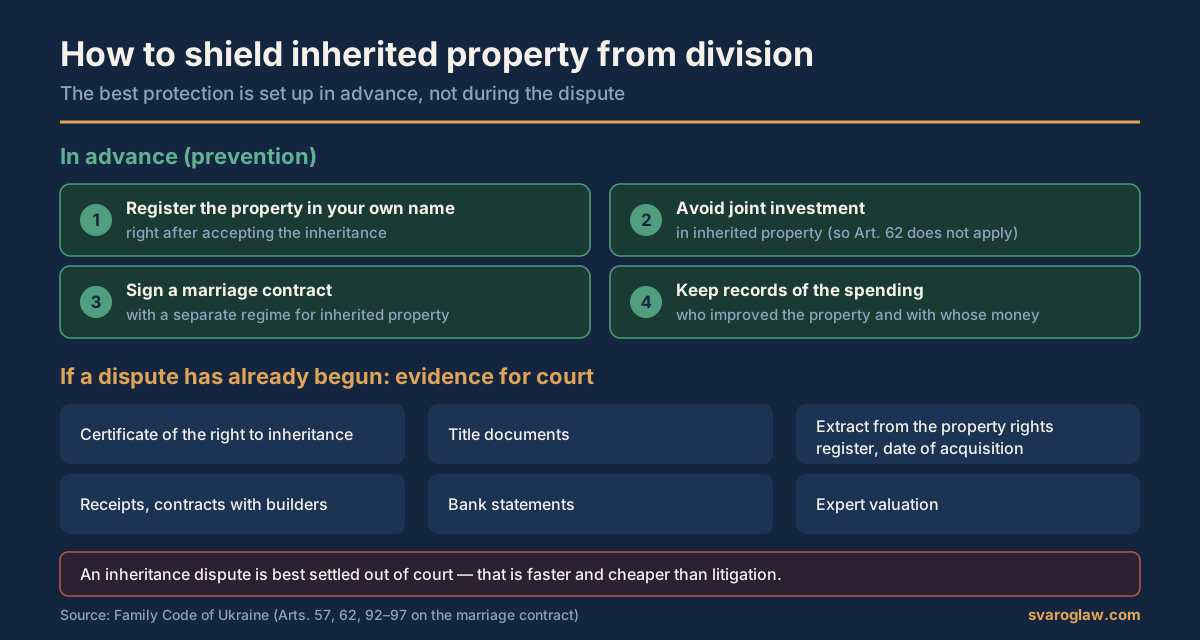
The owner defending the property from division establishes that it was acquired personally: with the certificate of the right to inherit, the title documents, an extract from the State Register of Real Property Rights and the technical documentation. Those papers fix where the property came from and when ownership arose.
The person claiming a share must prove the scale of the joint outlay and its effect on the value: with contractors’ agreements, receipts, bank statements, expert reports and, where needed, witness evidence. Without proof of a substantial improvement, a claim to a share has no prospects.
Step by step: what to do once a dispute has arisen
- Fix where the property came from (1–3 days). Order an extract from the State Register of Real Property Rights and have the certificate of the right to inherit ready, showing the date the estate opened.
- Compare the technical condition (1–2 weeks). Dig out the old technical documentation: it shows the area and characteristics before the works.
- Order a valuation report (3–10 days). Without figures for the current and earlier value, a claim of a “substantial increase” cannot be calculated.
- Gather the financial documents for all the works: building contracts, acceptance certificates, receipts, payment orders, loan agreements.
- Try to settle in writing (2–4 weeks). Compensation by agreement is often cheaper than an expert report and two years of litigation.
- File the claim or the defence within the three-year limitation period running from the day the person learned their right had been infringed (Art. 72). The running of limitation, suspended for the quarantine and martial law, resumed on 4 September 2025.
How to protect inherited property from division
The most reliable protection is built in advance, not during the dispute. In practical terms:
- Register the property in your own name as soon as you accept the inheritance, and keep the papers in order.
- Avoid joint outlays on inherited property — they are what triggers Article 62.
- Make a marriage contract with a separate regime for inherited property (Chapter 10, Arts. 92–103).
- Keep evidence of whose money paid for any improvements, and when.
- Keep the money separate: hold the proceeds of selling inherited property in a separate account so the source of a later purchase can be proved.
Typical mistakes
- Mixing the money. Proceeds from an inherited flat paid into a joint account and spent alongside wages are almost impossible to trace, and the court will treat the new home as joint.
- Works with no paperwork. Someone who put cash into another’s inherited house with no contracts or receipts will prove neither the amount nor their contribution.
- Putting the inherited home into joint names. Gifting half an inherited flat to a spouse is practically impossible to undo after a falling out.
- Relying on witnesses. The scale of the outlay is proved by payment documents and a valuation; relatives’ testimony without them is treated with scepticism.
- Delay after the divorce. The three-year limitation period slips by unnoticed, and “I didn’t know about the case” rarely restores it.
When you do not need a lawyer
If the inherited flat was not rebuilt during the marriage, the papers are in order and the other spouse’s claims go no further than words, the opponent has no case — keeping the certificate of the right to inherit and a register extract is enough. The same goes where the parties have agreed compensation and are going to a notary to draw up the agreement. Legal help is needed where the property was extended or reconstructed, where a business or several assets are being divided, or where a claim to have the property declared joint has already been filed: then the quality of the evidence decides whether the flat stays with one person. How the remaining assets are divided is set out on the page of our property-division lawyer.
Questions and answers
Is an inheritance divided between spouses on divorce?
As a rule, no. An inheritance belongs to the spouse who received it and is their personal private property (Art. 57).
When can inherited property be treated as joint?
Where its value rose substantially during the marriage thanks to joint outlays or works — Article 62 then applies, and the court sets the share in proportion to the increase in value.
Does it matter when the certificate of the right to inherit was issued?
No. An inheritance belongs to the heir from the day of the deceased’s death (part 5 of Art. 1268 of the Civil Code), so the date of the certificate does not change how the property is treated.
What if joint funds went into the inherited property?
Gather evidence of how much was spent and how it affected the value: contracts, receipts, bank statements, a valuation report.
Is a flat bought with the proceeds of inherited housing divided?
No, where the source of the money is proved: the contract of sale of the inherited property, bank statements, and sums and dates matching the new purchase.
Does registering a child in an inherited flat affect ownership?
No. Registration creates no ownership right, though the court takes account of the child’s right to use the home.
Can an inheritance be protected from division in advance?
Yes. Register the property in your own name, avoid joint outlays, and make a marriage contract with a separate regime for inherited property.
How long is there to bring a claim about inherited property after a divorce?
Three years from the day the person learned, or could have learned, that their right had been infringed (Art. 72). Until the marriage is dissolved no limitation period applies.
What does filing a claim to have inherited property declared joint cost?
The court fee is 1 % of the value of the claim: within a division of property on divorce, from 1,331.20 to 9,984 UAH; at the general monetary rate, up to 16,640 UAH.
Is a plot of land inherited by one spouse divided?
No, it is the heir’s personal property. A dispute is possible only over buildings put up on the land with joint funds.
Sources
- Family Code of Ukraine, Arts. 57, 60, 62, 69, 72, 92–103 — zakon.rada.gov.ua
- Civil Code of Ukraine, Arts. 1268, 1270, 1297 — zakon.rada.gov.ua
- Law of Ukraine “On Court Fees” No. 3674-VI, Art. 4 — zakon.rada.gov.ua
- Supreme Court reviews of the case law on Articles 57 and 62 of the Family Code — supreme.court.gov.ua
Protecting inherited property with Svarog
If a divorce has brought a dispute over inherited property, or you want to protect it in advance, Svarog’s lawyers will assess the risks, build the evidence, draft the marriage contract or the claim and defend your personal ownership in court. More on the page about dividing an estate without a will and in the family law section.
+38 095 554-54-24 · Kyiv, 7 Khoriva Street (Podil) · Mon–Fri 9.00–18.00