

Олександр Сич
24 June 2026
A will and intestate succession reach the same destination by different roads. A will lets the testator name the heirs and the shares themselves; under the law the estate is divided equally among five classes of heirs. The choice makes no difference to tax: 0% for relatives of the first and second degree, 5% income tax plus a 5% military levy for other residents. The period for accepting an inheritance is six months.
Articles 1233 and 1258 of the Civil Code describe two different ways property passes on death, and a person chooses between them while still alive: make a will, or leave everything as the law provides. That choice decides who gets the flat or the stake in the business, and how many years the family spends arguing. It makes no difference at all to the tax: Article 174 of the Tax Code sets that by the degree of kinship and the parties’ residence.
Below: what a will gives you, where the statutory order of succession is strongest, what the paperwork costs and which deadlines must not be missed. If a dispute has already begun, the page of our inheritance lawyer sets out that route.
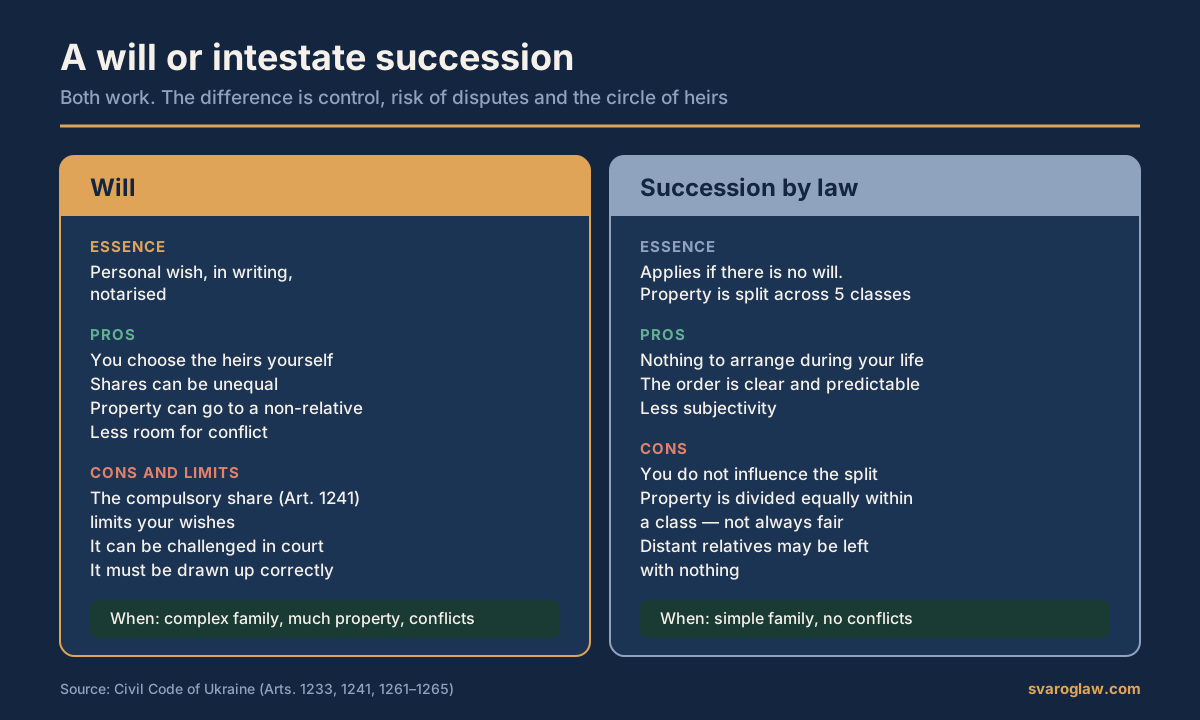
How a will differs from intestate succession
Article 1233 defines a will as an individual’s personal disposition to take effect on their death. Only a person with full civil capacity can make one, and only in person: part 2 of Article 1234 forbids making a will through a representative. Article 1247 sets the form — a written document stating the place and time of making, the testator’s own signature, and certification by a notary with registration in the Inheritance Register. It is through that register that a notary finds the document after a death, even where the family knew nothing about it.
The freedom of disposition is wide: under Article 1235 the testator may appoint anyone as heir regardless of family ties and may, without giving reasons, exclude a relative from inheriting. The decision is not final, since Article 1254 allows a will to be revoked or changed at any time. Spouses have one more instrument — a joint will over property held in joint common ownership (Art. 1243).
Intestate succession comes into play where there is no will, where it has been declared invalid, or where it covers only part of the estate. The order of classes under Article 1258 then applies, and under Article 1267 the shares of all heirs within one class are equal.
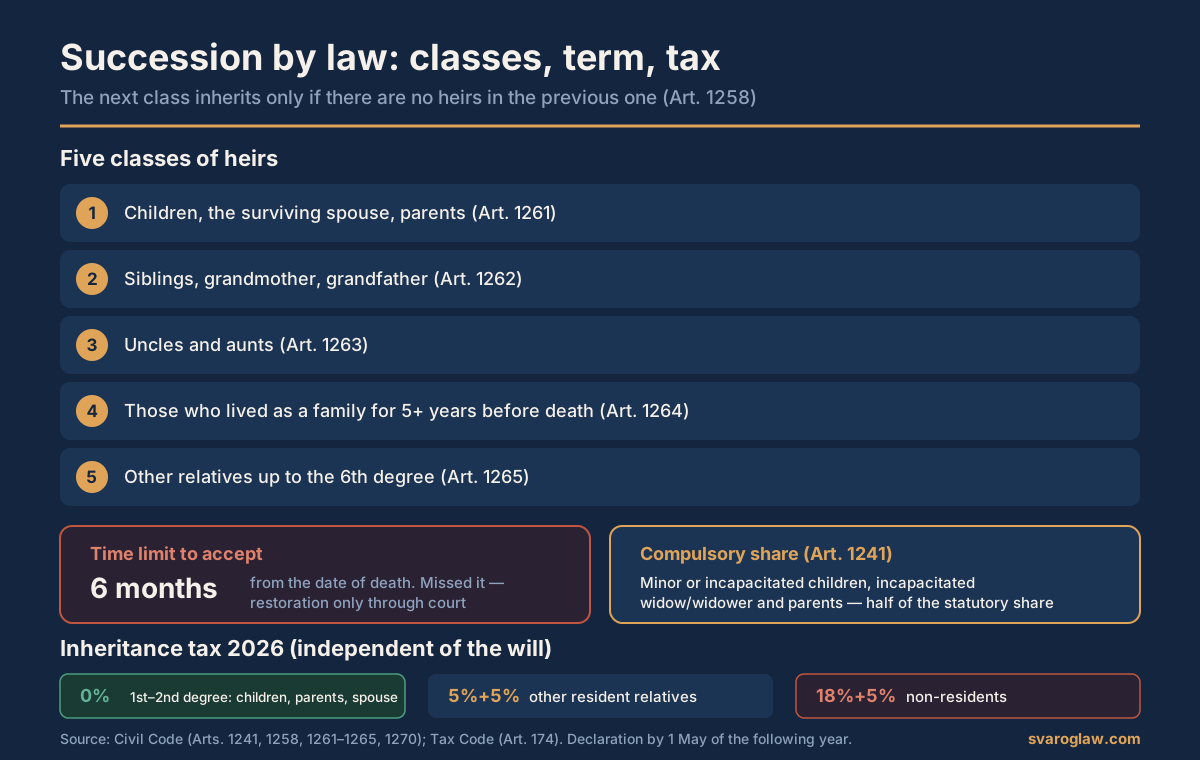
The five classes of heirs under the law
The next class inherits only where there are no heirs in the preceding one, or they are excluded from inheriting, did not accept the estate or renounced it.
| Class | Who inherits | Civil Code article |
|---|---|---|
| First | Children (including those conceived during the deceased’s life and born after the death), the surviving spouse, the parents | 1261 |
| Second | Full brothers and sisters, grandmother and grandfather on both the father’s and the mother’s side | 1262 |
| Third | Uncles and aunts by blood | 1263 |
| Fourth | People who lived with the deceased as one family for at least five years before the estate opened | 1264 |
| Fifth | Other relatives up to and including the sixth degree, and dependants who were not family members | 1265 |
Grandchildren, great-grandchildren, nephews, nieces and cousins are not listed directly, but take by representation (Art. 1266): they inherit the share their own parent would have taken had that parent been alive when the estate opened. Article 1259 allows the order to be changed by a notarised agreement of the interested heirs made after the estate opens, and Article 1224 excludes from inheriting anyone who deliberately took the deceased’s life, obstructed the making of a will or avoided maintaining them.
What a will gives you, and where its force ends
A will solves the situations where an equal division by classes produces an unfair result: a second family, children from different marriages, a business that must stay in one pair of hands, a home for someone who cared for the deceased but is no relation. It is not absolute protection, though, and it has two limits.
The compulsory share
Under Article 1241 the deceased’s minor children, children under 18 and adult children unable to work, an incapacitated widow or widower and incapacitated parents inherit half of the share each of them would have taken on intestacy, whatever the will says. Counted towards the compulsory share are the value of ordinary household goods and effects and the value of any testamentary legacy in that person’s favour. The court may reduce the share having regard to the relationship between the heir and the deceased, but a will cannot deprive the person of the right altogether.
When a will is challenged
Challenges begin after the death. The commonest grounds are the testator’s condition at the moment of certification, if it prevented them from understanding what they were doing; pressure or deception by interested parties; and defects of form. Such cases turn on evidence: medical records, witness testimony, a posthumous forensic psychiatric report. The sequence of steps is set out on the page about challenging a will.
When intestate succession suits you better than a will
Having no will often creates no problem at all. Where there is one child, or several children with identical rights, and no asset that cannot be split physically, the statutory order produces exactly the result the deceased would have wanted. A will starts working for you only where your wishes differ from that order.
What it costs: tax and notarial expenses
The tax rate depends not on the form of succession but on the degree of kinship and on residence. The first degree under subparagraph 14.1.263 of the Tax Code is parents, husband or wife, and children including adopted ones; the second is full brothers and sisters, grandparents on both sides, and grandchildren.
| Who receives the estate | Income tax | Military levy | Total |
|---|---|---|---|
| Family members of the first and second degree (subpara. 174.2.1) | 0% | 0% | 0% |
| Other residents: aunts, uncles, nephews and nieces, cousins, strangers under a will (subpara. 174.2.2) | 5% | 5% | 10% |
| A non-resident heir, or an estate from a non-resident deceased (subpara. 174.2.3) | 18% | 5% | 23% |
The 5% military levy is charged on the income listed in Article 163, but subparagraph 1.7 of paragraph 16-1 of subsection 10 of section XX exempts income taxed at the zero rate, so relatives of the first and second degree pay neither the income tax nor the levy. The zero rate also applies regardless of kinship to a person with a group I disability, an orphan and a child deprived of parental care (subpara. 174.2.1).
The state duty for certifying a will is 0.05 of the tax-free minimum (85 kopiykas), and for issuing a certificate of the right to inherit 2 tax-free minimums, that is 34 UAH (Decree “On State Duty” No. 7-93). A private notary charges a contractual tariff instead of the duty, which under Article 31 of the Law “On Notaries” cannot be lower than the duty, plus a fee for legal and technical services, so the bill for a certificate covering a flat comes to several thousand hryvnia. A valuation is needed only at the 5% and 18% rates. What a lawyer’s handling of a case costs is set out in the legal services price list.
Deadlines that must not be missed
The application to accept the estate goes to the notary at the place where the estate opened, within six months of the death (Art. 1270), and that period is the same for a will and for intestacy. There is an exception for an heir who lived permanently with the deceased: under part 3 of Article 1268 they are treated as having accepted the estate unless they file a renunciation. A missed deadline is restored by the written consent of all the heirs who accepted, or by a court order setting an additional period for a valid reason (Art. 1272); the Supreme Court does not treat martial law or living abroad as a valid reason in themselves.
Where the estate includes real property, the heir must apply for a certificate of the right to inherit (Art. 1297). Another deadline concerns debts: a creditor must bring their claims no later than six months from the day the heir receives the certificate (Art. 1281), and heirs are liable only up to the value of what they received (Art. 1282).
How to make a will: five steps
- Draw up a list of the property with the details: the address and registration number of the property, the car’s VIN, the bank and account, the size of any shareholding.
- Check who is entitled to a compulsory share under Article 1241 and calculate it in advance, or the will gets cut back after your death.
- Make an appointment with a notary, taking your passport and tax number: the will is certified the same day, and witnesses are needed only for a secret will.
- Check that the notary registered the will in the Inheritance Register: without that entry the document may simply never be found.
- Revisit the text after selling property, marrying, divorcing or having a child. A new will revokes the previous one in full (part 3 of Art. 1254), so the old one has to be rewritten.
Typical mistakes
- Leaving the flat to one child when there is an incapacitated spouse: the compulsory share takes half the widow’s or widower’s statutory share, and the actual division will not match what was written.
- Making a new will on the assumption that the old one still covers “the rest”. Under part 3 of Article 1254 property not mentioned in the new document passes on intestacy.
- Asking a relative to make the will under a power of attorney: part 2 of Article 1234 forbids making a will through a representative, and no notary will certify it.
- Accepting an estate without checking the deceased’s debts. A creditor has six months from the issue of the certificate, so sometimes renouncing under Article 1273 works out cheaper than accepting.
- Ordering a property valuation where the rate is zero: relatives of the first and second degree do not need one.
When you do not need a lawyer
If you are the sole first-class heir, the papers on the flat are in order, there are no rival claimants and the deceased left no debts, the inheritance goes through the notary without a lawyer. The same goes for a simple will in favour of one child where nobody is entitled to a compulsory share. Help is needed where there is a second family, a business or assets abroad, a conflict between heirs, lost proof of the family relationship, or a six-month deadline already missed.
Questions and answers
Which is better: a will or intestate succession?
A will is needed where your wishes differ from the statutory order: a second family, unequal shares, an heir who is not a relative. If the statutory outcome suits you, a will adds only expense and one more ground for a challenge.
Who inherits if there is no will?
The first-class heirs under Article 1261: children, the surviving spouse and the parents, in equal shares. If there are none, or they do not accept, the right passes to the next of the five classes.
What is the compulsory share and can it be avoided?
It is half the statutory share, taken by minor children, children under 18 and adult children unable to work, an incapacitated widow or widower and incapacitated parents, whatever the will says (Art. 1241). A will cannot cancel it; the court may only reduce it having regard to the relationship between the heir and the deceased.
Does having a will affect the tax?
No. Article 174 ties the rate to the degree of kinship and to residence, not to the basis of succession. A daughter under a will and a daughter on intestacy pay the same — nothing.
What does a nephew or an unmarried partner pay under a will?
10% of the value: 5% income tax under subparagraph 174.2.2 plus a 5% military levy. Those rates require a valuation, and the income is declared or the tax paid before the notarial formalities.
How long is there to accept an inheritance?
Six months from the day of death (Art. 1270). Anyone who lived permanently with the deceased is treated as having accepted automatically unless they file a renunciation.
Do debts pass with the property?
Yes. Heirs satisfy creditors’ claims up to the value of what they received (Art. 1282), and the creditor has six months from the issue of the certificate to bring those claims (Art. 1281).
Can heirs divide the estate differently from the statutory shares?
They can: the order of classes is changed by a notarised agreement of the heirs after the estate opens (Art. 1259), and the size of the shares by agreement between them — in writing and notarised for real property and vehicles (Art. 1267).
Sources
- Civil Code of Ukraine, Arts. 1224, 1233–1235, 1241, 1243, 1247, 1254, 1258–1268, 1270, 1272, 1273, 1281, 1282, 1297 — zakon.rada.gov.ua/laws/show/435-15
- Tax Code of Ukraine, Art. 174, subpara. 14.1.263, para. 16-1 of subsection 10 of section XX — zakon.rada.gov.ua/laws/show/2755-17
- Decree of the Cabinet of Ministers “On State Duty” No. 7-93, para. 3 of Art. 3 — zakon.rada.gov.ua/laws/show/7-93
- Law of Ukraine “On Notaries” No. 3425-XII, Arts. 31, 34, 38 — zakon.rada.gov.ua/laws/show/3425-12
- Procedure for notarial acts by notaries of Ukraine, Ministry of Justice order No. 296/5 — zakon.rada.gov.ua/laws/show/z0282-12
A will or intestate succession, with Svarog
Tell us what the estate consists of and who the relatives are, and we will work out what the law would produce without a will, where a compulsory share arises and what the tax would be. We will draft a will that is hard to challenge, or run the inheritance from the application to the notary through to the registration of title. Related services: inheritance lawyer, dividing an estate without a will, civil lawyer.
+38 095 554-54-24 · Kyiv, 7 Khoriva Street (Podil) · Mon–Fri 9.00–18.00