

Олександр Сич
21 November 2026
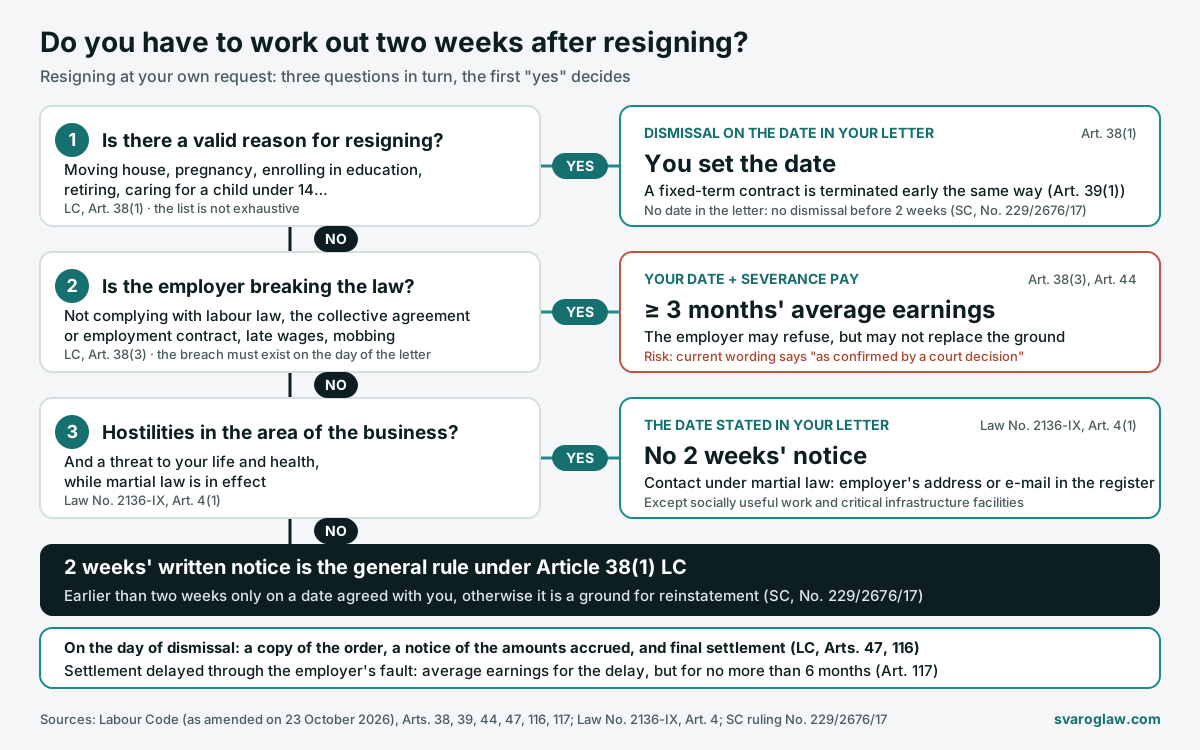
Your employer must release you on the date stated in your resignation letter, without two weeks’ notice, if you have a valid reason (Labour Code, or LC, Art. 38(1)), if the employer itself is breaching the law or the employment contract (Art. 38(3)), or if hostilities are under way in the area where the business is located (Law No. 2136-IX, Art. 4(1)). Valid reasons include moving house, pregnancy, enrolling in an educational institution or retiring. A breach by the employer also entitles you to severance pay of at least three months’ average earnings (Art. 44), but you will have to prove the breach: an employer who denies it may refuse to dismiss you on that ground. The hostilities must threaten your life and health, and martial law must still be in effect. In all other cases, your employer may release you before the two weeks are up only on a date agreed with you.
The law does not make you work out two weeks: the term “working out” does not appear in Article 38 LC. It requires you to give your employer two weeks’ written notice, but not to obtain the employer’s consent to your resignation. So resignation at the employee’s own request without working out the notice period and without the employer’s consent is possible only on the three grounds named above, and on each of them you set the date.
Resigning without working out notice: three grounds, and what to do if there is no order
A valid reason under Article 38(1) LC
your date · Art. 38(1)When it applies: you are resigning because you cannot continue working for one of the reasons named in the law: moving house, your husband or wife being transferred to work in another locality, enrolling in an educational institution, pregnancy, caring for a child under 14, retiring and so on (the full list is in the table below). The list is not exhaustive, because it ends with the words “and for other valid reasons”.
In that case the employer “must terminate the employment contract within the period requested by the employee”. You do not have to agree that period with the employer, but you must state it in your letter.
A valid reason without a date in the letter achieves nothing. An employee of BalTrans LLC asked to be dismissed because he was changing his place of residence, but gave no date. The employer issued the dismissal order the very next day, while the employee, by his account, changed his mind, kept working and learned of his dismissal only a month and a half later from a letter from the company. The court of appeal reinstated him and awarded UAH 36,844 for the period of forced absence, and on 18 November 2019 the Supreme Court agreed: dismissal before the two weeks expire without an agreed date violates the employee’s rights (No. 229/2676/17).
The employer is breaching the law or the contract: Article 38(3) LC
your date + 3 months' payWhen it applies: the employer is not complying with labour legislation or the terms of the collective agreement or employment contract, has engaged in workplace harassment (mobbing), or has failed to take steps to stop it. A typical example is systematic delay in paying wages. Cases over pay are increasing in first-instance courts, while reinstatement cases are decreasing (Vladyslav Shypovych, judge of the Civil Cassation Court, or CCC SC, 6 October 2026).
What you are entitled to: dismissal on the date you set and severance pay in the amount set by the collective agreement, but not less than three months’ average earnings (Art. 44). The chief accountant of the state enterprise Dobropilliavuhillia-Vydobutok filed a resignation letter under Article 38(3) because of systematic delays in her wages, but was dismissed simply “under Art. 38”. The courts changed the wording of the dismissal and awarded UAH 179,997.03 in severance pay (3 × UAH 59,999.01). The court of appeal added another UAH 168,568.90 for the delay in final settlement, and on 20 December 2023 the Supreme Court agreed (No. 153/758/22). In the same case the Supreme Court pointed out that an employer who disagrees with your ground may refuse to dismiss you under Article 38(3), but may not replace it with another ground on its own.
What you must prove: the breaches must exist on the day you submit the letter (No. 153/758/22). A dismissal that a court had already set aside before the letter is no longer a ground (No. 369/12450/21). Nor will a letter sent by post four days after the order help: in case No. 587/1641/21 this was why the employee was refused both the change of wording and the severance pay.
The war does not in itself justify late wages: the employer is released from liability for missing pay deadlines only if it proves the impact of hostilities or force majeure, and the obligation to pay remains (Law No. 2136-IX, Art. 10(3); Supreme Court, No. 337/4651/23). That said, Part 4 of the same article allows payment to be deferred until the business resumes operations if hostilities prevent it from paying on time. How to recover the debt itself is covered in our article on recovering unpaid wages.
The current wording of Article 38(3) (Law No. 2759-IX, in force from 11 December 2022) ends with the words “as confirmed by a court decision that has entered into legal force”. We have not found a Supreme Court position on whether such a decision is required for any breach or only for mobbing: all the cases mentioned concern events before that date. Be prepared for the employer to demand a court decision. A lawyer for employment disputes with your employer can help you draft the letter so that the ground cannot be swapped.
Hostilities in the area of the business: Article 4 of Law No. 2136-IX
martial law · Art. 4When it applies: while martial law is in effect, hostilities are taking place in the area where the business is located and there is a threat to your life and health. In that case the contract may be terminated “within the period specified in his letter” (Art. 4(1)), except where the employee has been compulsorily engaged in socially useful work or work at critical infrastructure facilities.
If the office is closed: the employee keeps in touch with the employer through its address or e-mail listed in the Unified State Register of Legal Entities, and if there is no post or internet, may send a text message to its official number (Art. 7(3)). If the employer has not provided new contact details, communication through the last known ones is deemed proper (Art. 7(4)). The provision deals with communication between the parties in general, not specifically with a resignation letter, so our advice to send the letter through these channels is by analogy.
We found no Supreme Court rulings specifically on Article 4(1), either in the CCC SC case-law review covering 2023 to April 2026 or in the Supreme Court’s 2025 presentation on employment disputes under martial law. So describe in your letter what is happening in the area of the business and how it threatens you, check whether the local community is on the List of territories where hostilities are taking place and, as of the date of your letter, whether martial law has been extended. Where possible, back up a letter sent by text message with a copy by post or e-mail.
Two weeks have passed, but there is no order
on the day of dismissal · Art. 47What should have happened: on the day of dismissal the employer gives you a copy of the order and a written notice of the amounts accrued and paid, and settles up with you (Art. 47(1)). If you were not at work that day, the money must be paid no later than the day after you request final settlement (Art. 116(1)).
What not to do: simply stop coming to work without a word. We have not found a ruling that expressly allows you to stay away after two weeks without an order. On the other hand, the Joint Chamber of the CCC SC treated leaving without following the procedure in Article 38(1) as unauthorised abandonment of work, even where the wage debt was real but the employee had not referred to it in his letter (No. 589/771/16-ц; there, a bricklayer had stopped coming to work even before submitting the letter). And an employee who keeps working after the two weeks and does not demand dismissal can no longer be dismissed on the old letter, unless someone who by law cannot be refused employment has been invited to take the post (Art. 38(2)).
What to do: demand in writing that the employer issue the order and settle up with you, and get the date and a signature of receipt on your copy. Such a demand is where pre-trial settlement of a dispute with your employer begins. If the employer stays silent, the only option left is court, but the case law here is mixed. In case No. 369/12450/21 the Supreme Court pointed out that courts hear reinstatement disputes and that dismissal is the “prerogative of the employer”. Yet in case No. 757/61865/16-ц, where there was nobody to dismiss the director because the sole member of the LLC had died, the Supreme Court itself terminated the employment relationship under Article 38(1).
Until there is an order, do not disappear from work. Which claim to file depends on whether an order was issued and whether you were paid, so bring your letter, your demand and the employer’s reply when you come to us for representation in court proceedings.
Valid reasons under Article 38(1) and how to prove them
The Labour Code expressly requires a document for only two reasons, and in both cases it is a medical report. For the rest, the law does not set out a list of documents, so the table gives examples. Attach a copy to your letter to make it harder for the employer to dispute that the reason is valid.
| Reason under Article 38(1) LC | How to prove it |
|---|---|
| Moving to a new place of residence | A document on the new home or place of residence, such as a tenancy agreement or a registration extract |
| Husband or wife transferred to work in another locality | An order or certificate from the spouse’s employer about the transfer, and a marriage certificate |
| Enrolling in an educational institution | An enrolment order or a certificate from the educational institution |
| Inability to live in the locality | A medical report (required by law) |
| Pregnancy | A doctor’s certificate |
| Caring for a child under 14 or a child with a disability | The child’s birth certificate; a document establishing the disability |
| Caring for a sick family member or a person with a Group I disability | For a sick family member, a medical report (required by law) and a document proving the family relationship; for a person with a Group I disability, a document establishing the group |
| Retirement | A document showing entitlement to a pension (pensionable age, insurance record), or a decision of the Pension Fund if the pension has already been granted |
| Appointment to a job through a competition | A document on the results of the competition or a letter from the new employer |
| Other valid reasons | Any document showing the reason and that you cannot continue working |
Resignation letter without working out notice: what to write
In cases No. 229/2676/17, No. 153/758/22 and No. 587/1641/21, the outcome turned on the letter itself: the date, the ground and the day the employer received it. Check five things in it:
- Date of dismissal: a specific date. Without it, the employer cannot dismiss you before the two weeks are up, even if a valid reason is given (No. 229/2676/17).
- The ground, with the part of the article: Article 38(1) or 38(3) LC, or Article 4(1) of Law No. 2136-IX. The employer cannot replace it with another ground on its own (No. 153/758/22).
- The specific reason or breach: what happened and since when. If the wage debt is not mentioned in the letter, it will not save you from a finding of unauthorised abandonment of work (No. 589/771/16-ц).
- Copies of documents from the table above (a medical report is mandatory for two of the reasons).
- Proof of submission: a second copy with the date, a signature and an incoming reference number, because a letter that arrives after the order will no longer help (No. 587/1641/21).
Sample wording for a valid reason: “Please dismiss me from the position of manager at my own request on 27 November 2026 because I am moving to a new place of residence (Article 38(1) of the Labour Code of Ukraine). A copy of the tenancy agreement for housing in Lviv is attached.” For breaches by the employer, the wording follows the same pattern as in case No. 153/758/22: “Please dismiss me at my own request on 27 November 2026 under Article 38(3) of the Labour Code of Ukraine due to non-compliance with labour legislation: my wages for September and October 2026 have not been paid.”
What breaking the dismissal procedure can cost the employer
- Up to six months’ average earnings for a delay in final settlement through the employer’s fault (Art. 117(1)). If the amounts are disputed, the compensation depends on how that dispute ends (Art. 117(2)).
- At least three months’ average earnings in severance pay on dismissal under Article 38(3), and the collective agreement may provide for more (Art. 44).
- Average earnings for the entire period of forced absence if the copy of the order was handed over late through the employer’s fault (Art. 235(5)).
- Change of wording: the court must correct an incorrectly recorded reason for dismissal and, if it prevented you from finding work, award average earnings for the period of forced absence, as a general rule for no more than one year (Art. 235(2) and (3)).
- Reinstatement if you were dismissed before the two weeks were up without a date agreed with you (No. 229/2676/17).
A hypothetical example (simplified, by month): average earnings of UAH 20,000 a month, dismissal under Article 38(3), and eight months of waiting for final settlement. Severance pay will be at least 3 × UAH 20,000 = UAH 60,000, and compensation for the delay is capped at six months, i.e. about 6 × UAH 20,000 = UAH 120,000. Together that is about UAH 180,000 on top of the debt itself. However, compensation for the delay is not guaranteed: it may not be awarded if the employer proves that hostilities prevented it from settling up on time (Law No. 2136-IX, Art. 10(3)). In case No. 153/758/22 the first-instance court refused it precisely by reference to martial law. The court of appeal awarded the compensation because the enterprise had not proved that the war prevented settlement. It was calculated by days: UAH 2,857.10 × 59 days = UAH 168,568.90. If the employer does not pay voluntarily, these amounts are recovered through the courts, where you can be represented by a lawyer in a court case against your employer.
Withdrawing the letter, pressure from a manager and deadlines for going to court
Can you withdraw your resignation letter?
Yes, until the notice period expires, unless someone has been invited to take your place by way of transfer from another enterprise (Resolution No. 9 of the Plenum of the Supreme Court of Ukraine of 6 November 1992, para. 12; under Article 24 LC such a person cannot be refused employment). If you went on leave together with submitting the letter and set the dismissal date after the leave, you can withdraw the letter only within two weeks of the day you gave notice (Supreme Court, No. 295/14595/17, 25 March 2020).
What if you wrote the letter under pressure from your manager?
Challenge the dismissal: courts must examine the employee’s arguments about coercion (Plenum Resolution No. 9, para. 12). In case No. 143/254/24, a police records clerk proved pressure: her job description was changed for her alone, and she was made to travel daily by scheduled bus from Pohrebyshche to Lypovets, so she had to get up at 5:00. On 15 April 2026 the Supreme Court agreed that she had not resigned of her own free will. What else can be recovered besides reinstatement is covered in our article on challenging unlawful dismissal.
Can a fixed-term contract be terminated early?
Yes, at the employee’s request: if illness or disability prevents you from doing the work, if the employer is breaching labour legislation, the collective agreement or the employment contract, and also for the valid reasons in Article 38(1) (Art. 39(1)). Severance pay for a breach by the employer is due here as well, because Article 44 expressly refers to Articles 38 and 39.
What is the deadline for going to court?
In dismissal cases, the claim is filed within one month of the day you were handed a copy of the order, and for amounts due on dismissal, within three months of receiving written notice of them (Art. 233(2)). On 11 December 2025 the Constitutional Court declared unconstitutional the three-month period in Article 233(1) for claims for wages and other payments (Decision No. 1-р/2025), but that decision does not affect Part 2.
Labour Code, Law No. 2136-IX and 9 Supreme Court rulings from the Unified State Register of Court Decisions
- Labour Code (as amended on 23 October 2026), Articles 38, 39, 44, 47, 116, 117, 233, 235 — zakon.rada.gov.ua; Law No. 2136-IX on labour relations under martial law, Articles 4, 7, 10 — zakon.rada.gov.ua; Resolution No. 9 of the Plenum of the Supreme Court of Ukraine of 6 November 1992, para. 12 — zakon.rada.gov.ua; Decision of the Constitutional Court of Ukraine No. 1-р/2025 of 11 December 2025 — zakon.rada.gov.ua
- Supreme Court rulings: Joint Chamber of the CCC SC, No. 589/771/16-ц (17 October 2018), No. 757/61865/16-ц (22 May 2019), No. 229/2676/17 (18 November 2019), No. 295/14595/17 (25 March 2020), No. 153/758/22 (20 December 2023), No. 587/1641/21 (19 February 2025), No. 369/12450/21 (23 April 2025), No. 337/4651/23 (20 August 2025), No. 143/254/24 (15 April 2026)
- Supreme Court: CCC SC case-law review on labour legislation under martial law (decisions from 2023 to April 2026), digest of case law on employment relations, presentation “Employment disputes in Supreme Court case law under martial law” (2025), news item of 6 October 2026 on trends in employment disputes