

Олександр Сич
15 November 2026
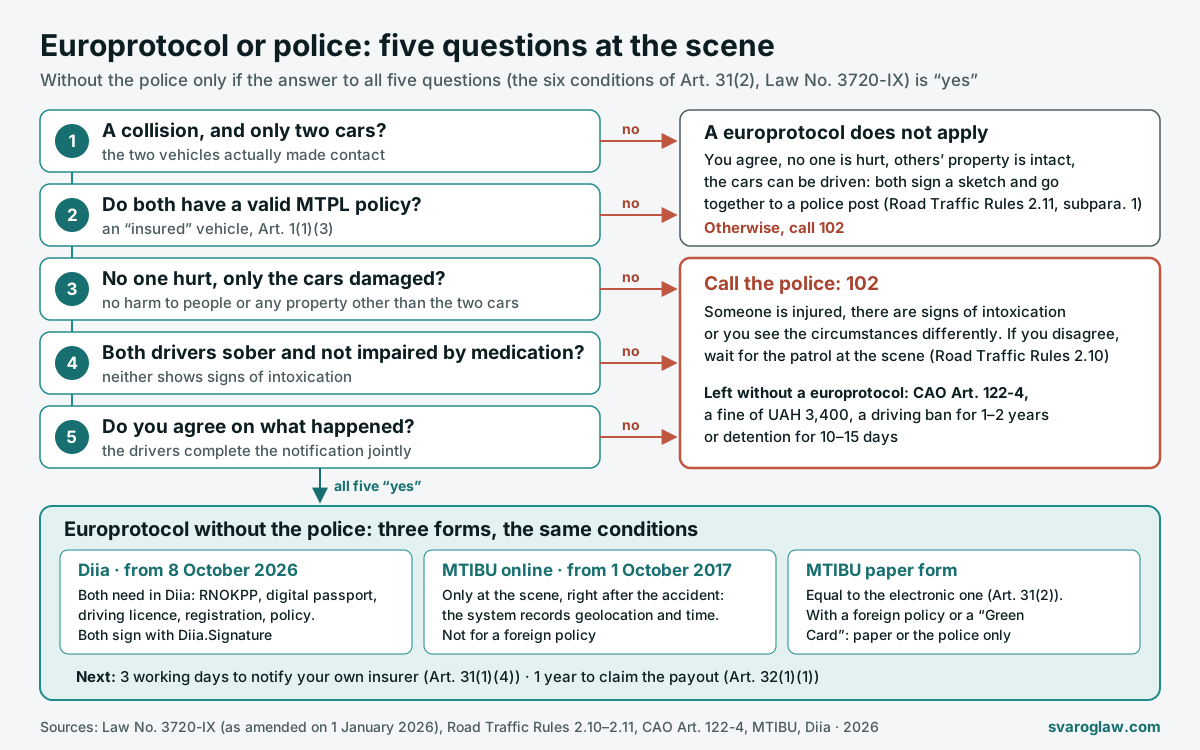
Insurers check a European accident report (europrotocol) filed in Diia the same way as a paper one, and a refusal is a risk in two cases: if not all the conditions of Art. 31(2) of Law No. 3720-IX were met at the scene, or if one of the grounds in the closed list of Art. 30 applies, for example both cars are the joint property of a married couple. The conditions are: the cars collided, there are two of them and both are insured, only the cars were damaged, no one was hurt, both drivers are sober and agree on what happened. The Motor (Transport) Insurance Bureau of Ukraine (MTIBU) warns directly about the first risk, and these conditions have not changed since 8 October 2026, when the Diia service went live. Notify your own insurer within three working days (Art. 31(1)(4)), even if Diia has already sent the report to the MTIBU.
According to the MTIBU, 69,157 insured events were recorded with a europrotocol in 2025, 26.09% more than in 2024. In the first quarter of 2026 there were 25,463 payouts for such accidents, totalling more than UAH 1 billion. By amount, that is almost twice as much as a year earlier, and europrotocols accounted for 53% of payouts (43% in 2025).
How to file a europrotocol in Diia from 8 October and how much will be paid
The government announced the resolution allowing the full europrotocol procedure in Diia on 11 December 2025 and promised a launch in the first quarter of 2026, but the service only went live on 8 October 2026. As of 25 October, it can be used for accidents involving two cars with no deaths or injuries, where both drivers hold compulsory motor third-party liability insurance (MTPL) policies. The europrotocol is created under “Services” → “For drivers”: Diia takes the drivers’, cars’ and policies’ details from the registers, photos are taken at the scene, the second driver joins via a QR code or a notification, and both sign the document with Diia.Signature. The app then sends it to the MTIBU, and the MTIBU passes it on to the insurers.
For this, both drivers must have in Diia a verified taxpayer registration number (RNOKPP), a digital passport (ID card, international passport or residence permit), a driving licence, a vehicle registration certificate listing the driver as the owner or authorised user, and a valid policy. It is better to check that all five documents are in your Diia today rather than on the roadside after a crash. If any document is missing, Diia recommends the paper form or calling the police. You can also fill in a europrotocol online through the MTIBU’s “Electronic Europrotocol” form, which has been running since 1 October 2017.
The amount of the payout has changed too: before 2025, payouts under a europrotocol were capped at a fixed sum, most recently UAH 80,000 under NBU Resolution No. 108. According to the MTIBU, there is now no separate cap, although the law allows the NBU to set one (Art. 31(2), para. 2; Art. 51(2)(19)). The payout is limited by the sum insured for property damage: in 2026, UAH 250,000 per injured party and UAH 1.25 million per event (Section VI, para. 5, subpara. 2). It will rise to UAH 2 million per event no earlier than 1 January of the year following the end of martial law.
The old cap still comes up in court, because policies that were concluded and took effect before 1 January 2025 remain governed by Law No. 1961-IV (Section VI, para. 6, subpara. 1). In case No. 201/16443/25, concerning an accident on 19 March 2025 under a policy dated 24 September 2024, the court applied both that Law and NBU Resolution No. 108, even though the resolution had ceased to have effect on 1 January 2025.
The six conditions of Art. 31(2): when you can file a europrotocol without the police
An accident is recorded without the police only when all the conditions are met at the same time. The law defines an “insured” vehicle as one listed in a valid MTPL contract (Art. 1(1)(3)), so both cars need a policy, not only the at-fault driver’s car.
- There was a collision: if the cars did not touch, no europrotocol is filed.
- There are two cars, and both are insured: a third vehicle involved, or a policy that expired yesterday, means the accident is recorded without a europrotocol.
- Only the cars were damaged: if a fence or a pole was hit as well as the cars, the condition is not met.
- No one was hurt: even a minor injury to a passenger is harm to health, and then the police are needed.
- Both drivers are sober: neither of them may show signs of intoxication or of the effects of medication that reduces attention and reaction speed.
- You agree on what happened: if you disagree about who hit whom and how, a europrotocol cannot be filed.
Diia takes policies and documents from the registers, while the absence of injuries, sobriety and agreement on the circumstances are confirmed by the drivers’ own signatures. If it later turns out that one of the conditions was not met, the claim may drag on or end in a refusal to pay.
When a europrotocol cannot be filed. If more than two cars are involved, one of the drivers has no policy, or there was no collision, no europrotocol is filed. In that case the Road Traffic Rules allow the drivers to draw up and sign a sketch of the accident and go together to the nearest police post or station (para. 2.11, subpara. 1), provided the drivers agree, no one was hurt, no one else’s property was damaged and the cars can be driven safely. If someone is injured or there are signs of intoxication, call the police (102), and if you do not agree on the circumstances, wait for the patrol officers at the scene (Road Traffic Rules, para. 2.10). And if the drivers simply left without a europrotocol when the conditions for one were not met, Art. 122-4 of the Code of Administrative Offences (CAO) provides for a fine of UAH 3,400, a driving ban for 1–2 years or detention for 10–15 days.
What to do at the scene while you wait for the patrol officers is covered in our guide to the first hours after a road accident.
Four cases of refusal under a europrotocol and the closed list of Art. 30
The grounds for refusal are listed in Art. 30 of Law No. 3720-IX, and the insurer has no right to refuse “in other cases” (Art. 30(3)). That is why on 16 March 2026 the Mykolaiv Court of Appeal upheld a decision ordering NASK Oranta to pay UAH 80,000 under an electronic europrotocol (No. 490/3535/25). The repair of a BMW was valued at UAH 209,419.68, and the at-fault driver himself paid the injured party UAH 120,000 on top of the UAH 80,000 cap, which the court applied under NBU Resolution No. 108. The total came to UAH 200,000, less than the cost of the repair. The insurer refused precisely because of that extra payment, but Art. 30 contains no such ground. It would be different if the at-fault driver had covered the entire loss: then an insurer that had already paid could demand the payout or the difference back (Art. 36(4)). A refusal must be in writing and state the grounds (Art. 34(1), (3)). That letter is where resolving an insurance dispute begins: the ground for refusal is checked against the list in Art. 30.
The conditions for a europrotocol were not actually met
The next day it turned out that the other driver’s policy had expired, a passenger had gone to the doctor, or one of the drivers had shown signs of intoxication. Art. 30 contains no ground for an “incorrectly filed europrotocol”, but the MTIBU directly names this as a risk of refusal. And if the drivers left knowing that the conditions for a europrotocol were not met, they may also face Art. 122-4 of the CAO.
How to avoid it: before signing, check all six conditions from the list above, and if in doubt, record the accident through the police.
They promised a europrotocol and drove off
In case No. 130/2103/22, the claimant told the police on 102 that the drivers would record the accident with a europrotocol, but the report was never drawn up and the driver left. On 20 December 2023 the Supreme Court found the refusal to pay under a CASCO (own-damage) contract lawful: the accident had not been recorded by the police, and no europrotocol had been filed either. Under MTPL, driving off like this can also lead to liability under Art. 122-4 of the CAO and a recourse claim against the at-fault driver (Art. 37(1)(1)(c)).
How to avoid it: leave the scene only once both drivers have signed the report, because without the second signature Diia will not send it to the MTIBU anyway.
Both cars belong to one person or to a married couple
If the cars belong to the at-fault driver and the injured party in joint (common) ownership, the debtor and the creditor are the same person, and the insurer will refuse (Art. 30(2)(7)). For example, a husband driving one of the couple’s cars hit the other. A car bought during the marriage is considered joint property (Family Code, Art. 60(2)), even if the registration certificate names only one spouse, as we explained in our article on a car signed over to a brother before divorce. Under the old Law, the Supreme Court held that no MTPL payout is due when two tractors of the same agricultural company collided and the accident was recorded with a europrotocol (No. 910/14262/21, 16 June 2023).
What to bear in mind: before recording an accident with a relative, find out who owns both cars. In the tractor case, the CASCO insurer compensated the loss and then could not recover it from the MTPL insurer.
The insurer does not believe the damage came from this accident
Under an electronic europrotocol of 16 January 2025, in which the at-fault driver admitted fault, Kniazha Vienna Insurance Group refused to pay because a trace evidence report concluded that the damage had not been caused in this accident. On 3 June 2026 the Dnipro Court of Appeal agreed that the refusal was unfounded: the report had been prepared from the insurer’s materials, without inspecting the cars or reconstructing the accident, and it contradicted the europrotocol. UAH 82,711.85 and UAH 3,725 in expert assessment costs were awarded (No. 203/3986/25, a case under the old Law).
How to avoid it: photograph both cars and the points of impact, do not repair the car before the inspection, and for a dispute order an independent assessment of damage after a road accident.
After signing: from 3 working days to a year for the claim
| Requirement and deadline | Provision of Law No. 3720-IX | What happens if it is breached |
|---|---|---|
| Notify your own insurer of the accident, and of where the car is, your phone number and address: within 3 working days | Art. 31(1)(4) | If the injured party did not notify, this is a ground to refuse them payment where, as a result, the insurer could not establish the fact of the accident, its circumstances or the amount of damage (Art. 30(2)(6)); the new Law provides for no recourse claim against the at-fault driver for failure to notify |
| Make the car and documents available for inspection and report the known circumstances: 7 working days from receipt of the relevant information or document | Art. 33(2) | For the injured party, the same ground under Art. 30(2)(6), for example if they repaired the car before the inspection and the amount of damage can no longer be established |
| File a claim for the insurance payout: 1 year from the date of the accident | Art. 32(1)(1) | Refusal, unless good reasons for missing the deadline are supported by documents (Art. 30(2)(3)) |
| Insurer’s decision: 60 calendar days from the filing of the claim and all documents, up to 90 with an expert assessment; payment within 3 working days of notice of the decision | Art. 32(4), (5); Art. 34(2) | The period is suspended if the insurer reported missing documents within 30 days (Art. 32(5), para. 2); if it did not, the documents are deemed submitted (Art. 32(4)); a refusal may only be in writing, with grounds (Art. 34(3)), and is challenged in court (Art. 38) |
In our view, missing the three working days does not in itself give the insurer the right to refuse: Art. 30(2)(6) applies only where, because of the delay, the insurer could not establish the fact of the accident, its circumstances or the amount of damage, and Art. 30(3) allows no other grounds. We have not found any Supreme Court rulings on a refusal under a europrotocol based specifically on this deadline, so do not test this position on your own case and notify the insurer on the first working day. After signing, Diia also advises contacting your insurer. The insurer must inspect the car within 10 working days of the notification (Art. 31(4)).
Recourse under Art. 37: when the insurer will recover the payout from the at-fault driver
Having paid the injured party, the insurer can recover the payout from the at-fault driver if they were driving while intoxicated or without the right to drive, or refused an intoxication test. A recourse claim is also possible where the accident was recognised, in the manner established by law, as a direct consequence of the car’s technical condition or equipment failing to meet road safety standards, the Road Traffic Rules or the rules of technical operation. The same applies if the at-fault driver used the car to commit a criminal offence or their actions were deliberately aimed at causing the insured event (Art. 37(1)(1)(d), (e) and Art. 37(1)(3) of Law No. 3720-IX). There is no recourse claim for leaving the scene of the accident without permission if the drivers filed a europrotocol (Art. 37(1)(1)(c)). The exception is tied to the words “except in the case provided for by part two of Article 31”, so, in our view, it will not protect you if one of the conditions of that part was not met.
The new Law provides for no recourse claim for failing to notify the insurer within three working days, although the old Law No. 1961-IV did (subpara. (e) of para. 38.1.1), and it may still be relied on for accidents under policies that took effect before 1 January 2025. We have not found any decisions on recourse claims under the new Law in europrotocol cases. Show the recourse claim, together with the europrotocol and the policy, to a road accident lawyer before agreeing to the amount.
The difference above the payout under Art. 1194 of the Civil Code: what to recover from the at-fault driver and what not to sign
The insurer does not compensate damage above the sum insured, loss of market value or lost profit (Art. 30(1)(7), (12), (14)). The difference between the actual loss and the payout is paid by the at-fault driver (Civil Code, Art. 1194). On 20 November 2024 the Supreme Court upheld an award of UAH 110,645 against the employer of the at-fault driver, on top of an insurance payout of UAH 47,400 under a europrotocol, and rejected the argument that by signing the europrotocol the injured party had agreed to the cap. According to the court, the difference is determined without taking into account the wear of the injured party’s car (No. 756/2755/22). On 13 October 2026 the Volyn Court of Appeal upheld an award of UAH 438,583.55 against the at-fault driver: the repair cost UAH 515,383.55, and the insurer paid UAH 76,800 (No. 161/9309/25). Both accidents happened before 2025, when the europrotocol cap and the deductible applied, but Art. 1194 of the Civil Code does not depend on that.
The difference can be lost while still dealing with the insurer. After an accident on 9 September 2025 recorded with a europrotocol, the injured party signed a claim at TAS with an agreed amount of UAH 73,542.21, waived an expert assessment, and then sued the at-fault driver. On 15 October 2026 the Lviv Court of Appeal overturned the award of UAH 49,720.63 and dismissed the claim: such a demand “contradicts both the claimant’s previous conduct and the principles of reasonableness and dispositivity” (No. 442/8534/25, a case under the old Law). The court referred to Supreme Court ruling No. 127/2551/23 (21 April 2025), even though there the accident had been recorded by the police. So do not agree to an amount until you have your own assessment, and plan recovering the difference above the insurance payout from the at-fault driver before the insurer closes the claim.
Law No. 3720-IX, Road Traffic Rules, CAO, court decisions and MTIBU data
- Law No. 3720-IX on compulsory motor third-party liability insurance (as amended on 1 January 2026): Art. 1(1)(3), Art. 30–34, Art. 36(4), Art. 37, 38, Art. 51(2)(19), Section VI, paras. 5, 6 — zakon.rada.gov.ua; Law No. 1961-IV (no longer in force), subpara. (e) of para. 38.1.1 — zakon.rada.gov.ua
- Road Traffic Rules (as amended on 14 October 2026), paras. 2.10, 2.11 — zakon.rada.gov.ua; CAO (as amended on 10 September 2026), Art. 122-4, note to Art. 124 — zakon.rada.gov.ua; Civil Code, Art. 1194 — zakon.rada.gov.ua; Family Code, Art. 60(2) — zakon.rada.gov.ua
- Europrotocol in Diia: Cabinet of Ministers news of 11 December 2025, Ministry of Internal Affairs news of 8 October 2026, Diia instructions of 8 October 2026
- MTIBU: “Europrotocol” in the educational materials, the “Europrotocol” page in the “Motor TPL” section, MTPL market results for 2025, payouts for the first quarter of 2026
- Supreme Court rulings: No. 756/2755/22 (20 November 2024), No. 127/2551/23 (21 April 2025), No. 130/2103/22 (20 December 2023), No. 910/14262/21 (16 June 2023). Courts of appeal: Mykolaiv No. 490/3535/25 (16 March 2026), Dnipro No. 203/3986/25 (3 June 2026), Volyn No. 161/9309/25 (13 October 2026), Lviv No. 442/8534/25 (15 October 2026); case No. 201/16443/25 (accident of 19 March 2025)
Other questions about the europrotocol and Art. 124 of the CAO
What should you file if the other driver’s policy is from a foreign insurer?
A paper europrotocol form or a call to the police: the MTIBU requires this if even one of the cars is insured with a foreign insurer. A paper europrotocol is also filed when a Green Card is involved. The conditions of Art. 31(2) do not depend on the form.
Can you file a europrotocol later, at home?
No. The law allows you to leave the scene after the drivers have jointly completed the notification (Art. 31(2)). The MTIBU online form is filled in only at the scene and immediately after the accident, because the system records the geolocation and time, and the photos for Diia are taken at the scene of the crash.
Does a europrotocol exempt the at-fault driver from a fine under Art. 124 of the CAO?
Yes, but only a policy together with a jointly completed europrotocol, not the policy on its own. The note to Art. 124 of the CAO exempts the insured person from liability for the traffic violation that caused damage to the cars, provided the parties to the accident “exercised the right to jointly complete a notification of the accident”. If the accident was recorded by the police, the policy will not save you from an offence report under Art. 124.