

Олександр Сич
25 October 2026
A refusal to privatise a service apartment or an apartment in a condemned building is lawful when the status of the housing is confirmed by a decision of the relevant authority. An apartment becomes service housing by a decision of the executive committee of a district, city or city-district council adopted at the request of the enterprise (paragraph 3 of the Regulation approved by Resolution No. 37 of the Council of Ministers of the Ukrainian SSR), and a building becomes condemned by a decision of the competent authority. If the refusal rests only on the word “service” in the occupancy warrant (orden), on an order of a military unit commander or on a percentage of wear and tear cited in a letter, then in the cases we reviewed the Supreme Court sided with the residents or sent the case back for a new hearing. If such a decision does exist, the court, as a rule, does not order the authority to remove the apartment from service housing: the Supreme Court considers this the authority’s right, not its obligation. The exception is military personnel, to whom the law guarantees housing for permanent residence: in case No. 760/27764/21 the courts ordered a Ministry of Defence commission to approve providing a reserve colonel with the service apartment he occupied for permanent residence, and on 24 September 2025 the Supreme Court upheld that decision.
The privatisation body may refuse residents only in cases provided for by law (Art. 8(10) of Law No. 2482-XII), and the Grand Chamber of the Supreme Court has called this list exhaustive (case No. 200/18858/16-ц). On 5 May 2025 the Joint Chamber of the Civil Cassation Court (CCC SC) clarified that a refusal is possible “only where they have no right to privatisation and/or there is a ban on privatising the specific premises” (case No. 759/1426/22). It is worth checking the ground for the refusal now: Law No. 2482-XII, which prohibits the privatisation of service housing (Art. 2(2)), is still in force, while the Housing Code chapter on service dwellings ceased to have effect on 15 February 2026.
Refusal to privatise: what grounds the authority can rely on
Article 2(2) of Law No. 2482-XII does not allow five categories of housing to be privatised:
- museum apartments;
- housing on the territory of closed military settlements, enterprises, institutions and organisations, nature reserves, parks, museums and other sites listed in the provision;
- apartments and dormitory premises in a condemned (unsafe) condition, that is, premises “in which it is impossible to ensure safe living for people”;
- apartments, rooms and houses “classified as service housing in the established manner”;
- housing in the zone of unconditional (mandatory) resettlement contaminated as a result of the Chornobyl nuclear power plant accident.
For dormitories, the restrictions in Art. 1(2) and (4) of Law No. 500-VI also apply, and the Grand Chamber counts them among the grounds for refusal. Only vacant housing can be designated as service housing (paragraph 4 of Regulation No. 37), and until 15 February 2026 Art. 118(1) of the Housing Code also provided that it is the executive committee’s decision that confers the status. The Supreme Court did not accept a letter from the housing registration department as a proper decision refusing privatisation (No. 642/2812/17), so insist on a written decision that states the ground. And it is better to find out the status of the housing before you order the technical passport and certificates for apartment privatisation.
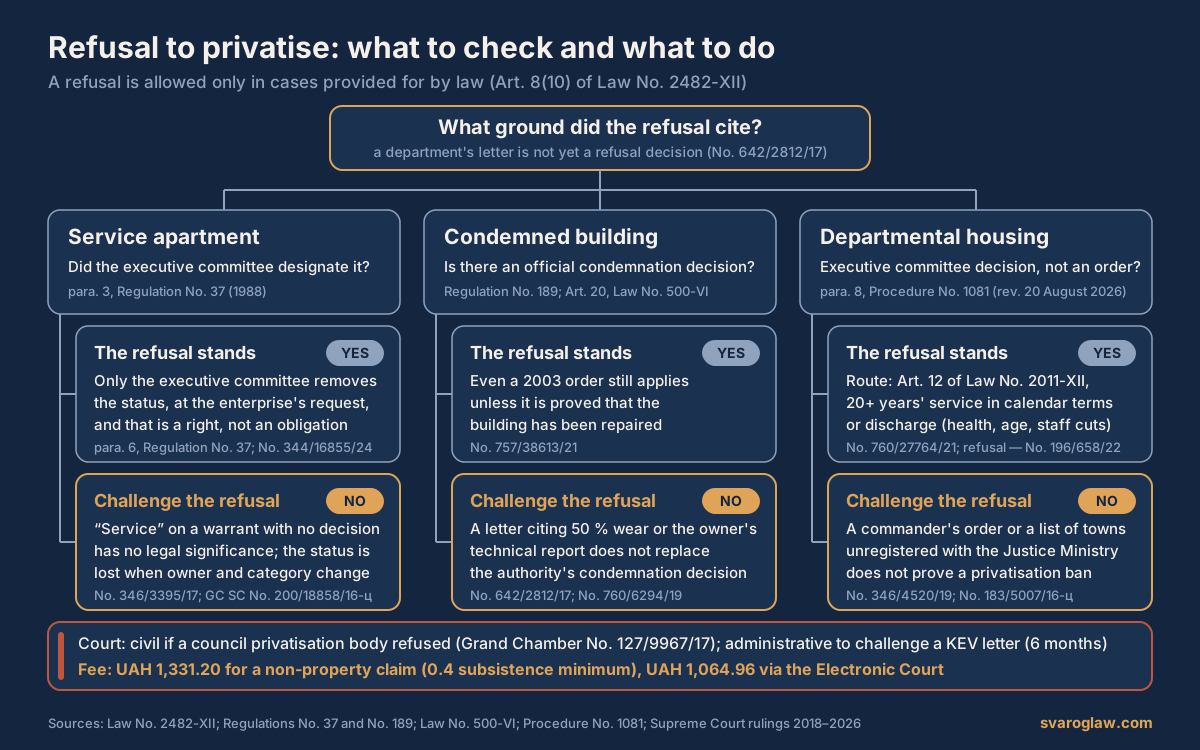
Service, condemned, departmental: how the Supreme Court assesses a refusal
Service apartment
Regulation No. 37, para. 3The refusal is lawful if a decision designating the apartment as service housing was adopted and the apartment has not been removed from that category. In case No. 201/3211/24 the status was confirmed by an archival extract from decision No. 737 of 9 July 1991 of the executive committee of the Zhovtnevyi District Council of Dnipropetrovsk, and on 4 July 2025 the Supreme Court upheld the judgments dismissing the claim. Housing is removed from the service category by the executive committee at the request of the enterprise, once it is no longer needed for that purpose (paragraph 6 of Regulation No. 37). According to the Supreme Court, even the liquidation of the housing maintenance office ZhEO-7, whose head had been given the apartment in 1987, does not mean that the need has ceased (No. 344/16855/24, 29 January 2026).
The refusal can be challenged if there is no such decision. The Supreme Court held that the note “service” on the 1997 and 2007 occupancy warrants for a departmental building of a forestry office “has no legal significance”: an apartment acquires that status only after a corresponding decision is made (No. 346/3395/17, 12 February 2020). The status is also lost when the owner and the category of the housing change: a factory dormitory was donated to the city council, its premises were included in the permanent housing stock, and the Grand Chamber upheld the judgments that found the refusal to the resident unlawful (No. 200/18858/16-ц, 20 June 2018).
Start with a written request to the executive committee’s archive: ask for the number, date and a copy of the decision designating the apartment as service housing, as well as of any decision by which it was allocated “as service housing” or a service occupancy warrant was issued for it (the Supreme Court has accepted such decisions as proof of status: No. 201/3211/24, No. 344/16855/24, No. 196/658/22), or for a reply that no such decisions were made.
Condemned building
condemnation decisionThe refusal is lawful when the building was declared condemned by the competent authority, even if long ago. The Pecherskyi District State Administration in Kyiv declared a building condemned by order No. 87 of 27 January 2003, and for that reason the residents of an apartment in it were refused privatisation orally. They failed to have the order cancelled: they had moved in more than 11 years after it was issued and did not prove that the building had been repaired (No. 757/38613/21, 14 December 2023).
The refusal can be challenged when there is no decision declaring the building condemned. The Kharkiv housing registration department refused by letter because the building was “ancient” and 50 % worn out, and the Supreme Court sent the case back for a new hearing: the courts had not established “whether the competent authorities had adopted a corresponding decision” (No. 642/2812/17, a claim for recognition of ownership). A dormitory is declared condemned by the council’s executive body, and the council session approves that decision (Art. 20(1) of Law No. 500-VI). The Supreme Court did not treat the owner’s technical report, which placed certain structures in condition categories 3 and 4, as equivalent to such a decision (No. 760/6294/19, an eviction case). In our view, this conclusion can also be applied to a refusal to privatise.
We have not found a Supreme Court ruling that overturned a refusal specifically because the condemnation report was missing or outdated, nor a new Cabinet of Ministers procedure for housing unfit for habitation (Art. 15(4) of Law No. 4751-IX). So what remains is an analogy with Regulation No. 189: the report is drawn up by a commission of the executive committee, and the decision is made by the executive committee (paragraphs 6–8). Paragraph 9 of that Regulation, which allows 15 days to appeal to the “executive committee of the higher-level Council”, cannot be applied today: such executive committees no longer exist.
Departmental housing
Procedure No. 1081, para. 8The refusal is lawful if the building is located in a closed military settlement or the apartment was designated as service housing under paragraph 8 of the Procedure approved by Cabinet of Ministers Resolution No. 1081 (as amended by Resolution No. 1035 of 19 August 2026). Such a decision is made by the council’s executive body (in Kyiv, by the district state administration) at the request of a unit commander or the garrison commander, agreed with the housing maintenance authority. On 23 December 2024 the Supreme Court also upheld a refusal concerning an apartment that a settlement council had taken onto its balance sheet for law enforcement officers: the executive committee had issued a service occupancy warrant for it, and the council refused to remove it from service housing (No. 196/658/22). A separate decision designating it as service housing is not among the circumstances established in that case.
The refusal can be challenged when the status rests on a commander’s order or an unregistered list. The Ivano-Frankivsk district housing maintenance unit (KECh) relied on a 2003 order of a military unit commander, and the Supreme Court reiterated that the “only proper evidence” of service status is a decision of the executive committee (No. 346/4520/19, 2 February 2022). The list of closed military towns of 19 August 2013 relied on by the Dnipropetrovsk housing maintenance department (KEV) had not been registered with the Ministry of Justice, so it “cannot be applied” (No. 183/5007/16-ц).
On 9 September 2026 the Administrative Cassation Court (ACC SC) sent back for a new hearing a dispute between a reserve warrant officer and the Poltava KEV (No. 440/6814/24): the courts were to check whose balance sheet the building is on, whether there is a decision under paragraph 8 of Procedure No. 1081 and whether the building stands outside a closed military town. Put these three questions to the KEV in writing before you file a claim.
For military personnel and police officers, special laws provide another route. Article 12 of Law No. 2011-XII transfers housing into ownership free of charge to service members with 20 or more years of service in calendar terms, as well as to those discharged on health grounds, on reaching the age limit, due to staff reductions or other organisational measures, to members of their families, and to the families of those killed (deceased) or missing under special circumstances. For police officers with at least 10 years of service who were dismissed on the grounds listed in the law, this right is established by the second paragraph of Art. 96(7) of the Law “On the National Police”. Both laws allow the housing you occupy to be obtained only if it was bought or built with state budget funds and transferred to municipal ownership.
What to request from the archive and the balance holder before filing a claim
In these disputes the court looks at documents, so request them in writing and keep the envelopes and delivery marks: they show when you received the refusal.
- A written decision refusing privatisation that states the ground. The body must decide on a transfer into ownership no later than one month after receiving the application (Art. 8(3) of Law No. 2482-XII); the law sets no separate deadline for a refusal.
- The executive committee’s decision designating the apartment as service housing or allocating it “as service housing”, or a reply that there are no such decisions (paragraph 3 of Regulation No. 37; for military personnel, paragraph 8 of Procedure No. 1081), and an extract from the register of service dwellings (paragraphs 5 and 6 of Regulation No. 37).
- The inspection report and the decision declaring the building condemned or unfit for habitation (paragraphs 5–8 of Regulation No. 189), and for a dormitory, the decision of the council’s executive body approved by the council session (Art. 20 of Law No. 500-VI).
- The occupancy warrant or its archival copy. A copy of the warrant is one of the documents for privatisation (paragraph 18 of the Regulation approved by Order No. 396 of the Ministry of Housing and Utilities), but the “service” note on it decides nothing by itself. If the warrant has been lost, our article on privatising an apartment without an occupancy warrant will help.
- A certificate stating the building’s owner and balance holder: it determines whether the service status has been lost (No. 200/18858/16-ц) and who must consider your application (No. 440/6814/24).
- For military personnel, certificates of length of service, grounds for discharge and housing waiting-list registration: the right under Art. 12 of Law No. 2011-XII depends on them.
You can manage without a lawyer if the archive has replied in writing that no decision was made on the apartment’s service status or on the building being condemned, and the refusal cites no other grounds. Reapply with this reply attached and ask for a written decision. But if a decision on service status exists and the enterprise is not asking for the apartment to be removed from service housing, a claim will most likely achieve nothing (No. 344/16855/24, No. 196/658/22).
Where to appeal a refusal to privatise and how much it costs
Privatisation disputes are decided by a court (Art. 8(11) of Law No. 2482-XII), and which court depends on who refused:
- A privatisation body under the council (executive committee, department, directorate). The dispute is heard by a civil court: the body acts as the owner of the housing stock and “is not in a public-law but in a private-law relationship with the citizen” (Grand Chamber of the Supreme Court, No. 127/9967/17). In our view, the time limit is set by the three-year limitation period (Art. 257(1) of the Civil Code).
- A Ministry of Defence KECh or KEV. The claim against the KECh in case No. 346/4520/19 was heard by civil courts, whereas the letter in which the Poltava KEV replied to a privatisation application was held by the ACC SC to be an administrative act: the claimant was challenging the KEV’s procedural actions rather than asking for the apartment to be transferred into ownership (No. 440/6814/24). A claim must be filed with an administrative court within six months (Art. 122(2) of the Code of Administrative Procedure). Before going to court, you can file an administrative complaint within 30 calendar days; if the act does not state the time limit and procedure for appeal, that time limit is not considered missed (Art. 80(1), (4) of the Law “On Administrative Procedure”). After a decision on the complaint, you have three months from the day it is served to go to court (Art. 122(4) of the Code of Administrative Procedure).
- The housing commission of a military unit or a ministry. The Grand Chamber of the Supreme Court classifies such disputes as administrative disputes related to public service (No. 362/643/21), and for these Art. 122(5) of the Code of Administrative Procedure allows only one month. We have not come across decisions applying this time limit to housing claims, so it is better not to delay.
A court cannot transfer the apartment into ownership: only authorised bodies do that, “and the court is not one of them” (Supreme Court, No. 932/2640/22, 14 July 2026). That is why we advise asking the court to declare the refusal unlawful and to order the body to carry out the privatisation.
The court fee is 0.4 of the subsistence minimum, i.e. UAH 1,331.20 for a non-property claim, or UAH 1,064.96 if filed through the Electronic Court (Art. 4 of the Law “On Court Fee”); for administrative claims, the Constitutional Court held this rate constitutional on 9 September 2026. If the court counts the two claims separately, a paper filing will cost UAH 2,662.40 (second paragraph of Art. 6(3)). People with Group I–II disabilities do not pay the fee (Art. 5(1)(9)), and combat veterans are exempt in cases concerning violations of their rights (Art. 5(1)(13)). It is convenient to prepare the requests and the claim together as part of court representation in your case, while a dispute with a KEV or a housing commission in an administrative court is handled by an administrative law lawyer.
Privatisation of service housing after 15 February 2026: what has changed
Since 15 February 2026 Law No. 4751-IX has been in force, replacing the 1983 Housing Code. The Code’s chapter on service dwellings (Art. 118–126-1) was not on the list of articles that remained in force.
- Law No. 2482-XII is still in force for now: the provision repealing it will take effect one year after martial law ends or is lifted (paragraph 1 and subparagraph 2 of paragraph 2, Section IV of Law No. 4751-IX), and martial law has been extended until 05:30 on 31 October 2026 (Decree No. 596/2026). What you risk by putting off your application is covered in our article on when free apartment privatisation will end.
- New service housing is provided under a lease (Art. 1(1)(16), Art. 30), and the term “occupancy warrant” does not appear in the law at all. Housing owned by territorial communities is not subject to privatisation, “except for transfer under a lease with the right of purchase and other cases provided for by law” (Art. 12(3); for state housing there is a similar ban in Art. 13(3), but without any mention of a lease). We consider privatisation under Law No. 2482-XII during the transition period to be such a case, but we have not found any Supreme Court rulings on this.
- Transactions for moving into service housing that were valid on 15 February 2026 remain in effect until the end of their term, and the legislation in force when they were concluded applies to them (paragraph 4 and subparagraph 2 of paragraph 5, Section IV). On zakon.rada.gov.ua Regulation No. 37 is marked as in force, and the responsible ministry takes the same view in its clarification of 16 March 2026, with a caveat: it applies to the extent that it does not contradict the new law. So, in our view, the proof of status for an apartment designated as service housing before the reform will still be a decision of the executive committee, although, as far as we know, the Supreme Court has not yet considered this question.
- The deadline for the Cabinet of Ministers’ procedures expired on 14 August 2026. As of 6 October 2026, we have found neither the procedure for providing service housing (Art. 30(1)), nor the list of persons who cannot be evicted without being provided with other housing (Art. 30(10)), nor the procedure for removing housing unfit for habitation from the housing stock (Art. 15(4)).
For new service housing leases, termination of employment is now named as a ground for eviction, and the eviction procedure is set by the lease. There are exceptions, in particular for people disabled as a result of an injury sustained in service (Art. 30(5)). If you are already being required to vacate the apartment, prepare for the dispute together with a housing lawyer.
Briefly: dormitories, length of service and cancelled council decisions
So a room in a dormitory cannot be privatised either?
It can, if none of the prohibitions applies to it. Article 2(1) of Law No. 2482-XII names residential premises in dormitories as objects of privatisation, and Art. 1(3) and the second paragraph of Art. 8(3) refer to a special law for them, Law No. 500-VI. That law does not apply, in particular, to temporary dormitories for the period of study or contract work; dormitories of military units, the Ministry of Internal Affairs, the police and the State Emergency Service (except those located outside their grounds); dormitories of state educational institutions and the National Academy of Sciences (except family-type dormitories); or to people living in a dormitory without legal grounds (Art. 1(2)–(4)).
I have worked for the enterprise for more than 10 years. Can I demand that the apartment be removed from service housing?
No, unless the employer itself requests it. In case No. 757/30286/22-ц the claim relied on 10 years of work as a caretaker at ZhEO-311 and more than 40 years of living in the service apartment. On 29 August 2024 the Supreme Court agreed with the lower courts: Art. 125 of the Housing Code only protected against eviction without the provision of other housing, and removal from service housing “is the employer’s right, not its obligation”. Since 15 February 2026 Art. 125 has no longer been in force. In our view, its protection has been preserved for those who moved in earlier (paragraph 4, Section IV of Law No. 4751-IX), but we have not come across any Supreme Court rulings on this point.
Can the council cancel an executive committee decision removing an apartment from service housing?
Only by explaining which law that decision contradicts. In case No. 193/566/22 a session of the Sofiivka Settlement Council, without giving reasons, cancelled a 2019 executive committee decision removing an apartment of the Main Directorate of the Ministry of Internal Affairs from service housing. The courts set aside that item of the council’s decision, the Supreme Court upheld them on 17 September 2025, and the CCC SC case-law review for September 2025 stresses that such a cancellation “violates the residents’ rights to privatise such housing”. The court of appeal refused to order the council to adopt a privatisation decision, and the Supreme Court did not review that part.
Laws, regulations and Supreme Court rulings
- Law “On Privatisation of the State Housing Stock” No. 2482-XII, Art. 2, 8 (version of 25 July 2018) — zakon.rada.gov.ua; Law No. 500-VI on the housing rights of dormitory residents, Art. 1, 20 — zakon.rada.gov.ua
- Law No. 4751-IX of 13 January 2026, Art. 1, 12, 13, 15, 30, Section IV — zakon.rada.gov.ua; Housing Code, Art. 118, 125 (no longer in force since 15 February 2026) — zakon.rada.gov.ua; Presidential Decree No. 596/2026 of 13 July 2026 — zakon.rada.gov.ua
- Regulation approved by Resolution No. 37 of the Council of Ministers of the Ukrainian SSR of 4 February 1988, paragraphs 3–6 (version of 12 June 2025) — zakon.rada.gov.ua, and the clarification of its validity of 16 March 2026 — mininfra.gov.ua; Regulation approved by Resolution No. 189 of the Council of Ministers of the Ukrainian SSR of 26 April 1984, paragraphs 5–9 — zakon.rada.gov.ua
- Procedure approved by Cabinet of Ministers Resolution No. 1081 of 3 August 2006, paragraph 8 (version of 20 August 2026) — zakon.rada.gov.ua; Law No. 2011-XII, Art. 12 — zakon.rada.gov.ua; Law “On the National Police”, Art. 96 — zakon.rada.gov.ua; Regulation approved by Order No. 396 of the Ministry of Housing and Utilities of 16 December 2009, paragraph 18 — zakon.rada.gov.ua
- Civil Code, Art. 257 — zakon.rada.gov.ua; Code of Administrative Procedure, Art. 122 — zakon.rada.gov.ua; Law “On Administrative Procedure”, Art. 80 — zakon.rada.gov.ua; Law “On Court Fee”, Art. 4–6 — zakon.rada.gov.ua; Constitutional Court Decision No. 10-р(II)/2026 of 9 September 2026 — zakon.rada.gov.ua; Law “On the State Budget of Ukraine for 2026”, Art. 7 — zakon.rada.gov.ua
- In favour of residents: Grand Chamber of the Supreme Court No. 200/18858/16-ц (20 June 2018); Joint Chamber of the Civil Cassation Court of the Supreme Court No. 759/1426/22 (5 May 2025); Civil Cassation Court of the Supreme Court No. 346/3395/17 (12 February 2020), No. 346/4520/19 (2 February 2022), No. 183/5007/16-ц (12 December 2018), No. 642/2812/17 (6 March 2018), No. 193/566/22 (17 September 2025), No. 760/27764/21 (24 September 2025), No. 760/6294/19 (19 March 2021, eviction from a dormitory); Administrative Cassation Court of the Supreme Court No. 440/6814/24 (9 September 2026)
- In favour of the authority or the owner of the housing: Civil Cassation Court of the Supreme Court No. 201/3211/24 (4 July 2025), No. 196/658/22 (23 December 2024), No. 757/38613/21 (14 December 2023), No. 344/16855/24 (29 January 2026), No. 757/30286/22-ц (29 August 2024)
- Jurisdiction and the limits of a court decision: Grand Chamber of the Supreme Court No. 127/9967/17 (21 November 2018), No. 362/643/21 (8 June 2022); Civil Cassation Court of the Supreme Court No. 932/2640/22 (14 July 2026); CCC SC case-law review for September 2025, items 6.2–6.3
You have a refusal letter: the first step to take this week
Send the executive committee or the city council a written request asking whether a decision was ever made to designate your apartment as service housing, to allocate it “as service housing” or to declare the building condemned, and ask for the number, date and a copy. If there is no decision, that reply will become your main evidence in court. If there is one, you will have to look for another route: a request from the enterprise to remove the apartment from service housing, or a right under a special law for military personnel or police officers. Bring the refusal letter and the reply to your request to an advocate who handles apartment privatisation disputes: these two documents alone show whether it is worth going to court.