

Олександр Сич
9 November 2026
Yes, if an error in your return understated the tax and a documentary audit of that tax for that period has not yet started. An amended return (paragraph 50.1 of the Tax Code, or TC, calls it a “clarifying calculation”) will cost you a fine of 3% of the underpayment, and a penalty (penya) arises only if more than 90 days have passed since the payment deadline. If an audit finds the same underpayment, the State Tax Service (STS) will impose a 10% fine (25% for intentional understatement) and charge a penalty from the first working day after the payment deadline. While martial law is in effect, self-correction releases you from both the 3% and the penalty (TC, Section XX, subsection 10, paragraph 69, subparagraph 69.38).
From 1 October 2026, the STS may also start scheduled documentary audits of taxpayers who were added to the audit schedule during its June revision. The tax service published the revised schedule for 2026 on 26 June 2026, and the law allows a taxpayer added in the second quarter to be audited no earlier than 1 October (TC 77.2). How often a taxpayer is included in the schedule depends on its risk level: no more than once every three years for low risk, no more than once every two years for medium risk, and no more than once a year for high risk. Notice of a scheduled audit is given at least 10 calendar days in advance (TC 77.4), and those days are your last chance to correct errors at 3%. What else to get done before the inspectors arrive is explained in our article on how to prepare for a tax audit.
Why the fine for an amended return is only 3%
A taxpayer who finds an error in a filed return on its own (including following an electronic check) must correct it (TC 50.1, para. 1). If the error understated the tax, there are two ways to do so. The first is to file an amended return, having paid the underpayment and a 3% fine on it in advance (TC 50.1(a)). The second is to report the underpayment in the return for the period following the one in which the error was found and to charge a 5% fine on it (subparagraph (b)). The Tax Code provides for no other ways, as the Supreme Court emphasises (No. 320/23666/23).
What makes 3% a preferential rate is TC 112.8.8: self-correction under the rules of Art. 50, with payment of the additional tax and the fine under TC 50.1, releases you from liability under TC 123.1, that is, from the 10% fine an audit would have imposed. The 3% is calculated only on the underpayment, so an error that did not understate the tax carries no fine. On this basis, the courts set aside tax assessment notices issued to Lemtrans LLC for UAH 292,150, and the court of appeal set aside a notice issued to Syngenta LLC for UAH 2,968,105; the Supreme Court upheld these decisions (No. 805/9134/13-а, No. 826/20009/13-а). There is also no fine when a new return with corrected figures was sent before the filing deadline for the same period expired (the last paragraph of TC 50.1).
Outside martial law, the relief applies only if the fine has actually been charged and paid. Otherwise, the STS will apply a 5% fine on the self-assessed underpayment (TC 120.2 and TC 112.8.8, para. 2). By an amended VAT return of 15 October 2017, Cherkasyoblenergo PJSC increased its liability by UAH 18,040,937: this restored an amount the company had mistakenly reduced two days earlier with a previous amended return. But it did not pay the 3%, and on 29 January 2025 the Supreme Court upheld a fine of UAH 902,046.85 (No. 826/13026/18). We have looked separately at the situation where tax was understated in reliance on an STS explanation: what a tax consultation shields you from when additional tax is assessed.
Fine and penalty in each scenario: a calculation for UAH 100,000
| Who found the error and how it was corrected | Fine | Penalty | Tax Code provision |
|---|---|---|---|
| You: amended return, with the underpayment and the fine paid before filing | 3% of the underpayment | Only if more than 90 days have passed since the payment deadline: from day 91, 100% of the NBU discount rate per annum | 50.1(a); 129.1.3, 129.4 |
| You: underpayment reported in the next period’s return | 5% of the underpayment | Likewise, from day 91 | 50.1(b); 129.1.3 |
| You, by either of these methods, while martial law is in effect | None | None | Section XX, subsection 10, paragraph 69, subparagraph 69.38 |
| STS: an audit found the understatement | 10%; 25% if intentional; 50% for a repeated intentional understatement within 1,095 days | From the first working day after the payment deadline, 120% of the NBU discount rate per annum, for the entire period of understatement, including the time taken by any appeal | 123.1–123.3; 129.1.2, 129.4 |
| STS, while martial law is in effect: the understatement was found by a documentary audit started or resumed on or after 1 August 2023, and the tax was paid within 30 days of receiving the tax assessment notice | Deemed cancelled | Not charged, but the amount can no longer be challenged | Section XX, subsection 10, paragraph 69, subparagraph 69.37 |
A hypothetical example. A return understates tax by UAH 100,000. If you found the error yourself and filed an amended return within 90 days after the payment deadline, you will pay UAH 100,000 of tax and a UAH 3,000 fine, UAH 103,000 in total, with no penalty. Through the next period’s return, it comes to UAH 105,000. If, however, an audit finds the understatement a year after the payment deadline, a UAH 10,000 fine and a penalty will be added to the tax. The penalty is calculated at 120% of the NBU discount rate (16% from 18 September 2026), i.e. 19.2% per annum: if the rate does not change, that is UAH 19,200 for the year, or about UAH 52.60 a day. In total, UAH 129,200, which is UAH 26,200 more than with an amended return, and UAH 144,200 if the understatement is found to be intentional. Even if you notice the error yourself only a year later, the penalty from day 91 will add about UAH 12,400, and the amended return will still be cheaper by roughly UAH 13,800.
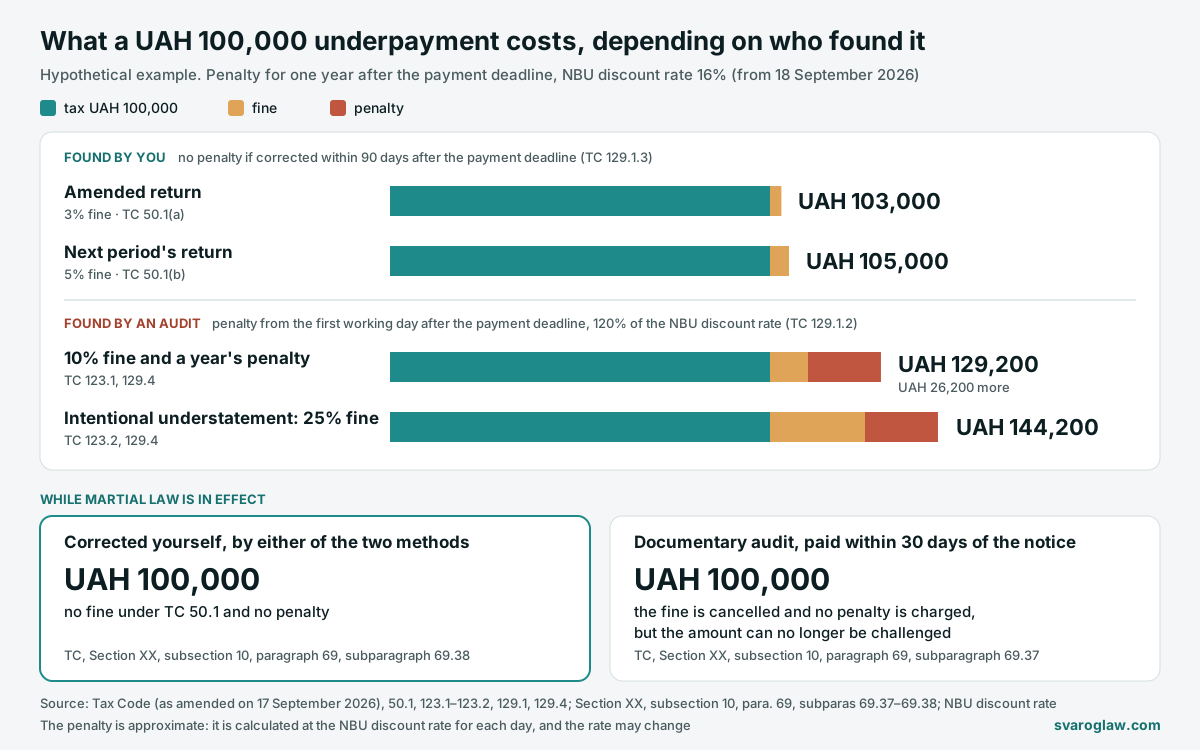
While martial law is in effect, the gap between these scenarios is smaller. If you correct the error yourself, you will pay only UAH 100,000 (subparagraph 69.38). The same UAH 100,000 can also be paid after an audit: if you pay the additionally assessed tax within 30 calendar days from the day after you receive the tax assessment notice, the fine is deemed cancelled and no penalty is charged (subparagraph 69.37). However, an amount paid this way can no longer be challenged, and subparagraph 69.37 itself covers only documentary audits started or resumed on or after 1 August 2023 and completed before martial law is terminated. An amended return filed before an audit does not depend on these conditions, and it is you, not the audit report, who determines the amount in it. Moreover, TC 50.1 obliges you to correct an error you have found, not to wait for an audit.
Amended return before and during an audit: the cut-off under TC 50.2
You are notified of a scheduled documentary audit at least 10 calendar days in advance (TC 77.4), but of an unscheduled one only by being handed a copy of the order before it starts (TC 78.4). Until the audit has started, TC 50.2 does not prohibit filing an amended return.
During a documentary audit, you may not amend returns for the tax and the periods being audited, even if the audit has been extended, suspended or postponed (TC 50.2). There is one exception: amending the annual corporate income tax return after an audit of the financial statements (TC 50.1, para. 3). For the tax and the period under audit, the Art. 50 relief will most likely not be available either.
Back on 25 August 2022, the STS Main Department in Zaporizhzhia Region acknowledged that amendments for periods that are going to be audited may be filed before the start date stated in the order and the notice. The Tax Code has no separate provision on such a window: the tax service derives it from TC 50.2 and 77.4. According to the Supreme Court, an on-site audit starts when the inspectors are admitted, not with a phone call. That is why the court held that amended VAT returns filed six days after the order, but before the taxpayer learned of the audit, were lawful (No. 812/1487/15; the tax assessment notices were also set aside on another ground). In case No. 280/4890/18, the amended return was filed on the day of the order, three days before the audit started, and the Supreme Court agreed with the lower courts that this was in time.
The municipal enterprise Kyivteploenergo filed an amended VAT return while a scheduled audit was suspended, and on 19 August 2024 the Supreme Court dismissed its claim: the tax assessment notices remained in force (No. 640/322/20). Nor did the Supreme Court regard a correction made after the audit had already started as self-correction: a tax agent paid the outstanding personal income tax on dividends the day after the audit began and did not amend its reporting, so instead of 5% under TC 120.2 it received a 25% fine under TC 127.1 as then in force (No. 804/8801/17; Art. 127 was repealed by Law No. 466-IX with effect from 1 January 2021). The TC 50.2 prohibition does not directly apply to other taxes and periods, or to desk and factual audits.
If you have already been handed the audit order and have only just found the error, show the order and your calculation to a tax dispute lawyer before the audit starts: whether you can still correct the error at 3% depends on its start date.
Once the audit is over but there is no tax assessment notice yet, an amended return may be filed, and the STS must take its data into account when determining the tax (Supreme Court, No. 440/4443/18, No. 420/5099/23, No. 320/23666/23). In case No. 420/5099/23, the amendment was filed two days after the audit report, and the court of appeal set aside the tax assessment notice reducing the VAT refund by UAH 1,692,601 and the UAH 846,301 fine; the Supreme Court upheld that decision. The Tax Code does not say whether such an amendment preserves the 3% rate instead of 10%, and in light of case No. 804/8801/17 we would not count on it. Once a tax assessment notice has been issued, an amended return no longer counts as a proper correction (No. 440/4443/18).
An amendment filed between the audit report and the decision should be put to use straight away in pre-trial settlement of tax disputes. If the STS has not taken it into account, it becomes evidence for challenging tax assessment notices in court. How much time you have at each of these stages is explained in our article on time limits for businesses to challenge tax assessment notices.
How to file an amended return and pay the 3%
- Calculate the underpayment. This is the difference between the correct amount of tax and the declared amount, and it is this figure that the 3% is calculated on (No. 826/20009/13-а). If more than 90 days have passed since the payment deadline, a penalty is added from day 91: 100% of the NBU discount rate per annum (16% from 18 September 2026; TC 129.1.3, 129.4). While martial law is in effect, there is no penalty for self-correction (subparagraph 69.38).
- Pay before filing. TC 50.1(a) requires the underpayment and the fine to be paid before the amended return is filed. It is safer for the payment to go through before you send the return. ISK Transexpo LLC paid the underpayment and the 3% on the same day it filed the amended return, and the courts accepted this. But the UAH 23,500 fine for late payment was set aside in that case also because it was based on a tax assessment notice that had been challenged and was therefore not agreed (No. 826/15115/16). Pay the tax first even when there is no fine. Subparagraph 69.38 releases you only from the fines under TC 50.1 and the penalty, whereas protection from the fine under TC 124.1 for late payment (5% for a delay of up to 30 days, 10% for more than 30 days) comes from TC 120.2, para. 3, and only if the Art. 50 procedure is followed.
- File the amended return using the form in force on the filing date, within 1,095 days (TC 50.1, para. 1, and Art. 102). In an amended VAT return, the fine is shown in column 6 of line 18.1 (paragraph 7 of Section VI of the Procedure approved by Ministry of Finance Order No. 21). Keep the receipt: from the filing date, the STS has 1,095 days (2,555 for audits under Arts 39 and 39-2 and paragraph 141.4) to determine the liability within the scope of your amendments (TC 102.1, para. 2).
An accountant can take these three steps without a lawyer if there has been no audit for that period and you have not received an order for one.
Before amending a period that has already been audited. An amended return for a period the STS has already audited entitles it to an unscheduled documentary audit of that period (TC 78.1.3, 50.3). So first work out whether the error really understated the tax: if there is no underpayment, there is no fine either. If you do file an amendment, be prepared for a new audit.
Where to check: the Tax Code, STS explanations and Supreme Court rulings
- Tax Code of Ukraine (as amended on 17 September 2026; the version of 1 November 2026 does not change these provisions), Arts 50, 54, 77, 78, 102, 112, 120, 123, 124, 129, subparagraphs 69.1, 69.37, 69.38 of paragraph 69 of subsection 10 of Section XX — zakon.rada.gov.ua; Procedure for Completing VAT Reporting (Ministry of Finance Order No. 21 of 28 January 2016), Section VI — zakon.rada.gov.ua; Presidential Decree No. 64/2022 on martial law — zakon.rada.gov.ua
- STS: audit schedule for 2026 (26 June 2026); STS Main Department in Zaporizhzhia Region (25 August 2022); Western Interregional Department of the STS for Large Taxpayers (4 May 2026); Central Interregional Department of the STS for Large Taxpayers (13 June 2024); STS Main Department in Kharkiv Region (10 May 2024); discount rate — NBU
- Supreme Court rulings: No. 805/9134/13-а (6 February 2018), No. 826/20009/13-а (31 January 2018), No. 826/15115/16 (13 February 2018), No. 826/13026/18 (29 January 2025), No. 320/23666/23 (8 May 2025), No. 812/1487/15 (23 January 2020), No. 280/4890/18 (17 August 2022), No. 640/322/20 (19 August 2024), No. 804/8801/17 (8 February 2019), No. 440/4443/18 (24 February 2020), No. 420/5099/23 (28 February 2024), No. 160/7775/23 (18 April 2024); review of the case law of the Administrative Cassation Court of the Supreme Court (ACC SC) for 2024
Martial law, VAT and 1,095 days: special cases
Should you enter the fine in the amended return if you are currently exempt from it?
Not necessarily. The STS acknowledges that while subparagraph 69.38 is in effect, the line for the self-assessed fine may be left blank (a letter of the State Tax Service of Ukraine published by the STS Main Department in Kharkiv Region on 10 May 2024; Central Interregional Department of the STS for Large Taxpayers, 13 June 2024). However, the tax service treats a declared fine as a self-agreed amount (TC 54.1), and in the STS’s view it can be corrected only through the courts. So a blank line is safer than a 3% entered out of habit.
Amended VAT return: can you make do with the next return and a 5% fine?
The Procedure for Completing VAT Reporting (Ministry of Finance Order No. 21) describes correction only by an amended return with a 3% fine under TC 50.1(a) in column 6 of line 18.1. The Procedure does not prohibit the 5% option, but nor does it explain how to show it in a VAT return, so for VAT we recommend an amended return. There is also a wartime restriction: until martial law is terminated, VAT payers may not file amended returns for periods before February 2022 that reduce tax liabilities or claim a budget refund (TC, Section XX, subsection 10, paragraph 69, subparagraph 69.1).
What is the earliest period for which you can still file an amended return?
In general, within 1,095 days after the deadline for filing the return or, if it was filed later, after the day it was actually filed (TC 102.1; TC 50.1, para. 1). For audits under Art. 39 (transfer pricing), Art. 39-2 (controlled foreign companies) and paragraph 141.4, this period is 2,555 days. According to the Supreme Court (No. 160/7775/23), the STS cannot refuse to accept an amendment because the 1,095 days have expired if the changes are required by a court decision that has become final. Such a refusal is challenged in an administrative court, and this is where you will need a lawyer for administrative cases.
What happens to the exemption from the fine when martial law is lifted?
Subparagraph 69.38 applies “until martial law is terminated or lifted”, so for amendments filed later, according to the text of the Tax Code, the 3% and 5% fines and the penalty will return. A separate paragraph of subparagraph 69.1 exempts corrections of errors in periods falling within martial law from the fine and the penalty. The law does not specify whether this provision will apply to amendments filed after martial law has ended, and we have not found any Supreme Court case law on this. Martial law is extended by separate decrees: on the day you file, check that it is still in effect.